
Phases of degluition, what is degluitition apnea
Reading File
Deglutition (swallowing) has 3 phases: oral (voluntary), pharyngeal (involuntary, most complex), and esophageal (involuntary peristalsis). Deglutition apnea is the brief, involuntary cessation of breathing that occurs during the pharyngeal phase to prevent aspiration.
Searching sources...
Finding Sources
Finding Sources
Reading File
Finding Sources
Reading File
Reading File
I now have comprehensive information. Let me also grab the swallowing diagram image.
Loading Image
Loading Image
Here is a full, textbook-sourced breakdown of deglutition and deglutition apnea.
Phases of Deglutition (Swallowing)
Swallowing is a complex mechanism involving both voluntary and involuntary components. It is divided into three phases.
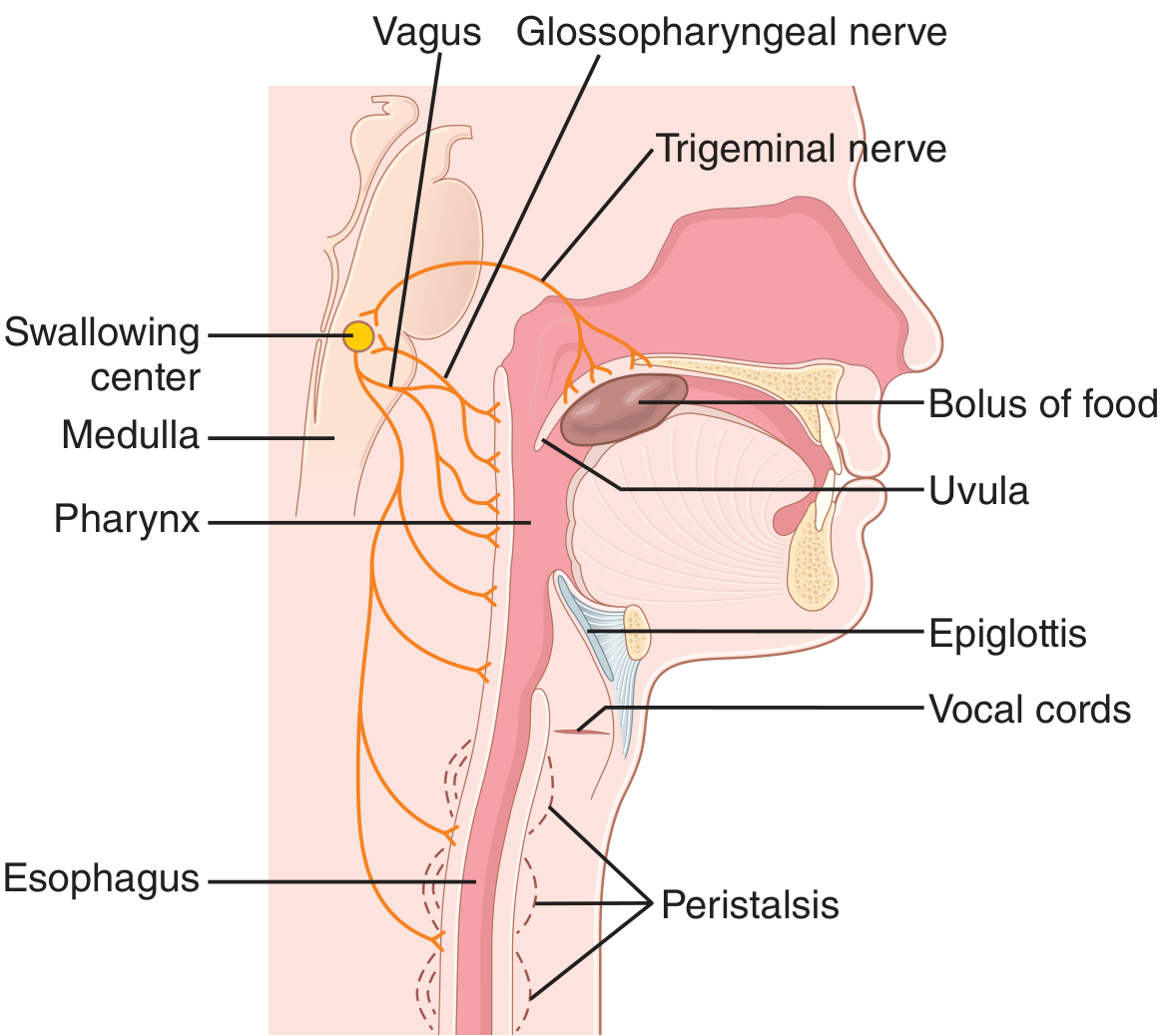
Phase 1 - Voluntary (Oral) Stage
- Initiated consciously by the person.
- The tongue squeezes and rolls the food bolus posteriorly toward the pharynx by pressing upward and backward against the hard palate.
- Once the bolus reaches the posterior mouth, the swallowing reflex is triggered and the process becomes entirely automatic - it cannot be stopped.
- The oral phase can be further subdivided into the oral preparatory phase (mastication, bolus formation) and the oral propulsive phase (tongue moves bolus backward).
Phase 2 - Pharyngeal Stage (Involuntary)
This is the most complex and physiologically important phase. The bolus contacts sensory receptor areas around the pharyngeal opening (greatest sensitivity on the tonsillar pillars), sending impulses via CN V (trigeminal) and CN IX (glossopharyngeal) to the swallowing center in the medulla oblongata and lower pons.
The following sequence occurs in rapid, automatic succession (completes in < 2 seconds):
- Soft palate pulled upward - closes the posterior nares, preventing nasal regurgitation.
- Palatopharyngeal folds approximate medially, forming a sagittal slit that only allows adequately chewed food to pass (a size-selection mechanism).
- Vocal cords approximate tightly + larynx pulled upward and anteriorly + epiglottis swings backward over the laryngeal opening - this triple mechanism prevents food from entering the trachea. The tight approximation of the vocal cords is the most essential protective step; the epiglottis is a secondary safeguard.
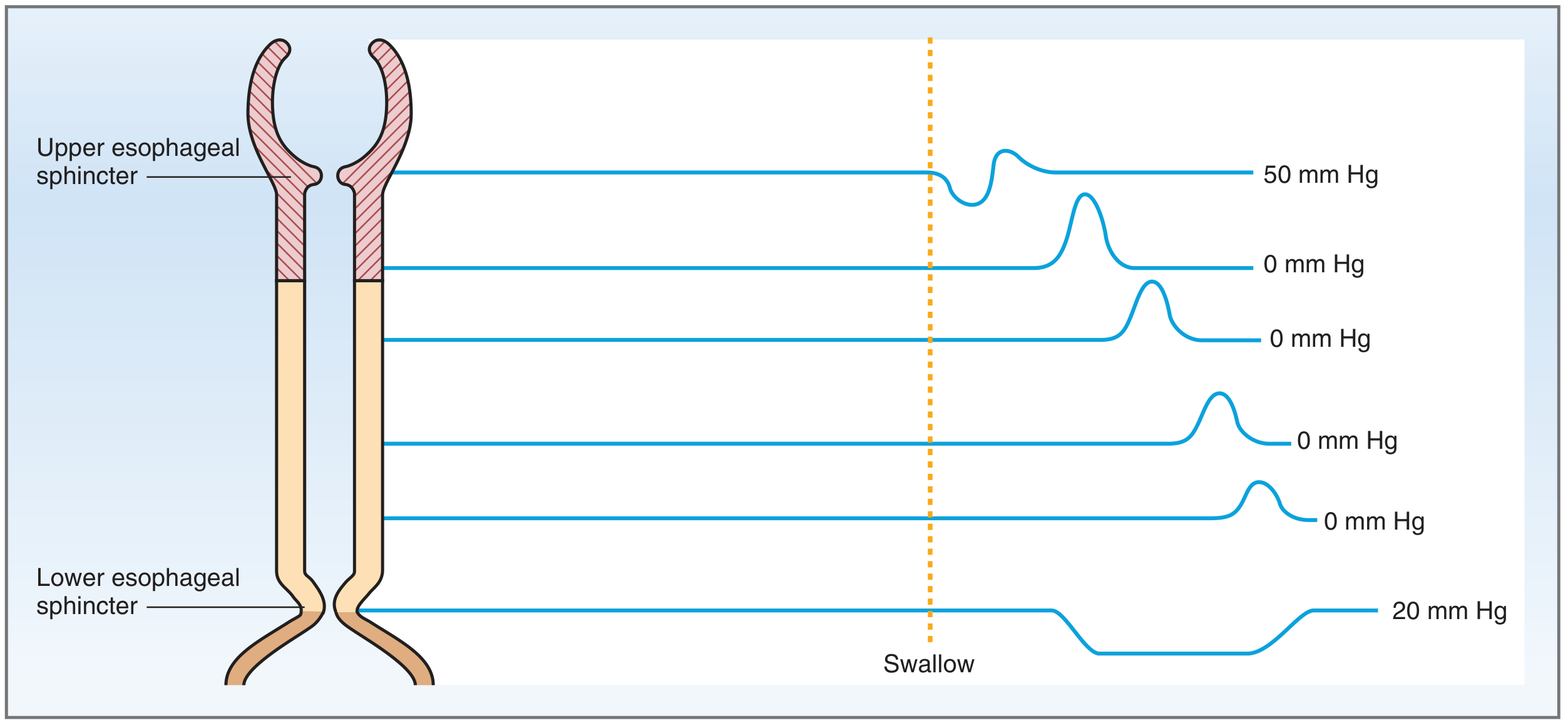
- Upper esophageal sphincter (UES) relaxes - the upward laryngeal movement also enlarges and opens the UES, allowing food to pass freely into the esophagus. Between swallows the UES remains tonically contracted to prevent air entry.
- Pharyngeal peristaltic wave - sweeps the bolus from the posterior pharynx into the upper esophagus.
Motor output from the swallowing center travels via CN V, IX, X, XII and upper cervical nerves.
Phase 3 - Esophageal Stage (Involuntary)
The esophagus propels the food bolus to the stomach using two types of peristalsis:
| Type | Description |
|---|---|
| Primary peristalsis | Continuation of the pharyngeal peristaltic wave; travels the full length of esophagus to stomach in 8-10 seconds (5-8 sec with gravity assistance in upright position) |
| Secondary peristalsis | Triggered by esophageal distension if the primary wave fails to clear the bolus; initiated at the site of distension and travels downward; mediated by the enteric nervous system |
- Upper 1/3 of esophagus - striated muscle, controlled by CN IX and X (skeletal nerve impulses).
- Lower 2/3 - smooth muscle, controlled by the vagus nerve and myenteric plexus (enteric nervous system).
- Lower esophageal sphincter (LES) - relaxes ahead of the arriving peristaltic wave; relaxation is mediated by VIP (vasoactive intestinal peptide) released from peptidergic vagal fibers.
The pressure tracing diagram below shows UES and LES dynamics during a swallow:
Deglutition Apnea
Definition: Deglutition apnea is the brief, involuntary cessation of breathing that occurs during the pharyngeal phase of swallowing.
Mechanism:
- The swallowing center in the medulla directly inhibits the respiratory center during the pharyngeal stage.
- This inhibition halts respiration at any point in the respiratory cycle - whether the person is mid-inspiration, mid-expiration, or anywhere else.
- The purpose is to prevent aspiration by ensuring the airway is fully closed (vocal cords approximated, epiglottis covering the larynx) before the bolus passes through the pharynx.
Duration:
- The entire pharyngeal stage lasts < 6 seconds, so breathing is interrupted for only a fraction of a normal respiratory cycle.
- Even during continuous speech, the interruption is so brief it is barely noticeable.
Clinical relevance:
- Impaired deglutition apnea (e.g., in neurological disease, prematurity, or stroke) can lead to aspiration - food/liquid entering the trachea and lungs.
- Aspiration most commonly occurs when vocal cord approximation is defective, even if the epiglottis is intact.
Sources:
- Guyton and Hall Textbook of Medical Physiology, pp. 788-789
- Costanzo Physiology, 7th Edition, p. 355
This is a shared conversation. Sign in to Orris to start your own chat.