
Speed test and yegerson test for biceps tendon rupture
Reading File
The Speed test and Yergason test are two classic clinical provocative tests for biceps tendon pathology. Here's a quick overview before I search the library:
- Speed's test: Resisted forward flexion of the shoulder with the elbow extended and forearm supinated - pain in the bicipital groove is positive, suggesting biceps tendon pathology or SLAP lesions.
- Yergason's test: Resisted supination with the elbow at 90° - pain or snapping at the bicipital groove indicates biceps tendon involvement or transverse humeral ligament laxity.
Searching sources...
Finding Sources
Finding Sources
Searching the Web
Speed test Yergason test biceps tendon rupture clinical examination sensitivity specificity
Now let me read the specific textbook sections for detailed content and fetch relevant images:
Reading File
Reading File
Reading File
Now let me fetch the key images from Campbell's:
Loading Image
Reading File
Reading File
Now let me get the Yergason test image from Campbell's and the Firestein sensitivity/specificity table:
Reading File
Finding Sources
I need to get the Yergason test image URL. Let me look a few lines before and after that section:
Reading File
Loading Image
Reading File
I have all the information needed. Here is the full, detailed answer:
Speed's Test and Yergason's Test for Biceps Tendon Pathology
These are the two classic provocative tests used to assess pathology of the long head of the biceps (LHB) tendon. Note that while they are classically taught for "biceps tendon rupture," both are primarily tests for bicipital tendinitis/tendinopathy and SLAP lesions - their utility for detecting actual rupture is limited.
1. Speed's Test
How to perform:
- Patient is seated or standing
- Shoulder is forward flexed to 90° with the elbow fully extended and forearm supinated (palm facing up)
- The examiner applies downward resistance against the shoulder flexion
- The test is positive if pain is localized to the bicipital groove
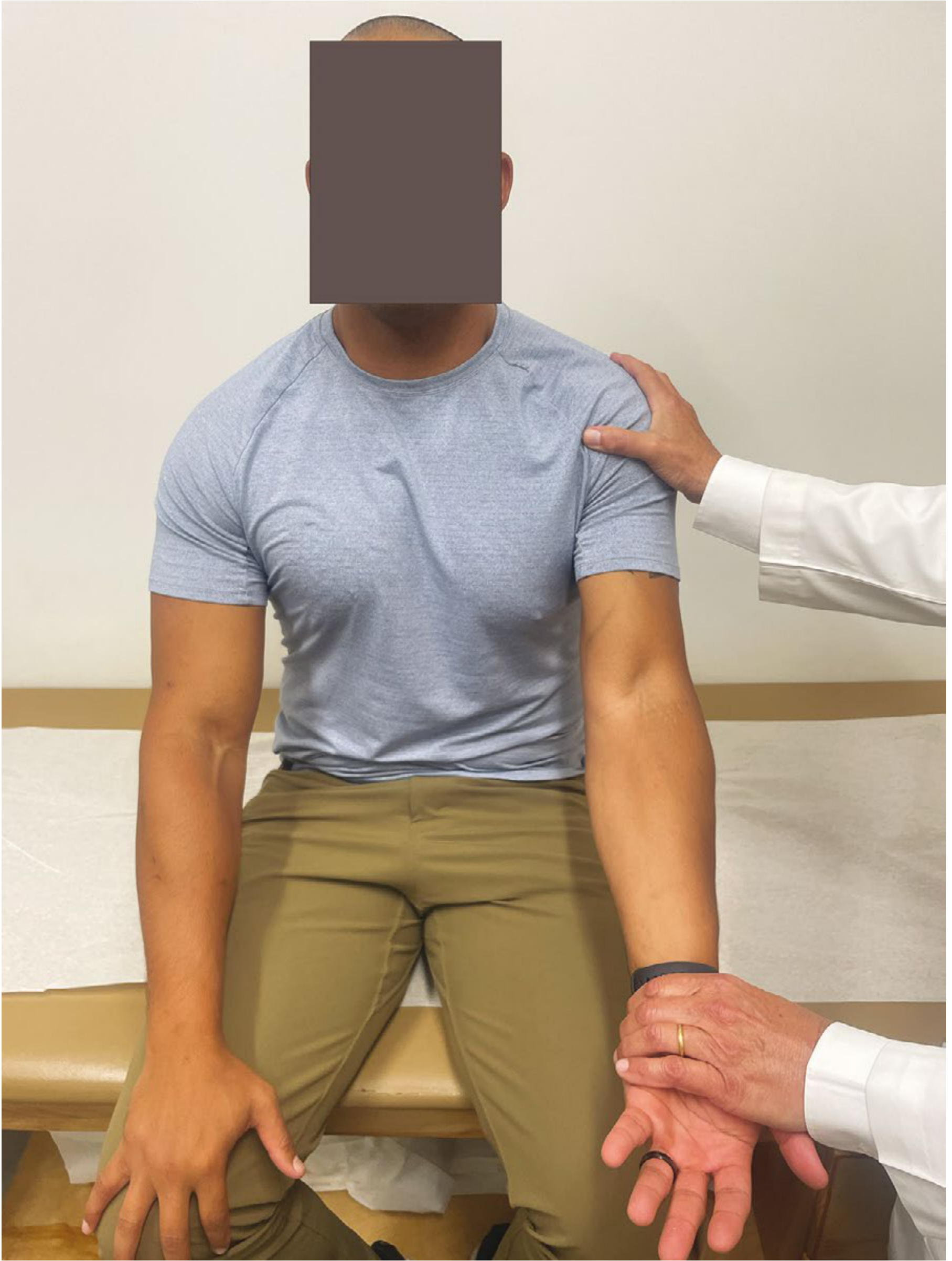
Positive finding: Pain at the bicipital groove
What it indicates:
- Bicipital tendinitis or tendinopathy
- SLAP (superior labrum anterior to posterior) lesion
- If weakness (rather than just pain) is produced, a tear of the LHB tendon may be present
Diagnostic accuracy (vs. arthroscopic gold standard):
| Metric | Value |
|---|---|
| Sensitivity | 32-63% |
| Specificity | 58-75% |
| Positive predictive value | 50% |
| Negative predictive value | 58% |
- Firestein & Kelley's Rheumatology: Sensitivity 53%, Specificity 67%
- Holtby & Razmjou (2004): Sensitivity 32%, Specificity 75%
2. Yergason's Test (Yergason's Supination Sign)
How to perform:
- Patient is seated or standing, elbow flexed to 90°, forearm pronated (palm facing down), arm stabilized against the body
- Patient is asked to actively supinate the forearm against the examiner's resistance applied at the wrist
- Alternatively described: examiner resists supination + external rotation of the arm simultaneously
Positive finding - two components:
- Pain in the bicipital groove - indicates bicipital tendinitis, tendinosis, or SLAP tear
- Snapping or clicking felt at the bicipital groove - indicates laxity or tear of the transverse humeral ligament, with the LHB tendon subluxing out of the groove
What it indicates:
- Inflammation of the long head of the biceps tendon
- Instability of the LHB in its groove (transverse humeral ligament tear)
- Note: Yergason himself observed the test may be negative with partial or complete rupture of the supraspinatus tendon
Diagnostic accuracy (vs. arthroscopic gold standard):
| Metric | Value |
|---|---|
| Sensitivity | 32-43% |
| Specificity | 78-83% |
| Positive predictive value | 60% |
| Negative predictive value | 65% |
- Holtby & Razmjou: Sensitivity 43%, Specificity 79%
- Ultrasound-based study: Sensitivity 32%, Specificity 78%
- For SLAP lesions specifically: Sensitivity 12%, Specificity 87%
Key Comparison Table
| Feature | Speed's Test | Yergason's Test |
|---|---|---|
| Patient position | Shoulder at 90° flexion, elbow extended, forearm supinated | Elbow at 90° flexion, forearm pronated |
| Movement tested | Resisted shoulder forward flexion | Resisted forearm supination |
| Positive sign | Pain at bicipital groove | Pain at groove OR snapping/clicking |
| Primary diagnosis | Bicipital tendinitis, SLAP lesion | Bicipital tendinitis, transverse humeral ligament tear |
| Sensitivity | Moderate (32-63%) | Low-moderate (32-43%) |
| Specificity | Moderate (58-75%) | Moderate-high (78-83%) |
| Better for | Screening (higher sensitivity) | Confirmation (higher specificity) |
Clinical Limitations
Both tests have poor diagnostic performance for biceps tendon rupture specifically. As Rosen's Emergency Medicine states directly: "The often-mentioned Speed's and Yergason's tests, while potentially useful, have poor diagnostic sensitivities and specificities for the diagnosis of biceps tendon rupture, and therefore should only be used in appropriate clinical contexts." - Rosen's Emergency Medicine, p. 641
For actual biceps tendon rupture, the more reliable signs are:
- Visible or palpable deformity ("Popeye" sign - bunching of the muscle belly distally after proximal rupture)
- Palpable gap at the proximal bicipital groove
- History of a snapping sound with sudden anterior shoulder pain
- Weakness of elbow flexion and forearm supination (especially with distal rupture)
A recent study (Diagnostic accuracy of clinical tests for LHBT lesions, ScienceDirect 2019) suggests a combined approach: use the Upper Cut test first as a screening test (higher sensitivity), and then apply Speed's and Yergason's tests as confirmatory tests after a positive result.
Sources: Campbell's Operative Orthopaedics 15th Ed (2026), Rosen's Emergency Medicine, Roberts & Hedges' Clinical Procedures in Emergency Medicine, Firestein & Kelley's Textbook of Rheumatology, Holtby & Razmjou - Accuracy of Speed's and Yergason's tests, PMID 15007311
SLAP TEAR
Searching sources...
Finding Sources
Finding Sources
Reading File
Reading File
Reading File
Finding Sources
Finding Sources
Loading Image
Reading File
Reading File
Reading File
Reading File
Finding Sources
I now have all the information needed for a comprehensive answer.
SLAP Tear (Superior Labrum Anterior to Posterior)
SLAP = Superior Labrum Anterior to Posterior. It describes a tear of the glenoid labrum that starts posteriorly and extends anteriorly, crossing the attachment of the long head of the biceps (LHB) tendon at the supraglenoid tubercle. First described and classified by Snyder et al. in 1990.
Anatomy
The superior labrum differs from the inferior labrum in being more loosely adherent to the glenoid, typically attaching more medially (off the glenoid face). The biceps tendon has a complex insertion:
- 50% of fibers insert into the superior labrum
- 50% insert into the supraglenoid tubercle (6.6 mm from the glenoid face at the 12-o'clock position)
Important anatomical variants that can mimic SLAP tears on imaging:
- Sublabral foramen (anterosuperior)
- Sublabral foramen + thickened MGHL (~9% of shoulders)
- Buford complex - absence of the anterosuperior labrum + thickened MGHL (1.5% of shoulders)
Snyder Classification
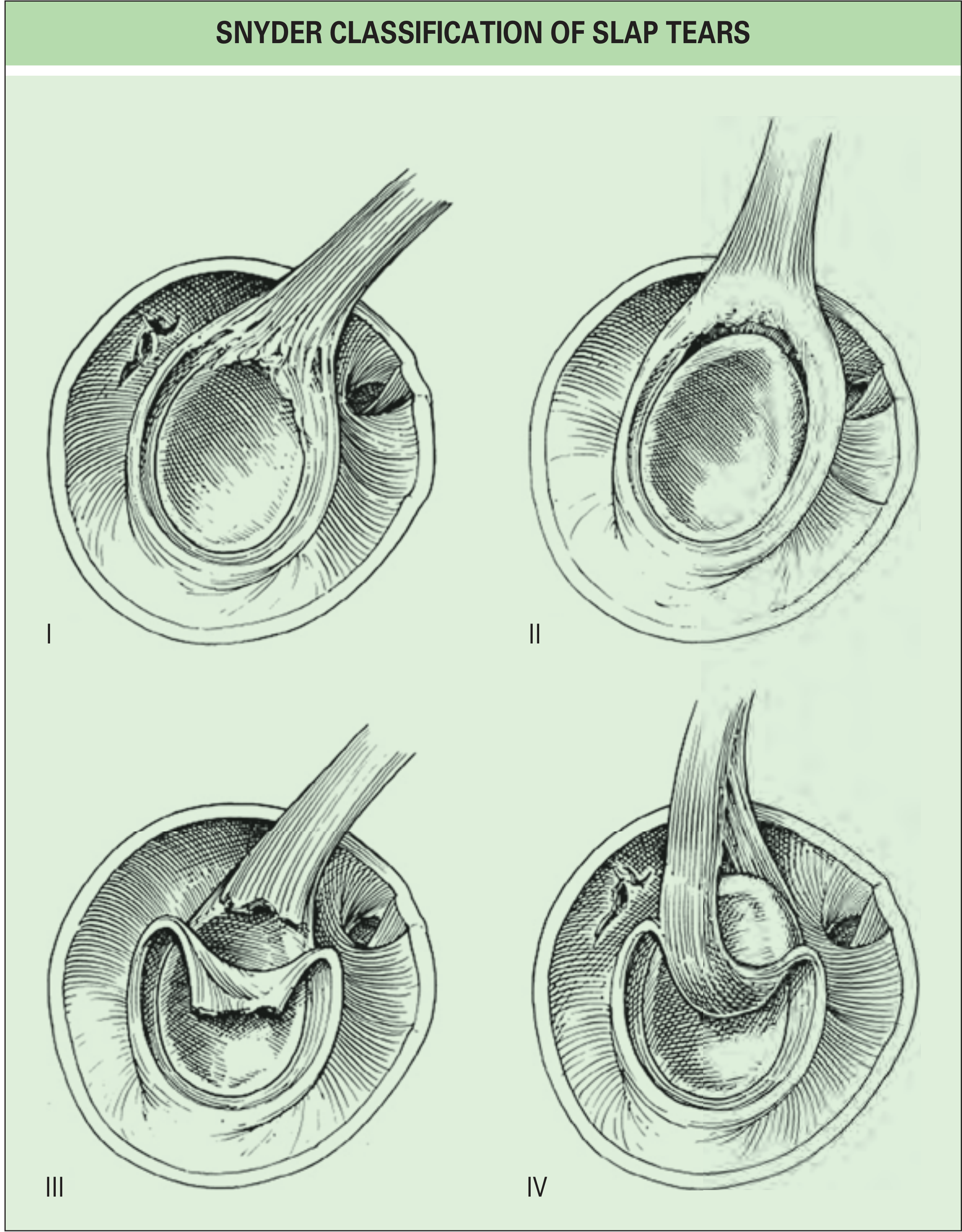
| Type | Description | Biceps Anchor | Treatment |
|---|---|---|---|
| I | Fraying/degeneration of the superior labrum edge | Intact | Debridement |
| II | Pathologic detachment of labrum + biceps anchor from superior glenoid | Unstable | Repair (most common - see subtypes below) |
| III | Vertical bucket-handle tear within the labrum (meniscoid-type) | Intact | Excision of fragment |
| IV | Bucket-handle tear extending into the biceps tendon | Involved | Excision if <30% tendon; repair or tenodesis if >30% |
Type II subtypes (most important - use mnemonic ABC):
- IIA - tear extends Anteriorly to biceps anchor
- IIB - tear extends posteriorly (Back)
- IIC - Combined (anterior + posterior)
Type II is the most common SLAP lesion overall. The original four-type classification has been expanded to 10 subtypes. - Miller's Review of Orthopaedics
Epidemiology & Risk Factors
- SLAP tears are uncommon, accounting for ~5% of all shoulder injuries
- Most common in overhead athletes (pitchers, swimmers, volleyball players) and laborers
- Onset may be traumatic or insidious
Mechanism of Injury
Two main mechanisms (Campbell's Operative Orthopaedics):
- Traction - fall on an outstretched hand, sudden pull on the arm, or throwing motion generating traction on the biceps anchor
- Peel-back - torsional force during the late cocking phase of throwing (shoulder in maximum abduction + external rotation). The biceps-labral complex twists and peels medially off the superior glenoid. This is the classic mechanism for posterior Type II SLAP lesions
Other mechanisms include compression (FOOSH with axial loading) and repetitive microtrauma from overhead activities.
Clinical Features
- Anterior shoulder pain radiating into the biceps
- Catching, clicking, or popping with overhead activity
- "Dead arm" syndrome in throwing athletes - sudden loss of strength/control during throwing
- Pain with overhead activities, especially in the late cocking phase
- May present with instability symptoms if the labral detachment is significant
Physical Examination
No single test is specific for SLAP tear. A combination of tests is recommended.
| Test | How Performed | Positive Finding | Sensitivity | Specificity |
|---|---|---|---|---|
| O'Brien's (Active Compression) | Arm at 90° FF, 10° adduction, maximal pronation - resist flexion; then supinate and repeat | Pain or click with pronation, relieved with supination | Moderate | High (~90% for AC joint; moderate for SLAP) |
| Crank test | Arm at 160° FF, axial load applied, rotate humerus | Pain or click with loading | Moderate | Moderate |
| Speed's test | 90° shoulder FF, elbow extended, forearm supinated - resist flexion | Bicipital groove pain | 32-63% | 58-75% |
| Yergason's test | Elbow at 90°, forearm pronated - resist supination | Bicipital groove pain or snap | 32-43% | 78-83% |
| Dynamic labral shear test | - | - | Higher sensitivity | - |
| Kibler anterior slide test | - | - | Moderate | Moderate |
| Kim biceps load test | - | - | High | High |
Best test combinations (Campbell's, 2026):
- Most sensitive combination: O'Brien + Crank test (in parallel)
- Most specific combination: Yergason + Anterior slide test (in series)
- Running tests in series (both must be positive) increases specificity; running in parallel (either positive) increases sensitivity
Imaging
| Modality | Utility |
|---|---|
| Plain X-ray | Generally unhelpful; may show paralabral cyst |
| Standard MRI | Poor sensitivity for SLAP lesions |
| MR arthrography (gadolinium) | Investigation of choice - sensitivity 91%, specificity 93% for labral pathology |
| CT arthrography | Alternative to MRA |
| Ultrasound | Can detect biceps tendon subluxation but not SLAP lesions directly |
MRA findings suggesting SLAP tear:
- Abnormal signal or contrast extending into the substance of or beneath the superior labrum
- Signal extending lateral to the glenoid or posterior to the biceps tendon
- A paralabral cyst (almost pathognomonic for a SLAP or posterior labral tear); if it extends to the spinoglenoid notch it can compress the suprascapular nerve causing infraspinatus wasting
Arthroscopic Findings
On arthroscopy, positive signs include:
- Superior sulcus >5 mm in depth
- Displaceable biceps root with a probe
- Positive drive-through sign
- Positive peel-back sign - in abduction + external rotation, the posterior labrum and biceps-labral complex drop medially over the glenoid edge (diagnostic of posterior type II SLAP)
Treatment
Nonoperative (first line for virtually all patients)
- Rotator cuff strengthening + scapular stabilization
- Posterior capsule stretching (especially in throwers)
- Intraarticular corticosteroid injections
- Activity modification
Operative
Indicated for symptomatic overhead athletes who fail conservative management. Treatment is highly controversial, especially for Type II lesions.
| Type | Surgical Treatment |
|---|---|
| Type I | Arthroscopic debridement |
| Type II | SLAP repair in young overhead/throwing athletes (<35-40 yrs); biceps tenodesis or tenotomy in older patients or non-throwing athletes |
| Type III | Excision of bucket-handle fragment (if biceps anchor intact) |
| Type IV | Excision if <30% biceps tendon involved; suture repair if ~1/3 involved; biceps tenodesis/tenotomy if >1/3 involved |
Key principle: Primary SLAP repair is NOT recommended in patients >35-40 years old. Multiple studies show poor results with SLAP repair in older individuals. Biceps tenodesis is a more reliable option for this group. - Campbell's Operative Orthopaedics 15th Ed, p. 3161
Sources: Miller's Review of Orthopaedics 9th Ed, Campbell's Operative Orthopaedics 15th Ed (2026), Firestein & Kelley's Textbook of Rheumatology, Rheumatology 2-Volume Set (Elsevier 2022)
This is a shared conversation. Sign in to Orris to start your own chat.