
Precipitation rcb in microbiology
Reading File
Precipitation reactions involve antibody-antigen complexes forming visible precipitates. In microbiology, RCB likely refers to ring/tube precipitation tests or could be a specific test abbreviation. Let me search the textbooks for the precise content.
Searching sources...
Finding Sources
Finding Sources
Reading File
Reading File
The Sherris microbiology section on "Precipitation" seems sparse. Let me search more specifically for the precipitation reactions in immunology/microbiology context, including gel diffusion and immunodiffusion tests.
Finding Sources
Finding Sources
Finding Sources
Finding Sources
Found a dedicated "BACKGROUND AND PRINCIPLES OF PRECIPITIN" section in Henry's Clinical Diagnosis. Let me read both that and the Tietz precipitin reaction section in parallel.
Reading File
Reading File
Excellent content found. Now let me also fetch the precipitin curve diagram and read the Sherris microbiology section on precipitation, plus search for specific precipitation tests in microbiology (ring test, Ouchterlony, etc.).
Reading File
Finding Sources
Loading Image
Now let me get more detail on the specific precipitation techniques (immunodiffusion, nephelometry, etc.) from Henry's.
Reading File
I now have comprehensive information. Let me compile the full answer on precipitation reactions in microbiology.
Precipitation Reactions in Microbiology
Definition and Basis
A precipitation (precipitin) reaction occurs when soluble antigens react with their specific antibodies to form large, insoluble complexes that visibly precipitate out of solution. Unlike agglutination (which involves particulate antigens), precipitation involves soluble antigens.
The precipitate forms because multivalent antibodies and multivalent antigens cross-link to create a three-dimensional lattice network that is insoluble and visible to the naked eye.
The Precipitin Curve and Zones
The key concept is the Antigen:Antibody (Ag:Ab) ratio, which determines whether a visible precipitate forms:
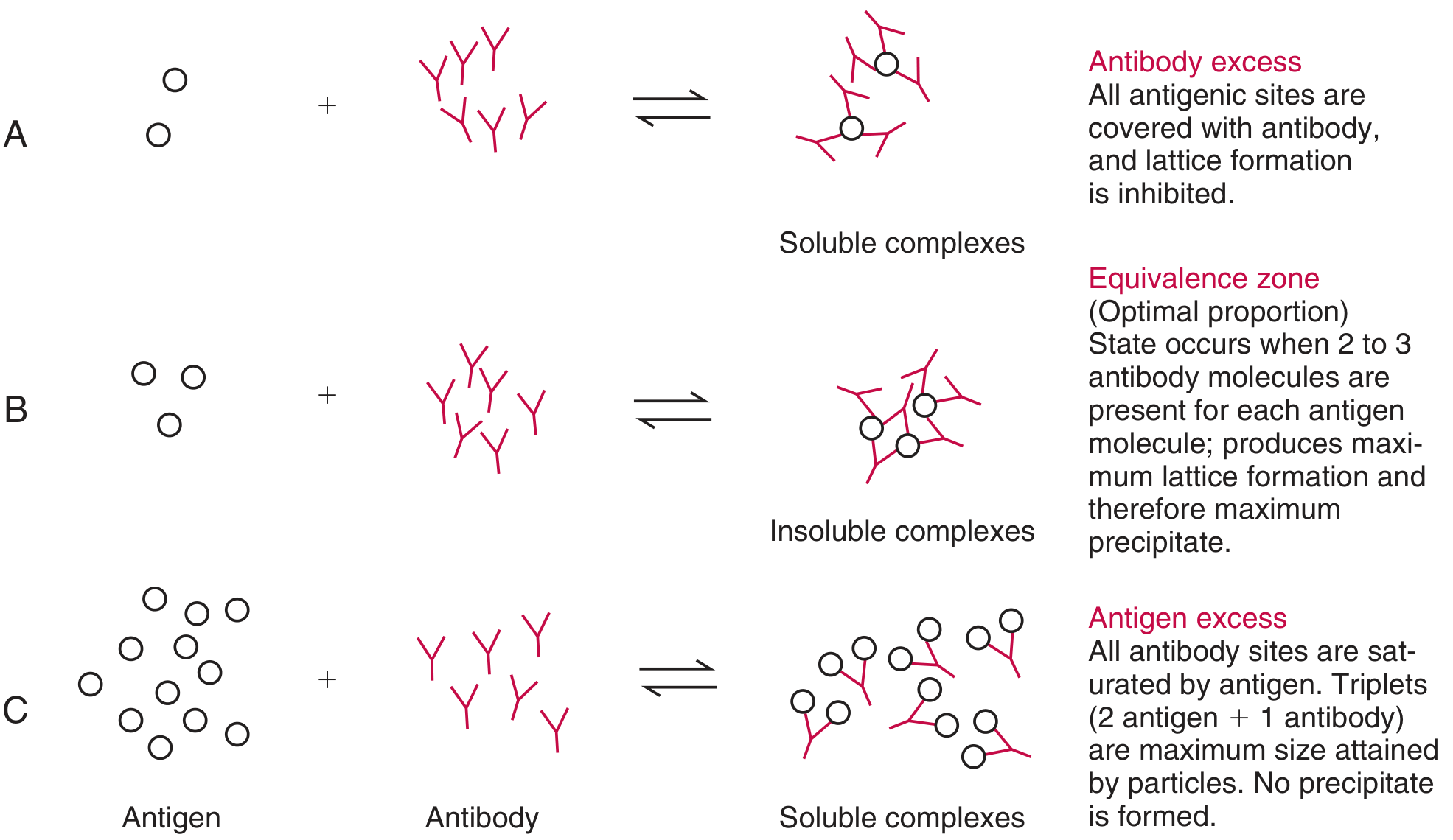
| Zone | Condition | Result |
|---|---|---|
| A - Antibody excess (Prozone) | [Ab] >> [Ag] | All antigenic sites covered by Ab; lattice formation inhibited → Soluble small complexes, NO precipitate |
| B - Zone of Equivalence | [Ab] ≈ [Ag] (optimal ~2-3 Ab per Ag) | Maximum lattice/cross-linking → Maximum insoluble precipitate |
| C - Antigen excess (Postzone) | [Ag] >> [Ab] | All antibody sites saturated; only small triplets (2Ag:1Ab) form → Soluble complexes, NO precipitate |
Prozone phenomenon (antibody excess): A false-negative result can occur if undiluted serum is tested. This is clinically important in syphilis serology and other tests - diluting the sample restores the reaction.
- Henry's Clinical Diagnosis and Management by Laboratory Methods, p. 1028-1029
- Tietz Textbook of Laboratory Medicine, 7th Ed., p. 795
Factors Affecting the Precipitin Reaction
(Heidelberger, 1935):
- Relative proportions of Ag and Ab (most important - as above)
- Temperature - optimal near 37°C initially, then 4°C for precipitation
- pH - usually optimal near physiologic pH (7.2-7.4)
- Ionic strength of the medium
- Antibody characteristics - avidity and affinity of the Ab
- Accelerants - polyethylene glycol (PEG 6000 at 3-5 g/dL) can promote complex formation
Types of Precipitation Tests
1. Qualitative Methods (Gel Diffusion / Immunodiffusion)
These allow Ag and Ab to diffuse toward each other in a gel (agar/agarose); a visible precipitin line forms at the zone of equivalence.
| Test | Description | Use |
|---|---|---|
| Ring (Tube) Precipitin Test | Antibody serum is layered under antigen solution in a narrow tube. A white precipitin ring forms at the interface. | Anthrax (B. anthracis Ascoli test), food identification |
| Single Immunodiffusion (Oudin) | Antigen diffuses into Ab-containing agar in a tube | Qualitative detection |
| Double Immunodiffusion (Ouchterlony) | Both Ag and Ab diffuse toward each other in agar; precipitin lines form. Detects identity, partial identity, non-identity between antigens | Typing antigens, fungal serology (histoplasmosis, aspergillosis) |
| Immunoelectrophoresis (IEP) | Proteins separated by electrophoresis, then Ab diffused into troughs; precipitin arcs form | M-protein identification in myeloma |
2. Semiquantitative Methods
| Test | Description |
|---|---|
| Single Radial Immunodiffusion (Mancini/RID) | Antigen diffuses from a well into Ab-containing agar; ring diameter is proportional to Ag concentration. Used to quantify immunoglobulins (IgG, IgA, IgM) |
| Rocket Electrophoresis (Laurell) | Ag driven by electrophoresis into Ab-agar; "rocket" height proportional to Ag quantity |
3. Quantitative Methods (Modern)
| Method | Principle |
|---|---|
| Turbidimetry | Measures decrease in transmitted light as immune complexes form (forward scatter) |
| Nephelometry | Measures light scattered at an angle (90° or forward) by immune complexes; more sensitive than turbidimetry. Used for serum protein quantification (IgG, IgA, IgM, complement, CRP, etc.) |
Key Clinical Applications in Microbiology
| Test | Organism/Disease |
|---|---|
| Ascoli thermoprecipitin test | Bacillus anthracis (anthrax) - ring precipitin |
| Ouchterlony (double diffusion) | Histoplasma capsulatum, Aspergillus spp., Coccidioides immitis serology |
| Immunoelectrophoresis | Monoclonal gammopathies (multiple myeloma) |
| Counterimmunoelectrophoresis (CIE) | Rapid detection of bacterial antigens in CSF (meningitis) |
| Flocculation tests | VDRL, RPR for syphilis (technically a flocculation - a type of precipitation with cardiolipin antigen) |
Comparison with Agglutination
| Feature | Precipitation | Agglutination |
|---|---|---|
| Antigen type | Soluble | Particulate (cells, bacteria, coated particles) |
| Antibody class | IgG, IgM | IgM more efficient (750x vs IgG) |
| Sensitivity | Lower (0.1-0.5 mg/dL minimum) | Higher (more visible at low concentrations) |
| Lattice requirement | Yes (multivalent Ag + bivalent Ab) | Yes, but particles amplify the effect |
Summary: Precipitation reactions in microbiology exploit the Ag-Ab lattice to identify and sometimes quantify antigens or antibodies. The zone of equivalence produces maximum precipitate; both prozone (Ab excess) and postzone (Ag excess) give false-negative results. Modern clinical labs use nephelometry for speed and sensitivity, while gel diffusion methods remain useful for fungal serology and protein identification.
- Henry's Clinical Diagnosis and Management by Laboratory Methods, p. 1028-1029
- Tietz Textbook of Laboratory Medicine, 7th Ed., p. 794-795
- Sherris & Ryan's Medical Microbiology, 8th Ed., p. 143-144
This is a shared conversation. Sign in to Orris to start your own chat.