
diff bw alpha and beta hemihydrate in a short note 5 to 7 marks from philips material of dental sciences
alpha beta hemihydrate difference dental materials Phillips science
Alpha vs Beta Hemihydrate - Short Note (5-7 Marks)
Chemical Composition
Method of Manufacture
| Property | α-Hemihydrate | β-Hemihydrate |
|---|---|---|
| Process | Heated under steam pressure (autoclaving) in a closed container or in a 30% calcium chloride solution | Heated in an open kettle or kiln at atmospheric pressure (calcination) |
| Product name | Dental Stone (Type II, III, IV, V) | Dental Plaster / Plaster of Paris (Type I, II) |
Crystal Structure
- α-Hemihydrate: Crystals are dense, regular, prismatic (cleavage fragments). They have a smaller specific surface area and low porosity.
- β-Hemihydrate: Crystals are irregular, porous, and spongy in shape. They have a much larger specific surface area due to internal voids and cracks formed during open-air calcination.
Water-Powder (W/P) Ratio
- α-Hemihydrate: Requires less water for mixing (W/P ratio ~0.22-0.30) because the dense, regular crystals have less surface area to wet.
- β-Hemihydrate: Requires more water (W/P ratio ~0.45-0.50) because the porous, irregular crystals absorb more water to become workable.
Setting Reaction (Same for Both)
CaSO₄ · ½H₂O + 1½H₂O → CaSO₄ · 2H₂O + Heat (exothermic)
Mechanical Properties of the Set Product
| Property | α-Hemihydrate | β-Hemihydrate |
|---|---|---|
| Compressive strength | Higher (~20-35 MPa) | Lower (~6-8 MPa) |
| Hardness | Greater | Lesser |
| Porosity | Lower (28-35%) | Higher (40-50%) |
| Surface hardness | Superior | Inferior |
Dental Applications
- α-Hemihydrate → Dental stone (Type III), die stone (Type IV/V) - used where high strength and accuracy are needed (e.g., dies, master casts for fixed prosthetics, orthodontic study models)
- β-Hemihydrate → Dental plaster (Type I/II) - used for preliminary impressions, articulator mounting, and laboratory work where high strength is not needed
Key Exam Points to Remember
- No mineralogical difference - both are CaSO₄ · ½H₂O
- α-form = autoclave → dense crystals → less water → more strength
- β-form = open kettle → spongy crystals → more water → less strength
- The degree of crystal perfection determines whether it is called α or β hemihydrate
- Modified α-hemihydrate (die stone) is produced when calcination occurs under pressure in 30% CaCl₂ solution - crystals are shorter and thicker than regular α-hemihydrate, requiring even less mixing water
Generate a comparison chart poster: Alpha vs Beta hemihydrate
A clean, professional dental science comparison chart poster titled "Alpha vs Beta Hemihydrate" with two columns side by side. Left column header: "α-Hemihydrate (Dental Stone)" with a blue color theme. Right column header: "β-Hemihydrate (Dental Plaster)" with an orange color theme. The chart compares the following rows with clear labels: 1. Manufacture: "Autoclaved under steam pressure" vs "Heated in open kettle/kiln"; 2. Crystal Shape: "Dense, regular, prismatic" vs "Irregular, porous, spongy"; 3. W/P Ratio: "0.22–0.30 (less water)" vs "0.45–0.50 (more water)"; 4. Compressive Strength: "High (~20–35 MPa)" vs "Low (~6–8 MPa)"; 5. Porosity: "Low (28–35%)" vs "High (40–50%)"; 6. Surface Hardness: "Superior" vs "Inferior"; 7. Applications: "Dies, master casts, fixed prosthetics" vs "Preliminary impressions, articulator mounting". At the bottom, a note: "Both are chemically identical: CaSO₄ · ½H₂O". Include small crystal shape illustrations in each column header. Clean white background, bold modern typography, medical/dental educational style.
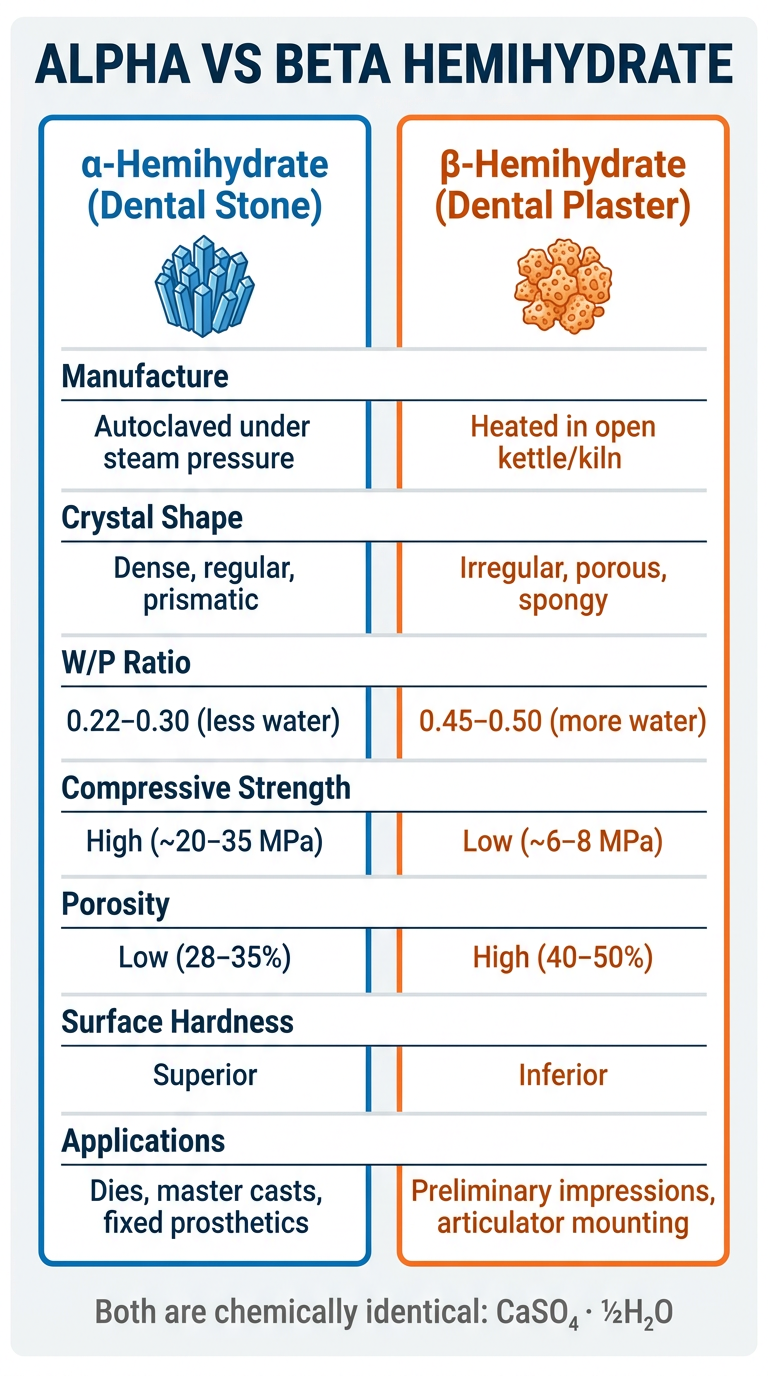
- Blue column (α) - Dental Stone: autoclave-made, dense prismatic crystals, low W/P ratio, high strength
- Orange column (β) - Dental Plaster: open-kettle calcination, spongy irregular crystals, high W/P ratio, lower strength
- Bottom note reminds that both share the same chemical formula: CaSO₄ · ½H₂O