
cri du chat
Reading File
Finding Sources
Finding Sources
Searching PubMed
"cri du chat syndrome" chromosome 5p deletion
Reading File
Reading File
Reading File
Reading File
Loading Image
Reading File
Cri du Chat Syndrome (5p– Syndrome)
Cri du chat (French: "cat's cry") syndrome is a chromosomal deletion disorder caused by loss of material from the short arm of chromosome 5. It is one of the most recognizable contiguous gene deletion syndromes.
Genetics
- Deletion: Terminal or interstitial deletion of chromosome 5p — the critical region is band 5p15
- Karyotype notation: 46,XX or XY, del(5p)
- Incidence: ~1 in 15,000–50,000 live births
- Most cases are sporadic (de novo); only 10–15% result from a parent carrying a balanced translocation
- The degree of intellectual impairment generally correlates with deletion size; haploinsufficiency of regions within 5p14–p15 contributes disproportionately to severe intellectual disability
- Detected by routine karyotype (large deletions) or chromosomal microarray (CMA) for smaller ones
Clinical Features
| Domain | Features |
|---|---|
| Pathognomonic | High-pitched, cat-like cry in infancy (due to laryngeal underdevelopment) |
| Craniofacial | Microcephaly, hypertelorism, epicanthal folds, low-set ears, micrognathia, round/moon face, brachycephaly, antimongoloid palpebral slant |
| Neurological | Severe intellectual disability, hypotonia, developmental delay |
| Cardiac | Congenital heart disease: VSD, ASD, PDA |
| Growth | Low birth weight, failure to thrive |
| Other | Strabismus, preauricular tags (occasional) |
The Characteristic Cry
The syndrome's name derives from the cat-like mewing cry of affected neonates — a consequence of underdevelopment (hypoplasia) of the larynx. This is the most distinctive early feature and typically diminishes with age.
Diagnosis
- Prenatal: Can be detected on non-invasive prenatal testing (NIPT) for fetal microdeletion/duplication syndromes; also by conventional karyotyping of chorionic villus or amniocentesis samples
- Postnatal: Karyotype or chromosomal microarray (CMA detects all cases, including those with cytogenetically invisible deletions)
Clinical photograph and karyotype
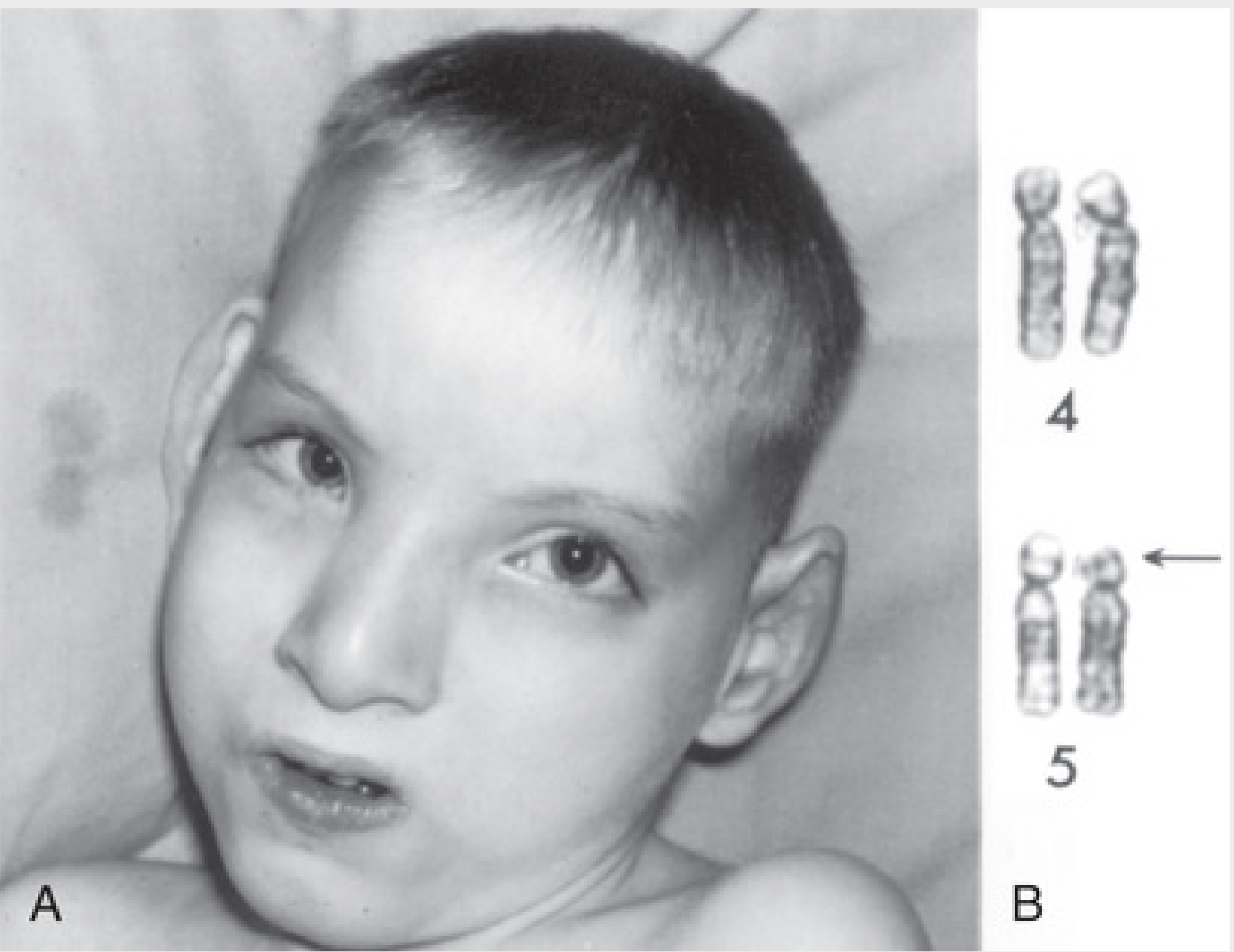
Child with cri du chat syndrome (A) showing microcephaly and hypertelorism; (B) partial karyotype with the arrow indicating the terminal deletion of chromosome 5p short arm. — The Developing Human: Clinically Oriented Embryology
Key Points for Exam/Clinical Practice
- 5p deletion → cri du chat (compare: 4p deletion → Wolf-Hirschhorn syndrome)
- Critical deleted band: 5p15
- Cry is due to laryngeal hypoplasia, NOT a neurological cause
- Intellectual disability is severe; degree correlates with deletion size
- Sporadic in ~85–90% of cases; recurrence risk low unless a parent carries a translocation
- Diagnosed postnatally by CMA; prenatally by NIPT or amniocentesis karyotype
Sources: Thompson & Thompson Genetics and Genomics in Medicine (9th ed.), Emery's Elements of Medical Genetics and Genomics, The Developing Human: Clinically Oriented Embryology, Adams and Victor's Principles of Neurology (12th ed.), Harriet Lane Handbook (23rd ed.)
This is a shared conversation. Sign in to Orris to start your own chat.