
Why obturator nerve block is given in TURBT surgery
"transurethral resection" AND "obturator nerve block"
obturator nerve block TURBT obturator jerk bladder perforation guideline
Quick answer
- Bladder wall perforation, often extraperitoneal
- Bleeding
- Incomplete tumor resection
- Injury to adjacent structures and possible tumor cell spillage
Find recent guidelines on anesthesia for TURBT
EAU guidelines 2026 non-muscle-invasive bladder cancer TURBT anaesthesia obturator nerve block
guideline anaesthesia transurethral resection bladder tumour TURBT obturator nerve block society
"transurethral resection" AND anesthesia
https://uroweb.org/guidelines/urological-trauma/chapter/urog…
PMID: 42477956
PMID: 36341572
Recent guidance relevant to anesthesia for TURBT
-
EAU Guidelines on Urological Trauma, current online guidance
- For a lateral-wall bladder tumor, use either an obturator nerve block (ONB) or adequate neuromuscular relaxation to reduce the obturator jerk and the risk of intraoperative bladder injury/perforation.
- The EAU notes that evidence that bipolar TURBT alone prevents the obturator jerk is conflicting. See the EAU prevention guidance.
-
EAU Non-muscle-invasive Bladder Cancer Guidelines 2026
- These are the most current EAU TURBT guidelines. They focus chiefly on oncologic and technical quality of TURBT rather than prescribing one anesthetic technique.
- Therefore, anesthesia should be planned around tumor location, especially lateral-wall involvement, comorbidities, and whether obturator-reflex prophylaxis is needed. The 2026 EAU NMIBC guideline update confirms the current edition.
-
Japanese Society of Urologic Oncology consensus checklist, 2026
- This practice-guideline level consensus explicitly includes documentation of the anesthesia method and obturator-reflex prophylaxis in TURBT planning.
- It supports making anesthesia choice and ONB planning deliberate preoperative checklist items rather than routine afterthoughts. Taoka et al. (2026), International Journal of Urology, PMID: 42477956.
Practical anesthesia interpretation
- Spinal anesthesia is commonly appropriate for TURBT, but it does not reliably block the obturator nerve.
- For a lateral or inferolateral wall lesion, add an obturator nerve block under regional anesthesia, or choose general anesthesia with sufficient neuromuscular blockade.
- General anesthesia may be preferable when regional anesthesia is contraindicated, the procedure is expected to be prolonged/complex, patient cooperation or positioning is difficult, or reliable paralysis is desired.
- Preoperatively assess standard anesthetic risks, particularly anticoagulant/antiplatelet use, cardiopulmonary disease, renal function, anemia, infection, and whether intravesical therapy is planned.
Compare obturator nerve block techniques for TURBT
"obturator nerve block" AND "transurethral resection"
obturator nerve block TURBT techniques proximal distal ultrasound nerve stimulation systematic review 2023
PMID: 35483676
PMID: 42286464
PMID: 38863316
https://pmc.ncbi.nlm.nih.gov/articles/PMC10028043
Obturator nerve block techniques for TURBT
| Technique | Target and method | Main strengths | Main limitations |
|---|---|---|---|
| Classic pubic / landmark block | Needle advanced near the pubic tubercle toward the obturator foramen, often using nerve stimulation to elicit adductor twitch | Familiar traditional approach; can block the common nerve before branching | Deeper needle path, proximity to pubic ramus and vessels, more technically demanding; blind technique has lower reliability |
| Inguinal approach | More lateral/proximal approach near the groin, with landmark, ultrasound, or nerve-stimulator localization | Better success and fewer attempts than classic pubic technique in a meta-analysis | Still relies on accurate deep anatomy; may be less practical than a straightforward medial-thigh approach |
| Distal interadductor / medial thigh block | At proximal medial thigh, block anterior branch between adductor longus and brevis and posterior branch between adductor brevis and magnus | Common ultrasound-guided approach; superficial, avoids pelvic needle path; each branch can be identified and blocked separately | Requires two interfascial injections and the posterior branch can be difficult to visualize, creating a risk of incomplete block |
| Proximal ultrasound-guided block | Single injection near the common nerve before division, between pectineus and obturator externus | Can cover both divisions with one injection; ranked best for preventing perforation in one network meta-analysis | More technically difficult, deeper, and potentially greater vascular-puncture risk |
| Transvesical block | Injection directed toward the nerve from inside the bladder during cystoscopy, with or without a needle electrode/stimulation | Performed by the surgeon during TURBT, potentially avoids a separate external block | Less commonly used; needs specialized instrumentation and surgical experience; limited comparative evidence |
Guidance methods
| Guidance | Advantages | Limitations |
|---|---|---|
| Ultrasound alone | Visualizes adductor fascial planes, local-anesthetic spread, and vessels. Helps reduce blind vascular puncture. | The nerve, especially the posterior branch, may not be seen clearly. Seeing spread does not guarantee motor blockade. |
| Peripheral nerve stimulation alone | Confirms the functional endpoint: adductor twitch. Useful when the nerve is poorly visualized. | Does not visualize vessels or needle trajectory. |
| Ultrasound plus nerve stimulation | Combines anatomical safety with functional confirmation. Has the strongest practical rationale when a failed block would be consequential. | Takes slightly longer and requires both equipment and familiarity. |
| Landmark-only | Fast and equipment-free. | Least reliable and more operator-dependent. A 2024 RCT found absence of adductor contraction in 91.4% with ultrasound versus 76.6% with blind ONB. Yasar et al., 2024 |
What does the evidence suggest?
- ONB plus spinal anesthesia is better than spinal anesthesia alone for lateral-wall TURBT. A systematic review/meta-analysis reported lower obturator reflex and bladder perforation with ONB, though the underlying trials were relatively small. Krishan et al., 2021
- In a 2023 network meta-analysis, distal ONB with nerve stimulation ranked best for preventing the obturator reflex, while proximal ultrasound-guided ONB ranked best for preventing bladder perforation. These are indirect comparative rankings, so they should not be interpreted as proof that one technique is universally superior. Wu et al., 2023
- For inguinal versus classic pubic blocks, a 2022 meta-analysis of five RCTs found the inguinal technique had higher success, fewer puncture attempts, and shorter procedure time. Chou et al., 2022
- A recent randomized study in TURBT found a nonsignificant trend toward more cephalad injectate spread into the obturator canal with ultrasound-guided than nerve-stimulation-guided interadductor block. Uchino et al., 2026
Practical choice
- Most practical default: ultrasound-guided distal interadductor block, targeting both anterior and posterior divisions.
- If complete motor block is particularly important: add nerve stimulation to confirm adductor response before injection.
- If using a single-injection proximal block: it can cover both branches, but should be done by an operator comfortable with the deeper anatomy and vascular risk.
- Avoid landmark-only techniques when ultrasound or nerve stimulation expertise is available, particularly for high-risk lateral-wall resection.
Anatomy of obturator nerve around urinary bladder
anatomical diagram obturator nerve pelvic sidewall relationship lateral wall urinary bladder
"obturator nerve" AND "transurethral resection"
obturator nerve pelvic sidewall lateral bladder wall anatomy TURBT
Obturator nerve anatomy in relation to the urinary bladder
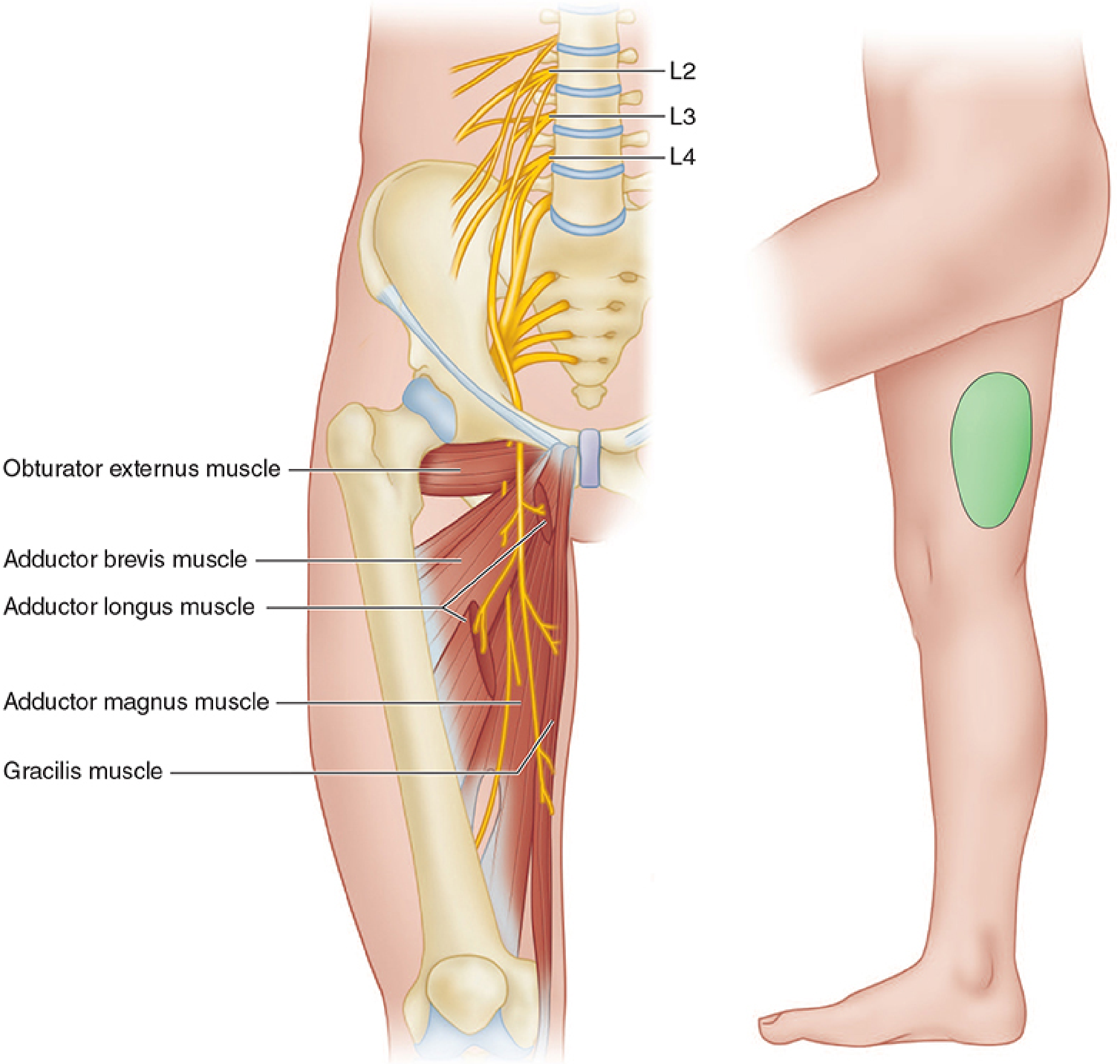
Course
-
Origin
- Arises within the psoas major muscle from L2, L3, and L4 anterior rami.
-
Pelvic course
- Emerges from the medial border of psoas major.
- Descends on the lateral pelvic wall, over the obturator internus fascia.
- It lies lateral and posterolateral to the bladder, travelling toward the obturator canal.
- At this level, it is close enough to the lateral and inferolateral bladder wall for electrical current from a resectoscope to stimulate it.
-
Exit from pelvis
- Passes through the obturator canal at the superior part of the obturator foramen, accompanied by the obturator vessels.
- It then enters the medial thigh and usually divides into anterior and posterior branches.
-
Branches in the thigh
- Anterior branch: passes between adductor longus and adductor brevis.
- Posterior branch: passes between adductor brevis and adductor magnus.
Functional anatomy
- Motor: adductor longus, adductor brevis, adductor magnus adductor part, gracilis, and obturator externus. Its key visible action is thigh adduction.
- Sensory: variable cutaneous sensation over the medial thigh, plus articular branches to the hip and knee.
Relevance during TURBT
Electrocautery near lateral bladder wall→
obturator nerve stimulation→
powerful adductor contraction→
sudden leg movement, termed obturator jerk→
risk of bladder perforation, bleeding, and incomplete resection