
Angel wing sign of xray
Reading File
The angel wing sign on chest X-ray refers to bilateral, butterfly-shaped perihilar opacities that look like outstretched wings - most classically seen in pulmonary edema. Let me pull textbook sources and images.
Searching sources...
Finding Sources
Finding Sources
Searching the Web
angel wing sign chest xray radiology findings
Loading Image
Loading Image
Reading Web Page
https://radiopaedia.org/articles/spinnaker-sign-mediastinum?…
Finding Sources
Here is a complete overview of the Angel Wing Sign on X-ray:
Angel Wing Sign (= Spinnaker Sail Sign)
What it is
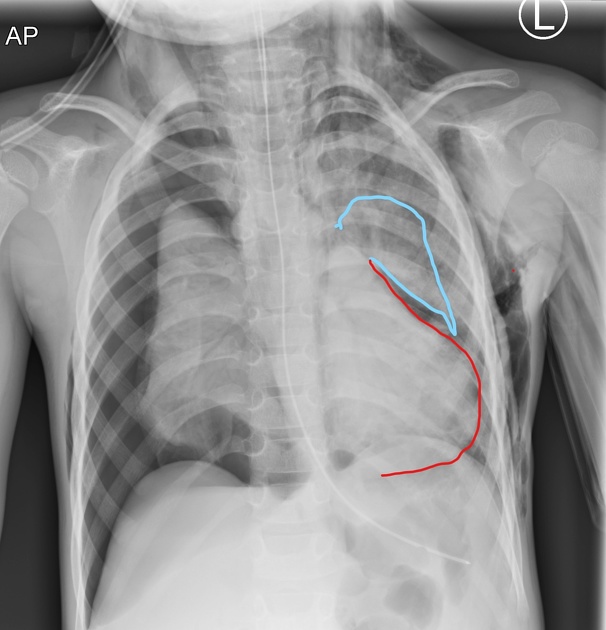
The angel wing sign is a radiographic sign of pneumomediastinum, most commonly seen on neonatal/pediatric chest X-rays. It describes the elevation and lateral displacement of both lobes of the thymus by free air in the mediastinum, making them look like outstretched angel wings (or a spinnaker sail on a sailboat).
Note: In older radiology texts, "angel wing" or "bat wing" appearance was also used loosely for bilateral perihilar pulmonary edema, but the more precise and widely accepted modern usage refers specifically to the thymic/pneumomediastinum sign described here.
Radiographic appearance
- Both lobes of the thymus are lifted upward and pushed laterally
- They are separated from the mediastinum by a lucent (black) band of air below them
- On a frontal (AP/PA) chest X-ray, the two lobes resemble symmetrical wings with air beneath them
- The lucency outlines the inferior border of the thymus on each side
Below is a labeled example showing the angel wing sign (blue outline = elevated thymic lobe; red = mediastinal air interface):
And the same patient's plain CXR without annotations:
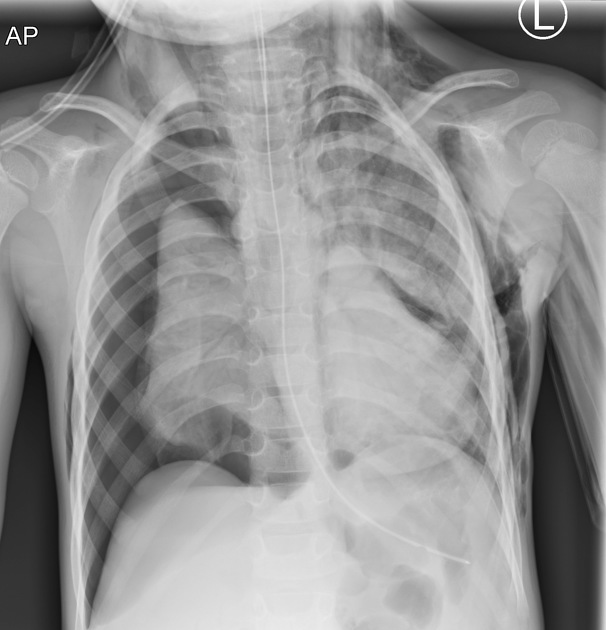
(Images via Radiopaedia)
Underlying cause: Pneumomediastinum
Free air enters the mediastinum and tracks under the thymus, lifting it off the underlying structures. Common causes include:
| Setting | Causes |
|---|---|
| Neonates | Birth trauma, meconium aspiration, respiratory distress syndrome, vigorous crying, positive pressure ventilation |
| Older children/adults | Asthma exacerbation, forceful Valsalva (e.g., vomiting, Boerhaave's), trauma, mechanical ventilation barotrauma |
Related signs of pneumomediastinum on CXR
| Sign | Description |
|---|---|
| Angel wing / Spinnaker sail sign | Bilateral thymic lobe elevation by mediastinal air |
| Retrosternal/precardiac hyperlucency | Air collection in anterior mediastinum |
| Periaortic/peritracheal lucent streaks | Air dissecting along mediastinal structures |
| Ring-around-the-artery sign | Radiolucent halo around right pulmonary artery (lateral view) |
| Continuous diaphragm sign | Air outlines the full diaphragm including the central portion |
Other uses of "angel wing" in radiology
- In facioscapulohumeral muscular dystrophy, prominent/winged scapulae give an "angel wing" appearance on physical exam and can be appreciated on chest/shoulder X-rays (Adams & Victor's Neurology, 12th ed.)
- Some older sources use "angel wing" or "butterfly shadow" interchangeably with bat wing sign of pulmonary edema - bilateral perihilar alveolar opacities - but these terms are not equivalent in modern usage
Clinical significance
- The angel wing sign confirms pneumomediastinum, which is usually benign and self-limiting in neonates
- In neonates: management is often conservative (supplemental O2 to speed nitrogen reabsorption, supportive care)
- Requires monitoring for progression to tension pneumomediastinum or associated pneumothorax (which is more dangerous and may need chest drain)
- The thymus itself is not pathological - the sign is purely mechanical displacement by air
This is a shared conversation. Sign in to Orris to start your own chat.