
Massive intraoperative bleeding protocol anesthesia
I'll start by reading the medical library skill, then search for relevant content in parallel.
Searching sources...
Reading File
Now I'll run parallel searches across the medical library and PubMed simultaneously.
Finding Sources
Finding Sources
Searching PubMed
"massive transfusion protocol" AND intraoperative
Excellent - found relevant sections in Miller's Anesthesia and Sabiston. Let me read these in parallel along with searching for more anesthesia-specific content.
Reading File
Reading File
Finding Sources
Finding Sources
Let me now read the most anesthesia-relevant sections from Miller's Anesthesia and Barash's Clinical Anesthesia, plus the MTP section from Sabiston.
Reading File
Reading File
Reading File
Excellent content found. Let me now read the critical anesthesia-specific sections on damage control resuscitation and the coagulation complications from Miller's, plus the Barash content on blood conservation.
Reading File
Reading File
Finding Sources
Finding Sources
Now let me read the Phase 1 uncontrolled hemorrhage section from Miller's Anesthesia (block 26) and the damage control resuscitation box from Sabiston, plus fetch the MTP flowchart image.
Reading File
Reading File
Loading Image
Loading Image
Excellent - I now have comprehensive content and two very informative MTP flowchart images. Let me read the continuation of the Phase 1 section from Miller's Anesthesia (permissive hypotension details) to complete the picture.
Reading File
Reading File
I now have comprehensive material from Miller's Anesthesia, Sabiston, and Barash. Let me compile this into a thorough, well-organized response.
Massive Intraoperative Bleeding Protocol - Anesthesia Management
Massive intraoperative hemorrhage is defined as loss of the total blood volume within 24 hours, loss of 50% of blood volume within 3 hours, or blood loss >150 mL/min. The anesthesiologist's role is central - bridging the patient's physiology while surgery achieves hemostasis.
1. Recognition and Triggers
The first step is recognizing when to activate the Massive Transfusion Protocol (MTP). Common triggers include:
- SBP <70 mmHg, OR SBP 71-90 mmHg with HR ≥108
- Combined with high-risk injury patterns (penetrating torso, major pelvic fracture, FAST positive in >1 region)
- Blood loss equivalent to circulating blood volume, or ongoing hemodynamic instability after initial resuscitation
- Clinical scoring tools: Assessment of Blood Consumption (ABC) score or Trauma-Associated Severe Hemorrhage (TASH) score
The ATLS classes of hemorrhagic shock guide early recognition:
| Class | Blood Loss | HR | BP | CNS Status |
|---|---|---|---|---|
| I | 0-15% | <100 | Normal | Slightly anxious |
| II | 15-30% | >100 | Normal | Mildly anxious |
| III | 30-40% | >120 | Decreased | Anxious/confused |
| IV | >40% | >140 | Decreased | Confused/lethargic |
- Sabiston Textbook of Surgery, Table 33.1
2. Immediate Anesthesia Actions
Access and Monitoring:
- Insert 2+ large-bore IVs (16G minimum; 14G preferred)
- Establish arterial line for beat-to-beat BP and repeated blood draws
- Consider central venous access (MAC introducer/9Fr sheath > standard CVP line - for rapid volume)
- Consider rapid infusion catheter (RIC line) or Level 1 pressure infuser
- Foley catheter - urine output target >0.5 mL/kg/hr
- Continuous SpO2, ETCO2, temperature monitoring
Airway:
- RSI if not already intubated; expect full stomach in trauma
- In uncontrolled hemorrhage with hemodynamic instability, use ketamine (maintains sympathetic tone) or etomidate for induction
- Avoid propofol as sole induction agent in severe hypovolemia - catastrophic vasodilation
Anesthetic Maintenance During Active Bleeding:
- Use ketamine or high-dose volatile agent with caution (vasodilation)
- Reduce or eliminate volatile agent concentration during hypotension - rely on opioids and ketamine
- Avoid nitrous oxide (reduces FiO2, myocardial depressant, dilates bowel)
- Maintain FiO2 1.0 during hemorrhagic shock
3. Damage Control Resuscitation (DCR) - The Core Strategy
DCR is the foundational anesthesia framework for Phase 1 (uncontrolled hemorrhage). It combines three pillars:
"DCR combines an empiric hemostatic resuscitation strategy in combination with permissive hypotension during surgical or angioembolization control of ongoing hemorrhage." - Miller's Anesthesia, 10e
Components of DCR (Sabiston Box 33.2):
- Permissive hypotension until definitive surgical control
- Minimize crystalloid use - crystalloids worsen the lethal triad
- Initial use of 5% hypertonic saline if available
- Early blood products (PRBCs, FFP, platelets, cryoprecipitate)
- Tranexamic acid (TXA) - early administration
- Prothrombin Complex Concentrate (PCC) as adjunct
- Warm all fluids/blood products - target core temp >35°C
4. Permissive Hypotension
Maintain SBP 80-100 mmHg (or MAP 50-65 mmHg) until surgical hemorrhage control is achieved. The rationale: higher BP disrupts soft extraluminal clot and exacerbates bleeding.
Goals during Phase 1 (Miller's Anesthesia, Box 62.5):
- Systolic BP: 80-100 mmHg
- Hematocrit: 25-30%
- PT/PTT within normal range
- Platelet count >50,000/µL
- Normal ionized calcium
- Core temp >35°C
- Prevent worsening acidosis (serum lactate trending down)
Contraindications to permissive hypotension:
-
Traumatic Brain Injury (TBI) - requires MAP ≥80 mmHg, CPP >60 mmHg
-
Spinal cord injury
-
Elderly patients (reduced physiologic reserve)
-
Known ischemic coronary disease
-
Miller's Anesthesia, 10e, Chapter 62
5. Massive Transfusion Protocol (MTP)
MTP Activation (Algorithm from Miller's / Schwartz's):
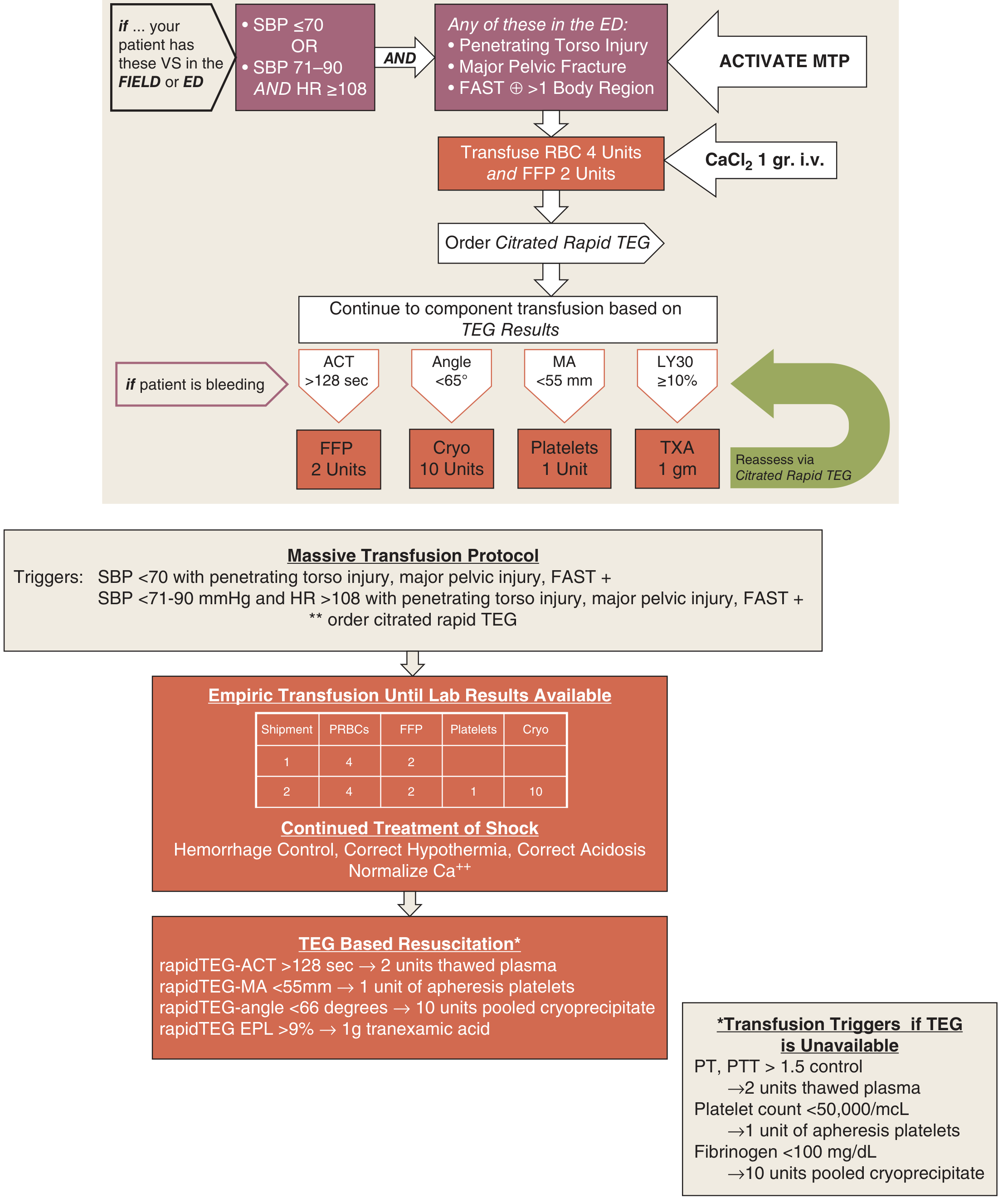
MTP Triggers: SBP <70 OR (SBP 71-90 + HR ≥108) with penetrating torso, major pelvic fracture, or FAST+ in >1 region
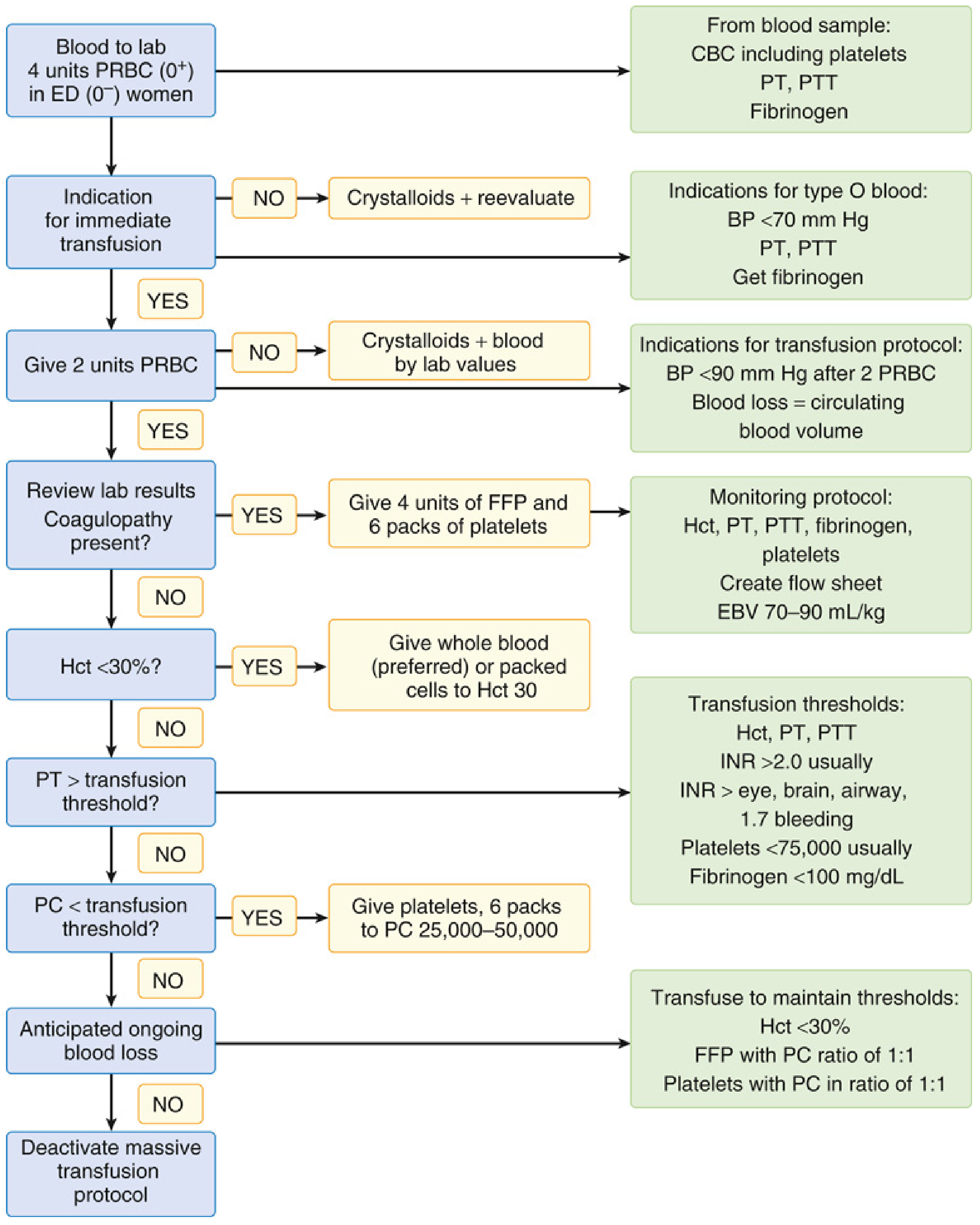
Blood Product Ratios:
The gold standard is the 1:1:1 ratio of PRBCs : FFP : Platelets.
- This approximates whole blood and corrects the coagulopathy of massive hemorrhage
- Empiric shipments (before lab results): Pack 1 = 4 PRBCs + 2 FFP; Pack 2 = 4 PRBCs + 2 FFP + 1 apheresis platelet unit + 10 units cryoprecipitate
Preferred resuscitation fluids (most → least preferred, per Sabiston):
- Low-titer type O cold-stored whole blood (FDA approved, military preferred)
- Fresh whole blood
- PRBCs + Plasma + Platelets in 1:1:1
- Plasma + PRBCs in 1:1
- Plasma or PRBCs alone (last resort)
"Whole blood has been a component of transfusion for over 70 years... experience in Vietnam showed that typed and crossmatched warm whole blood was extremely effective in treating coagulopathy from massive transfusions." - Miller's Anesthesia, 10e
6. Viscoelastic-Guided Resuscitation (TEG/ROTEM)
Thromboelastography (TEG) or rotational thromboelastometry (ROTEM) allows real-time, point-of-care coagulation guidance - superior to traditional PT/PTT:
| TEG Parameter | Abnormal Value | Treatment |
|---|---|---|
| ACT (clotting time) | >128 sec | FFP 2 units |
| Angle (fibrinogen function) | <65° | Cryoprecipitate 10 units |
| MA (platelet function) | <55 mm | Platelets 1 apheresis unit |
| LY30 (fibrinolysis) | ≥10% | Tranexamic acid 1g |
When TEG is unavailable, use traditional labs:
-
PT/PTT >1.5× control → 2 units thawed plasma
-
Platelets <50,000/µL → 1 apheresis platelet unit
-
Fibrinogen <100 mg/dL → 10 units pooled cryoprecipitate
-
Schwartz's Principles of Surgery, 11e, Fig. 7; Miller's Anesthesia, 10e
7. Specific Blood Product Thresholds
| Product | Transfusion Threshold | Target |
|---|---|---|
| PRBCs | Hct <25-30% | Hct 25-30% |
| FFP | PT/INR >1.5-2.0 | INR <1.5 |
| Platelets | <50,000-75,000/µL | >50,000/µL |
| Cryoprecipitate | Fibrinogen <100 mg/dL | >150 mg/dL |
| Calcium | Ionized Ca²⁺ <1.0 mmol/L | Give CaCl₂ 1g IV |
Calcium replacement is mandatory with massive transfusion - citrate in stored blood chelates calcium, causing myocardial depression. Give CaCl₂ 1g IV at MTP activation and after each 4 units of PRBCs.
8. Pharmacological Adjuncts
Tranexamic Acid (TXA)
- Antifibrinolytic - inhibits plasminogen activation and fibrin degradation
- Dose: 1g IV over 10 min, then 1g IV over 8 hours (CRASH-2 protocol)
- Must be given within 3 hours of injury - after 3 hours, mortality increases
- Indicated in trauma, obstetric hemorrhage, cardiac surgery
- "Tranexamic acid was associated with decreased death due to bleeding in a large, international, randomized trial, and its early use is now recommended." - Barash Clinical Anesthesia, 9e
Prothrombin Complex Concentrate (PCC)
- Contains factors II, VII, IX, X (± protein C/S)
- Rapid reversal of coagulopathy, particularly in anticoagulated patients
- 4-factor PCC preferred; dose 25-50 IU/kg
Vasopressors
- Norepinephrine first-line for refractory hypotension during active hemorrhage
- Vasopressin as adjunct (0.03-0.04 U/min) - especially if vasodilatory component
- Do NOT rely solely on vasopressors - address the underlying volume deficit
Recombinant Factor VIIa (rFVIIa)
- Last-resort option for uncontrolled hemorrhage refractory to standard therapy
- High cost, thrombotic risk
- Requires adequate platelets, fibrinogen, and temperature correction to work
9. The Lethal Triad - Prevention is Paramount
The anesthesiologist must aggressively prevent and treat:
Hypothermia + Acidosis + Coagulopathy = "Bloody Vicious Cycle"
| Problem | Causes | Treatment |
|---|---|---|
| Hypothermia (temp <35°C) | Cold OR, open abdomen, cold fluids, volatile agents | Warm all IV fluids, forced air warming blanket, raise OR temp, humidified circuit |
| Acidosis (pH <7.35, BE <-6) | Hypoperfusion, large crystalloid load | Optimize perfusion, bicarbonate if pH <7.1, TXA |
| Coagulopathy | Dilution, hypothermia, acidosis, DIC | MTP, TEG-guided products, calcium, TXA, avoid crystalloids |
- Mulholland and Greenfield's Surgery, 7e; Miller's Anesthesia, 10e
10. Coagulation Complications to Recognize
Dilutional thrombocytopenia:
- Platelets rarely fall as low as predicted by dilution alone (splenic/marrow release)
- Clinical bleeding usually at <50 × 10⁹/L for surgical bleeding; <10 × 10⁹/L for spontaneous bleeding
- Platelet count <75 × 10⁹/L is a reasonable guide for transfusion in massively bleeding patients
DIC-like syndrome:
- Develops in prolonged hypotension + massive transfusion
- Signs: oozing into surgical field, hematuria, gingival bleeding, petechiae, venipuncture site bleeding
- Differential: dilutional thrombocytopenia, Factor V/VIII deficiency, true DIC, transfusion reaction
- Treat the underlying cause + component therapy guided by labs/TEG
Fibrinogen depletion:
- First coagulation factor to fall during hemorrhage
- Target fibrinogen >150-200 mg/dL
- Supplement with cryoprecipitate or fibrinogen concentrate (4-8 g)
11. Blood Conservation Strategies
- Intraoperative Cell Salvage (ICS): Autotransfusion with washed RBCs - reduces allogeneic blood requirement. Avoid in contaminated field or malignancy (relative contraindication; use leukocyte depletion filter in cancer patients)
- Deliberate hypotension where appropriate (not in TBI/spinal cord injury)
- Antifibrinolytics: TXA or epsilon-aminocaproic acid (EACA) - particularly in cardiac surgery with CPB
- Acute normovolemic hemodilution (ANH)
- Topical hemostatic agents (fibrin glue, thrombin) in surgical field
12. Uncrossmatched Blood in Emergencies
If no time for crossmatch:
- Type O Rh-negative PRBCs for women of childbearing age
- Type O Rh-positive for men and older women (less antigenic risk)
- After >2 units of type O whole blood given: do NOT switch to ABO-specific blood until bank confirms anti-A/anti-B titers have fallen sufficiently - risk of major hemolysis
- Miller's Anesthesia, 10e
13. Communication and Team Coordination
- Activate MTP early - do not wait for lab confirmation
- Clear communication between anesthesiologist, surgeon, blood bank, and nursing
- Assign one team member to track units transfused and document response
- Serial labs every 30-60 minutes during active MTP: CBC, PT/INR, PTT, fibrinogen, ABG, ionized calcium, lactate, temperature
- Deactivate MTP when hemorrhage is controlled and hemodynamics stabilize
Summary Algorithm
MASSIVE INTRAOPERATIVE BLEEDING
         ↓
1. CALL FOR HELP + ACTIVATE MTP
         ↓
2. ACCESS: Large-bore IV × 2, Art line, Foley
         ↓
3. AIRWAY: RSI if needed (Ketamine/Etomidate), FiO₂ 1.0
         ↓
4. PERMISSIVE HYPOTENSION: Target SBP 80-100 (NOT in TBI)
         ↓
5. EMPIRIC BLOOD: 4 PRBCs + 2 FFP → next pack + platelets + cryo
   CaCl₂ 1g IV immediately
         ↓
6. TXA 1g IV ASAP (within 3 hours)
         ↓
7. PREVENT LETHAL TRIAD: Warm fluids, warming blanket, correct pH
         ↓
8. TEG/ROTEM-guided: Titrate FFP, cryo, platelets, TXA
         ↓
9. REASSESS Q30 min: Labs, temp, lactate, urine output
         ↓
10. DEACTIVATE MTP when controlled
Sources: Miller's Anesthesia 10e (Chapters 45, 62); Barash Clinical Anesthesia 9e (Chapter 41); Sabiston Textbook of Surgery (Chapter 33); Schwartz's Principles of Surgery 11e; Mulholland & Greenfield's Surgery 7e
This is a shared conversation. Sign in to Orris to start your own chat.