
Malaria basic to clinical
malaria pathophysiology clinical features treatment 2024 guidelines
malaria treatment artemisinin combination therapy
Malaria: Basic to Clinical
1. Overview & Epidemiology
- Robbins & Kumar Basic Pathology, p. 391
2. The Causative Agents - Five Plasmodium Species
| Species | Disease | Fever Periodicity | Special Notes |
|---|---|---|---|
| P. falciparum | Falciparum (tertian) malaria | Every 48 h | Most dangerous; causes severe/fatal disease; no hypnozoites |
| P. vivax | Benign tertian | Every 48 h | Hypnozoites → relapse; can cause ARDS |
| P. ovale | Ovale tertian | Every 48 h | Hypnozoites → relapse |
| P. malariae | Quartan malaria | Every 72 h | Causes nephrotic syndrome (membranoproliferative pattern) |
| P. knowlesi | Zoonotic malaria (SE Asia) | Every 24 h | Morphologically resembles P. malariae; can be rapidly fatal |
Transmission: bite of the female Anopheles mosquito. Humans are the only natural reservoir for the four main species.
3. Life Cycle & Pathogenesis
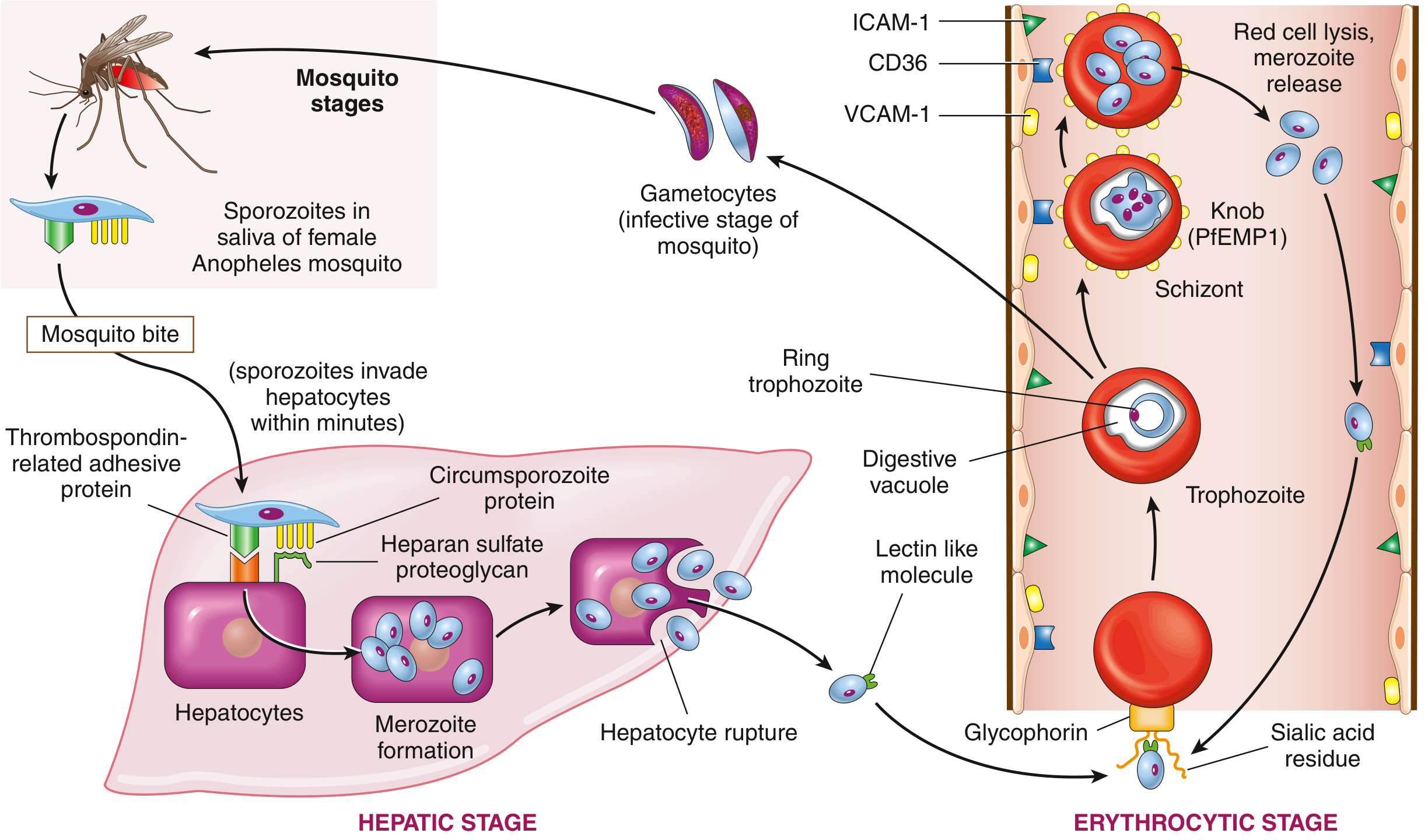
Hepatic (Pre-erythrocytic) Stage - Clinically Silent
- Mosquito bite injects sporozoites into the bloodstream
- Two sporozoite surface proteins (thrombospondin-related adhesive protein and circumsporozoite protein) bind heparan sulfate proteoglycans on hepatocytes
- Sporozoites enter hepatocytes → differentiate into merozoites (1-4 week incubation)
- Infected hepatocytes rupture → release thousands of merozoites into blood
- In P. vivax and P. ovale: some organisms remain dormant as hypnozoites in the liver, capable of relapsing months to years later
Erythrocytic Stage - Clinical Disease
- A lectin-like molecule on the merozoite surface binds to sialidated glycophorin on RBCs → merozoite invaginates into a digestive vacuole
- Intraerythrocytic organisms differentiate into trophozoites
- Trophozoites follow two paths:
- Some → gametocytes (sexual stage; infective for mosquitoes)
- Most → schizonts, which express PfEMP1 (P. falciparum erythrocyte membrane protein 1) on knoblike extensions of the RBC surface
- Cytoadherence: PfEMP1 binds ICAM-1, VCAM-1, and CD36 on microvascular endothelium → parasitized RBCs sequester in capillary beds (especially brain, placenta)
- Schizonts mature → burst → release new merozoites → cycle repeats every 48 h (falciparum)
Sequestration of infected erythrocytes in brain microvessels is the key pathogenic mechanism of cerebral malaria. Malaria has also been the most powerful selective force on human evolution: sickle cell trait, thalassemia, G6PD deficiency, and Duffy antigen negativity all arose in malaria-endemic regions because they confer partial protection.
- Robbins & Kumar Basic Pathology, p. 392; Murray & Nadel's Respiratory Medicine, p. 1352
4. Morphology (What You See Under the Microscope)
- Red cell trophozoites from each species have distinctive appearances on Giemsa/Wright-stained blood films
- Destruction of RBCs → hemolytic anemia with elevated LDH, indirect bilirubin, low haptoglobin
- A characteristic brown malarial pigment (hematin/hemozoin) - a degradation product of hemoglobin - discolors the spleen, liver, lymph nodes, and bone marrow
- Activation of mononuclear phagocytes → massive splenomegaly and hepatomegaly
- Falciparum uniquely: only ring forms and banana-shaped gametocytes seen in peripheral blood (late forms sequester internally)
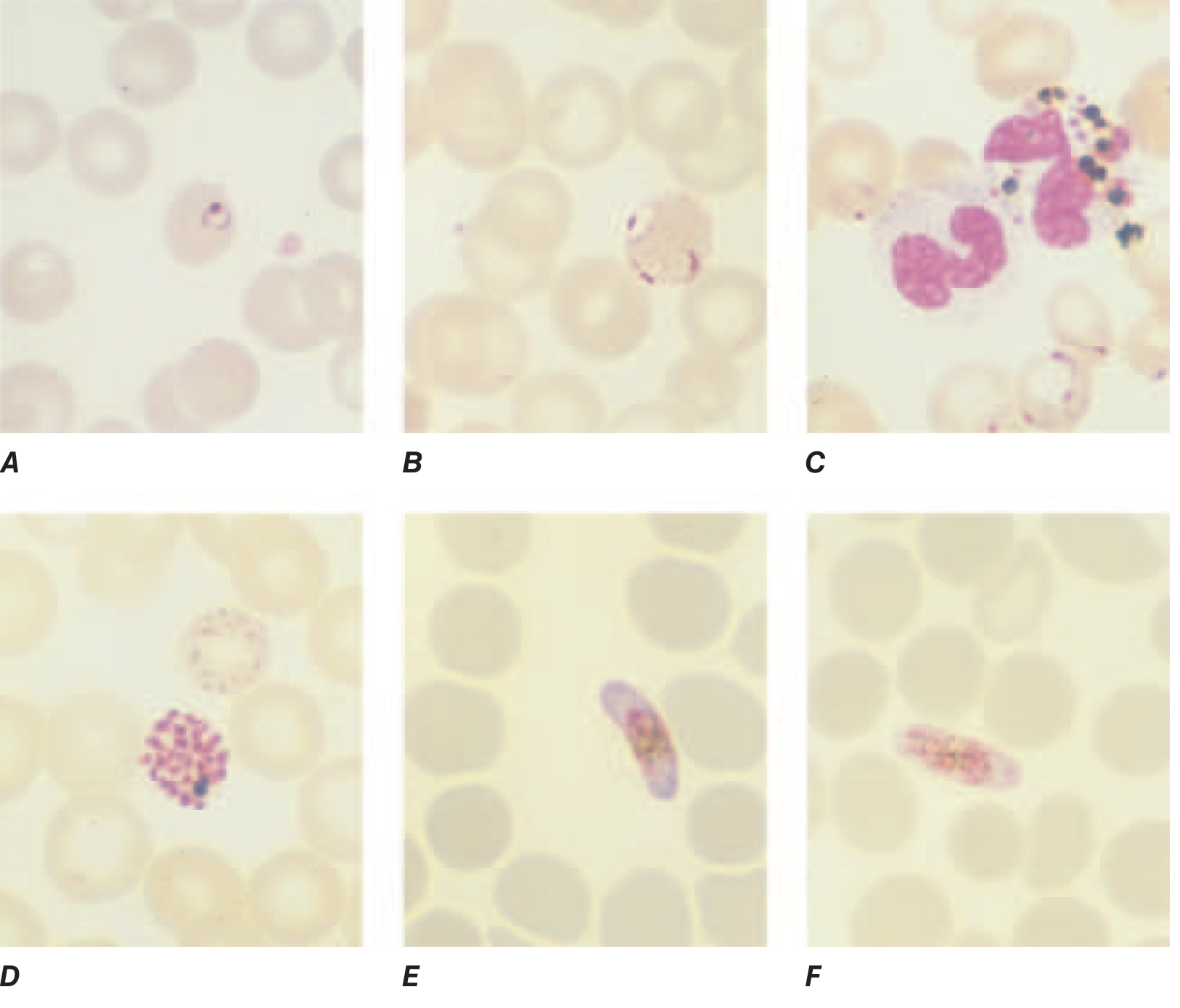
5. Clinical Features
Uncomplicated Malaria
- Classic triad: headache + fatigue → fever + chills + rigors → sweating (each episode lasts a few hours)
- Periodic fever: every 24 h (P. knowlesi), every 48 h (P. falciparum, P. vivax, P. ovale), every 72 h (P. malariae) - but NOT reliable, especially in falciparum
- Hemolytic anemia, thrombocytopenia, splenomegaly, jaundice
- Nausea, vomiting, myalgias
Severe / Complicated Malaria (almost always P. falciparum)
| Complication | Notes |
|---|---|
| Cerebral malaria | Impaired consciousness, seizures, coma; rapidly progressive; high mortality even with treatment |
| Severe anemia | Hb <5 g/dL in hyperparasitemia |
| Acute respiratory distress syndrome (ARDS) | Bilateral lung opacities; children, pregnant women, and non-immune travelers most at risk |
| Acute kidney injury | Renal failure from hemoglobinuria, microthrombi |
| Blackwater fever | Massive intravascular hemolysis → hemoglobinemia + hemoglobinuria + jaundice + AKI (rare complication of falciparum) |
| Hypoglycemia | Due to parasite glucose consumption + quinine-induced hyperinsulinemia |
| Hyperparasitemia | >5% RBCs parasitized = poor prognosis marker |
| Thrombocytopenia | Very common |
| Circulatory collapse / shock | "Algid malaria" |
| Metabolic acidosis | Lactic acidosis from poor tissue perfusion |
P. falciparum can progress from uncomplicated to multiorgan failure within days in non-immune individuals.
- Murray & Nadel's Respiratory Medicine, p. 1352; Robbins & Kumar, p. 392
6. Diagnosis
Microscopy (Gold Standard)
- Thick blood film: lysed RBCs concentrate parasites 40-100x; best sensitivity for low-parasitemia detection; count parasites per 200 WBCs under oil immersion (×1000); examine at least 100-200 fields before calling negative
- Thin blood film: RBCs intact; best for species identification and parasite density (% parasitized RBCs)
- Repeat smears at least twice daily if first is negative but malaria remains suspected
- Artifacts are common on thick films; experience is needed for interpretation
- In high-transmission areas, up to 10,000 parasites/µL may be tolerated in partial immunity - thus a positive smear in endemic areas doesn't always mean malaria is the cause of illness
Rapid Diagnostic Tests (RDTs)
- Antibody-based stick/card tests detecting:
- PfHRP2 (P. falciparum histidine-rich protein 2) - falciparum specific
- Parasite lactate dehydrogenase (pLDH) - all species
- Aldolase - pan-species
- Main method of diagnosis at the point of care in endemic regions
- Note: deletions in pfhrp2/pfhrp3 genes can cause false negatives with HRP2-based tests
Other
-
PCR: most sensitive, used for species confirmation and low-density infection
-
CBC: anemia, thrombocytopenia; leukocyte count usually normal
-
Liver function tests: elevated bilirubin, transaminases
-
Blood glucose: monitor closely (hypoglycemia risk)
-
Renal function: AKI in severe disease
-
Harrison's Principles of Internal Medicine 22e, p. 1810
7. Treatment
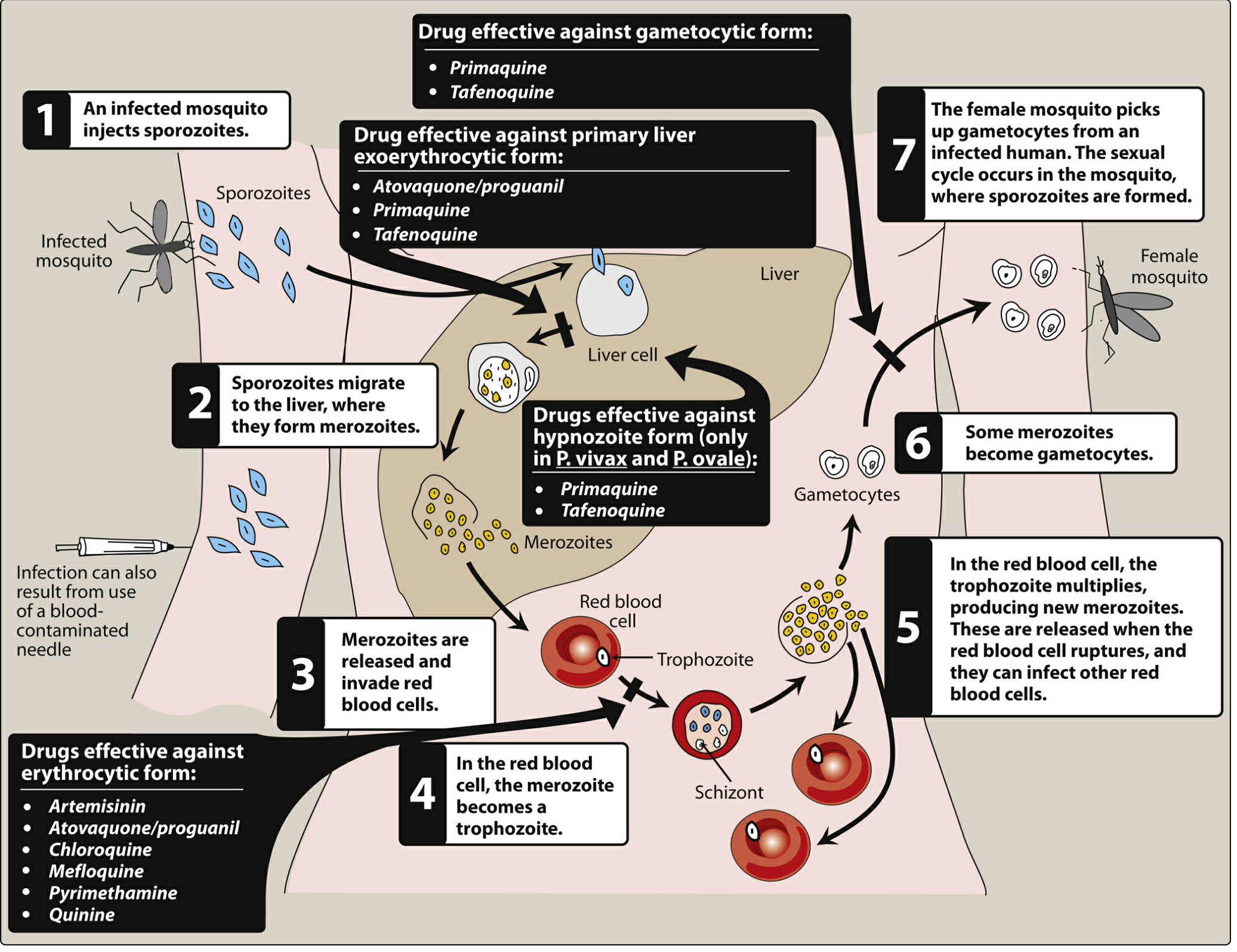
Drug Classes and Mechanisms
8-Aminoquinolines (Liver/Gametocyte Drugs)
- Active against: primary liver exoerythrocytic forms (causal prophylaxis), hypnozoites (P. vivax, P. ovale - prevents relapse), and gametocytes (blocks transmission)
- NOT active against erythrocytic stage → cannot be used as monotherapy
- Mechanism: oxidant metabolites disrupt plasmodial mitochondria
- Key toxicity: hemolytic anemia in G6PD deficiency (test G6PD before use); methemoglobinemia; GI upset
- Contraindicated in pregnancy; not with rheumatoid arthritis or SLE
- Long-acting 8-aminoquinoline; single dose for hypnozoite eradication (vs. 14-day primaquine course)
- Also used for chemoprophylaxis (weekly dosing after loading)
- Same G6PD contraindication; additionally: neuropsychiatric effects (depression, anxiety, abnormal dreams)
4-Aminoquinolines (Blood Schizonticides)
- Mechanism: concentrates in parasite food vacuole → binds heme → prevents polymerization to hemozoin → toxic heme accumulates → oxidative damage → parasite lysis
- Was the cornerstone of malaria treatment for decades
- Now mostly useless for P. falciparum due to widespread resistance (except parts of Central America)
- Still used for P. vivax/P. ovale/P. malariae in chloroquine-sensitive areas and for chemoprophylaxis in chloroquine-sensitive zones
- Also treats extraintestinal amebiasis
Artemisinins (Most Important Current Drugs)
- Derived from sweet wormwood (Artemisia annua) used in Chinese traditional medicine
- Mechanism: heme iron in parasite food vacuole cleaves the endoperoxide bridge → free radical generation → broad oxidative damage to parasite proteins and membranes
- IV artesunate = preferred treatment for severe malaria (faster parasite clearance, lower mortality than IV quinine)
- Short half-life → always used in combination (Artemisinin-based Combination Therapy, ACT) to prevent resistance
- Artemether-lumefantrine (oral ACT): first-line for uncomplicated falciparum
- Adverse effects: thrombocytopenia, hemolytic anemia, elevated LFTs, hyperbilirubinemia
- For P. vivax/P. ovale treated with artesunate, always add primaquine or tafenoquine to eradicate hypnozoites
Antifolates
- Inhibits plasmodial dihydrofolate reductase → blocks tetrahydrofolate synthesis → inhibits nucleic acid synthesis
- Blood schizonticide + sporonticide
- Combined with sulfadoxine (SP); resistance common, now used with ACT
- Pyrimethamine + sulfadiazine also treats toxoplasmosis
- If megaloblastic anemia develops: treat with leucovorin
Quinoline Methanol / Aryl Amino Alcohols
Atovaquone-Proguanil (Malarone)
- Atovaquone: inhibits mitochondrial electron transport (collapses mitochondrial membrane potential)
- Proguanil: inhibits dihydrofolate reductase
- Active against liver stage (causal prophylaxis) and erythrocytic stage
- First-line for uncomplicated falciparum and chemoprophylaxis for travelers
Treatment Summary Table
| Clinical Scenario | Preferred Regimen |
|---|---|
| Severe falciparum malaria | IV artesunate; complete with oral ACT |
| Uncomplicated falciparum (chloroquine-resistant area) | Artemether-lumefantrine OR atovaquone-proguanil OR quinine + doxycycline |
| Uncomplicated falciparum (chloroquine-sensitive area) | Chloroquine |
| P. vivax / P. ovale (chloroquine-sensitive) | Chloroquine + primaquine (or tafenoquine) for radical cure |
| P. vivax (chloroquine-resistant) | ACT + primaquine/tafenoquine |
| P. malariae | Chloroquine |
| Cerebral malaria | IV artesunate; anticonvulsants if seizures; steroids NOT proven beneficial |
Note on cerebral malaria: corticosteroids (once thought lifesaving) have been shown in controlled studies to be ineffective and may worsen outcome. Exchange transfusion has modest benefit in hyperparasitemia.
- Lippincott Pharmacology, p. 1167-1177; Adams & Victor's Neurology, p. 743
8. Chemoprophylaxis for Travelers
| Drug | Schedule | Notes |
|---|---|---|
| Atovaquone-proguanil | Daily (start 1-2 days before, continue 7 days after) | Causal prophylaxis; good tolerance |
| Doxycycline | Daily | Inexpensive; photosensitivity; no use in pregnancy or children <8 |
| Mefloquine | Weekly (start 2 weeks before, continue 4 weeks after) | Neuropsychiatric effects |
| Chloroquine | Weekly | Only for chloroquine-sensitive zones (now limited) |
| Tafenoquine | Weekly (single loading dose ×3 days, then weekly) | New; G6PD testing mandatory |
| Primaquine | Daily | G6PD testing mandatory; for P. vivax-endemic areas |
- Red Book 2021; Harrison's Principles of Internal Medicine 22e
9. Special Populations
- Pregnancy: P. falciparum sequesters in the placenta (binds CSA on chondroitin sulfate A) → placental malaria → IUGR, preterm birth, maternal anemia; IV artesunate preferred for severe malaria in pregnancy; ACT in 2nd/3rd trimester for uncomplicated; avoid primaquine, doxycycline
- Children: Most severe disease and deaths occur in children under 5 in Africa; cerebral malaria is the leading killer
- Nephrotic syndrome: P. malariae causes a membranoproliferative GN with nephrotic syndrome
- Splenomegaly: Hyperreactive malarial splenomegaly (HMS) - massive splenomegaly, high IgM, due to exaggerated immune response; distinct from acute splenomegaly
10. Prevention Beyond Drugs
- Insecticide-treated bed nets (ITNs) - most effective single intervention in endemic areas
- Indoor residual spraying (IRS) with insecticides
- Environmental management: elimination of mosquito breeding sites (stagnant water)
- Personal protection: repellents (DEET), protective clothing, screened accommodation
- RTS,S/AS01 vaccine (Mosquirix): Targets the P. falciparum circumsporozoite protein; partial protection (~30-50%); approved by WHO for routine use in children in sub-Saharan Africa; reduces but does not eliminate cases of fatal cerebral malaria in children
- Robbins & Kumar Basic Pathology, p. 393
11. Recent Evidence (2025)
Quick Reference: Key Mnemonics
- "Fever every 3 days = P. malariae (quartan)", every 2 days = the rest (tertian)
- Hypnozoites = vivax + ovale ("V.O. = vivid, overstays its welcome")
- Only falciparum shows banana gametocytes on peripheral smear
- Chloroquine MOA: prevents hemozoin formation → toxic heme accumulates
- Artesunate MOA: endoperoxide bridge + heme iron → free radicals
- Primaquine: G6PD check mandatory before prescribing
Create a clinical case workup guide for suspected severe malaria diagnosis and management
mkdir -p /home/daytona/workspace/severe-malaria-guide && ls /home/daytona/workspace/severe-malaria-guide/
node /home/daytona/skills/shared/scripts/fetch_images.js "https://cdn.orris.care/cdss_images/95c5879b3a1dda597f29bf69dce4c266650edaab7722bc613ac01d1ba491eb8f.png" "https://cdn.orris.care/cdss_images/64ffb6776f27ee5cda1c59e4fa39f048223a0a9ed89852c9a485a3f356e61fe1.png" "https://cdn.orris.care/cdss_images/170b7c1b92348d3114ce6055f2db6c9aa2fa2673143d7b08fa1617f6c20fab18.png" 2>/dev/null | head -c 200
~/severe-malaria-guide/build.js
const pptxgen = require("pptxgenjs");
const { execSync } = require("child_process");

// ─── Fetch images ───────────────────────────────────────────────────────────
const imgUrls = [
  "https://cdn.orris.care/cdss_images/95c5879b3a1dda597f29bf69dce4c266650edaab7722bc613ac01d1ba491eb8f.png", // life cycle
  "https://cdn.orris.care/cdss_images/64ffb6776f27ee5cda1c59e4fa39f048223a0a9ed89852c9a485a3f356e61fe1.png", // blood smear falciparum
  "https://cdn.orris.care/cdss_images/170b7c1b92348d3114ce6055f2db6c9aa2fa2673143d7b08fa1617f6c20fab18.png", // drug targets
];
const imgs = JSON.parse(
  execSync(
    `node /home/daytona/skills/shared/scripts/fetch_images.js ${imgUrls.map(u => `"${u}"`).join(" ")}`
  ).toString()
);
const [lifecycleImg, smearImg, drugImg] = imgs;

// ─── Palette ────────────────────────────────────────────────────────────────
const C = {
  darkBg:    "0D1B2A",   // deep navy  (title / section slides)
  medBg:     "1B3A5C",   // deep blue  (accent headers)
  accent:    "E63946",   // vivid red  (danger / alerts)
  accentOr:  "F4A261",   // amber      (warning markers)
  accentGr:  "2A9D8F",   // teal-green (positive / treatment)
  white:     "FFFFFF",
  lightGray: "F1F3F5",
  midGray:   "8D99AE",
  textDark:  "1A1A2E",
};

const pres = new pptxgen();
pres.layout = "LAYOUT_16x9";
pres.title  = "Severe Malaria – Clinical Case Workup Guide";
pres.author = "Orris Clinical Series";

// ═══════════════════════════════════════════════════════════════════════════
// HELPERS
// ═══════════════════════════════════════════════════════════════════════════
function darkSlide(slide) {
  slide.background = { color: C.darkBg };
}
function lightSlide(slide) {
  slide.background = { color: C.white };
}
function accentBar(slide, text, barColor = C.accent) {
  slide.addShape(pres.shapes.RECTANGLE, { x: 0, y: 0, w: 10, h: 0.55, fill: { color: barColor }, line: { color: barColor } });
  slide.addText(text, { x: 0.3, y: 0, w: 9.4, h: 0.55, fontSize: 14, bold: true, color: C.white, valign: "middle", margin: 0 });
}
function sectionLabel(slide, label, color = C.accentOr) {
  slide.addShape(pres.shapes.RECTANGLE, { x: 0, y: 0.55, w: 0.18, h: 4.5, fill: { color: color }, line: { color: color } });
}
function slideNum(slide, n) {
  slide.addText(`${n}`, { x: 9.5, y: 5.2, w: 0.4, h: 0.3, fontSize: 9, color: C.midGray, align: "right" });
}

// ═══════════════════════════════════════════════════════════════════════════
// SLIDE 1 — TITLE
// ═══════════════════════════════════════════════════════════════════════════
{
  const sl = pres.addSlide();
  darkSlide(sl);

  // Top red stripe
  sl.addShape(pres.shapes.RECTANGLE, { x: 0, y: 0, w: 10, h: 0.12, fill: { color: C.accent }, line: { color: C.accent } });

  // Large title text
  sl.addText("SEVERE MALARIA", {
    x: 0.6, y: 0.55, w: 8.8, h: 1.2,
    fontSize: 48, bold: true, color: C.white, charSpacing: 4,
    fontFace: "Calibri",
  });
  sl.addText("Clinical Case Workup Guide", {
    x: 0.6, y: 1.7, w: 8.8, h: 0.65,
    fontSize: 26, color: C.accentOr, italic: true,
  });

  // Subtitle block
  sl.addShape(pres.shapes.RECTANGLE, { x: 0.6, y: 2.55, w: 5.2, h: 0.04, fill: { color: C.midGray }, line: { color: C.midGray } });
  sl.addText([
    { text: "Recognition  •  Workup  •  ICU Management  •  Treatment Protocols", options: { breakLine: true } },
    { text: "Based on WHO 2024 Guidelines  |  Harrison's 22e  |  Red Book 2021", options: {} },
  ], {
    x: 0.6, y: 2.7, w: 8.6, h: 0.85,
    fontSize: 13, color: C.midGray,
  });

  // Bottom life cycle image
  if (lifecycleImg.base64) {
    sl.addImage({ data: lifecycleImg.base64, x: 5.8, y: 0.4, w: 4.0, h: 2.7, transparency: 15 });
  }

  // Bottom bar
  sl.addShape(pres.shapes.RECTANGLE, { x: 0, y: 5.32, w: 10, h: 0.305, fill: { color: C.medBg }, line: { color: C.medBg } });
  sl.addText("ORRIS CLINICAL SERIES  •  Severe Malaria Workup  •  July 2026", {
    x: 0.3, y: 5.32, w: 9.4, h: 0.305, fontSize: 9, color: C.midGray, valign: "middle", align: "center", margin: 0,
  });
}

// ═══════════════════════════════════════════════════════════════════════════
// SLIDE 2 — CASE PRESENTATION
// ═══════════════════════════════════════════════════════════════════════════
{
  const sl = pres.addSlide();
  lightSlide(sl);
  accentBar(sl, "CASE PRESENTATION", C.accent);

  sl.addShape(pres.shapes.RECTANGLE, { x: 0.3, y: 0.7, w: 9.4, h: 4.6,
    fill: { color: C.lightGray }, line: { color: "D0D7DE", width: 1 },
    shadow: { type: "outer", color: "000000", blur: 6, offset: 2, angle: 135, opacity: 0.1 }
  });

  // Patient box
  sl.addShape(pres.shapes.RECTANGLE, { x: 0.5, y: 0.85, w: 2.5, h: 0.9,
    fill: { color: C.medBg }, line: { color: C.medBg }
  });
  sl.addText([
    { text: "Patient: ", options: { bold: true, color: C.accentOr } },
    { text: "35 M, returning traveler", options: { color: C.white } },
  ], { x: 0.55, y: 0.85, w: 2.4, h: 0.9, fontSize: 11, valign: "middle", margin: 4 });

  sl.addShape(pres.shapes.RECTANGLE, { x: 3.2, y: 0.85, w: 3.0, h: 0.9,
    fill: { color: C.medBg }, line: { color: C.medBg }
  });
  sl.addText([
    { text: "Travel: ", options: { bold: true, color: C.accentOr } },
    { text: "Sub-Saharan Africa (3 wks ago)", options: { color: C.white } },
  ], { x: 3.25, y: 0.85, w: 2.9, h: 0.9, fontSize: 11, valign: "middle", margin: 4 });

  sl.addShape(pres.shapes.RECTANGLE, { x: 6.4, y: 0.85, w: 3.1, h: 0.9,
    fill: { color: C.medBg }, line: { color: C.medBg }
  });
  sl.addText([
    { text: "Prophylaxis: ", options: { bold: true, color: C.accentOr } },
    { text: "Incomplete (stopped early)", options: { color: C.white } },
  ], { x: 6.45, y: 0.85, w: 3.0, h: 0.9, fontSize: 11, valign: "middle", margin: 4 });

  // Presenting complaints
  sl.addText("Chief Complaints & History", { x: 0.5, y: 1.9, w: 4, h: 0.4, fontSize: 13, bold: true, color: C.medBg });
  sl.addText([
    { text: "• 5-day history of high-grade fever with rigors, now daily\n", options: { breakLine: false } },
    { text: "• Severe headache, myalgias, anorexia, and vomiting\n", options: { breakLine: false } },
    { text: "• Confusion and drowsiness since this morning\n", options: { breakLine: false } },
    { text: "• Decreased urine output; dark-colored urine\n", options: { breakLine: false } },
    { text: "• One episode of witnessed tonic-clonic seizure (2 min)\n", options: { breakLine: false } },
    { text: "• No prophylaxis completed; no jaundice noticed", options: {} },
  ], { x: 0.55, y: 2.3, w: 4.4, h: 2.75, fontSize: 12, color: C.textDark, lineSpacingMultiple: 1.3 });

  // Vitals
  sl.addText("Vitals on Arrival", { x: 5.15, y: 1.9, w: 4, h: 0.4, fontSize: 13, bold: true, color: C.accent });

  const vitals = [
    ["Temp", "40.2 °C", C.accent],
    ["HR", "118 bpm", C.accentOr],
    ["BP", "88/60 mmHg", C.accent],
    ["RR", "28/min", C.accentOr],
    ["SpO₂", "91% (RA)", C.accent],
    ["GCS", "10/15", C.accent],
  ];
  vitals.forEach(([label, val, col], i) => {
    const col_x = i < 3 ? 5.15 : 7.65;
    const row_y = 2.35 + (i % 3) * 0.75;
    sl.addShape(pres.shapes.RECTANGLE, { x: col_x, y: row_y, w: 2.3, h: 0.6,
      fill: { color: C.darkBg }, line: { color: col, width: 2 }
    });
    sl.addText([
      { text: `${label}\n`, options: { color: C.midGray, fontSize: 9, breakLine: true } },
      { text: val, options: { color: col, fontSize: 13, bold: true } },
    ], { x: col_x + 0.07, y: row_y, w: 2.16, h: 0.6, valign: "middle", align: "center" });
  });

  slideNum(sl, 2);
}

// ═══════════════════════════════════════════════════════════════════════════
// SLIDE 3 — CLINICAL RED FLAGS & WHY THINK MALARIA
// ═══════════════════════════════════════════════════════════════════════════
{
  const sl = pres.addSlide();
  darkSlide(sl);
  accentBar(sl, "STEP 1 — CLINICAL RECOGNITION: Red Flags for Severe Malaria", C.medBg);

  // Left column - red flags
  sl.addShape(pres.shapes.RECTANGLE, { x: 0.3, y: 0.65, w: 4.5, h: 4.7,
    fill: { color: "111C2B" }, line: { color: C.accent, width: 2 }
  });
  sl.addText("🚨 WHO Severe Malaria Criteria", {
    x: 0.4, y: 0.72, w: 4.3, h: 0.45, fontSize: 13, bold: true, color: C.accent,
  });

  const redFlags = [
    "Impaired consciousness / coma (Unarousable)",
    "Repeated convulsions (≥2 in 24 h)",
    "Respiratory distress / ARDS (acidotic breathing)",
    "Circulatory collapse / shock (SBP <70 mmHg)",
    "Severe anemia (Hb <7 g/dL in adults)",
    "Hyperparasitemia (>5% RBCs infected)",
    "Hypoglycemia (Blood glucose <2.2 mmol/L)",
    "Acute kidney injury (Creatinine ≥265 µmol/L)",
    "Clinically significant bleeding / DIC",
    "Hemoglobinuria (Blackwater fever)",
  ];
  redFlags.forEach((item, i) => {
    sl.addShape(pres.shapes.RECTANGLE, { x: 0.38, y: 1.22 + i * 0.38, w: 0.25, h: 0.25,
      fill: { color: C.accent }, line: { color: C.accent }
    });
    sl.addText(item, {
      x: 0.7, y: 1.2 + i * 0.38, w: 4.0, h: 0.35,
      fontSize: 10.5, color: C.white, valign: "middle",
    });
  });

  // Right column - risk factors / think malaria
  sl.addShape(pres.shapes.RECTANGLE, { x: 5.05, y: 0.65, w: 4.6, h: 2.2,
    fill: { color: "111C2B" }, line: { color: C.accentGr, width: 2 }
  });
  sl.addText("Always Consider Malaria When:", {
    x: 5.15, y: 0.72, w: 4.4, h: 0.4, fontSize: 13, bold: true, color: C.accentGr,
  });
  const thinkMalaria = [
    "• Fever + travel to endemic area (within 3 months)",
    "• Fever of unknown origin with no localizing signs",
    "• Thrombocytopenia + anemia in a febrile patient",
    "• Unexplained impaired consciousness with fever",
    "• Incomplete or no malaria prophylaxis",
  ];
  sl.addText(thinkMalaria.join("\n"), {
    x: 5.15, y: 1.15, w: 4.4, h: 1.6, fontSize: 11, color: C.white, lineSpacingMultiple: 1.4,
  });

  // Alert box
  sl.addShape(pres.shapes.RECTANGLE, { x: 5.05, y: 3.0, w: 4.6, h: 2.3,
    fill: { color: "111C2B" }, line: { color: C.accentOr, width: 2 }
  });
  sl.addText("⚠ KEY CLINICAL PEARL", {
    x: 5.15, y: 3.07, w: 4.4, h: 0.4, fontSize: 13, bold: true, color: C.accentOr,
  });
  sl.addText(
    "The classical periodic fever pattern (every 48-72 h) is UNRELIABLE in P. falciparum. " +
    "Do not wait for a 'textbook fever' — suspect malaria in ANY febrile returning traveler. " +
    "Onset of confusion or seizure = cerebral malaria until proven otherwise. " +
    "Mortality in cerebral malaria with treatment: ~15-20% in adults; higher if untreated.",
    { x: 5.15, y: 3.52, w: 4.4, h: 1.7, fontSize: 10.5, color: C.white, lineSpacingMultiple: 1.4 }
  );

  slideNum(sl, 3);
}

// ═══════════════════════════════════════════════════════════════════════════
// SLIDE 4 — IMMEDIATE WORKUP (STAT INVESTIGATIONS)
// ═══════════════════════════════════════════════════════════════════════════
{
  const sl = pres.addSlide();
  lightSlide(sl);
  accentBar(sl, "STEP 2 — IMMEDIATE WORKUP: Investigations to Order NOW", C.medBg);
  sectionLabel(sl, "", C.accentGr);

  // 3-column layout
  const cols = [
    {
      title: "CONFIRMATORY TESTS",
      color: C.accent,
      x: 0.35,
      items: [
        ["Thick + Thin Blood Film", "STAT — examine under oil immersion ×1000; confirm species, quantify % parasitemia. Repeat every 12-24h if first negative (×3 over 72h)"],
        ["RDT (PfHRP2 / pLDH)", "Rapid, finger-prick; run PARALLEL to smear. PfHRP2 = falciparum-specific. LDH = pan-species. Confirm all results by microscopy"],
        ["PCR (Reference lab)", "Most sensitive; speciation and resistance genotyping. NOT for acute management — use for confirmation"],
      ],
    },
    {
      title: "SEVERITY MARKERS",
      color: C.accentOr,
      x: 3.6,
      items: [
        ["% Parasitemia", ">5% = severe marker. Also note: >20% parasites pigmented + >5% PMNs with pigment = poor prognosis"],
        ["Blood Glucose", "STAT and every 6h. Hypoglycemia (<2.2 mmol/L) = medical emergency; treat with IV dextrose immediately"],
        ["Lactate / ABG", "Lactic acidosis = organ hypoperfusion; correlates with mortality. Check HCO₃, PaO₂, pH"],
      ],
    },
    {
      title: "ORGAN FUNCTION PANEL",
      color: C.accentGr,
      x: 6.85,
      items: [
        ["CBC + Reticulocytes", "Hb, platelets (almost always low), WBC (usually normal). Rapid fall in Hct expected; transfuse if Hct <20%"],
        ["RFT / LFT / Coagulation", "Creatinine ≥265 µmol/L = AKI criterion. Bilirubin elevated (hemolysis). PT/aPTT for DIC screen"],
        ["Urinalysis / Output", "Hemoglobinuria (dark urine) = blackwater fever. Monitor hourly urine output. Target >0.5 mL/kg/h"],
      ],
    },
  ];

  cols.forEach(col => {
    sl.addShape(pres.shapes.RECTANGLE, { x: col.x, y: 0.65, w: 3.1, h: 0.45,
      fill: { color: col.color }, line: { color: col.color }
    });
    sl.addText(col.title, { x: col.x, y: 0.65, w: 3.1, h: 0.45,
      fontSize: 10, bold: true, color: C.white, align: "center", valign: "middle", margin: 0
    });

    col.items.forEach(([test, note], i) => {
      const yBase = 1.18 + i * 1.42;
      sl.addShape(pres.shapes.RECTANGLE, { x: col.x, y: yBase, w: 3.1, h: 0.4,
        fill: { color: C.darkBg }, line: { color: col.color, width: 1.5 }
      });
      sl.addText(test, { x: col.x + 0.1, y: yBase, w: 2.9, h: 0.4,
        fontSize: 11, bold: true, color: col.color, valign: "middle", margin: 0
      });
      sl.addShape(pres.shapes.RECTANGLE, { x: col.x, y: yBase + 0.4, w: 3.1, h: 0.9,
        fill: { color: C.lightGray }, line: { color: "D0D7DE", width: 1 }
      });
      sl.addText(note, { x: col.x + 0.08, y: yBase + 0.42, w: 2.94, h: 0.85,
        fontSize: 9.5, color: C.textDark, lineSpacingMultiple: 1.25, valign: "top"
      });
    });
  });

  // Blood smear image small
  if (smearImg.base64) {
    sl.addImage({ data: smearImg.base64, x: 0.35, y: 4.55, w: 2.6, h: 0.95 });
    sl.addText("P. falciparum thin smear — ring trophozoites (A,B), schizont (D), banana gametocytes (E,F)", {
      x: 3.05, y: 4.65, w: 6.65, h: 0.8, fontSize: 9, color: C.midGray, italic: true
    });
  }

  slideNum(sl, 4);
}

// ═══════════════════════════════════════════════════════════════════════════
// SLIDE 5 — DIAGNOSTIC ALGORITHM (FLOWCHART-STYLE)
// ═══════════════════════════════════════════════════════════════════════════
{
  const sl = pres.addSlide();
  darkSlide(sl);
  accentBar(sl, "STEP 3 — DIAGNOSTIC ALGORITHM: Fever + Travel History", C.accent);

  // Box helper
  function box(x, y, w, h, text, bgColor, textColor, fSize = 11) {
    sl.addShape(pres.shapes.RECTANGLE, { x, y, w, h, fill: { color: bgColor }, line: { color: "334455", width: 1.5 } });
    sl.addText(text, { x, y, w, h, fontSize: fSize, color: textColor, align: "center", valign: "middle", bold: fSize >= 12 });
  }
  function arrow(x1, y1, x2, y2) {
    sl.addShape(pres.shapes.LINE, { x: x1, y: y1, w: x2 - x1, h: y2 - y1,
      line: { color: C.midGray, width: 1.5, endArrowType: "arrow" }
    });
  }

  // Start
  box(3.5, 0.65, 3, 0.5, "Febrile Patient + Travel to Endemic Area", C.medBg, C.white, 10);
  // Arrow down
  sl.addShape(pres.shapes.LINE, { x: 5, y: 1.15, w: 0.01, h: 0.3, line: { color: C.midGray, width: 1.5, endArrowType: "arrow" } });

  box(2.8, 1.45, 4.4, 0.5, "STAT: Blood Film (Thick+Thin) + RDT", C.accentOr, C.darkBg, 11);
  sl.addShape(pres.shapes.LINE, { x: 5, y: 1.95, w: 0.01, h: 0.3, line: { color: C.midGray, width: 1.5, endArrowType: "arrow" } });

  // Branch: positive
  box(0.4, 2.25, 3.5, 0.55, "POSITIVE for Plasmodium", C.accent, C.white, 11);
  // Branch: negative
  box(6.1, 2.25, 3.5, 0.55, "NEGATIVE — but suspect persists", C.accentGr, C.darkBg, 11);

  // Arrows from branch
  sl.addShape(pres.shapes.LINE, { x: 3.5, y: 2.0, w: -1.45, h: 0.25, line: { color: C.accent, width: 1.5, endArrowType: "arrow" } });
  sl.addShape(pres.shapes.LINE, { x: 6.5, y: 2.0, w: 1.1, h: 0.25, line: { color: C.accentGr, width: 1.5, endArrowType: "arrow" } });

  // Left branch steps
  box(0.4, 2.9, 3.5, 0.5, "Identify Species on Thin Film\n(Falciparum vs. non-falciparum)", C.darkBg, C.white, 10);
  sl.addShape(pres.shapes.LINE, { x: 2.15, y: 3.4, w: 0.01, h: 0.25, line: { color: C.midGray, width: 1.5, endArrowType: "arrow" } });
  box(0.4, 3.65, 3.5, 0.5, "Calculate % Parasitemia\n>5% = SEVERE  |  >1-2% = high risk", C.medBg, C.white, 10);
  sl.addShape(pres.shapes.LINE, { x: 2.15, y: 4.15, w: 0.01, h: 0.25, line: { color: C.midGray, width: 1.5, endArrowType: "arrow" } });
  box(0.4, 4.4, 3.5, 0.65, "Assess for Severe Malaria Criteria\n(any 1 = SEVERE → ICU + IV Artesunate)", C.accent, C.white, 10);

  // Right branch steps
  box(6.1, 2.9, 3.5, 0.5, "Repeat Smear every 12-24h\n(minimum 3 smears over 72h)", C.darkBg, C.white, 10);
  sl.addShape(pres.shapes.LINE, { x: 7.85, y: 3.4, w: 0.01, h: 0.25, line: { color: C.midGray, width: 1.5, endArrowType: "arrow" } });
  box(6.1, 3.65, 3.5, 0.5, "Consider PCR for low-density\nor mixed infection", "1B3A5C", C.white, 10);
  sl.addShape(pres.shapes.LINE, { x: 7.85, y: 4.15, w: 0.01, h: 0.25, line: { color: C.midGray, width: 1.5, endArrowType: "arrow" } });
  box(6.1, 4.4, 3.5, 0.65, "If all negative at 72h:\nSeek alternative fever diagnosis", C.accentGr, C.darkBg, 10);

  // Center label
  sl.addText("NEVER DELAY TREATMENT if high clinical suspicion with positive RDT — treat while awaiting confirmatory smear", {
    x: 3.85, y: 2.9, w: 2.2, h: 1.7, fontSize: 9, color: C.accentOr, align: "center", valign: "middle",
    italic: true, bold: true,
  });

  slideNum(sl, 5);
}

// ═══════════════════════════════════════════════════════════════════════════
// SLIDE 6 — ICU MANAGEMENT & MONITORING
// ═══════════════════════════════════════════════════════════════════════════
{
  const sl = pres.addSlide();
  lightSlide(sl);
  accentBar(sl, "STEP 4 — ICU MANAGEMENT: Monitoring & Supportive Care", C.medBg);

  // Left panel — monitoring
  sl.addShape(pres.shapes.RECTANGLE, { x: 0.25, y: 0.65, w: 4.6, h: 4.7,
    fill: { color: C.lightGray }, line: { color: C.medBg, width: 1.5 }
  });
  sl.addText("Bedside Monitoring Protocol", {
    x: 0.35, y: 0.7, w: 4.4, h: 0.45, fontSize: 13, bold: true, color: C.medBg,
  });

  const monItems = [
    { freq: "Continuous", items: "ECG, SpO₂, arterial line BP, temp" },
    { freq: "Every Hour", items: "GCS, urine output (target ≥0.5 mL/kg/h), fluid balance" },
    { freq: "Every 6 Hours", items: "Blood glucose (treat if <2.2 mmol/L), parasitemia %" },
    { freq: "Every 12 Hours", items: "CBC, ABG / lactate, RFT, electrolytes" },
    { freq: "Every 24 Hours", items: "LFT, coagulation panel (PT, aPTT, fibrinogen)" },
    { freq: "Twice Daily", items: "Blood smears for parasite count and stage" },
  ];
  monItems.forEach((item, i) => {
    const yy = 1.22 + i * 0.67;
    sl.addShape(pres.shapes.RECTANGLE, { x: 0.32, y: yy, w: 1.45, h: 0.55,
      fill: { color: C.medBg }, line: { color: C.medBg }
    });
    sl.addText(item.freq, { x: 0.32, y: yy, w: 1.45, h: 0.55, fontSize: 9.5, bold: true, color: C.white, align: "center", valign: "middle" });
    sl.addText(item.items, { x: 1.82, y: yy, w: 2.9, h: 0.55, fontSize: 10, color: C.textDark, valign: "middle" });
  });

  // Right panel — supportive care
  sl.addShape(pres.shapes.RECTANGLE, { x: 5.1, y: 0.65, w: 4.6, h: 4.7,
    fill: { color: C.lightGray }, line: { color: C.accent, width: 1.5 }
  });
  sl.addText("Supportive Care Priorities", {
    x: 5.2, y: 0.7, w: 4.4, h: 0.45, fontSize: 13, bold: true, color: C.accent,
  });

  const supportItems = [
    ["Airway & Breathing", "Intubate if GCS ≤8 or respiratory failure. ARDS: lung-protective ventilation (6 mL/kg tidal volume), PEEP. Supplemental O₂ target SpO₂ ≥95%."],
    ["Fluid Management", "NOT like sepsis — avoid aggressive fluid boluses (risk of pulmonary edema). Use cautious fluid replacement. Treat hypovolemia gently with balanced crystalloid."],
    ["Seizure Control", "IV/rectal benzodiazepine acutely. Levetiracetam preferred for ongoing control. Avoid full phenobarbital load (20 mg/kg) if respiratory support unavailable."],
    ["Blood Transfusion", "Transfuse packed RBCs if Hct <20% (or Hb <7 g/dL; use 15% threshold in high-burden settings). Transfuse slowly with cardiac monitoring."],
    ["Hypoglycemia", "Bolus 25-50% dextrose IV, then continuous 10% dextrose infusion. Monitor BGL every 6h minimum."],
    ["Avoid These!", "Corticosteroids (no benefit; may worsen coma duration). NSAIDs (bleeding risk). Exchange transfusion (no proven benefit per Red Book 2021)."],
  ];
  supportItems.forEach(([title, desc], i) => {
    const yy = 1.22 + i * 0.67;
    const col = i === 5 ? C.accent : C.accentGr;
    sl.addShape(pres.shapes.RECTANGLE, { x: 5.18, y: yy, w: 1.8, h: 0.55,
      fill: { color: col }, line: { color: col }
    });
    sl.addText(title, { x: 5.18, y: yy, w: 1.8, h: 0.55, fontSize: 9, bold: true, color: C.white, align: "center", valign: "middle" });
    sl.addText(desc, { x: 7.05, y: yy, w: 2.55, h: 0.55, fontSize: 8.5, color: C.textDark, valign: "middle" });
  });

  slideNum(sl, 6);
}

// ═══════════════════════════════════════════════════════════════════════════
// SLIDE 7 — TREATMENT PROTOCOLS (WITH DRUG DIAGRAM)
// ═══════════════════════════════════════════════════════════════════════════
{
  const sl = pres.addSlide();
  darkSlide(sl);
  accentBar(sl, "STEP 5 — TREATMENT PROTOCOL: Antimalarial Therapy", C.accentGr);

  // Drug life cycle image
  if (drugImg.base64) {
    sl.addImage({ data: drugImg.base64, x: 0.2, y: 0.65, w: 3.8, h: 2.6 });
    sl.addText("Drug targets across the malaria life cycle", {
      x: 0.2, y: 3.2, w: 3.8, h: 0.3, fontSize: 8.5, color: C.midGray, italic: true, align: "center"
    });
  }

  // Treatment table
  const rows = [
    { scenario: "Severe P. falciparum\n(any severity criterion)", drug: "IV Artesunate", dose: "2.4 mg/kg IV at 0, 12, 24h then daily", notes: "First-line. Safe in pregnancy. Does not need dose adjustment for renal/hepatic failure.", color: C.accent },
    { scenario: "Severe malaria\n(artesunate unavailable)", drug: "IV Quinine", dose: "20 mg/kg loading, then 10 mg/kg q8h by rate-controlled infusion", notes: "Dangerous if rapid bolus → hypotension. Reduce dose by 30-50% after day 2 in renal failure.", color: C.accentOr },
    { scenario: "Step-down therapy\n(once oral tolerated)", drug: "Artemether-\nLumefantrine (AL)", dose: "1 tab twice daily × 3 days (weight-based dosing in children)", notes: "Complete full 3-day ACT course after IV. Avoid mefloquine as follow-on (neurologic risk).", color: C.accentGr },
    { scenario: "P. vivax / P. ovale\n(add for relapse prevention)", drug: "Primaquine", dose: "0.25 mg/kg/day × 14 days (0.5 mg/kg in SE Asia)", notes: "CHECK G6PD FIRST. Tafenoquine 300 mg single dose = alternative if G6PD normal.", color: C.medBg },
  ];

  rows.forEach((row, i) => {
    const yy = 0.72 + i * 1.12;
    // Scenario box
    sl.addShape(pres.shapes.RECTANGLE, { x: 4.15, y: yy, w: 2.05, h: 0.95, fill: { color: row.color }, line: { color: row.color } });
    sl.addText(row.scenario, { x: 4.15, y: yy, w: 2.05, h: 0.95, fontSize: 9.5, color: C.white, bold: true, align: "center", valign: "middle" });
    // Drug name
    sl.addShape(pres.shapes.RECTANGLE, { x: 6.25, y: yy, w: 1.65, h: 0.95, fill: { color: "111C2B" }, line: { color: row.color, width: 2 } });
    sl.addText(row.drug, { x: 6.25, y: yy, w: 1.65, h: 0.95, fontSize: 10, color: row.color, bold: true, align: "center", valign: "middle" });
    // Dose
    sl.addShape(pres.shapes.RECTANGLE, { x: 7.95, y: yy, w: 2.0, h: 0.95, fill: { color: "111C2B" }, line: { color: "334455", width: 1 } });
    sl.addText(row.dose, { x: 8.0, y: yy, w: 1.9, h: 0.95, fontSize: 8.5, color: C.white, valign: "middle" });
    // Notes below
    sl.addShape(pres.shapes.RECTANGLE, { x: 4.15, y: yy + 0.95, w: 5.8, h: 0.15, fill: { color: "111C2B" }, line: { color: "111C2B" } });
    sl.addText(`  📌 ${row.notes}`, { x: 4.15, y: yy + 0.96, w: 5.8, h: 0.13, fontSize: 8, color: C.midGray, italic: true });
  });

  slideNum(sl, 7);
}

// ═══════════════════════════════════════════════════════════════════════════
// SLIDE 8 — COMPLICATION-SPECIFIC MANAGEMENT
// ═══════════════════════════════════════════════════════════════════════════
{
  const sl = pres.addSlide();
  lightSlide(sl);
  accentBar(sl, "STEP 6 — COMPLICATION-SPECIFIC MANAGEMENT", C.accent);

  const cards = [
    {
      title: "Cerebral Malaria",
      icon: "🧠",
      color: C.accent,
      points: [
        "IV artesunate — first line",
        "Levetiracetam for seizures (not phenobarbital if no ventilator)",
        "Head of bed at 30° if raised ICP suspected",
        "NO steroids — worsen outcome",
        "Avoid hypoglycemia, hyperpyrexia, hypoxia",
        "LP if CSF normal → rule out bacterial meningitis",
      ],
    },
    {
      title: "Severe Anemia",
      icon: "🩸",
      color: C.accentOr,
      points: [
        "Transfuse pRBCs if Hct <20% (Hb <7 g/dL)",
        "Transfuse slowly — risk of pulmonary edema",
        "15% threshold acceptable in resource-limited settings",
        "Children with Hb <4 g/dL + acidotic breathing → immediate transfusion",
        "Monitor for post-transfusion fluid overload",
      ],
    },
    {
      title: "AKI / Renal Failure",
      icon: "🫘",
      color: C.accentGr,
      points: [
        "Monitor creatinine ≥ daily",
        "Avoid NSAIDs, nephrotoxins",
        "Cautious fluid management (not aggressive resuscitation)",
        "Hemodialysis / CRRT for persistent AKI or fluid overload",
        "If quinine used: reduce maintenance dose 30-50% after day 2",
      ],
    },
    {
      title: "Pulmonary Edema / ARDS",
      icon: "🫁",
      color: C.medBg,
      points: [
        "Lung-protective ventilation (6 mL/kg, PEEP titration)",
        "Fluid restriction — ARDS risk worsens with excess fluid",
        "Target SpO₂ ≥95% with supplemental O₂",
        "Prone positioning if severe ARDS (P/F ratio <150)",
        "Screen for aspiration pneumonia",
      ],
    },
    {
      title: "Hypoglycemia",
      icon: "🍬",
      color: C.accentOr,
      points: [
        "BGL <2.2 mmol/L = emergency → IV 50% dextrose bolus",
        "Continuous 10% dextrose infusion thereafter",
        "Check BGL every 6h in all severe malaria",
        "Especially in: pregnant women, children, quinine users",
        "Quinine → hyperinsulinemia → recurrent hypoglycemia",
      ],
    },
    {
      title: "Blackwater Fever",
      icon: "🖤",
      color: C.textDark,
      points: [
        "Massive intravascular hemolysis → hemoglobinuria",
        "Monitor renal function hourly",
        "Maintain high urine output (forced diuresis if needed)",
        "Transfuse for severe hemolytic anemia",
        "Switch from quinine if quinine-triggered; use artesunate",
      ],
    },
  ];

  cards.forEach((card, i) => {
    const col = i % 3;
    const row = Math.floor(i / 3);
    const cx = 0.28 + col * 3.24;
    const cy = 0.7 + row * 2.35;

    sl.addShape(pres.shapes.RECTANGLE, { x: cx, y: cy, w: 3.1, h: 2.2,
      fill: { color: C.lightGray }, line: { color: card.color, width: 2 }
    });
    sl.addShape(pres.shapes.RECTANGLE, { x: cx, y: cy, w: 3.1, h: 0.42,
      fill: { color: card.color }, line: { color: card.color }
    });
    sl.addText(`${card.icon}  ${card.title}`, { x: cx, y: cy, w: 3.1, h: 0.42,
      fontSize: 11, bold: true, color: C.white, align: "center", valign: "middle"
    });

    card.points.forEach((pt, pi) => {
      sl.addShape(pres.shapes.RECTANGLE, { x: cx + 0.12, y: cy + 0.5 + pi * 0.28, w: 0.14, h: 0.14,
        fill: { color: card.color }, line: { color: card.color }
      });
      sl.addText(pt, { x: cx + 0.32, y: cy + 0.46 + pi * 0.28, w: 2.7, h: 0.28,
        fontSize: 8.8, color: C.textDark, valign: "middle"
      });
    });
  });

  slideNum(sl, 8);
}

// ═══════════════════════════════════════════════════════════════════════════
// SLIDE 9 — SPECIAL POPULATIONS
// ═══════════════════════════════════════════════════════════════════════════
{
  const sl = pres.addSlide();
  darkSlide(sl);
  accentBar(sl, "STEP 7 — SPECIAL POPULATIONS & DRUG CONSIDERATIONS", C.accentOr);

  const pops = [
    {
      group: "Pregnant Women",
      color: C.accentOr,
      points: [
        "IV artesunate = preferred for severe malaria in ALL trimesters",
        "ACT (artemether-lumefantrine) safe in 2nd & 3rd trimester",
        "1st trimester: artesunate preferred over quinine if both available",
        "Avoid: primaquine (teratogenic), doxycycline (fetal bone/teeth)",
        "P. falciparum sequesters in placenta → IUGR, maternal anemia, preterm birth",
        "Monitor BGL every 4h (higher hypoglycemia risk in pregnancy)",
      ],
    },
    {
      group: "Children (Pediatric)",
      color: C.accentGr,
      points: [
        "IV artesunate: weight-based dosing (2.4 mg/kg at 0, 12, 24h, then daily)",
        "Children <20 kg: consider higher mg/kg dosing (discuss with ID/Tropical Med)",
        "Artemether-lumefantrine oral step-down: weight-based tablet dosing",
        "Severe anemia (Hb <4 g/dL) + acidotic breathing → immediate transfusion",
        "Cerebral malaria: highest burden in children <5 in Africa",
        "Phenobarbital loading: DO NOT give full 20 mg/kg without ventilator support",
      ],
    },
    {
      group: "G6PD Deficiency",
      color: C.accent,
      points: [
        "SCREEN ALL patients before giving primaquine or tafenoquine",
        "Mild G6PD deficiency: primaquine 0.75 mg/kg once weekly × 8 weeks",
        "Severe G6PD deficiency: primaquine CONTRAINDICATED",
        "Tafenoquine: CONTRAINDICATED in any G6PD deficiency",
        "Artesunate, ACTs, chloroquine, quinine: safe in G6PD deficiency",
        "Hemolytic anemia + methemoglobinemia = signs of toxicity",
      ],
    },
  ];

  pops.forEach((pop, i) => {
    const cx = 0.25 + i * 3.25;
    sl.addShape(pres.shapes.RECTANGLE, { x: cx, y: 0.65, w: 3.1, h: 4.65,
      fill: { color: "111C2B" }, line: { color: pop.color, width: 2.5 }
    });
    sl.addShape(pres.shapes.RECTANGLE, { x: cx, y: 0.65, w: 3.1, h: 0.5,
      fill: { color: pop.color }, line: { color: pop.color }
    });
    sl.addText(pop.group, { x: cx, y: 0.65, w: 3.1, h: 0.5,
      fontSize: 12, bold: true, color: C.white, align: "center", valign: "middle"
    });
    pop.points.forEach((pt, pi) => {
      sl.addShape(pres.shapes.RECTANGLE, { x: cx + 0.15, y: 1.25 + pi * 0.62, w: 0.16, h: 0.16,
        fill: { color: pop.color }, line: { color: pop.color }
      });
      sl.addText(pt, { x: cx + 0.38, y: 1.2 + pi * 0.62, w: 2.6, h: 0.58,
        fontSize: 9.5, color: C.white, valign: "middle", lineSpacingMultiple: 1.2
      });
    });
  });

  slideNum(sl, 9);
}

// ═══════════════════════════════════════════════════════════════════════════
// SLIDE 10 — RESPONSE ASSESSMENT & DISCHARGE CRITERIA
// ═══════════════════════════════════════════════════════════════════════════
{
  const sl = pres.addSlide();
  lightSlide(sl);
  accentBar(sl, "STEP 8 — TREATMENT RESPONSE & DISCHARGE CRITERIA", C.accentGr);

  // Response column
  sl.addShape(pres.shapes.RECTANGLE, { x: 0.28, y: 0.65, w: 4.5, h: 4.65,
    fill: { color: C.lightGray }, line: { color: C.accentGr, width: 1.5 }
  });
  sl.addText("Assessing Treatment Response", {
    x: 0.38, y: 0.7, w: 4.3, h: 0.45, fontSize: 13, bold: true, color: C.accentGr,
  });

  const responseItems = [
    ["Parasitemia Clearance", "Expected: 50% reduction in parasitemia within 24h with artesunate. Full clearance by 72h. If NOT clearing → suspect partial artemisinin resistance (kelch13 mutation). Notify public health."],
    ["Fever Clearance", "Fever typically clears within 24-48h. Persistent fever with clearing parasitemia may reflect inflammatory response — not treatment failure."],
    ["Consciousness Recovery", "GCS should improve within 24-48h of treatment. Prolonged coma despite parasite clearance = post-malaria neurological syndrome (PMNS)."],
    ["Lab Normalization", "Creatinine, BGL, LFTs, Hb typically improve over 3-7 days. Platelet recovery lags (may take 1-2 weeks). Hb nadir may occur 7-10 days post-artesunate (delayed hemolysis)."],
    ["Oral Transition", "Switch IV → oral ACT once: patient conscious, tolerating oral fluids, parasitemia <1%, afebrile ≥24h."],
  ];

  responseItems.forEach(([title, desc], i) => {
    const yy = 1.22 + i * 0.82;
    sl.addShape(pres.shapes.RECTANGLE, { x: 0.35, y: yy, w: 0.25, h: 0.25,
      fill: { color: C.accentGr }, line: { color: C.accentGr }
    });
    sl.addText(title, { x: 0.68, y: yy - 0.02, w: 3.95, h: 0.3, fontSize: 11, bold: true, color: C.medBg });
    sl.addText(desc, { x: 0.42, y: yy + 0.28, w: 4.25, h: 0.48, fontSize: 9.2, color: C.textDark, lineSpacingMultiple: 1.2 });
  });

  // Discharge & follow-up column
  sl.addShape(pres.shapes.RECTANGLE, { x: 5.0, y: 0.65, w: 4.7, h: 2.25,
    fill: { color: C.lightGray }, line: { color: C.accentGr, width: 1.5 }
  });
  sl.addText("Discharge Criteria", {
    x: 5.1, y: 0.7, w: 4.5, h: 0.45, fontSize: 13, bold: true, color: C.accentGr,
  });
  const dischargeCriteria = [
    "✓ Completed full 3-day oral ACT course",
    "✓ No detectable parasitemia on smear for ≥24h",
    "✓ Afebrile for >24h without antipyretics",
    "✓ GCS 15/15, no neurological deficit",
    "✓ Tolerating oral medications and fluids",
    "✓ Renal, hepatic, glucose parameters stable",
    "✓ Hb ≥7 g/dL and stable (not dropping)",
  ];
  sl.addText(dischargeCriteria.join("\n"), {
    x: 5.1, y: 1.2, w: 4.5, h: 1.6, fontSize: 10.5, color: C.textDark, lineSpacingMultiple: 1.35,
  });

  // Follow-up
  sl.addShape(pres.shapes.RECTANGLE, { x: 5.0, y: 3.05, w: 4.7, h: 2.25,
    fill: { color: C.lightGray }, line: { color: C.accentOr, width: 1.5 }
  });
  sl.addText("Follow-Up & Relapse Prevention", {
    x: 5.1, y: 3.1, w: 4.5, h: 0.45, fontSize: 13, bold: true, color: C.accentOr,
  });
  const followUp = [
    "• P. vivax / P. ovale: ADD primaquine or tafenoquine for radical cure (G6PD screen first) — prevents hypnozoite relapse",
    "• Delayed hemolysis: warn patient about Hb drop at days 7-10 post-artesunate; recheck CBC at 1 week",
    "• Outpatient review in 1 week with repeat blood film",
    "• Report all malaria cases to public health authority",
    "• Travel counseling: prophylaxis, nets, repellents for future trips",
  ];
  sl.addText(followUp.join("\n"), {
    x: 5.1, y: 3.58, w: 4.5, h: 1.62, fontSize: 9.8, color: C.textDark, lineSpacingMultiple: 1.3,
  });

  slideNum(sl, 10);
}

// ═══════════════════════════════════════════════════════════════════════════
// SLIDE 11 — QUICK REFERENCE SUMMARY
// ═══════════════════════════════════════════════════════════════════════════
{
  const sl = pres.addSlide();
  darkSlide(sl);
  accentBar(sl, "QUICK REFERENCE — One-Glance Summary Card", C.accent);

  // Left quick checklist
  sl.addShape(pres.shapes.RECTANGLE, { x: 0.28, y: 0.65, w: 4.6, h: 4.65,
    fill: { color: "111C2B" }, line: { color: C.accentGr, width: 2 }
  });
  sl.addText("⚡ Management Checklist", {
    x: 0.38, y: 0.72, w: 4.4, h: 0.45, fontSize: 13, bold: true, color: C.accentGr,
  });
  const checklist = [
    ["Airway / O₂", "Secure airway, SpO₂ ≥95%"],
    ["IV Access", "2 large-bore IVs; send bloods"],
    ["Blood Film + RDT", "STAT — do not wait for results to start if high suspicion"],
    ["Blood Glucose", "STAT — treat hypoglycemia immediately"],
    ["IV Artesunate", "2.4 mg/kg IV at 0h (THEN 12h, 24h, then daily)"],
    ["Fluid Balance", "Cautious — not aggressive; avoid fluid overload"],
    ["Seizures", "IV benzos → levetiracetam; no phenobarbital without ventilator"],
    ["Monitor Parasitemia", "Every 12h smear; look for clearance"],
    ["NO Steroids", "Contraindicated in cerebral malaria"],
    ["Notify", "Public health reporting; consider ID/Tropical Med consult"],
  ];
  checklist.forEach(([step, detail], i) => {
    const yy = 1.22 + i * 0.4;
    sl.addShape(pres.shapes.RECTANGLE, { x: 0.35, y: yy + 0.07, w: 1.1, h: 0.27,
      fill: { color: i === 8 ? C.accent : C.accentGr }, line: { color: i === 8 ? C.accent : C.accentGr }
    });
    sl.addText(step, { x: 0.35, y: yy + 0.07, w: 1.1, h: 0.27, fontSize: 8.5, bold: true, color: C.white, align: "center", valign: "middle" });
    sl.addText(detail, { x: 1.5, y: yy + 0.07, w: 3.25, h: 0.27, fontSize: 9, color: C.white, valign: "middle" });
  });

  // Right — antimalarials quick ref
  sl.addShape(pres.shapes.RECTANGLE, { x: 5.1, y: 0.65, w: 4.6, h: 4.65,
    fill: { color: "111C2B" }, line: { color: C.accentOr, width: 2 }
  });
  sl.addText("💊 Antimalarial Quick Reference", {
    x: 5.2, y: 0.72, w: 4.4, h: 0.45, fontSize: 13, bold: true, color: C.accentOr,
  });

  const drugRef = [
    { drug: "IV Artesunate", dose: "2.4 mg/kg IV @ 0, 12, 24h then daily", use: "Severe malaria — 1st line", color: C.accent },
    { drug: "IV Quinine", dose: "20 mg/kg loading, 10 mg/kg q8h", use: "If artesunate unavailable", color: C.accentOr },
    { drug: "Artemether-\nLumefantrine", dose: "4 tablets BD × 3 days (adult)", use: "Oral step-down / uncomplicated", color: C.accentGr },
    { drug: "Primaquine", dose: "0.25 mg/kg/day × 14d", use: "Vivax/Ovale radical cure (G6PD check!)", color: C.medBg },
    { drug: "Tafenoquine", dose: "300 mg single dose", use: "Vivax/Ovale radical cure — G6PD normal only", color: C.midGray },
    { drug: "Atovaquone-\nProguanil", dose: "4 adult tabs daily × 3 days", use: "Uncomplicated falciparum / prophylaxis", color: C.accentGr },
  ];
  drugRef.forEach((d, i) => {
    const yy = 1.22 + i * 0.68;
    sl.addShape(pres.shapes.RECTANGLE, { x: 5.18, y: yy, w: 1.4, h: 0.58,
      fill: { color: d.color }, line: { color: d.color }
    });
    sl.addText(d.drug, { x: 5.18, y: yy, w: 1.4, h: 0.58, fontSize: 9, bold: true, color: C.white, align: "center", valign: "middle" });
    sl.addShape(pres.shapes.RECTANGLE, { x: 6.63, y: yy, w: 1.6, h: 0.58,
      fill: { color: "1B3A5C" }, line: { color: "334455", width: 1 }
    });
    sl.addText(d.dose, { x: 6.68, y: yy, w: 1.5, h: 0.58, fontSize: 8.5, color: C.white, valign: "middle" });
    sl.addShape(pres.shapes.RECTANGLE, { x: 8.28, y: yy, w: 1.35, h: 0.58,
      fill: { color: "0D1B2A" }, line: { color: "334455", width: 1 }
    });
    sl.addText(d.use, { x: 8.3, y: yy, w: 1.3, h: 0.58, fontSize: 8, color: C.midGray, valign: "middle" });
  });

  slideNum(sl, 11);
}

// ═══════════════════════════════════════════════════════════════════════════
// SLIDE 12 — CLOSING / SOURCES
// ═══════════════════════════════════════════════════════════════════════════
{
  const sl = pres.addSlide();
  darkSlide(sl);

  sl.addShape(pres.shapes.RECTANGLE, { x: 0, y: 0, w: 10, h: 0.12, fill: { color: C.accent }, line: { color: C.accent } });

  sl.addText("Key References", {
    x: 0.6, y: 0.4, w: 8.8, h: 0.65, fontSize: 28, bold: true, color: C.white,
  });
  sl.addShape(pres.shapes.RECTANGLE, { x: 0.6, y: 1.08, w: 4, h: 0.04, fill: { color: C.midGray }, line: { color: C.midGray } });

  const refs = [
    "Harrison's Principles of Internal Medicine, 22nd Edition (2025) — Chapter 231: Malaria",
    "Robbins & Kumar Basic Pathology — Chapter 10: Infectious Diseases",
    "Lippincott Illustrated Reviews: Pharmacology — Chapter 35: Antiprotozoal Drugs",
    "Murray & Nadel's Textbook of Respiratory Medicine — Pulmonary Manifestations of Malaria",
    "Adams & Victor's Principles of Neurology, 12th Edition — Cerebral Malaria",
    "Red Book 2021: Report of the Committee on Infectious Diseases (AAP)",
    "WHO Guidelines for Malaria, November 2024 (MAGICapp)",
    "Bohissou et al. (2025). ACT efficacy in sub-Saharan Africa 2010-2024. BMC Infect Dis [PMID 41291512]",
    "Yilma et al. (2025). Single-dose primaquine for P. falciparum transmission. Lancet Infect Dis [PMID 40286803]",
  ];
  refs.forEach((ref, i) => {
    sl.addShape(pres.shapes.RECTANGLE, { x: 0.6, y: 1.2 + i * 0.44, w: 0.22, h: 0.22,
      fill: { color: C.accentOr }, line: { color: C.accentOr }
    });
    sl.addText(ref, { x: 0.9, y: 1.18 + i * 0.44, w: 8.7, h: 0.42,
      fontSize: 10.5, color: C.white, valign: "middle"
    });
  });

  sl.addShape(pres.shapes.RECTANGLE, { x: 0, y: 5.32, w: 10, h: 0.305, fill: { color: C.medBg }, line: { color: C.medBg } });
  sl.addText("ORRIS CLINICAL SERIES  •  Severe Malaria Workup Guide  •  For educational purposes only — always follow local institutional protocols", {
    x: 0.3, y: 5.32, w: 9.4, h: 0.305, fontSize: 8.5, color: C.midGray, valign: "middle", align: "center", margin: 0,
  });
}

// ─── Write file ─────────────────────────────────────────────────────────────
pres.writeFile({ fileName: "/home/daytona/workspace/severe-malaria-guide/Severe_Malaria_Workup_Guide.pptx" })
  .then(() => console.log("✅ PPTX saved successfully"))
  .catch(err => { console.error("❌ Error:", err); process.exit(1); });
cd /home/daytona/workspace/severe-malaria-guide && node build.js 2>&1
cd /home/daytona/workspace/severe-malaria-guide && \ node -e " const { execSync } = require('child_process'); const fs = require('fs'); // Fetch images one at a time and save base64 strings to files const urls = [ 'https://cdn.orris.care/cdss_images/95c5879b3a1dda597f29bf69dce4c266650edaab7722bc613ac01d1ba491eb8f.png', 'https://cdn.orris.care/cdss_images/64ffb6776f27ee5cda1c59e4fa39f048223a0a9ed89852c9a485a3f356e61fe1.png', 'https://cdn.orris.care/cdss_images/170b7c1b92348d3114ce6055f2db6c9aa2fa2673143d7b08fa1617f6c20fab18.png', ]; const names = ['lifecycle.b64', 'smear.b64', 'drugcycle.b64']; urls.forEach((url, i) => { const raw = execSync(\`node /home/daytona/skills/shared/scripts/fetch_images.js '\${url}'\`); const data = JSON.parse(raw.toString()); fs.writeFileSync(names[i], data[0].base64 || ''); console.log('Saved', names[i], 'length:', (data[0].base64 || '').length); }); " 2>&1
cd /home/daytona/workspace/severe-malaria-guide && \ curl -s -o lifecycle.png "https://cdn.orris.care/cdss_images/95c5879b3a1dda597f29bf69dce4c266650edaab7722bc613ac01d1ba491eb8f.png" && \ curl -s -o smear.png "https://cdn.orris.care/cdss_images/64ffb6776f27ee5cda1c59e4fa39f048223a0a9ed89852c9a485a3f356e61fe1.png" && \ curl -s -o drugcycle.png "https://cdn.orris.care/cdss_images/170b7c1b92348d3114ce6055f2db6c9aa2fa2673143d7b08fa1617f6c20fab18.png" && \ ls -lh *.png
~/severe-malaria-guide/build.js
Successfully replaced 1 instance(s) of the string in '/home/daytona/workspace/severe-malaria-guide/build.js'
path instead of data:~/severe-malaria-guide/build.js
Successfully replaced 1 instance(s) of the string in '/home/daytona/workspace/severe-malaria-guide/build.js'
~/severe-malaria-guide/build.js
Error: String not found in file: '  // Blood smear image small
  if (smearImg.base64) {
    sl.addImage({ data: smearImg.base64, x: 0.35, y: 4.55, w: 2.6, h: 0.95 });
}'grep -n "smearImg\|drugImg\|lifecycleImg" /home/daytona/workspace/severe-malaria-guide/build.js
sed -i 's/if (smearImg\.base64) {/\/\/ smear image/g; s/ sl\.addImage({ data: smearImg\.base64,/ sl.addImage({ path: smearImg.path,/g; /^ }$/{ N; s/ }\n.*addText.*blood smear/ sl.addText("P. falciparum thin smear — ring trophozoites (A,B), schizont (D), banana gametocytes (E,F)",/; }' /home/daytona/workspace/severe-malaria-guide/build.js && \ sed -i 's/if (drugImg\.base64) {/\/\/ drug image/g; s/ sl\.addImage({ data: drugImg\.base64,/ sl.addImage({ path: drugImg.path,/g' /home/daytona/workspace/severe-malaria-guide/build.js && \ # Remove leftover closing braces for the old if blocks # Just run node to see remaining issues node /home/daytona/workspace/severe-malaria-guide/build.js 2>&1 | head -30
cd /home/daytona/workspace/severe-malaria-guide && \ python3 -c " txt = open('build.js').read() txt = txt.replace( 'if (smearImg.base64) {\n sl.addImage({ data: smearImg.base64, x: 0.35, y: 4.55, w: 2.6, h: 0.95 });\n }', 'sl.addImage({ path: smearImg.path, x: 0.35, y: 4.55, w: 2.6, h: 0.95 });' ) txt = txt.replace( 'if (drugImg.base64) {\n sl.addImage({ data: drugImg.base64, x: 0.2, y: 0.65, w: 3.8, h: 2.6 });\n', 'sl.addImage({ path: drugImg.path, x: 0.2, y: 0.65, w: 3.8, h: 2.6 });\n' ) # remove extra closing braces that were part of the if blocks open('build.js','w').write(txt) print('Done') " && node build.js 2>&1
cd /home/daytona/workspace/severe-malaria-guide && \ python3 -c " txt = open('build.js').read() # Remove the extra stray closing brace left from drugImg if-block removal # The pattern was: if (drugImg.base64) { ... \n addText line\n } # After replacement there's an extra } at end of drug section # Find and remove it import re # remove extra closing brace near line 477 lines = txt.split('\n') # find line 476 context for i, l in enumerate(lines[470:485], start=471): print(i, repr(l)) " 2>&1