
Dose titration of glimipride
I'll look up the dose titration details for glimepiride from the medical library.
Searching sources...
Reading File
Finding Sources
Searching PubMed
glimepiride dose titration type 2 diabetes
Finding Sources
Now let me read the most relevant sections - Katzung and Goodman & Gilman on glimepiride dosing:
Reading File
Reading File
Reading File
Reading File
Reading File
Finding Sources
Reading File
I now have enough data from the textbooks to give a thorough, well-cited answer. Let me also fetch the drug interaction image.
Loading Image
Here is a complete, textbook-referenced summary of glimepiride dose titration:
Glimepiride - Dose Titration
Drug Class & Brand Name
- Class: Second-generation sulfonylurea (insulin secretagogue)
- Brand name: Amaryl
- Route: Oral, once daily (with breakfast or first main meal)
Dose Titration Schedule
| Step | Dose | Notes |
|---|---|---|
| Starting dose | 1 mg once daily | Effective as monotherapy; lowest effective dose of any sulfonylurea |
| Titration | Increase by 1-2 mg every 1-2 weeks | Based on fasting blood glucose response and tolerability |
| Usual maintenance | 1-4 mg/day | Most patients are controlled in this range |
| Maximum dose | 8 mg/day | Higher doses offer no additional benefit |
"A single daily dose of 1 mg has been shown to be effective, and the recommended maximal daily dosage is 8 mg." - Katzung's Basic and Clinical Pharmacology, 16th Ed., p. 1185
Glimepiride "achieves blood glucose lowering with the lowest dosage of any sulfonylurea compound." - Katzung's Basic and Clinical Pharmacology
From the Goodman & Gilman table, the dosage range is confirmed as 1-8 mg with a 24-hour duration of action, allowing once-daily dosing. - Goodman & Gilman's The Pharmacological Basis of Therapeutics, Table 51-5
Key Pharmacokinetic Points Relevant to Titration
- Half-life: 5-9 hours under multidose conditions
- Duration of action: 24 hours (once-daily dosing is sufficient)
- Metabolism: Completely metabolized by the liver to metabolites with weak or no hypoglycemic activity
- Potency: 100-200 times more potent than first-generation sulfonylurea tolbutamide
Special Populations - Dose Adjustments
| Population | Recommendation |
|---|---|
| Renal impairment | Preferred over glyburide; use with caution, start at 1 mg, titrate carefully |
| Hepatic impairment | Use with caution - hepatic metabolism is the primary elimination route |
| Elderly | Start at 1 mg; glimepiride and glipizide are safer options than glyburide in the elderly due to lower hypoglycemia risk |
| Combination therapy | Can be used with metformin, thiazolidinediones, or insulin |
"Glipizide or glimepiride are safer options in renal dysfunction and in elderly patients." - Lippincott Illustrated Reviews: Pharmacology, p. 813
Adverse Effects to Monitor During Titration
- Hypoglycemia - most common, dose-dependent; risk increases with missed meals, exercise, or drug interactions
- Weight gain - due to hyperinsulinemia
- Rare: Cholestatic jaundice, agranulocytosis, aplastic/hemolytic anemia, generalized hypersensitivity
Drug Interactions Affecting Titration
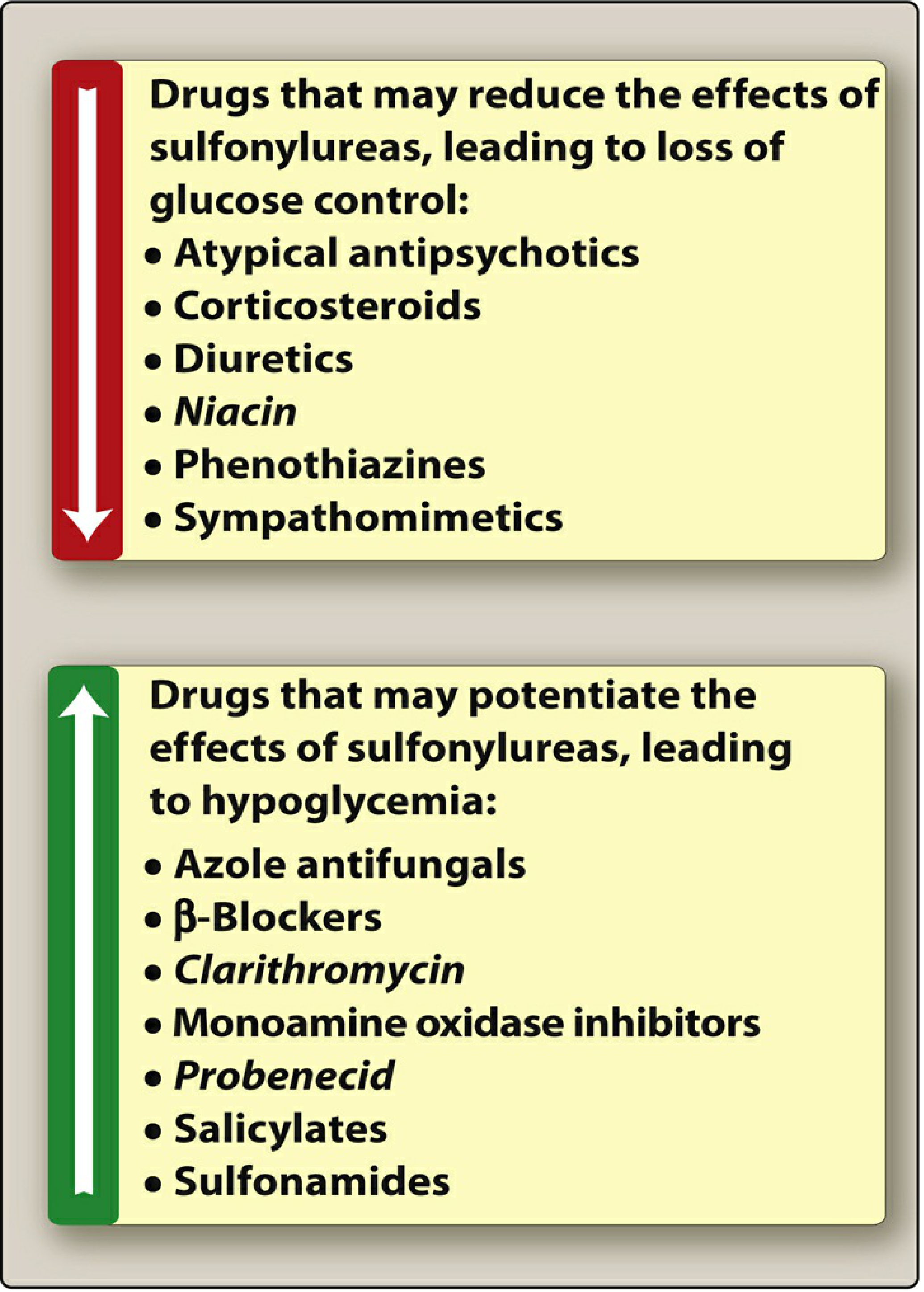
From Lippincott Illustrated Reviews: Pharmacology, Fig. 24.12
Drugs that potentiate hypoglycemia (may require dose reduction):
- Azole antifungals, beta-blockers, clarithromycin, MAO inhibitors, probenecid, salicylates, sulfonamides
Drugs that reduce glucose control (may require dose increase):
- Corticosteroids, diuretics, atypical antipsychotics, niacin, phenothiazines, sympathomimetics
Practical Titration Tips
- Administer with the first main meal of the day to reduce GI upset and hypoglycemia risk
- Allow at least 1-2 weeks between dose increments to assess response
- Monitor fasting plasma glucose and HbA1c as titration guides
- When switching from another sulfonylurea, no transition period is needed - start glimepiride at 1 mg and titrate
- If adequate glycemic control is not achieved at 8 mg, add a second agent rather than exceeding the maximum dose
This is a shared conversation. Sign in to Orris to start your own chat.