
Membranoproliferative glomerular nephritis
Reading File
Finding Sources
Finding Sources
Searching Images
membranoproliferative glomerulonephritis histology tram track double contour
Reading File
Reading File
Reading File
Searching Images
membranoproliferative glomerulonephritis glomerulus lobular pattern
Reading File
Loading Image
Searching PubMed
"membranoproliferative glomerulonephritis" AND treatment
I have enough to compose a comprehensive answer. Let me put together the full picture.
Membranoproliferative Glomerulonephritis (MPGN)
MPGN is not a single disease but a histologic pattern of glomerular injury seen on kidney biopsy - characterized by mesangial cell proliferation, increased mesangial matrix, and thickening/duplication ("splitting") of the glomerular basement membrane (GBM). It accounts for roughly 5-10% of cases of nephrotic syndrome in children and adults - Robbins Basic Pathology, p. 507.
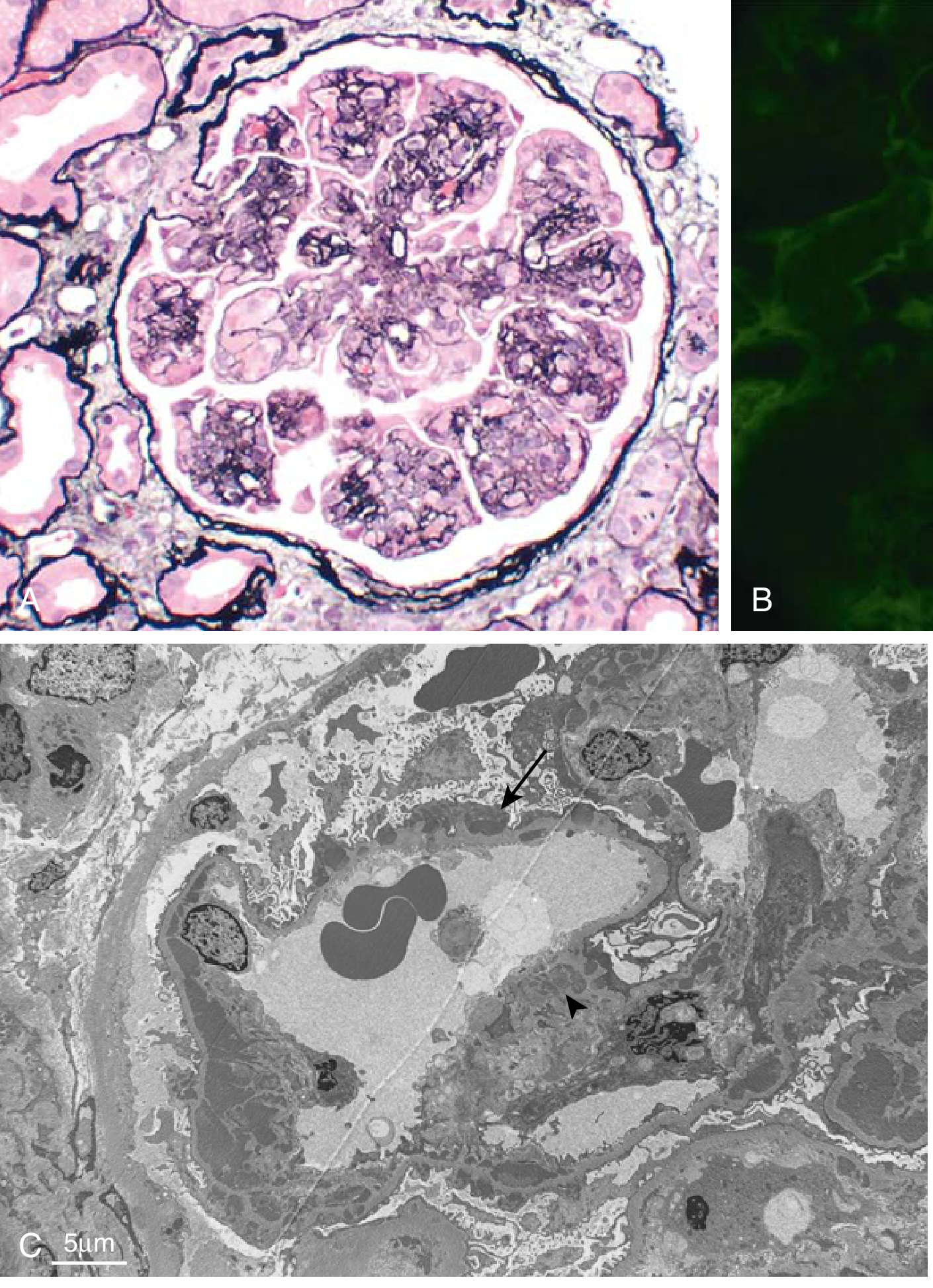
Modern classification (based on immunofluorescence, not just EM pattern I/II/III)
1. Immune complex-mediated MPGN (IC-MPGN) - the majority (~80%) of cases. Immune complexes deposit in the mesangium and subendothelial space, activating both classical and alternative complement pathways. Causes include:
- Infections: hepatitis C (often with cryoglobulinemia), hepatitis B, bacterial endocarditis, infected shunts, malaria, schistosomiasis, leprosy
- Autoimmune disease: SLE, Sjögren syndrome, rheumatoid arthritis, mixed connective tissue disease
- Monoclonal gammopathy (plasma cell or B-cell clonal Ig deposition)
- Idiopathic (a minority, more common in adolescents/young adults)
2. Complement-mediated MPGN (C3 glomerulopathy) - driven by dysregulation of the alternative complement pathway rather than immune complexes. Includes:
- Dense deposit disease (formerly "MPGN type II") - characteristic ribbon-like intramembranous C3 deposits on EM; can be associated with partial lipodystrophy
- C3 glomerulonephritis - C3 deposits without the dense intramembranous ribbon
- Driven by C3 nephritic factor (autoantibody stabilizing the alternative pathway C3 convertase), or mutations/deficiencies of factor H, factor I, or other complement regulators
3. MPGN-pattern without immune complexes or complement - seen in chronic thrombotic microangiopathies (TTP, antiphospholipid syndrome, radiation nephritis, drug-induced TMA, POEMS syndrome, sickle cell disease) - driven by chronic endothelial injury rather than immune deposition.
(Sources: Goldman-Cecil Medicine, p. 1260; Robbins & Kumar Basic Pathology, p. 507; Comprehensive Clinical Nephrology, 7th ed.)
Clinical features
- Presents with proteinuria (often nephrotic-range), hematuria, and sometimes nephrotic syndrome; slowly progressive course if untreated
- Low serum C3 and C4 intermittently in IC-MPGN; isolated low C3 (with normal C4) is typical in dense deposit disease/C3 glomerulopathy, reflecting alternative pathway activation
- Diagnosis requires kidney biopsy; light microscopy shows lobular accentuation and GBM "tram-track" duplication (from mesangial cell/matrix interposition), immunofluorescence localizes IgG/complement vs. C3-dominant deposits, and EM localizes deposits (subendothelial/mesangial in IC-MPGN vs. intramembranous ribbon-like in dense deposit disease)
- Every biopsy-proven case should be worked up for an underlying secondary cause (infection, autoimmune disease, monoclonal gammopathy) before being labeled idiopathic; if no cause found, evaluate for a complement-regulatory disorder
Treatment
- Treat the underlying cause first when identified (e.g., direct-acting antivirals for HCV-associated IC-MPGN, which effectively reduces recurrence risk; treatment of the autoimmune disease or monoclonal gammopathy)
- Idiopathic IC-MPGN with proteinuria ≤3 g/day and normal renal function: supportive care alone - blood pressure control with an ACE inhibitor or ARB
- Abnormal kidney function without crescents/active sediment: corticosteroids + immunosuppression - prednisone 1 mg/kg/day (max 60-80 mg/day) for 12-16 weeks; mycophenolate mofetil (2-3 g/day) added if suboptimal response; cyclophosphamide reserved for refractory cases
- C3 glomerulopathy: complement-targeted therapy (e.g., eculizumab in select cases) is being used increasingly, guided by the specific complement abnormality
- No treatment has been proven definitively effective for recurrent MPGN after kidney transplantation; recurrence risk is significant (20-45% for IC-MPGN), and HCV-endemic regions show higher graft loss from recurrence (Comprehensive Clinical Nephrology, 7th ed., p. 1474-1475)
Recent evidence note
A 2026 systematic review (Caravaca-Fontán et al., PMID 40971335) examined clinical presentation, treatment patterns, and the association of proteinuria with outcomes across C3 glomerulopathy and primary IC-MPGN - broadly consistent with the textbook framework above but underscores that proteinuria level is a key prognostic/treatment-response marker, and treatment protocols remain heterogeneous across the two disease categories. If precise, current treatment-response data are needed for a specific clinical decision, this paper is worth reviewing in full.
What's the prognosis and long-term kidney outcomes with treatment?
This is a shared conversation. Sign in to Orris to start your own chat.