
Explain types of Hearing Loss (Conductive. Sensord its investigations (Tunning Fork Test, Audiometry, Impedance Audiometry) Summarise Etiology. Pathology, Differential Diagnosis of Otosclerosis, Medical and surgical management of otosclerosis
Reading File
Now let me search the medical library in parallel for all topics requested.
Finding Sources
Finding Sources
Finding Sources
Finding Sources
Finding Sources
Finding Sources
Reading File
Reading File
Reading File
Reading File
Reading File
Finding Sources
Reading File
Finding Sources
Finding Sources
Reading File
Reading File
Reading File
Reading File
Finding Sources
Reading File
Reading File
Reading File
Reading File
Reading File
I now have comprehensive data from multiple authoritative textbooks. Let me fetch a key histology image and compile the full answer.
Loading Image
Loading Image
I now have all the information needed for a comprehensive answer. Let me compile everything.
Hearing Loss: Types, Investigations, and Otosclerosis
PART 1: TYPES OF HEARING LOSS
Hearing loss is broadly divided into four types: conductive, sensorineural (SNHL), mixed, and auditory neuropathy spectrum disorder (ANSD).
1. Conductive Hearing Loss (CHL)
Definition: A hearing loss classified as "conductive" when there is a difference of more than 10 dB between air conduction (AC) and bone conduction (BC) thresholds at any frequency - this is the air-bone gap (ABG). BC thresholds remain at normal-hearing levels (≤20 dBHL).
Mechanism: Disruption of transmission mechanisms of the external and/or middle ear. Sound cannot reach the cochlea efficiently.
Audiogram pattern: AC thresholds elevated, BC normal, significant ABG present (see Fig. 51.14a from Scott-Brown's below).
Maximum extent: Traditionally up to 60 dBHL.
Common causes:
| Category | Examples |
|---|---|
| External ear | Wax impaction, otitis externa, exostoses, atresia |
| Tympanic membrane | Perforation, tympanosclerosis |
| Middle ear | Otitis media with effusion, acute otitis media, cholesteatoma |
| Ossicular chain | Otosclerosis, ossicular discontinuity, tympanosclerosis |
Key feature: All sounds are attenuated equally regardless of input level - responds well to hearing-aid amplification.
2. Sensorineural Hearing Loss (SNHL)
Definition: Impairment in the cochlea and/or the primary nerve connections (cochlear nerve / CN VIII). Both AC and BC thresholds are raised and remain within 10 dB of each other (no significant ABG).
Mechanism: Damage to hair cells (inner or outer) of the cochlea, the stria vascularis, the spiral ganglion neurons, or the auditory nerve.
Audiogram pattern: AC and BC both elevated, no significant ABG.
Important features:
- Usually permanent
- Loudness recruitment (abnormal growth of loudness) is characteristic - helps distinguish from CHL
- Distortion of complex sounds, particularly speech in noise, which cannot be corrected by simple amplification
- The "neural" in SNHL refers only to the cochlear nerve connections from inner hair cells - it does NOT include auditory neuropathy
Common causes:
| Category | Examples |
|---|---|
| Congenital | Genetic mutations (connexin 26/GJB2), TORCH infections, CMV |
| Noise-induced | Industrial noise, recreational noise (4 kHz notch) |
| Presbyacusis | Age-related, high-frequency loss bilaterally |
| Ototoxicity | Aminoglycosides, cisplatin, loop diuretics, quinine |
| Infections | Labyrinthitis, meningitis, mumps |
| Autoimmune | Autoimmune inner ear disease |
| Sudden SNHL | Idiopathic (viral or vascular hypotheses) |
| Tumors | Acoustic neuroma (vestibular schwannoma) |
3. Mixed Hearing Loss
Both AC and BC thresholds are raised above 20 dBHL AND there is a significant ABG. Represents combined CHL + SNHL in the same ear (e.g., otosclerosis with cochlear involvement, chronic otitis media with sensorineural component).
4. Auditory Neuropathy Spectrum Disorder (ANSD)
Neural firing is diminished or out of synchrony across nerve fibers, causing fluctuations and distortion in speech. OAEs (otoacoustic emissions) may be present (hair cells intact) but ABRs are absent or abnormal. Speech discrimination disproportionately poor relative to pure-tone average.
PART 2: INVESTIGATIONS
A. Tuning Fork Tests
Tuning fork tests allow quick bedside assessment of hearing and help distinguish CHL from SNHL. A complement of frequencies (256, 512, and 1024 Hz) offers the most complete approach.
1. Weber Test
- Strike the tuning fork (512 Hz) and place on the center of the forehead, nasofrontal suture, or anterior incisors
- Patient reports which ear hears the tone louder, or if it is midline
- Interpretation:
- Midline = normal or equal bilateral loss
- Lateralizes to the worse (affected) ear = CHL in that ear (as little as 5 dB of CHL will cause lateralization)
- Lateralizes to the better ear = SNHL on the opposite (worse) side
- Weber is reliable but its acoustic basis remains unclear; patients with unilateral CHL may hesitate to acknowledge hearing better in the "bad" ear
2. Rinne Test
- Strike a 512 Hz tuning fork; place the base on the mastoid process (BC) - patient indicates when they can no longer hear it, then move the tines 2-3 cm in front of the EAC (AC) and ask if they still hear it
- Alternatively: compare loudness at mastoid vs. at ear canal
- Results:
- AC > BC (Positive Rinne) = Normal hearing OR sensorineural hearing loss
- BC > AC (Negative Rinne) = Conductive hearing loss (implies a CHL of ≥20 dB with a 512 Hz fork)
- Note: "Positive" = normal result - a common source of confusion; it is preferable to report as "AC > BC" or "BC > AC"
- False negative Rinne: In profound unilateral SNHL, the fork placed on the mastoid is heard by the opposite (better) cochlea via bone conduction - falsely suggesting CHL. This is detected by masking.
3. Bing Test (Occlusion Test)
- Assesses BC enhancement by canal occlusion
- In normal hearing and SNHL, occluding the EAC with a finger while fork is on the mastoid increases loudness (positive Bing)
- In CHL, no change in loudness (negative Bing) - canal is already functionally occluded
Summary Table (Weber + Rinne):
| Weber | Rinne | Interpretation |
|---|---|---|
| Midline | AC > BC bilaterally | Normal or bilateral SNHL |
| Lateralizes left | BC > AC left | CHL left ear |
| Lateralizes right | AC > BC bilaterally | SNHL left ear |
| Lateralizes left | BC > AC right | Mixed HL right |
B. Audiometry
Pure-tone audiometry (PTA) measures hearing thresholds in decibels across frequencies (250 Hz - 8000 Hz) for both AC and BC.
Key parameters:
- Air conduction (AC): Tested via headphones or insert earphones; tests entire auditory pathway
- Bone conduction (BC): Tested via a vibrator on the mastoid; bypasses the outer and middle ear - directly tests cochlear function
- Masking: Needed to prevent the non-test ear from participating (cross-hearing)
Audiogram configurations by type:
| Type | AC | BC | ABG |
|---|---|---|---|
| Normal | ≤20 dBHL | ≤20 dBHL | <10 dB |
| CHL | Raised | Normal | >10 dB |
| SNHL | Raised | Raised (matches AC) | <10 dB |
| Mixed | Raised | Raised | >10 dB |
Carhart Notch: A characteristic 2000 Hz dip in BC thresholds seen in otosclerosis due to impedance mismatch of the cochlea from stapes fixation - it is a mechanical artifact of stapes fixation, not true cochlear loss, and typically resolves after successful stapes surgery.
Speech audiometry:
- Speech Reception Threshold (SRT): Lowest level at which patient repeats 50% of spondee words; should correlate with PTA
- Word Recognition Score (WRS) / Speech Discrimination: Percentage of monosyllabic words correctly identified at comfortable listening level; typically good in CHL, poor in SNHL (due to distortion)
C. Impedance Audiometry (Immittance Audiometry)
Measures the impedance (resistance to energy flow) and admittance (ease of energy flow) of the middle ear system objectively. The battery consists of:
1. Tympanometry
Measures tympanic membrane compliance as a function of ear canal air pressure. Results displayed as a tympanogram.
| Tympanogram Type | Peak | Interpretation |
|---|---|---|
| Type A | Normal peak at 0 daPa | Normal middle ear |
| Type As ("shallow") | Low peak (reduced compliance) | Stapes fixation (otosclerosis), tympanosclerosis |
| Type Ad ("deep") | Abnormally high peak | Ossicular discontinuity, flaccid TM |
| Type B (flat) | No peak | Middle ear effusion, perforation, impacted wax |
| Type C | Peak shifted negative (< -200 daPa) | Eustachian tube dysfunction, early effusion |
In otosclerosis: Normal Type A or Type As (middle ear pressure is not affected by otosclerosis itself).
2. Acoustic Reflex Testing
The stapedius muscle contracts reflexively in response to loud sound (70-100 dB SL), stiffening the ossicular chain and producing a measurable change in compliance.
- Normal reflex: Bilateral (ipsilateral and contralateral) at appropriate levels
- In otosclerosis:
- Early: Diphasic (on-off) reflex - brief initial compliance change reverses quickly (characteristic of early stapedial fixation)
- Moderate/advanced: Absent reflex when probe is in the affected ear
- Advanced: Contralateral reflex also absent due to degree of CHL
3. Static Compliance
Measures the physical volume and compliance of the middle ear system. Reduced in otosclerosis and ossicular fixation.
PART 3: OTOSCLEROSIS
Etiology
Otosclerosis is the most common cause of progressive CHL in adults in developed countries.
Key etiological facts:
- Genetics: Autosomal dominant with variable penetrance (~25-40% penetrance). Sporadic cases account for 40-50%. Family history of hearing loss in approximately 2/3 of patients.
- Sex: Women are twice as likely to be affected as men. Pregnancy is known to accelerate disease progression.
- Race: Predominantly affects White (Caucasian) populations; rare in Africans and East Asians.
- Age: Typically presents in the third and fourth decades of life (teens to 20s onset); often not noticed until age 30-40.
- Bilateral: Approximately 75% of cases are bilateral, though often asymmetric.
- Viral trigger hypothesis: Measles virus RNA has been found in otosclerotic foci, suggesting persistent paramyxovirus infection may trigger disease in genetically susceptible individuals (supporting the role of measles vaccination in reducing incidence).
- Fluoride hypothesis: Low fluoride in drinking water is associated with higher prevalence; fluoride may stabilize otic capsule bone.
- Other factors: Hormonal influences (estrogen, pregnancy), autoimmunity, and TGF-β1 signaling pathways are implicated.
Pathology
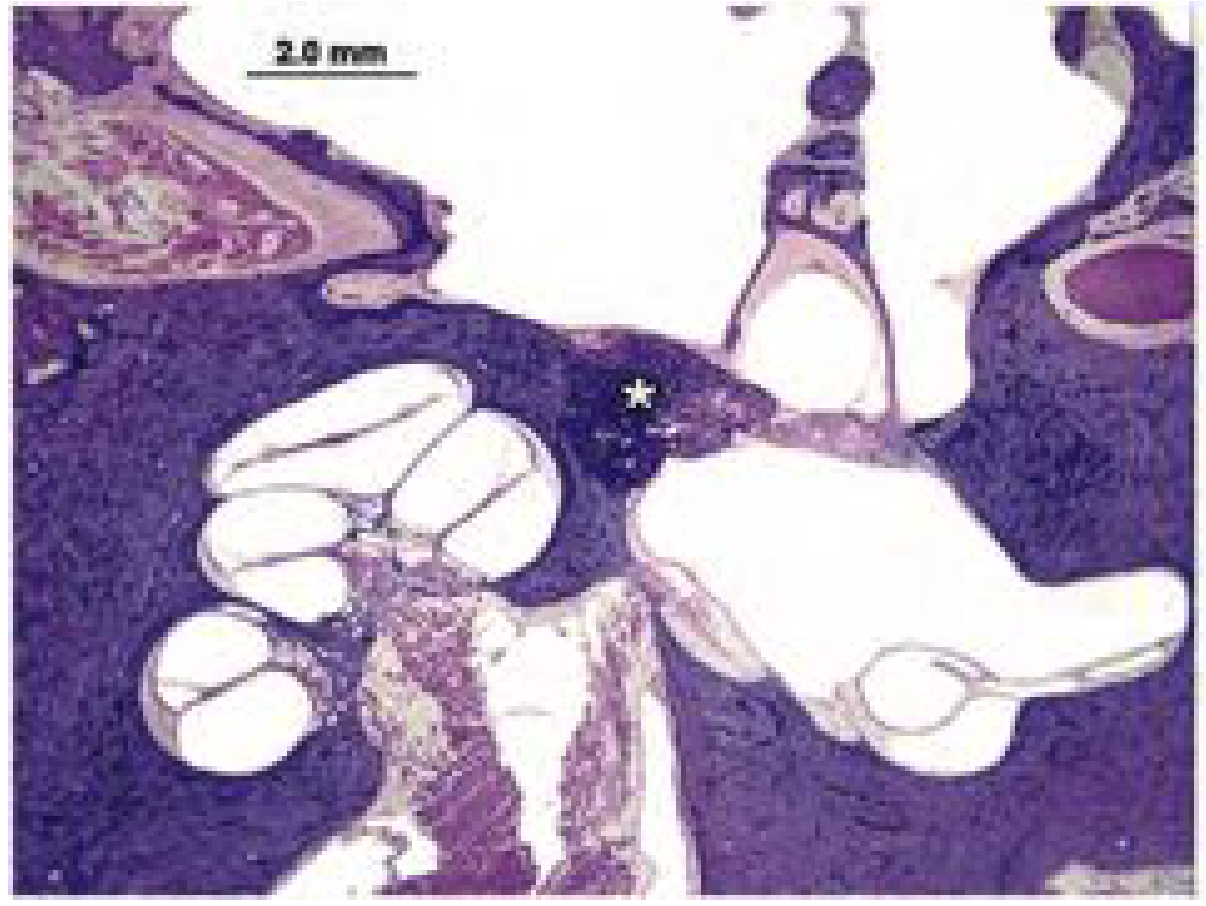
Otosclerosis represents an uncoupling of normal bone resorption and formation in the otic capsule - a unique enchondral bone that normally never remodels after development.
Pathological stages:
-
Active (otospongiotic) phase:
- Normal enchondral bone replaced by vascular, sponge-like woven bone
- Increased osteoclastic resorption creates lacunae filled with highly vascular fibrous tissue
- Blue lakes/haversian spaces filled with blood - responsible for the Schwartz sign (flamingo-pink blush on the promontory seen through the intact TM due to increased vascularity)
- Histologically: large vascular channels, active osteoblasts and osteoclasts, irregular "mosaic" pattern of bone
-
Inactive (sclerotic) phase:
- Vascular tissue replaced by dense, sclerotic lamellar bone
- Ankylosis of the stapes footplate in the oval window
- Spiral ligament hyalinization if cochlear extension occurs
Location:
- Fissula antefenestrum (anterior to the oval window): Most common site - explains why anterior footplate is fixed first
- Fenestral otosclerosis: Focus on the oval window niche - causes CHL by stapes fixation
- Cochlear (retrofenestral) otosclerosis: Extension to the cochlear capsule - causes or contributes to SNHL ("double-ring sign" or halo sign on CT)
- "Biscuit footplate": Total replacement of the annular ligament by otosclerotic bone - complete fixation
Radiological pathology (CT):
- Early: Low-density (demineralized) plaques at the fissula antefenestrum (anterior oval window border)
- Halo sign / double-ring effect: Band of demineralization surrounding the cochlear canal on CT - cochlear otosclerosis
- Fourth ring of Valvassori: Low-density ring around the otic capsule in advanced retrofenestral disease
- Late: Increased density and marked thickening of sclerotic bone around otic capsule
- MRI with gadolinium: Enhancement within active otospongiotic foci (mirrors Schwartz sign)
Differential Diagnosis of Otosclerosis
Any condition causing CHL with a normal tympanic membrane must be distinguished:
| Condition | Key Distinguishing Features |
|---|---|
| Tympanosclerosis | White plaques visible on TM; Type As tympanogram; calcification of ossicular chain visible on CT |
| Congenital ossicular fixation | Present since birth/childhood; no progression; family history may be absent; CT may show fusion |
| Malleus head fixation | More pronounced low-frequency CHL; CT shows adhesions in epitympanum |
| Ossicular discontinuity | Type Ad tympanogram (hypercompliant); CHL up to 60 dB; history of trauma/infection |
| Superior semicircular canal dehiscence (SSCD) | Autophony, Tullio phenomenon (vertigo with loud sounds); Type As; low-frequency BC thresholds improved (negative Rinne falsely); CT shows dehiscence |
| Otitis media with effusion (OME) | Type B tympanogram; otoscopic finding of effusion; common in children |
| Paget's disease | Older patients; elevated alkaline phosphatase; skull/long bone involvement; CT shows "cotton-wool" sclerosis |
| Osteogenesis imperfecta | Blue sclerae; multiple fractures; CHL; van der Hoeve's syndrome = OI + otosclerosis |
| Cholesteatoma / chronic OM | Retraction pocket or margin perforation on otoscopy |
| Glomus tympanicum | Pulsatile tinnitus; red mass behind TM; vascular mass on CT |
Clinical clues pointing specifically to otosclerosis:
- Bilateral, progressive CHL starting in young adulthood
- Normal TM and normal tympanogram (Type A or As)
- Absent acoustic reflexes
- Carhart notch at 2000 Hz on BC
- Paracusis of Willis (hearing better in noise - characteristic of CHL)
- Schwartz sign (flamingo-pink promontory blush)
- Positive family history
- Female sex; worsened with pregnancy
Medical Management of Otosclerosis
Medical treatment does not reverse hearing loss but may slow progression, particularly of the cochlear component:
1. Sodium Fluoride
- Mechanism: Fluoride converts hydroxyapatite to fluorapatite, which is more resistant to enzymatic resorption, potentially stabilizing active otospongiotic foci
- Dosage: Typically 20-40 mg/day (as sodium fluoride tablets), sometimes combined with calcium and vitamin D
- Indication: Active cochlear otosclerosis (active Schwartz sign, progressive SNHL, positive CT halo sign)
- Evidence: Controversial - some studies show slowing of SNHL progression; no benefit for established CHL
- Side effects: GI upset, fluorosis with long-term high-dose use; not universally endorsed
2. Bisphosphonates
- Etidronate and risedronate have been explored to inhibit osteoclastic activity in active disease
- Evidence remains limited; not standard of care
3. Hearing Aids
- A valid and effective non-surgical treatment
- Conventional air-conduction hearing aids work well in pure CHL
- Bone-anchored hearing aids (BAHA/Bonebridge) are an option for those unsuitable for surgery
- Patients must be counselled that a hearing aid is an alternative to surgery, not simply an inferior option
4. Cochlear Implants
- For advanced cochlear otosclerosis causing severe-to-profound SNHL
- Technically challenging due to cochlear ossification (may require drill-out)
- Outcomes are generally good but may be inferior to non-otosclerotic implantees due to cochlear fibrosis/ossification
Surgical Management of Otosclerosis
Surgery is the definitive treatment for CHL in otosclerosis. John Shea performed the first stapedectomy in 1956.
Indications for Surgery
- CHL with an air-bone gap (ABG) of ≥20-25 dB
- Absent acoustic reflexes confirming stapes fixation
- Normal or near-normal BC thresholds (cochlear reserve adequate)
- Patient preference after counselling of risks and alternatives
- Typically performed on the worse ear first; the better ear is operated 6-12 months later if desired
Contraindications
- Only-hearing ear (relative contraindication; increased risk not justified for most)
- Active infection
- ABR showing absent cochlear function (dead ear)
- Poor general health
- Pregnancy
Surgical Options
1. Total Stapedectomy (historical)
- Entire footplate removed and replaced with a vein or fat graft + piston/wire prosthesis
- Higher risk of labyrinthine trauma due to wide opening of vestibule
- Original Shea technique (Teflon stapes replica); evolved to wire-over-Gelfoam or fat graft
2. Partial Stapedectomy
- Posterior half of footplate removed; tissue graft placed; piston prosthesis used
3. Small Fenestra Stapedotomy (preferred current technique)
- A small circular hole (~0.6-0.8 mm) is made in/near the center of the footplate
- A piston prosthesis (typically 0.4-0.6 mm diameter wire-Teflon or titanium piston) is hooked over the long process of the incus and inserted through the fenestra
- Advantages: Minimal opening of vestibule, lower risk of inner ear trauma, lower rate of postoperative high-frequency SNHL
- No significant difference in PTA, ABG closure, or speech discrimination vs. stapedectomy overall
- Increasingly favored for >35 years
Techniques for fenestra creation:
- Micropicks/fine picks
- Microdrill (Skeeter drill)
- Laser stapedotomy: KTP-532, argon, or CO2 laser - precise, non-contact, reduces mechanical trauma; CO2 laser now deliverable via handheld fiberoptic cables; single-shot scanning system available. Debate exists on which laser is optimal.
Prosthesis types:
- Teflon piston with stainless steel wire (Schuknecht)
- Platinum fluoroplastic piston
- Titanium piston (MRI-compatible)
- Shape-memory nitinol (self-crimping)
Stapedotomy Procedure Overview (key steps):
- Transcanal approach under general or local anesthesia with microscope (or endoscope)
- Tympanomeatal flap elevated, middle ear entered
- Chorda tympani nerve identified and preserved
- Ossicular chain palpated - stapes fixation confirmed
- Superstructure of stapes removed (crurotomy)
- Fenestra created in center of footplate (laser, drill, or pick)
- Prosthesis hooked to long process of incus, piston placed in fenestra (sometimes covered with vein/fat graft)
- Tympanomeatal flap replaced
Outcomes:
- Air-bone gap closure to ≤10 dB: achieved in ~90% of cases
- Hearing improved to serviceable levels in ~95%
- Results stable over long-term follow-up
Complications
| Complication | Incidence | Notes |
|---|---|---|
| Severe-to-profound SNHL | ~0.2% total; <2% further loss | Most feared; patient counselled of <1% total deafness risk |
| Vertigo/dizziness | Common (transient); persistent rare | Due to inner ear manipulation |
| Perilymph fistula | Rare | Prosthesis too long, labyrinthine breach |
| Prosthesis displacement/extrusion | Delayed | May require revision |
| Reparative granuloma | Rare | Foreign body reaction; causes delayed SNHL + vertigo |
| Chorda tympani injury | Common | Taste disturbance, usually resolves |
| Tinnitus | May persist or worsen | Usually improves with CHL correction |
| Oval window re-obliteration | Delayed | Requires revision surgery |
Postoperative care:
- Dry ear precautions for first 3 weeks
- Swimming and diving permitted after ~3 weeks
- No contact sports initially
- Flying: generally permitted after 2-4 weeks
Summary Table: Otosclerosis at a Glance
| Feature | Detail |
|---|---|
| Most common cause | Progressive CHL in adults (developed world) |
| Genetics | Autosomal dominant, variable penetrance (25-40%) |
| Sex | F:M = 2:1; worsened by pregnancy |
| Age of onset | 20s-30s; symptomatic 30s-40s |
| Location | Fissula antefenestrum (anterior oval window) most common |
| Pathology | Active spongiosis → sclerosis; uncoupled bone remodelling in otic capsule |
| Audiogram | CHL with ABG; Carhart notch at 2000 Hz BC |
| Tympanogram | Type A or As; absent acoustic reflexes |
| CT | Lucency at anterior oval window; halo sign (cochlear); fourth ring of Valvassori |
| Schwartz sign | Flamingo-pink blush on promontory through TM (active disease) |
| Paracusis of Willis | Hears better in noise (characteristic of CHL) |
| Medical Rx | Sodium fluoride ± Ca/Vit D (active cochlear disease); hearing aids |
| Surgical Rx | Small fenestra stapedotomy (preferred); total/partial stapedectomy |
| Success rate | ~90% ABG closure to ≤10 dB |
| Main surgical risk | Total SNHL in 0.2% |
Sources: Cummings Otolaryngology Head and Neck Surgery (Chapter 146); Scott-Brown's Otorhinolaryngology Head & Neck Surgery Vol. 1 & 2 (Chapters 51, 97); Shambaugh Surgery of the Ear (Chapter 13); Bailey and Love's Short Practice of Surgery 28e (Chapter 51); Robbins & Cotran Pathologic Basis of Disease; Harrison's Principles of Internal Medicine 22e
This is a shared conversation. Sign in to Orris to start your own chat.