
Amygdala parts and low and high roads and nuclear subdivisions in detailed and understandable from textbook references
I'll start with a quick overview while I search the medical library for detailed textbook content.
Quick Answer: The amygdala is an almond-shaped structure in the medial temporal lobe with several nuclear subdivisions (basolateral, centromedial, cortical groups). The "low road" (thalamus → amygdala) allows rapid, unconscious fear responses, while the "high road" (thalamus → cortex → amygdala) provides slower, more refined emotional processing - a concept popularized by Joseph LeDoux.
Searching sources...
Reading File
Now I'll run parallel searches across the library for amygdala content:
Finding Sources
Finding Sources
Finding Sources
Excellent results! Now I'll read the key sections in parallel - Neuroscience (Exploring the Brain), Stahl's, Kandel's Principles of Neural Science, and Kaplan & Sadock:
Reading File
Reading File
Reading File
Reading File
Now let me get the Guyton physiology section, Neuroanatomy through Clinical Cases, and the low/high road content from Kandel and Neuroscience Exploring the Brain:
Reading File
Reading File
Finding Sources
Now let me search specifically for the low/high road concept in Neuroscience (Exploring the Brain) and Kandel, and also get the fear circuit details:
Finding Sources
Reading File
Let me now get the specific low road/high road content from Kandel and also the fear conditioning circuit details:
Reading File
Finding Sources
Now let me get the specific fear circuit/low road content from Neuroscience: Exploring the Brain block5:
Reading File
Reading File
Let me get the key LeDoux low road/high road passage from Kandel and fetch relevant images:
Reading File
Loading Image
Excellent! Now I have rich content from multiple textbooks. Let me also fetch the fear circuit diagram and the LeDoux dual pathway description:
Loading Image
Reading File
I now have comprehensive material from multiple textbooks. Let me compile the full, detailed answer.
The Amygdala: Parts, Nuclear Subdivisions, and the Low & High Roads
1. Overview and Location
The amygdala (from the Greek for "almond") is an almond-shaped complex of nuclei located in the anteromedial temporal lobe, just dorsal to the anterior tip of the hippocampus and below the medial surface of the temporal cortex. Each hemisphere has one amygdala, and together they are sometimes called the "amygdaloid nuclear complex."
Guyton & Hall famously called it the "window through which the limbic system sees the place of the person in the world" because it receives signals from virtually all cortical lobes and sends outputs back to cortex, hippocampus, septum, thalamus, and most importantly the hypothalamus.
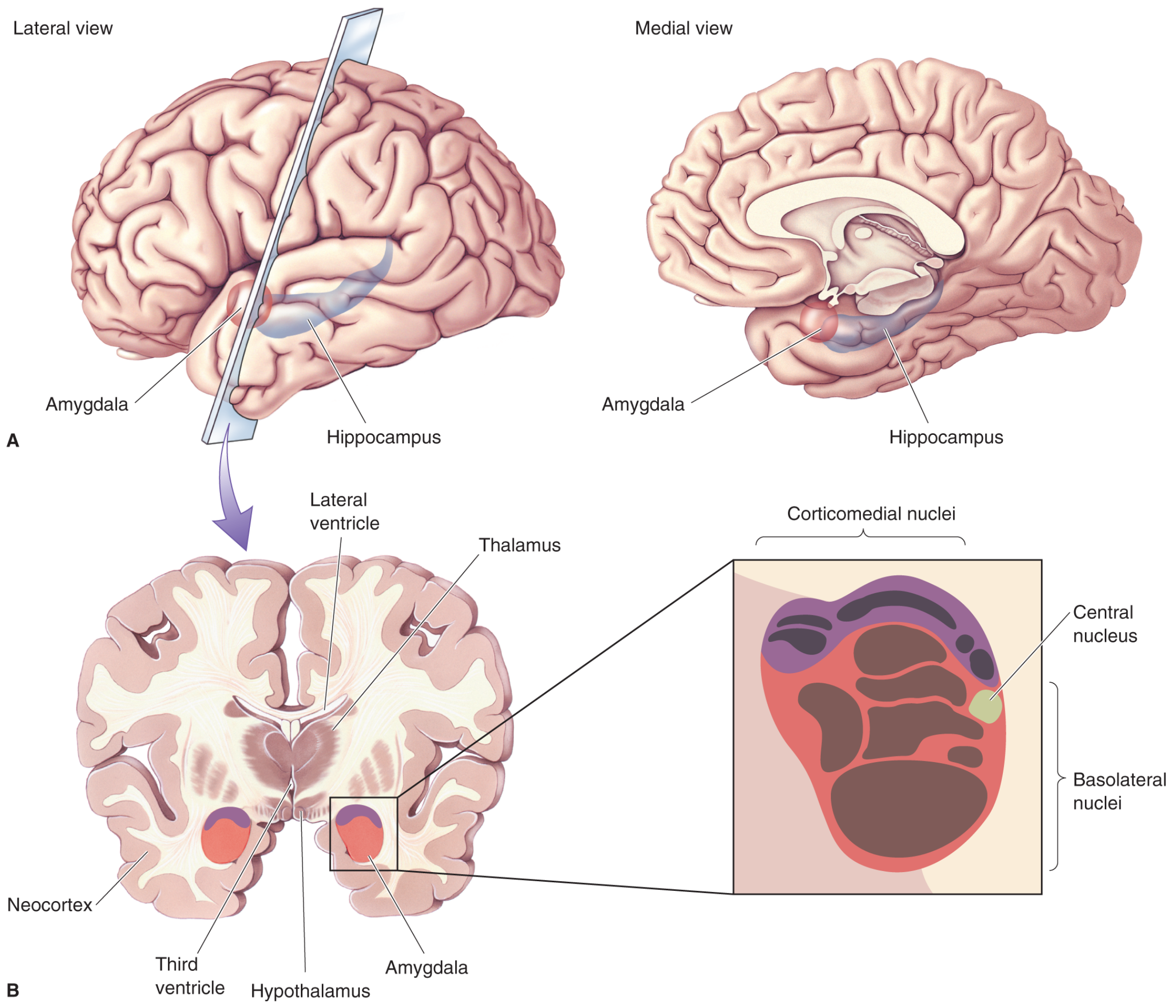
2. Nuclear Subdivisions (in Detail)
The amygdala contains approximately 12 nuclei total, but these are classically organized into three main groups:
A. Basolateral Group (BLA) - The "Input Station"
This is the largest group in humans and the most highly developed. It includes:
- Lateral nucleus - the primary input nucleus; receives sensory information from both thalamus and cortex (auditory, visual, gustatory, tactile)
- Basal nucleus (also called basal or accessory basal)
- Accessory basal nucleus
Function: The lateral nucleus is the primary site where sensory information about conditioned stimuli (CS) converges with unconditioned stimuli (US) during fear learning. This is where synaptic plasticity for fear memory occurs. Neurons in the lateral nucleus learn to respond to previously neutral stimuli when those stimuli are paired with pain or threat.
The BLA sends axons to the central nucleus and is predominantly responsible for direct and indirect connections to diverse cortical areas, the basal forebrain, and medial thalamus.
"The lateral nucleus of the amygdala receives most sensory input... including sensory information about the CS from both the thalamus and the cortex... The lateral nucleus is thought to be a site of synaptic change during fear conditioning."
- Kandel, Principles of Neural Science, 6th Ed.
B. Corticomedial Group - The "Olfactory/Visceral Nucleus"
Includes:
- Cortical nucleus - sits on the medial surface of the temporal lobe, near basal forebrain and olfactory areas; has a cortical (layered) structure
- Medial nucleus - receives olfactory input (primary olfactory afferents)
- Anterior amygdaloid area
Function: This group is primarily concerned with olfaction and interactions with the hypothalamus related to appetitive states (hunger, sexual behavior, reproductive drive). In lower animals and phylogenetically older circuits, the corticomedial nuclei are the dominant group.
Note the important distinction: despite its name, the corticomedial nucleus is NOT the one with the major cortical connections - that is the basolateral group.
"The smaller corticomedial nucleus... located on the medial surface of the temporal lobe, near the basal forebrain and olfactory areas. The main connections of the corticomedial nucleus are involved in olfaction and in interactions with the hypothalamus related to appetitive states."
- Neuroanatomy through Clinical Cases, 3rd Ed.
C. Central Nucleus (CeA) - The "Output Station"
The smallest of the three groups, but arguably the most critical for the expression of fear and emotional responses. It has two main subdivisions:
- Lateral central nucleus - receives input from the lateral/basal nuclei
- Medial central nucleus - projects to the brainstem and hypothalamus
Function: The central nucleus is the output hub of the amygdala's fear system. It projects to:
- Hypothalamus - triggering HPA axis activation (cortisol release), autonomic responses (heart rate, blood pressure)
- Periaqueductal gray (PAG) - mediating freezing behavior (via ventral PAG) and defensive responses (via dorsal PAG)
- Parabrachial nucleus - altering respiratory rate (hyperventilation in panic)
- Locus coeruleus - noradrenergic activation (fight/flight arousal, increased pulse)
- Anterior cingulate cortex (ACC) and orbitofrontal cortex (OFC) - generating the subjective feeling of fear
"It is orchestrated by the central nucleus of the amygdala, a brain structure that connects to critical brain areas responsible for response execution."
- Kaplan & Sadock's Comprehensive Textbook of Psychiatry
The Bed Nucleus of the Stria Terminalis (BNST)
Also considered part of the "extended amygdala." It mediates more sustained, diffuse anxiety states (as opposed to phasic fear responses), and is connected to the amygdala via the stria terminalis pathway.
3. The Two Major Output Pathways
Outputs from the amygdala to the hypothalamus travel through two main routes:
| Pathway | Description |
|---|---|
| Ventral amygdalofugal pathway | Short, direct pathway connecting amygdala to hypothalamus and basal forebrain |
| Stria terminalis | A longer, arching fiber bundle that follows the curve of the caudate nucleus; the "classical" limbic pathway |
4. The Low Road and High Road (LeDoux's Dual Pathways)
This is one of the most important concepts in emotional neuroscience, developed by Joseph LeDoux at NYU.
The key insight: the amygdala (lateral nucleus) receives sensory input from the thalamus via TWO different routes - one fast and crude, one slow and detailed.
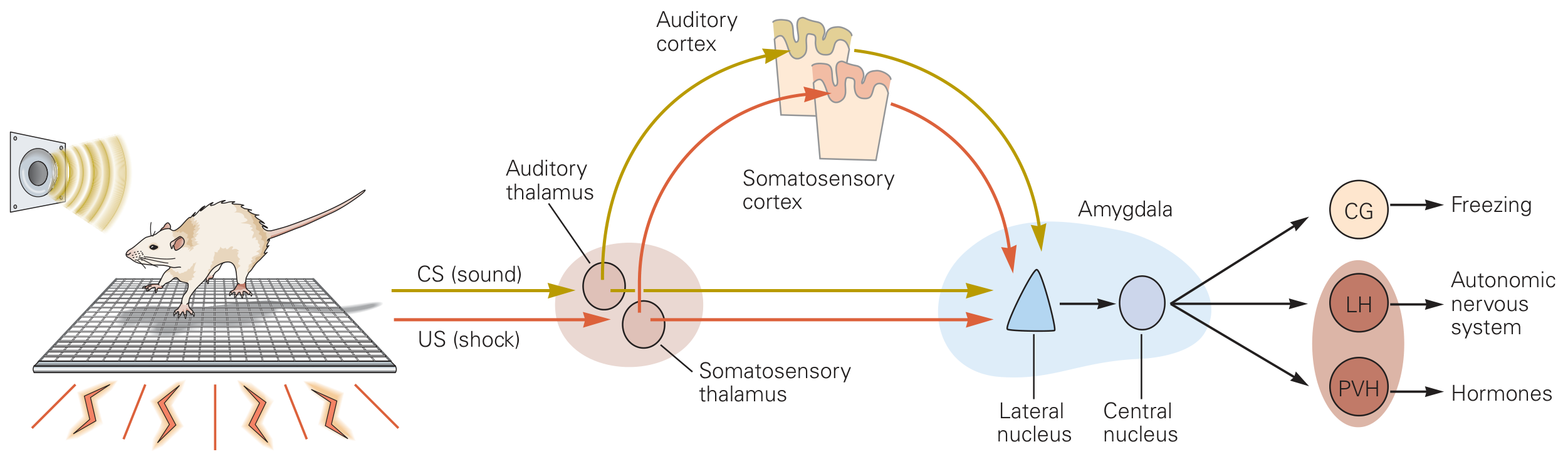
The Low Road (Fast Path): Thalamus → Amygdala
Route: Sensory input → sensory thalamic relay nuclei → directly to the lateral nucleus of the amygdala
Speed: Very fast - bypasses the cortex entirely
What it carries: Crude, unanalyzed sensory information (e.g., "something loud," "something moving fast")
Purpose: Allows the amygdala to begin generating a fear response before the cortex has even finished processing the stimulus. This is critical for survival - you jump away from a snake-shaped stick before your cortex confirms it is actually a stick.
"The amygdala is able to respond to an auditory danger cue before the cortex can fully process the stimulus information."
- Kandel, Principles of Neural Science, 6th Ed.
Think of it as: "Ready, Fire... Aim" - act first, think later.
The High Road (Slow Path): Thalamus → Cortex → Amygdala
Route: Sensory input → sensory thalamic relay nuclei → sensory cortex (auditory, visual, somatosensory cortex) → lateral nucleus of the amygdala
Speed: Slower - involves full cortical processing
What it carries: Detailed, analyzed, contextually interpreted information
Purpose: Allows the amygdala to receive a refined, accurate assessment of the stimulus. This is how the cortex can modulate or suppress the amygdala's initial fear response - for example, telling the amygdala "that was just a stick, not a snake" and allowing you to calm down.
Think of it as: "Ready, Aim, Fire" - think carefully, then act appropriately.
Summary Table: Low Road vs. High Road
| Feature | Low Road | High Road |
|---|---|---|
| Route | Thalamus → Lateral amygdala | Thalamus → Sensory cortex → Lateral amygdala |
| Speed | Very fast (milliseconds) | Slower (requires cortical processing) |
| Information quality | Crude, unrefined | Detailed, contextually accurate |
| Consciousness | Unconscious, automatic | Can generate conscious awareness |
| Purpose | Immediate survival response | Accurate threat appraisal and emotion regulation |
| Coined by | Joseph LeDoux | Joseph LeDoux |
5. What Happens After the Signal Reaches the Amygdala?
Once the lateral nucleus receives a danger signal (from either road), it communicates with the central nucleus through intra-amygdala circuits including the basal nucleus and intercalated cell masses (small GABAergic neurons that can inhibit the central nucleus, acting as a gate).
The central nucleus then activates:
| Target | Response |
|---|---|
| Periaqueductal gray (PAG) | Freezing (ventral PAG) or active defense (dorsal PAG) |
| Lateral hypothalamus | Autonomic responses: increased heart rate, blood pressure |
| Paraventricular hypothalamus | HPA axis activation - cortisol release |
| Locus coeruleus | Norepinephrine release - arousal, vigilance |
| Parabrachial nucleus | Increased respiratory rate |
| Anterior cingulate / OFC | Subjective feeling of fear (conscious experience) |
6. The Amygdala is More than a "Fear Center"
Textbooks now emphasize that the amygdala's role is broader than fear:
- It responds to positive emotions and reward (certain nuclei respond to pleasure)
- It detects stimulus salience - anything unexpected, novel, or emotionally charged (positive or negative)
- It modulates attention, perception, memory, and decision making through widespread cortical projections
- It is necessary for social recognition and reading emotional faces
- Stimulation of different amygdaloid nuclei can cause either fear/rage or pleasure/reward depending on which nuclei are stimulated
- Bilateral amygdala lesions in humans produce Urbach-Wiethe syndrome - complete abolition of fear to external threats but preserved panic to internal (interoceptive) cues like CO2 inhalation, suggesting multiple fear systems exist
7. Clinical Relevance
| Condition | Amygdala Involvement |
|---|---|
| PTSD | Hyperactivation of central nucleus; impaired top-down prefrontal regulation |
| Anxiety disorders/panic | Overactivation of amygdala-periaqueductal gray and amygdala-locus coeruleus circuits |
| Depression | Reduced connectivity between amygdala and prefrontal cortex; impaired emotion regulation |
| Klüver-Bucy syndrome | Bilateral temporal lobectomy removing amygdala: fearlessness, hypersexuality, hyperorality, visual agnosia |
| Autism | Amygdala dysfunction related to impaired social emotion recognition |
Sources
- Neuroscience: Exploring the Brain, 5th Ed. (Bear, Connors, Paradiso) - Ch. 18: Anatomy, Klüver-Bucy, fear circuit
- Principles of Neural Science, 6th Ed. (Kandel et al.) - Ch. 42: Low road/high road, fear conditioning, lateral/central nucleus roles
- Guyton and Hall Textbook of Medical Physiology, 14th Ed. - Functions, stimulation/ablation effects, corticomedial vs. basolateral
- Neuroanatomy through Clinical Cases, 3rd Ed. (Blumenfeld) - Nuclear subdivisions and connectivity
- Stahl's Essential Psychopharmacology, 5th Ed. - Fear neurobiology, amygdala-OFC-ACC-brainstem circuits
- Kaplan & Sadock's Comprehensive Textbook of Psychiatry - Amygdala connectivity patterns, PTSD, depression
This is a shared conversation. Sign in to Orris to start your own chat.