
Erthyrocyte maturation factor and their role on treatment
I'll start by reading the medical library skill, then search for erythrocyte maturation factors simultaneously.
Reading File
Now let me run parallel searches across the library and PubMed:
Finding Sources
Finding Sources
Finding Sources
Searching PubMed
erythrocyte maturation factors erythropoiesis treatment
Good results. Let me now read the most relevant textbook sections in parallel:
Reading File
Reading File
Finding Sources
Finding Sources
Excellent content. Let me now read the erythrocyte maturation section and fetch key content from Harrison's and Goodman & Gilman's:
Reading File
Reading File
Finding Sources
Let me get the key therapeutic content from Goodman & Gilman's and also fetch the maturation diagram:
Reading File
Reading File
Loading Image
Now let me get one more block of content - specifically the iron and folate therapy sections from Goodman & Gilman's:
Finding Sources
Finding Sources
I now have comprehensive information to write a detailed, well-organized answer. Let me compile it.
Erythrocyte Maturation Factors and Their Role in Treatment
Overview of Erythrocyte Maturation (Erythropoiesis)
Erythropoiesis is the process of producing mature red blood cells (RBCs) from pluripotent stem cells in the bone marrow. It takes approximately 7 days and involves 3-5 cell divisions. The maturation sequence involves characteristic changes: decreasing cell/nuclear volume, increasing chromatin condensation, progressive hemoglobin synthesis (as RNA/polyribosomes decline), and eventual nuclear extrusion.
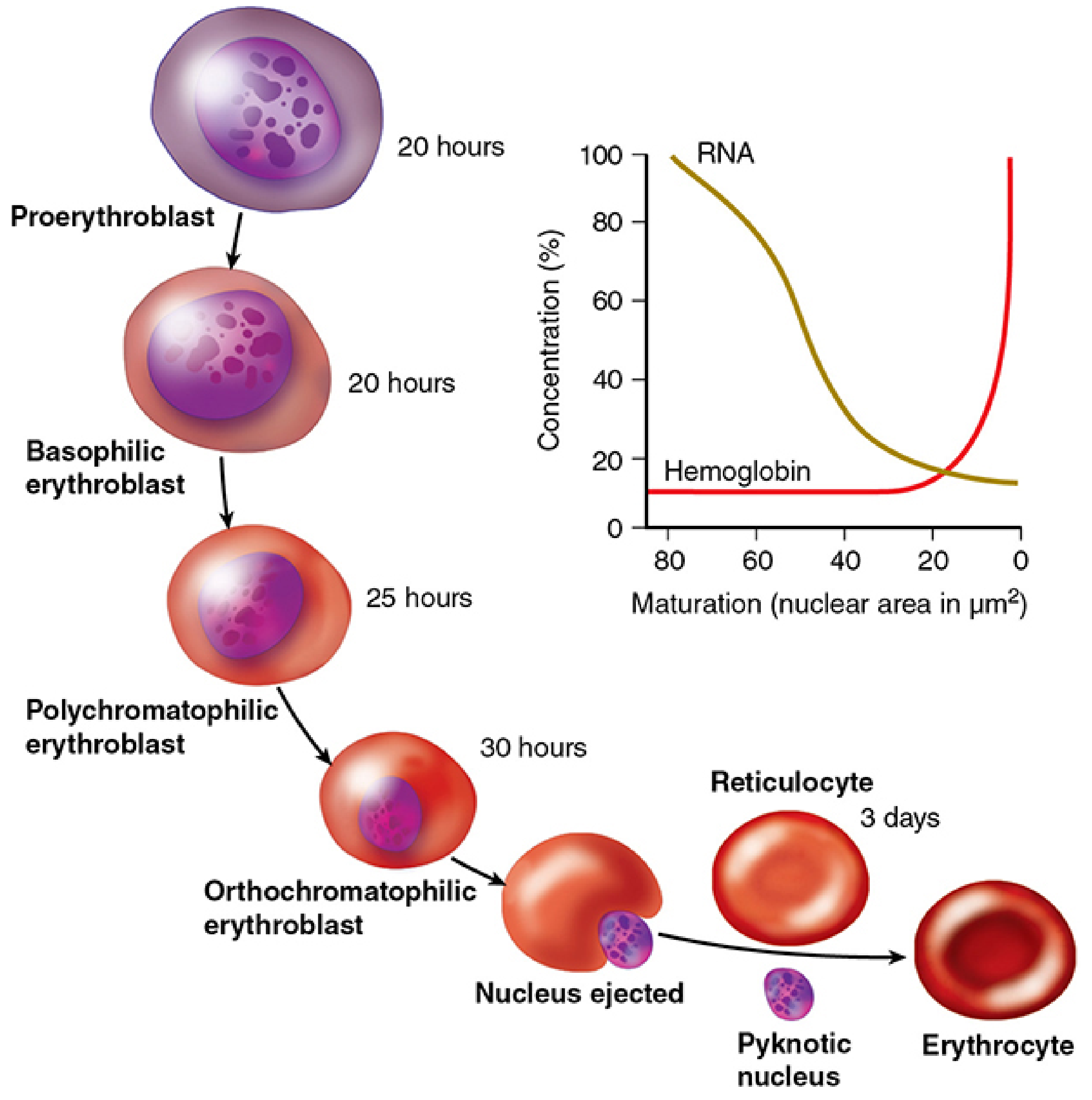
Maturation Stages
| Stage | Duration | Key Features |
|---|---|---|
| Proerythroblast | ~20 hrs | Large cell, lacy chromatin, nucleoli, basophilic cytoplasm |
| Basophilic erythroblast | ~20 hrs | Intense basophilia, hemoglobin synthesis begins |
| Polychromatophilic erythroblast | ~25 hrs | Mixed basophilic + eosinophilic cytoplasm |
| Orthochromatophilic erythroblast | ~30 hrs | Nearly eosinophilic; pyknotic nucleus is ejected |
| Reticulocyte | ~3 days | Anucleate; residual RNA/polyribosomes; circulates in blood |
| Mature erythrocyte | 120-day lifespan | Biconcave disc; fully hemoglobinized; no organelles |
Erythrocyte Maturation Factors
These are the essential substrates, hormones, and growth factors required for normal erythropoiesis. Their deficiency causes specific types of anemia, which are treated by replacing the deficient factor.
1. Erythropoietin (EPO)
Role: EPO is a glycoprotein hormone produced primarily by peritubular cells in the renal cortex. It is the principal hormonal driver of erythropoiesis, stimulating the proliferation and differentiation of erythroid progenitors (BFU-E and CFU-E) and the production of hemoglobin mRNA. After EPO stimulation, circulating RBC levels rise in 2-3 days due to the relatively slow maturation process. - Ganong's Review of Medical Physiology, 26e
Therapeutic Use - EPO / Erythropoiesis-Stimulating Agents (ESAs):
- Anemia of Chronic Kidney Disease (CKD): The primary indication. A normocytic normochromic anemia develops as early as Stage 3 CKD due to insufficient EPO production. ESAs (epoetin alfa, darbepoetin alfa) correct this. - Harrison's Principles of Internal Medicine, 22e
- Cancer/Chemotherapy-Associated Anemia: Epoetin alfa (150 units/kg TID or 450-600 units/kg once weekly) reduces transfusion requirement. Current guidelines restrict ESA use to patients with Hb < 10 g/dL on palliative chemotherapy who cannot tolerate transfusions; do not normalize Hb. - Goodman & Gilman's, 14e
- Perioperative Use: Epoetin alfa 150-300 units/kg/day for 10 days before surgery or 600 units/kg on days -21, -14, -7, and day of surgery; reduces allogeneic transfusion in orthopedic/cardiac procedures.
- Myelodysplastic Syndrome (MDS): ESAs are first-line for low-risk MDS with low serum EPO levels.
Adverse effects of ESAs: Hypertension, thromboembolic events; a meta-analysis showed ~10% increased mortality risk in cancer patients treated to normalize Hb - hence the strict Hb targets.
2. Iron
Role: Iron is the core component of the heme moiety of hemoglobin. It is essential for every step of hemoglobin synthesis and is required for erythroid cell proliferation. Serum transferrin receptors (sTfRs) are shed during erythrocyte maturation and reflect the rate of erythropoiesis. - Henry's Clinical Diagnosis, 23e
Deficiency Effect: Iron deficiency anemia - microcytic, hypochromic anemia.
Therapeutic Use:
- Oral iron: Ferrous sulfate, ferrous fumarate, or ferrous gluconate are first-line. Timed-release preparations are discouraged as iron release may bypass the absorptive duodenum. - Textbook of Family Medicine, 9e
- Intravenous iron: Ferric carboxymaltose (FDA-approved), iron sucrose, ferric gluconate - used when oral iron is not tolerated or absorbed (IBD, post-bariatric surgery, dialysis patients). Adverse events comparable to oral ferrous sulfate.
- Iron with ESAs: Iron supplementation is often required to improve ESA response in CKD/cancer patients with low ferritin. - Harrison's, 22e
3. Vitamin B12 (Cobalamin)
Role: Cobalamin is essential for DNA synthesis. It is required for the conversion of methylmalonyl-CoA to succinyl-CoA and for the regeneration of methionine from homocysteine (via methionine synthase), which in turn regenerates tetrahydrofolate (THF) from methyl-THF. Without B12, folate becomes trapped as methyl-THF ("methyl trap"), starving cells of the THF needed for thymidylate (DNA) synthesis. Rapidly dividing erythroid precursors are especially affected, causing megaloblastic anemia.
Deficiency Effect: Megaloblastic anemia + neurological damage (subacute combined degeneration of the spinal cord).
Therapeutic Use:
- Uncomplicated pernicious anemia: Intramuscular cyanocobalamin (1-10 µg/day) as a therapeutic trial; once confirmed, maintenance injections for life.
- Severe/emergency cases (neurological changes, severe leukopenia/thrombocytopenia): Do not wait for full diagnostics. Give IM cyanocobalamin 100 µg/day + oral folic acid 1-2 mg/day for 1-2 weeks. Packed RBC transfusion if Hb critically low.
- Response monitoring: Megaloblastic morphology disappears first. Serum iron falls dramatically within 48 hours (taken up for Hb synthesis). Reticulocyte count peaks day 5-7. Full Hb correction in weeks.
- Important caution: Never treat with folate alone in suspected B12 deficiency - folic acid can normalize the blood picture while neurological damage progresses silently. - Goodman & Gilman's, 14e
- Long-term therapy: Must be lifelong in pernicious anemia (absent intrinsic factor). Oral high-dose B12 (1000-2000 µg/day) may be used as an alternative to injections in some patients.
4. Folic Acid (Folate)
Role: THF and its derivatives are required as one-carbon carriers for purine and pyrimidine synthesis (particularly thymidylate synthesis). Folate deficiency impairs DNA synthesis in erythroid precursors, causing megaloblastic maturation arrest - large, morphologically abnormal precursors that undergo intramedullary destruction (ineffective erythropoiesis).
Deficiency Causes: Poor diet, alcohol, malabsorption (celiac disease), pregnancy (increased demand), drugs (methotrexate, phenytoin, azathioprine, zidovudine).
Deficiency Effect: Megaloblastic anemia (without neurological damage, distinguishing it from B12 deficiency).
Therapeutic Use:
- Oral folic acid 1-5 mg/day corrects most cases.
- Celiac-related deficiency responds to a gluten-free diet plus folate supplementation.
- Leucovorin (folinic acid): Active reduced folate used to rescue after high-dose methotrexate; given 24 hours after methotrexate to replenish active folate without rescuing tumor cells. - Goodman & Gilman's, 14e
- Pregnancy: Periconceptional folic acid 400-800 µg/day prevents neural tube defects and supports the markedly increased RBC production of pregnancy.
5. TGF-β Superfamily Ligands and Luspatercept (Novel Target)
Role in Ineffective Erythropoiesis: Under physiological conditions, activins and growth differentiation factors (GDF8, GDF11) bind activin receptors, signaling through SMAD2/SMAD3 to provide a tightly regulated brake on terminal erythroid differentiation. In diseases like thalassemia and myelodysplastic syndrome (MDS), constitutive SMAD2/SMAD3 overactivation inhibits late-stage red cell maturation, leading to massive ineffective erythropoiesis.
Luspatercept: A recombinant fusion protein (modified ActRIIB extracellular domain + IgG1 Fc) that acts as a ligand trap for GDF8, GDF11, and activin B, reducing SMAD2/SMAD3 signaling and enabling erythroblast differentiation. - Goodman & Gilman's, 14e
Therapeutic Uses:
- Beta-thalassemia (transfusion-dependent): Starting dose 1 mg/kg SC every 3 weeks; ~20% of patients achieved ≥33% reduction in transfusion burden vs. 4.5% placebo (Phase III BELIEVE trial). ~11% achieved transfusion independence.
- MDS with ring sideroblasts: Also approved in lower-risk MDS. Used after ESA failure.
- Dose-hold: Delay if Hb ≥ 11.5 g/dL.
- Adverse effects: Thromboembolic events (especially post-splenectomy patients), bone/joint pain, dizziness, hypertension, hyperuricemia.
6. Other Contributing Factors
| Factor | Role | Deficiency Consequence |
|---|---|---|
| Copper | Cofactor for ceruloplasmin; required for iron mobilization | Anemia + neutropenia |
| Vitamin C | Enhances non-heme iron absorption; antioxidant | Exacerbates iron deficiency |
| Pyridoxine (B6) | Required for ALA synthase (first step of heme synthesis) | Sideroblastic anemia (iron-refractory) |
| Thyroid hormone | Modulates EPO production and erythroid proliferation | Anemia of hypothyroidism |
| Androgens | Stimulate EPO production; direct marrow effect | Loss causes normocytic anemia in hypogonadism |
| Stem Cell Factor (SCF) / c-Kit | Early proliferation of erythroid progenitors | Aplasia |
| GM-CSF / IL-3 | Early multi-lineage support of erythroid progenitors | Multilineage cytopenias |
Clinical Summary - Matching Deficiency to Treatment
| Deficiency | Anemia Type | Treatment |
|---|---|---|
| EPO (CKD, cancer) | Normocytic normochromic | Epoetin alfa, darbepoetin alfa |
| Iron | Microcytic hypochromic | Oral ferrous salts; IV iron if needed |
| Vitamin B12 | Megaloblastic (+ neurological signs) | IM cyanocobalamin (lifelong) |
| Folate | Megaloblastic (no neuro) | Oral folic acid 1-5 mg/day |
| TGF-β dysregulation (thalassemia, MDS) | Transfusion-dependent, ineffective erythropoiesis | Luspatercept SC every 3 weeks |
| Pyridoxine (B6) | Sideroblastic | Pyridoxine supplementation |
Recent evidence to note: A 2024 review in J Clin Med (PMID 38731114) summarized key regulators of both steady-state and ineffective erythropoiesis, and a 2025 review (PMID 40650116) highlighted epigenetic regulation of erythropoiesis as an emerging therapeutic target (e.g., targeting GATA1, KLF1, BCL11A in hemoglobinopathies). These do not contradict the established framework above but represent the frontier of next-generation therapies.
Sources: Junqueira's Basic Histology 17e; Goodman & Gilman's 14e; Harrison's Principles of Internal Medicine 22e; Henry's Clinical Diagnosis and Management 23e; Ganong's Review of Medical Physiology 26e; Goldman-Cecil Medicine; Lippincott Illustrated Reviews Pharmacology.
This is a shared conversation. Sign in to Orris to start your own chat.