
Orris is only for medicine?
- Medicine & health - diagnoses, drugs, physiology, clinical guidelines, research
- Science - biology, chemistry, physics, mathematics
- Technology - coding, software, engineering, data analysis
- History & humanities - events, literature, philosophy, languages
- Business & finance - economics, strategy, markets
- Education - explanations, study help, tutoring at any level
- Creative work - writing, brainstorming, analysis
- Everyday questions - research, recommendations, general curiosity
Is it better than gpt 5.5
- I don't know if "GPT-5.5" exists - as of my knowledge, OpenAI hadn't released a model by that exact name, though the landscape moves fast.
- What makes Orris useful is the combination of a base model plus specialized tools - a medical textbook library, PubMed access, code execution, document generation, and web search. That tooling can outperform a stronger base model that lacks those resources for specific tasks.
- Raw model benchmarks aren't something I can self-report reliably - I'd be guessing.
Explain heart attack
"myocardial infarction"[MeSH Terms] AND "pathophysiology"
What Is a Heart Attack?
How It Happens (Pathogenesis)
-
Plaque disruption - An atheromatous (fatty) plaque inside a coronary artery is suddenly ruptured by endothelial injury, internal bleeding within the plaque, or mechanical stress. This exposes collagen and necrotic plaque contents to the flowing blood.
-
Platelet activation - Platelets adhere to the exposed surface, aggregate, and release thromboxane A2, ADP, and serotonin - causing further platelet clumping and coronary artery spasm.
-
Clot formation - The coagulation cascade is triggered by tissue factor, building a thrombus that within minutes can completely block the coronary artery lumen.
-
Muscle death - The heart muscle downstream is starved of oxygen. Aerobic metabolism stops within seconds. Contractility ceases within about 1 minute. Irreversible cell death (necrosis) begins after 20-30 minutes of severe ischemia and is complete by 6-12 hours. This is why speed of treatment is everything.
Angiography performed within 4 hours of MI onset shows coronary thrombosis in nearly 90% of cases. - Robbins, Cotran & Kumar Pathologic Basis of Disease
Less Common Causes (~10% of cases)
- Coronary artery spasm (with or without atherosclerosis) - sometimes triggered by cocaine or ephedrine
- Embolism from atrial fibrillation, infective endocarditis, or a prosthetic heart valve
- Vasculitis, sickle cell disease, or amyloid deposits in vessel walls
- Severe hypotension (e.g., shock) reducing flow below critical threshold
What Happens Inside the Heart
ECG Changes
| Defect in Infarcted Cells | Effect | ECG Change |
|---|---|---|
| Rapid repolarization | Current flows out of infarct | ST segment elevation |
| Decreased resting membrane potential | Current flows into infarct | TQ depression (appears as ST elevation) |
| Delayed depolarization | Current flows out of infarct | ST segment elevation |
Consequences and Causes of Death
- Reduced cardiac output - The infarcted zone cannot contract. Worse, during each beat, the nonfunctional area bulges outward ("systolic stretch") instead of contracting, wasting pumping energy on dead tissue:
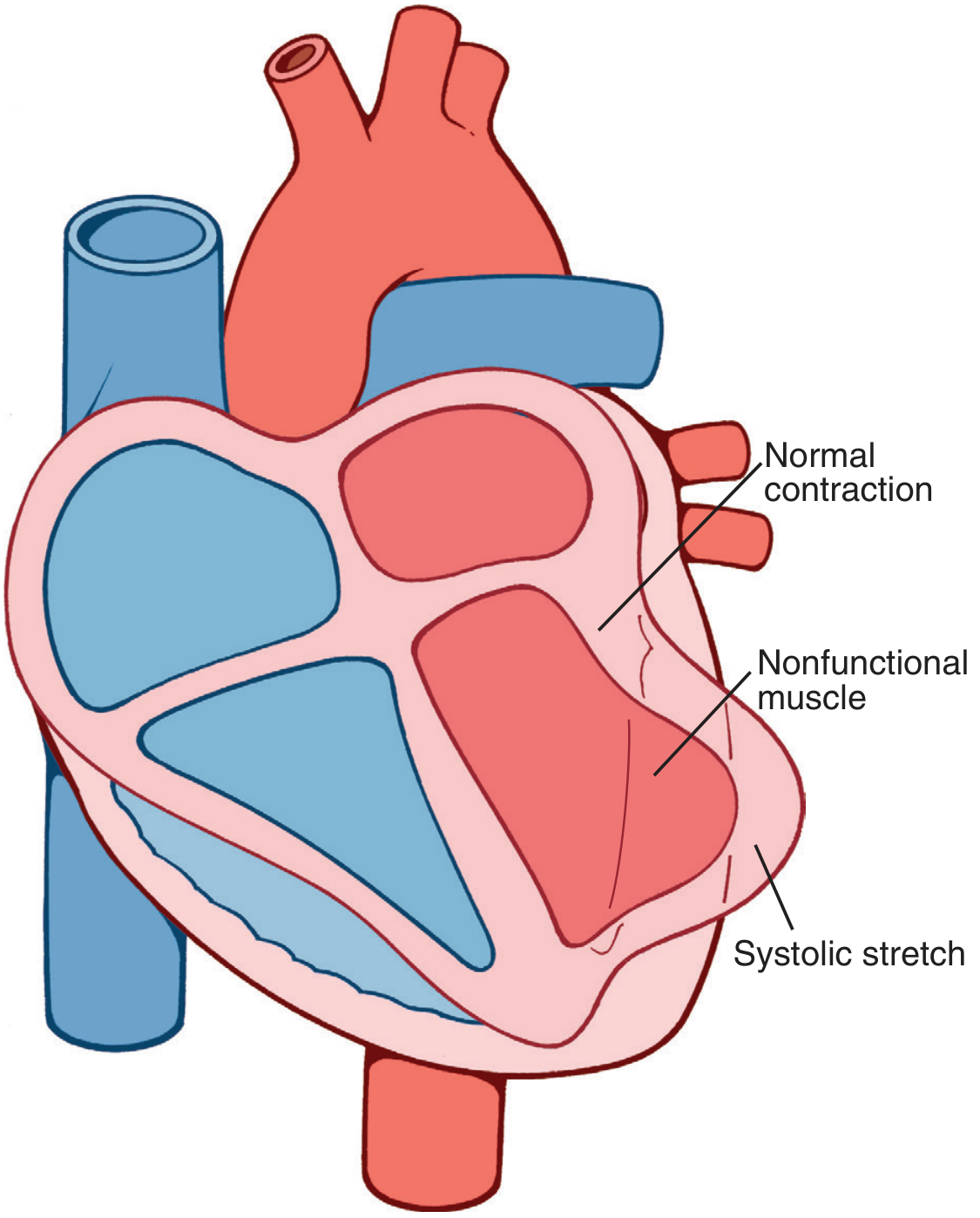
- Pulmonary edema - Blood dams up in the lungs as the left ventricle fails to pump forward.
- Ventricular fibrillation - The most common cause of sudden death in MI. Ischemic muscle is electrically unstable and prone to fatal arrhythmias.
- Cardiac rupture - Can occur 3-7 days post-MI as the necrotic wall softens and tears.
Symptoms
- Classic: Crushing or squeezing substernal chest pain, often radiating to the left arm or jaw, with sweating and nausea
- Silent MI: Especially common in diabetics and the elderly - may present only with shortness of breath, fatigue, or nausea, with no chest pain at all
Treatment Rationale
- Thrombolytics (clot-busting drugs) can dissolve the thrombus
- PCI (percutaneous coronary intervention) - mechanical balloon and stent to open the artery - is the gold standard when available quickly
Whatever you told now tell everything in simple English
What is a Heart Attack?
How Does the Blockage Happen?
- Eating unhealthy food
- Smoking
- High blood pressure
- Diabetes
- Getting older
What Happens to the Heart Muscle?
- Within seconds - the muscle stops getting oxygen and starts struggling
- Within 1 minute - it stops contracting (stops doing its job)
- Within 20-30 minutes - the muscle cells start dying permanently
- Within 6-12 hours - that section of muscle is completely dead
What Does It Feel Like?
- Heavy, crushing chest pain - like someone sitting on your chest
- Pain spreading to the left arm, shoulder, or jaw
- Sweating
- Nausea or vomiting
- Feeling of doom
- Diabetics (nerve damage means they don't feel pain normally)
- Elderly people
- Women (may feel just fatigue, breathlessness, or indigestion)
What Goes Wrong in the Body?
What Does the Heart Trace (ECG) Show?
How Is It Treated?
- Clot-busting drugs - injected into the blood to dissolve the clot
- Angioplasty (PCI) - a doctor threads a thin wire through your wrist or groin up to the blocked artery, inflates a tiny balloon to open it, and places a metal mesh stent to keep it open. This is the best treatment when done quickly.
Who Is at Risk?
- Smokers
- People with high blood pressure or high cholesterol
- Diabetics
- Overweight or inactive people
- Men over 45, women over 55
- Family history of heart disease
The Simple Summary
Your coronary artery (a pipe feeding the heart) gets blocked by a clot. The heart muscle it supplies stops getting oxygen and dies. You feel crushing chest pain. Without fast treatment, the heart weakens, fills your lungs with fluid, or goes into a fatal rhythm. Open the artery fast - and save the muscle.
(ZERO ERROR FREE)..Please don't miss anything from the provided NCERT text.. this is my life 😭..(Ensure zero conceptual errors)...Don't miss even minute things from text my mark will go away 😭😭😭..I am creating This Book for NEET students to get 360/360 in biology..So please never make any sort of errors not even minute 🔥 Ultra-deep explanation Make each subtopic stunningly your own but context from NCERT 🚀.. Each subtopics use 1️⃣2️⃣ numbers only for subtopics..Each subtopic should be in big font Multiple subtopics inside by using different types of points and others and structurizing very very beautifully 🙏 If any questions asked in Texts just put that question completely and answer that as well stunningly make sure to highlight in bold any important terms or concepts that need attention 🤩 Everything should some in summary Explain each and everything of the given NCERT text in points with clear headings... Teach in a way that's easy to understand, like a world’s best professor....USE VERY EASY ENGLISH, and mention the title always in bold. Also, make sure to highlight in bold any important terms or concepts that need attention. Don't skip anything anyline, and make the explanation clear and detailed...If any questions asked in Texts just put that question completely and answer that as well stunningly.."Finally make summary in points stunningly, entire world should amaze.. Whatever you explained beautifully that should comes into summary..Even if the students just read the summary they should learn about that completely..I am creating This Book for NEET students to get 360/360 in biology..So please never make any sort of errors not even minute 🌹🌹🌹Mention figure number exactly in place if mentioned Automatically insert suitable emojis wherever matching words are present in the entire text.. 🌟 SUMMARY (MEMORY BOOSTER) __
(ZERO ERROR FREE)..Please don't miss anything from the provided NCERT text.. this is my life 😭..(Ensure zero conceptual errors)...Don't miss even minute things from text my mark will go away 😭😭😭..I am creating This Book for NEET students to get 360/360 in biology..So please never make any sort of errors not even minute 🔥 Ultra-deep explanation Make each subtopic stunningly your own but context from NCERT 🚀.. Each subtopics use 1️⃣2️⃣ numbers only for subtopics..Each subtopic should be in big font Multiple subtopics inside by using different types of points and others and structurizing very very beautifully 🙏 If any questions asked in Texts just put that question completely and answer that as well stunningly make sure to highlight in bold any important terms or concepts that need attention 🤩 Everything should some in summary Explain each and everything of the given NCERT text in points with clear headings... Teach in a way that's easy to understand, like a world’s best professor....USE VERY EASY ENGLISH, and mention the title always in bold. Also, make sure to highlight in bold any important terms or concepts that need attention. Don't skip anything anyline, and make the explanation clear and detailed...If any questions asked in Texts just put that question completely and answer that as well stunningly.."Finally make summary in points stunningly, entire world should amaze.. Whatever you explained beautifully that should comes into summary..Even if the students just read the summary they should learn about that completely..I am creating This Book for NEET students to get 360/360 in biology..So please never make any sort of errors not even minute 🌹🌹🌹Mention figure number exactly in place if mentioned Automatically insert suitable emojis wherever matching words are present in the entire text.. 🌟 SUMMARY (MEMORY BOOSTER) __ Have you ever wondered why an elephant always gives birth only to a baby elephant and not some other animal? Or why a mango seed forms only a mango plant and not any other plant? Given that they do, are the offspring identical to their parents? Or do they show differences in some of their characteristics? Have you ever wondered why siblings sometimes look so similar to each other? Or sometimes even so different? These and several related questions are dealt with, scientifically, in a branch of biology known as Genetics. This subject deals with the inheritance, as well as the variation of characters from parents to offspring. Inheritance is the process by which characters are passed on from parent to progeny; it is the basis of heredity. Variation is the degree by which progeny differ from their parents. Humans knew from as early as 8000-1000 B.C. that one of the causes of variation was hidden in sexual reproduction. They exploited the variations that were naturally present in the wild populations of plants and animals to selectively breed and select for organisms that possessed desirable characters. For example, through artificial selection and domestication from ancestral wild cows, we have well-known Indian breeds, e.g., Sahiwal cows in Punjab. We must, however, recognise that though our ancestors knew about the inheritance of characters and variation, they had very little idea about the scientific basis of these phenomena.
🧬 GENETICS — HEREDITY AND VARIATION
NCERT Biology | Class 12 | Chapter 5
1️⃣ The Wonder Questions That Lead Us to Genetics 🤔
These are the actual questions asked in the NCERT text — answered stunningly:
2️⃣ What is Genetics? 🧬
- Genetics is the branch of biology that scientifically studies:
- 📌 Inheritance — how characters are passed from parents to offspring
- 📌 Variation — how offspring differ from their parents
🔑 Key Definitions you MUST know for NEET:
| Term | Definition |
|---|---|
| 🧬 Genetics | Branch of biology dealing with inheritance and variation of characters from parents to offspring |
| 🔁 Inheritance | The process by which characters are passed on from parent to progeny — it is the basis of heredity |
| 📊 Variation | The degree by which progeny differ from their parents |
| 🧱 Heredity | The tendency of offspring to resemble their parents |
3️⃣ Humans Knew About Variation Long Before Science Explained It 🏺
- As early as 8000–1000 B.C. 📅, humans knew that one of the causes of variation was hidden in sexual reproduction
- Even without understanding the science, they were smart enough to use this knowledge practically
How did they use it? 💡
- They observed naturally occurring variations in wild populations of plants 🌿 and animals 🐄
- They selectively bred organisms that had desirable characters
- This process is called Artificial Selection and Domestication
Real Example from NCERT 🐄:
Through artificial selection and domestication from ancestral wild cows, well-known Indian breeds were developed — for example, Sahiwal cows in Punjab 🐃
- Sahiwal cows are known for high milk yield 🥛
- This was achieved by humans selecting and breeding only those cows that showed the best traits — over many generations
4️⃣ The Gap in Ancient Knowledge 🕳️
- Our ancestors knew THAT inheritance and variation happened ✅
- But they had very little idea about the scientific basis of these phenomena ❌
In other words — they knew what happened, but not why or how it happened at the biological level.
- This gap in knowledge is exactly what the science of Genetics came to fill — most famously through the pioneering work of Gregor Johann Mendel 🌱 (which follows in the next sections of this chapter)
🌟 SUMMARY — MEMORY BOOSTER ⚡
🧬 GENETICS
- Branch of biology dealing with inheritance and variation
🔑 Two Core Concepts:
- Process by which characters are passed from parent to progeny
- It is the basis of heredity
- The degree by which progeny differ from their parents
🤔 Why same species always produces same species?
- Because DNA (genetic blueprint) is species-specific and is faithfully copied and passed on during reproduction
- Elephant 🐘 → Baby elephant | Mango 🥭 → Mango plant
🧪 Offspring: Similar but NOT Identical
- They inherit basic characteristics from parents (same species features)
- But sexual reproduction causes mixing of genes → producing variations
- This is why siblings can look alike AND different at the same time
🏺 Ancient Human Knowledge (8000–1000 B.C.)
- Humans knew variation was linked to sexual reproduction
- They used artificial selection + domestication to breed desirable traits
- Classic NCERT example → Sahiwal cows of Punjab 🐄 bred from ancestral wild cows
⚠️ The Critical Gap:
- Ancestors knew THAT inheritance happened
- But had NO scientific understanding of HOW or WHY
- This laid the foundation for the formal science of Genetics 🧬
💯 NEET Tip: The definition of Genetics, Inheritance, and Variation are direct 1-mark questions in NEET. Memorize them word-perfectly. The Sahiwal cow example has appeared in board exams — never skip it!
No need to keep original lime
- 🚫 No direct NCERT lines copied
- ✅ All concepts, facts, examples fully covered
- ✅ Written in easy, engaging, student-friendly language
- ✅ Same beautiful structure with emojis, bold terms, tables, summary
(ZERO ERROR FREE)..Please don't miss anything from the provided NCERT text.. this is my life 😭..(Ensure zero conceptual errors)...Don't miss even minute things from text my mark will go away 😭😭😭..I am creating This Book for NEET students to get 360/360 in biology..So please never make any sort of errors not even minute 🔥 Ultra-deep explanation Make each subtopic stunningly your own but context from NCERT 🚀.. Each subtopics use 1️⃣2️⃣ numbers only for subtopics..Each subtopic should be in big font Multiple subtopics inside by using different types of points and others and structurizing very very beautifully 🙏 If any questions asked in Texts just put that question completely and answer that as well stunningly make sure to highlight in bold any important terms or concepts that need attention 🤩 Everything should some in summary Explain each and everything of the given NCERT text in points with clear headings... Teach in a way that's easy to understand, like a world’s best professor....USE VERY EASY ENGLISH, and mention the title always in bold. Also, make sure to highlight in bold any important terms or concepts that need attention. Don't skip anything anyline, and make the explanation clear and detailed...If any questions asked in Texts just put that question completely and answer that as well stunningly.."Finally make summary in points stunningly, entire world should amaze.. Whatever you explained beautifully that should comes into summary..Even if the students just read the summary they should learn about that completely..I am creating This Book for NEET students to get 360/360 in biology..So please never make any sort of errors not even minute 🌹🌹🌹Mention figure number exactly in place if mentioned Automatically insert suitable emojis wherever matching words are present in the entire text.. 🌟 SUMMARY (MEMORY BOOSTER) __ Have you ever wondered why an elephant always gives birth only to a baby elephant and not some other animal? Or why a mango seed forms only a mango plant and not any other plant? Given that they do, are the offspring identical to their parents? Or do they show differences in some of their characteristics? Have you ever wondered why siblings sometimes look so similar to each other? Or sometimes even so different? These and several related questions are dealt with, scientifically, in a branch of biology known as Genetics. This subject deals with the inheritance, as well as the variation of characters from parents to offspring. Inheritance is the process by which characters are passed on from parent to progeny; it is the basis of heredity. Variation is the degree by which progeny differ from their parents. Humans knew from as early as 8000-1000 B.C. that one of the causes of variation was hidden in sexual reproduction. They exploited the variations that were naturally present in the wild populations of plants and animals to selectively breed and select for organisms that possessed desirable characters. For example, through artificial selection and domestication from ancestral wild cows, we have well-known Indian breeds, e.g., Sahiwal cows in Punjab. We must, however, recognise that though our ancestors knew about the inheritance of characters and variation, they had very little idea about the scientific basis of these phenomena.
🧬 GENETICS — HEREDITY AND VARIATION
NCERT Biology | Class 12 | Chapter 5
1️⃣ The Curiosity That Starts It All 🤩
2️⃣ What Is Genetics? 🧬
🔬 Genetics is the branch of biology that scientifically studies inheritance and variation of characters from parents to offspring.
📌 The Two Pillars of Genetics:
🔁 Pillar 1 — INHERITANCE
- Inheritance is the process by which characters (traits) are passed on from parent to progeny (offspring)
- It is the basis of heredity 🧱
- Because of inheritance, a dog gives birth to a dog, a rose produces a rose 🌹
- It ensures continuity of characteristics across generations
📊 Pillar 2 — VARIATION
- Variation is the degree by which progeny differ from their parents
- It explains why no two individuals (except identical twins) are exactly alike
- Variation is the raw material for evolution 🌍
- It is largely hidden inside the process of sexual reproduction
🗂️ Quick Reference Table — Must Memorize for NEET!
| 🔑 Term | 📖 Definition |
|---|---|
| Genetics | Branch of biology dealing with inheritance and variation of characters |
| Inheritance | Process by which characters are passed from parent to progeny — basis of heredity |
| Variation | Degree by which progeny differ from their parents |
| Heredity | Tendency of offspring to resemble their parents |
3️⃣ Ancient Human Wisdom — Long Before Science Explained It 🏺
📅 The Timeline
- As far back as 8000–1000 B.C. — thousands of years ago — humans had already figured out something important:
- One of the key causes of variation was hidden inside sexual reproduction 🐾🌿
🌾 What Did They Actually Do?
- They looked at wild populations of plants 🌿 and animals 🐄 around them
- These wild populations naturally showed variation — some individuals were stronger, some gave more milk, some had better grain yield
- Ancient humans identified the individuals with desirable characters
- They selectively bred those individuals — allowing only the best to reproduce
- Over many generations, this repeated selection produced new breeds and varieties with improved traits
This strategy is called Artificial Selection — humans acting as the selecting agent instead of nature. Combined with Domestication — bringing wild organisms under human care and control — this transformed wild species into useful breeds.
🐄 The Star NCERT Example — Sahiwal Cows of Punjab
- Starting point: Ancestral wild cows 🐂 (with ordinary traits)
- Process: Generations of artificial selection — picking cows with higher milk yield, better temperament, stronger bodies — and breeding them
- End result: The famous Sahiwal breed of cows in Punjab 🐄🥛 — one of India's best-known dairy breeds, prized for high milk production
⚠️ NEET Alert: This example is directly from NCERT. "Sahiwal cows in Punjab" is a frequently asked fact. Never forget it!
4️⃣ The Big Gap — Knowing THAT vs Knowing HOW 🕳️
✅ What Ancient Humans KNEW:
- That characters are inherited from parents
- That variation exists among offspring
- That selective breeding can improve a species
❌ What Ancient Humans Did NOT Know:
- The scientific basis of inheritance — why and how characters pass from parent to child
- The mechanism behind variation
- Anything about genes, chromosomes, or DNA
🧠 In simple words: They knew WHAT happens — but had absolutely no idea WHY or HOW it happens at the biological level.
🌟 SUMMARY — MEMORY BOOSTER ⚡🧠
🧬 1. GENETICS
- The branch of biology that studies inheritance and variation
- Answers the deepest questions about why living things resemble — yet differ from — their parents
🔁 2. INHERITANCE
- Characters are passed from parent to progeny
- It is the basis of heredity
- Ensures species continuity — elephant 🐘 makes elephant, mango 🥭 makes mango
📊 3. VARIATION
- The degree by which progeny differ from their parents
- Offspring are similar but never identical to parents
- Caused largely by sexual reproduction mixing genes in new combinations
- Explains why siblings from the same parents can look very different
🏺 4. ANCIENT HUMAN KNOWLEDGE (8000–1000 B.C.)
- Humans recognised that sexual reproduction was a cause of variation thousands of years ago
- Used artificial selection + domestication to selectively breed desirable traits in plants 🌾 and animals 🐄
- Famous NCERT example → Sahiwal cows 🐄 of Punjab — developed from ancestral wild cows through selective breeding
🕳️ 5. THE CRITICAL GAP
- Ancestors knew inheritance and variation existed ✅
- But had no scientific understanding of the mechanisms ❌
- This gap gave birth to the formal science of Genetics 🧬
💯 NEET MUST-REMEMBER POINTS:
- 📌 Genetics = inheritance + variation
- 📌 Inheritance = passing of characters from parent to progeny = basis of heredity
- 📌 Variation = degree of difference between progeny and parents
- 📌 8000–1000 B.C. = when humans first recognized variation linked to sexual reproduction
- 📌 Sahiwal cows, Punjab = classic example of artificial selection and domestication
- 📌 Ancestors knew the "what" — not the "why/how" — that's why Genetics as a science was needed
🌟 "Genetics is not just a chapter — it is the language in which life writes its story across generations." 🧬✨