
Why rupture of spongy urethra,urine spreads into scrotum but not to the thigh
Reading File
Finding Sources
Finding Sources
Reading File
Finding Sources
Finding Sources
Finding Sources
Finding Sources
Searching the Web
Colles fascia attachments why urine not spread thigh after urethral rupture anatomy
Reading File
Searching Images
Colles fascia attachments urine extravasation spongy urethra rupture scrotum diagram
Now I have all the information needed for a comprehensive answer. Let me also fetch the clinical image of butterfly hematoma pattern.
Loading Image
Here is a thorough anatomical explanation:
Why Urine Spreads into the Scrotum but NOT into the Thigh after Spongy (Bulbar) Urethral Rupture
The answer lies entirely in the attachments and continuities of Colles' fascia (superficial perineal fascia).
The Anatomical Sequence
Step 1 — Rupture site
The spongy (penile/bulbar) urethra is most vulnerable at the bulb, just below the perineal membrane. A straddle injury compresses it against the pubic arch, causing laceration and urine extravasation into the superficial perineal pouch — the space between Colles' fascia (above) and the perineal membrane/muscles (below).
Step 2 — What is Colles' fascia?
Colles' fascia is the membranous (deep) layer of the superficial fascia of the perineum. It is continuous with:
- Superiorly/anteriorly → Scarpa's fascia of the anterior abdominal wall
- Into the penis → Dartos fascia of the penile shaft
- Into the scrotum → Dartos muscle/fascia of the scrotum
Step 3 — The critical attachments that BLOCK spread to the thigh
Colles' fascia has three firm bony/fascial attachments that create a closed compartment:
| Attachment | Direction Blocked |
|---|---|
| Laterally — firmly fused to the ischiopubic rami and then to the fascia lata of the thigh at/below the inguinal ligament | ❌ Prevents lateral spread into the thigh |
| Posteriorly — fused to the posterior margin of the perineal membrane and the perineal body | ❌ Prevents posterior spread into the anal triangle |
| Deep — separated from deep structures by the perineal membrane itself | ❌ Prevents deep spread |
"Colles fascia forms the roof of the superficial perineal space. Laterally, this fascia is firmly attached to the fascia lata of the thigh at the ischiopubic ramus and defines the perineal-thigh crease." — Campbell-Walsh-Wein Urology
Why Urine CAN reach the scrotum (and upward)
Because Colles' fascia is directly continuous with:
- The dartos fascia of the scrotum → urine tracks freely into the scrotal skin
- The dartos fascia of the penile shaft → urine extends along the penis
- Scarpa's fascia of the anterior abdominal wall → urine can track upward to the umbilicus if untreated
Why Urine CANNOT reach the thigh
The lateral attachment of Colles' fascia to the fascia lata along the ischiopubic ramus forms a watertight seal at the perineal-thigh crease. Urine simply cannot cross this fascial fusion line to enter the medial thigh compartment.
Summary Diagram (in words)
URINE EXTRAVASATES INTO SUPERFICIAL PERINEAL POUCH
                        ↓
        Colles' fascia acts as the container
                        ↓
    ┌─────────────────────────────────────┐
    │  OPEN routes (fascial continuity):  │
    │  → Scrotum (dartos)                 │
    │  → Penis (penile dartos fascia)     │
    │  → Anterior abdominal wall (Scarpa) │
    └─────────────────────────────────────┘
    ┌─────────────────────────────────────┐
    │  BLOCKED routes (firm attachments): │
    │  ✗ Thigh – fascia lata fusion       │
    │  ✗ Anal triangle – perineal membrane│
    └─────────────────────────────────────┘
Clinical Appearance — "Butterfly Hematoma"
The resulting swelling produces the classic butterfly-pattern bruising/swelling over the scrotum, perineum, penile shaft, and lower abdominal wall — stopping abruptly at the perineal-thigh crease on each side.
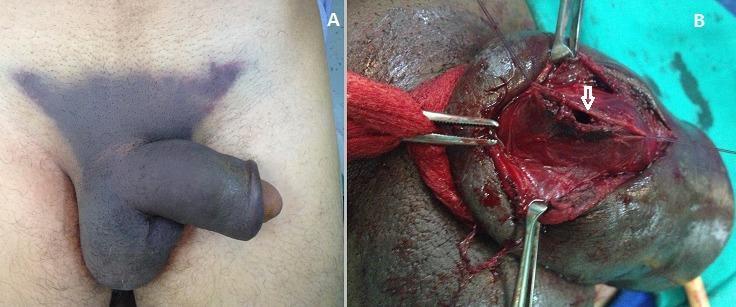
(Panel A shows the classic butterfly ecchymosis pattern — spread to scrotum and perineum but sharply limited at the perineal-thigh crease, exactly as the fascial anatomy predicts.)
Sources:
- Campbell-Walsh-Wein Urology, Perineum section (block 59)
- Smith and Tanagho's General Urology, 19th Ed., Ch. 18 — Anterior urethral injuries, p. 318
- Gray's Anatomy for Students — Deeper layer of superficial fascia (Colles' fascia)
This is a shared conversation. Sign in to Orris to start your own chat.