
Pallor
Reading File
Now let me search the medical library for comprehensive content on pallor.
Now let me read the key textbook sections on pallor for comprehensive content.
Reading File
Reading File
Finding Sources
Now let me get more detailed content on causes and grading of pallor.
Finding Sources
Reading File
I now have comprehensive information to provide a thorough answer on pallor. Let me compile it.
Pallor
Pallor refers to an abnormal paleness or loss of normal skin/mucous membrane color, most commonly due to reduced hemoglobin concentration (anemia) or redistribution of blood away from the periphery.
Definition
Pallor is the clinical sign of paleness resulting from:
- Reduced oxyhemoglobin in superficial blood vessels
- Decreased number of red blood cells
- Reduced blood flow to skin/mucosa (vasoconstriction, shock)
It can affect the skin, mucous membranes, nail beds, conjunctiva, and tongue.
Sites of Examination
Pallor is assessed at multiple anatomical sites, with varying diagnostic utility:
| Site | Clinical Significance |
|---|---|
| Palpebral conjunctiva | Most specific - conjunctival rim pallor has LR+ of 16.7 for anemia |
| Palmar creases | Palmar crease pallor has LR+ of 7.9; failure of creases to redden on finger extension suggests Hb ≤ 7-8 g/dL |
| Nail beds | Less specific (LR+ < 5) |
| Facial skin | Least specific; difficult to assess due to variation in skin pigmentation |
| Tongue / oral mucosa | Used in systemic assessment, especially in thalassemia (diffuse pallor + cyanosis) |
Key point: Pallor of the conjunctival mucosa generally indicates Hb < 9 g/dL. The absence of pallor does NOT rule out anemia - the overall sensitivity and specificity of the physical exam for anemia is only ~70%. - Symptom to Diagnosis, 4th Ed.
How to Examine for Conjunctival Pallor
Conjunctival rim pallor is present when the anterior rim of the inferior palpebral conjunctiva appears the same pale pink color as the deeper posterior aspect, rather than its normal bright red color.
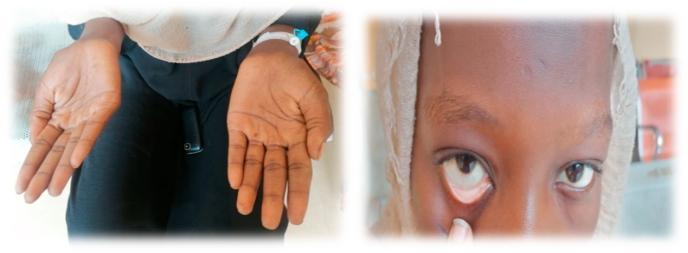
Grading of Pallor (Clinical / IMNCI)
In pediatric IMNCI (Integrated Management of Neonatal and Childhood Illness), palmar pallor is graded:
| Grade | Description | Action |
|---|---|---|
| Severe palmar pallor | Marked blanching of palm | Refer URGENTLY to hospital |
| Some palmar pallor | Partial pallor | Treat with iron; follow up in 14 days |
| No palmar pallor | Normal pink coloring | No anemia; counsel on feeding if < 2 years |
- Park's Textbook of Preventive and Social Medicine
Causes of Pallor
1. Anemia (most common)
Pallor is a cardinal sign of anemia from any cause:
- Blood loss - acute hemorrhage (hypovolemic pallor) or chronic GI blood loss (iron deficiency)
- Decreased production:
- Iron deficiency anemia (most common worldwide)
- Megaloblastic anemia (B12 or folate deficiency)
- Aplastic anemia (fatigue, weakness, pallor, headaches)
- Anemia of chronic disease/inflammation
- Increased destruction (hemolysis):
- Thalassemia (diffuse oral mucosal pallor + cyanosis)
- Sickle cell anemia
- G6PD deficiency
- Autoimmune hemolytic anemia
- Transfusion reactions
2. Non-anemic Causes (reduced peripheral blood flow)
- Shock (hypovolemic, septic, cardiogenic) - vasoconstriction diverts blood to vital organs
- Hypothermia
- Vasovagal syncope - sudden pallor + bradycardia
- Raynaud's phenomenon - episodic digital pallor
- Autonomic instability (e.g., in neuroleptic malignant syndrome - pallor + diaphoresis + tachycardia)
- Cholinesterase inhibitor toxicity (organophosphate poisoning) - mydriasis + pallor
- Chronic lead poisoning - facial pallor, especially perioral
- Anxiety / emotional stress
Associated Symptoms (Anemia-Driven Pallor)
Symptoms reflect reduced oxygen delivery to tissues:
- Fatigue - most common, though non-specific
- Dyspnea on exertion - reduced oxygen-carrying capacity
- Palpitations / tachycardia - compensatory increased cardiac output
- Exertional chest pain - especially with underlying coronary artery disease
- Edema - from decreased renal blood flow causing neurohormonal activation (note: cardiac output is HIGH in anemia, distinguishing it from heart failure)
- Pica - craving non-nutritive substances (ice, clay) - specific for iron deficiency
- Restless leg syndrome - a manifestation of iron deficiency
- Jaundice - if pallor is accompanied by jaundice, suggests hemolysis
- Retinal hemorrhages - in very severe anemia on fundoscopy
- Goldman-Cecil Medicine, International Edition
Diagnostic Approach
| Finding | Next Step |
|---|---|
| Conjunctival rim pallor or palmar crease pallor | Order CBC regardless of symptoms |
| Symptomatic (fatigue, dyspnea, palpitations) without pallor | Still order CBC |
| Pallor + jaundice | Add peripheral smear, LDH, bilirubin (hemolysis screen) |
| Pallor + pica/restless legs | Iron studies (serum iron, ferritin, TIBC) |
| Pallor + shock signs | Emergency stabilization; blood loss workup |
Clinical Pearl: No single physical sign rules out anemia. Always correlate with CBC. Order a CBC if patients have symptoms suggesting anemia, even without physical signs, or if conjunctival rim or palmar crease pallor is observed. - Symptom to Diagnosis, 4th Ed.
Key Numbers to Remember
- Conjunctival pallor: generally indicates Hb < 9 g/dL
- Palmar crease pallor (creases don't redden on extension): suggests Hb ≤ 7-8 g/dL
- Conjunctival rim pallor LR+: 16.7
- Palmar crease pallor LR+: 7.9
- Physical exam sensitivity/specificity for anemia: ~70%
This is a shared conversation. Sign in to Orris to start your own chat.