
Show me portal tract diagram
Reading File
This is a visual/anatomy query. Searching the library for portal tract diagrams now.
Searching sources...
Finding Sources
Finding Sources
Good results. Let me read the Sleisenger section on liver parenchyma organization (which mentions portal tract zones diagram) and the Junqueira histology section, as these are most likely to contain actual diagrams.
Reading File
Reading File
Excellent! Found two great diagrams. Let me fetch both images now.
Loading Image
Loading Image
Here are two authoritative portal tract diagrams from major medical textbooks:
Portal Tract & Liver Architecture Diagrams
Diagram 1 - Liver Architecture Models
(Sleisenger & Fordtran's Gastrointestinal and Liver Disease, Fig. 71.4)
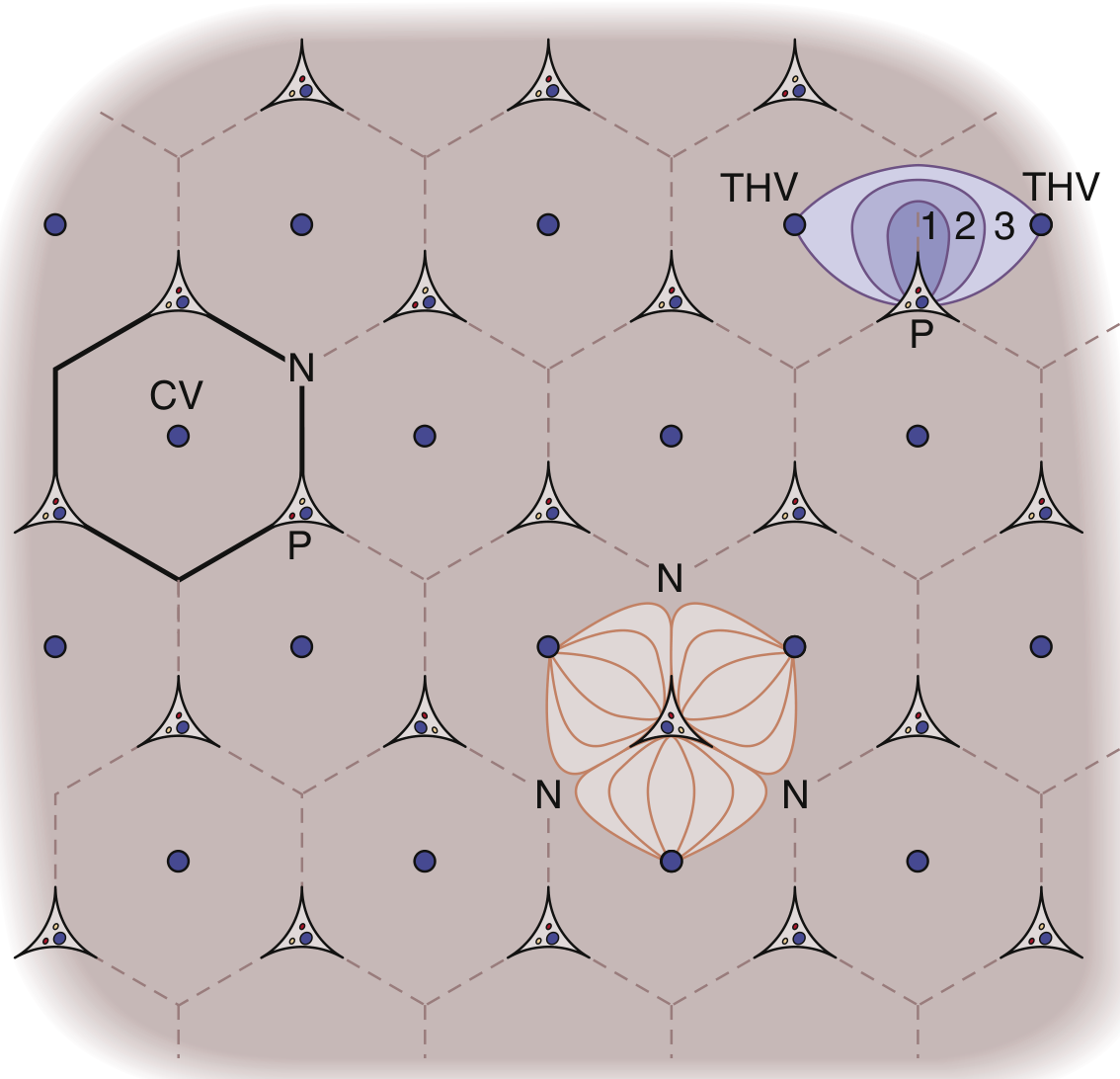
Key: CV = Central vein | P = Portal tract | N = Nodal point | THV = Terminal hepatic venule
- Classic lobule (left, bold hexagon): Portal tracts at 3 corners, central vein at center
- Portal unit (middle, orange): Portal tract at center, central veins at periphery
- Hepatic acinus (upper right, blue oval): Zones 1-2-3 spanning from portal tract (P) to terminal hepatic venule (THV)
Diagram 2 - Three Functional Concepts of Liver Structure
(Junqueira's Basic Histology, 17th Ed., Fig. 16-18)
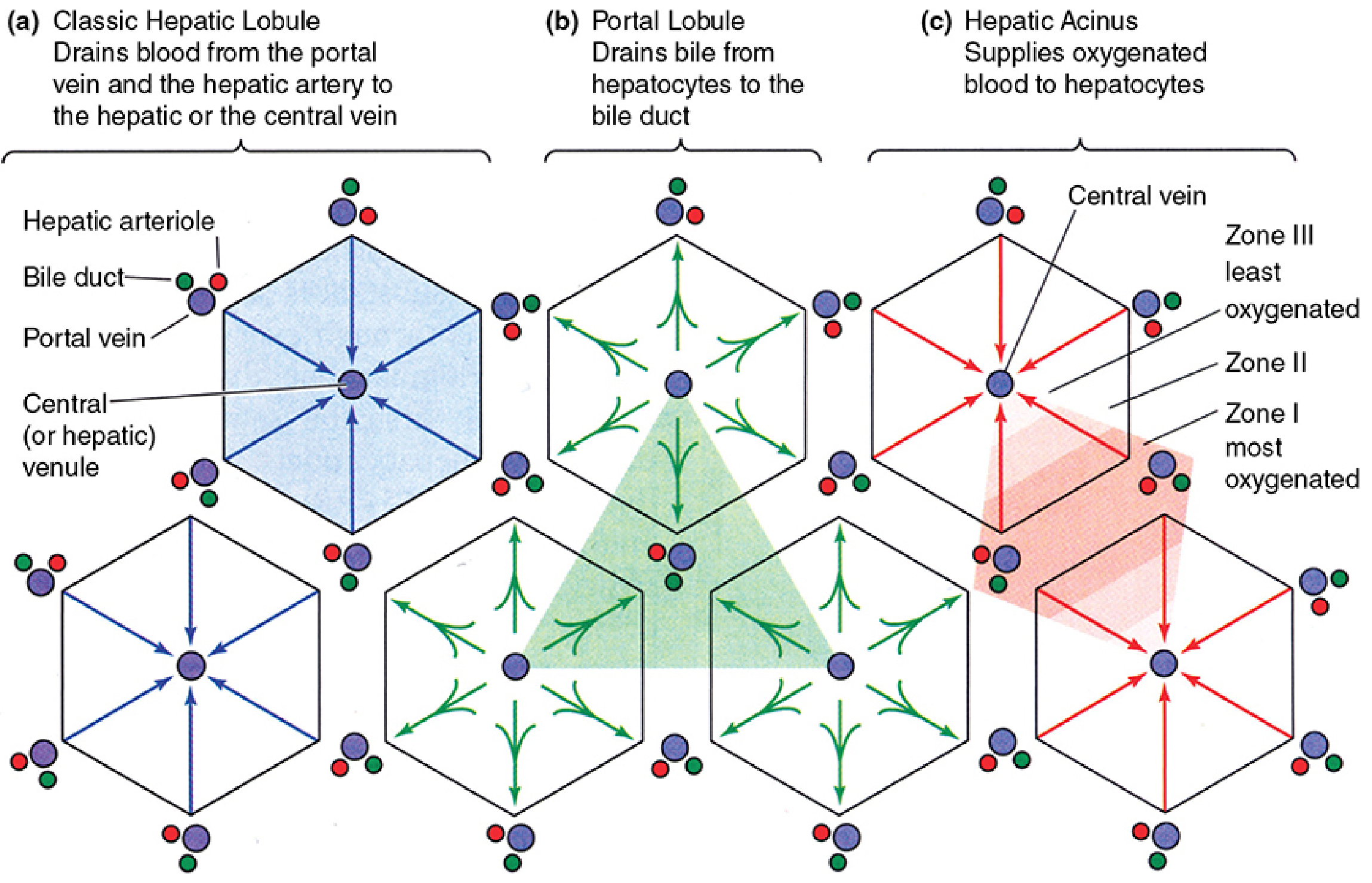
Each portal tract (the cluster of hepatic arteriole + bile duct + portal vein at each corner) is shown as a group of three colored circles:
- Red = hepatic arteriole
- Green = bile duct
- Blue/purple = portal vein / central venule
(a) Classic Hepatic Lobule - hexagonal unit with a central venule at the center; blood flows inward from the portal tracts at the corners
(b) Portal Lobule - triangular unit centered on the bile duct; emphasizes the exocrine (bile secretion) function; bile flows outward from hepatocytes toward the central bile duct
(c) Hepatic Acinus (Rappaport's acinus) - diamond/oval unit spanning two portal tracts and two central veins; highlights the oxygen gradient:
- Zone I (periportal) - most oxygenated; active in oxidative metabolism, protein synthesis
- Zone II (intermediate) - intermediate metabolic activity
- Zone III (perivenular/centrilobular) - least oxygenated; site of fatty accumulation, ischemic necrosis, and drug biotransformation
The portal tract itself contains three key structures (the "portal triad"):
- Branch of the portal vein (largest vessel)
- Branch of the hepatic artery (thicker wall, smaller lumen)
- Bile duct (lined by cuboidal cholangiocytes)
Lymphatics and nerves also travel within the portal tract connective tissue. Blood flows from the portal tract sinusoids toward the central vein; bile flows in the opposite direction, from hepatocytes into canaliculi and then into the bile ductules at the portal tract.
Show me diagram
Could you clarify what diagram you're looking for? There are many possibilities.
Asking for Preferences
What topic should the diagram cover?
Searching the medical library for bile duct anatomy diagrams now.
Searching sources...
Finding Sources
Finding Sources
Good finds. Let me read the Gray's Anatomy and Histology sections for the best anatomy diagrams.
Reading File
Reading File
Two excellent diagrams found. Fetching both now.
Loading Image
Loading Image
Here are two bile duct anatomy diagrams from authoritative textbooks:
Bile Duct Anatomy
Diagram 1 - Bile Drainage System
(Gray's Anatomy for Students, Fig. 4.112)
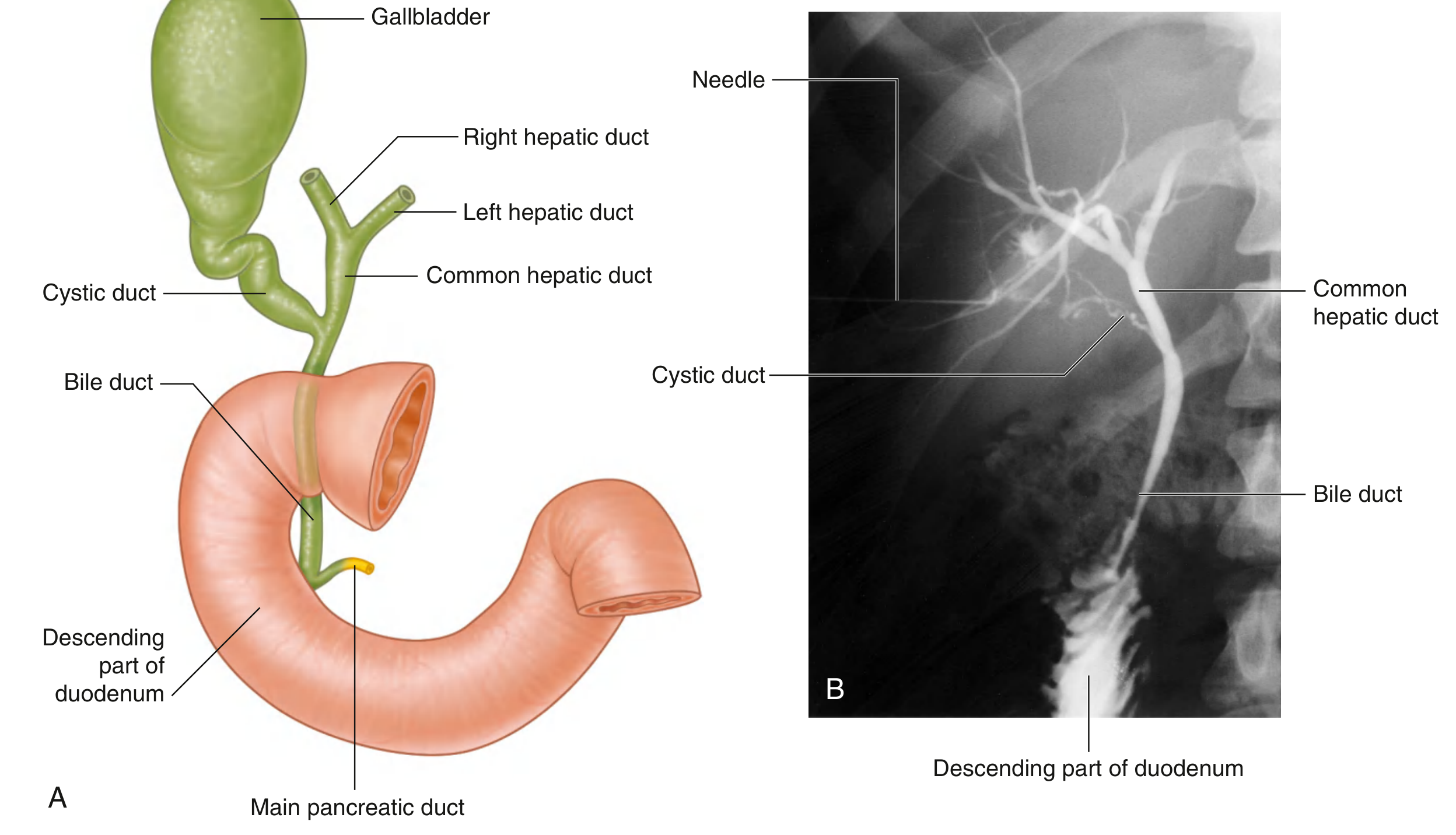
(A) Schematic showing the full duct pathway from liver to duodenum. (B) Percutaneous transhepatic cholangiogram showing the same structures in a real patient.
Bile flow pathway:
Right hepatic duct + Left hepatic duct → Common hepatic duct → joins with cystic duct (from gallbladder) → Common bile duct → joins with main pancreatic duct → enters duodenum at the major duodenal papilla
Diagram 2 - Detailed Biliary & Pancreatic Duct Anatomy
(Histology: A Text and Atlas, Fig. 18.17)
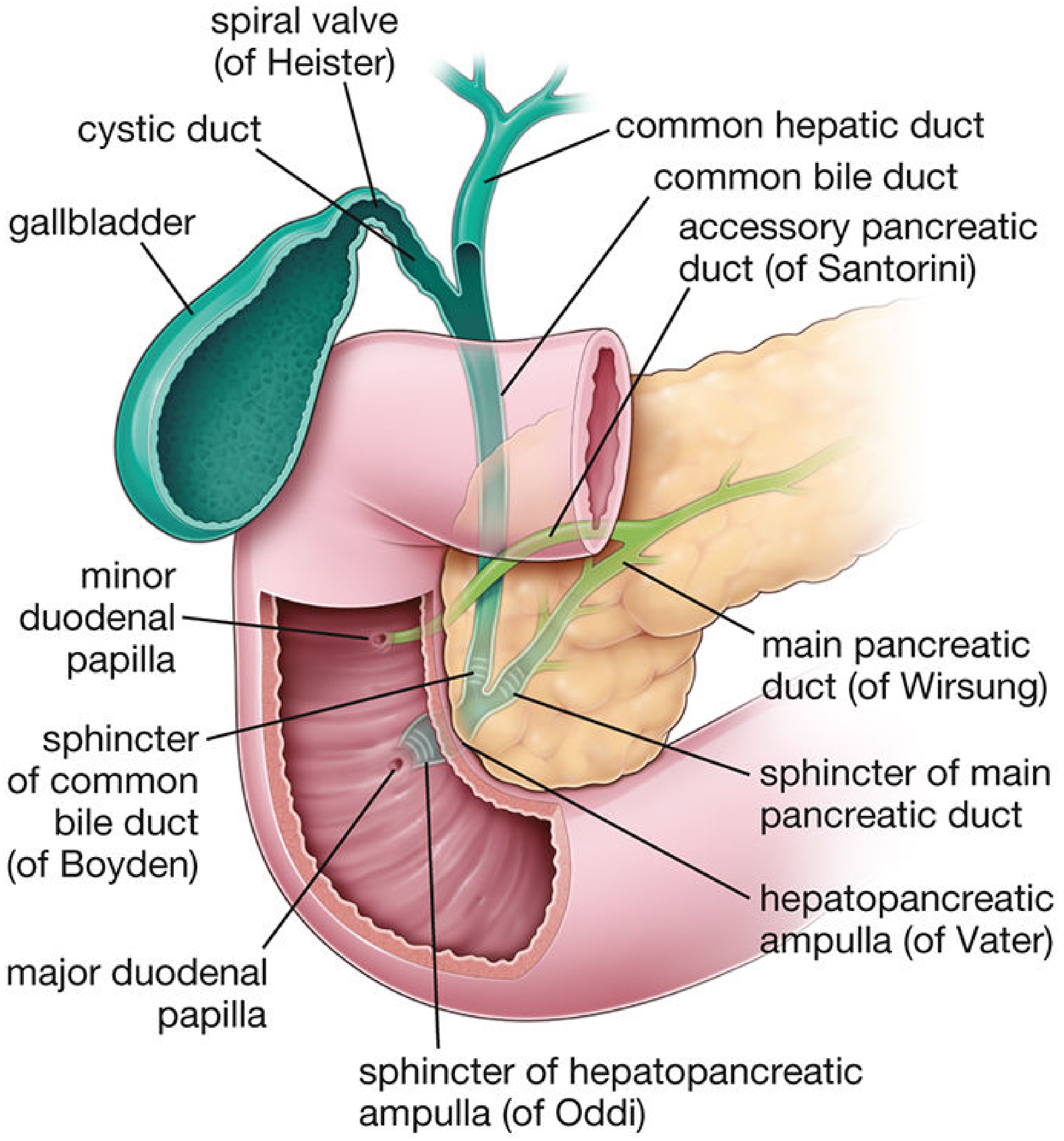
This diagram shows the full system with all named structures:
| Structure | Details |
|---|---|
| Spiral valve (of Heister) | Mucosal folds inside the cystic duct |
| Common hepatic duct | ~3 cm; formed by right + left hepatic ducts at porta hepatis |
| Common bile duct (CBD) | Formed when cystic duct joins common hepatic duct |
| Sphincter of Boyden | Controls flow through the distal common bile duct |
| Main pancreatic duct (of Wirsung) | Runs through the pancreas, joins CBD distally |
| Accessory pancreatic duct (of Santorini) | Drains into minor duodenal papilla |
| Hepatopancreatic ampulla (of Vater) | Junction of CBD + pancreatic duct before entering duodenum |
| Sphincter of Oddi | Surrounds the ampulla; controls bile and pancreatic juice entry into duodenum |
| Major duodenal papilla | Opening into the 2nd part of the duodenum |
When the sphincter of Boyden contracts, bile cannot enter the duodenum and backs up into the gallbladder via the cystic duct for storage and concentration.
This is a shared conversation. Sign in to Orris to start your own chat.