
Make a PowerPoint presentation on the topic palliative care during pandemics
palliative care during pandemics key principles COVID-19 2024
palliative care team patient support comfort
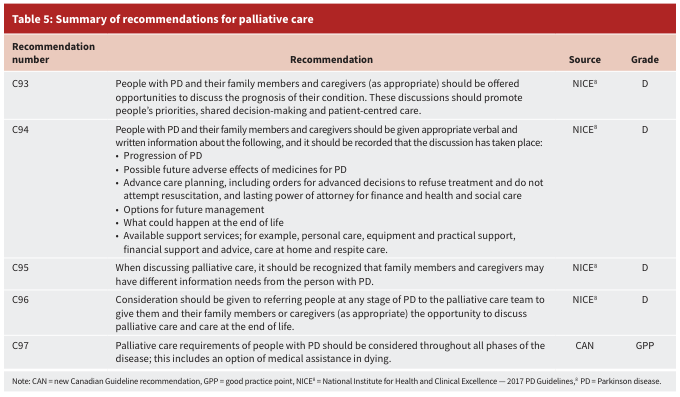
Table 5: Summary of recommendations for palliative care <table><thead><tr><th>Recommendation number</th><th>Recommendation</th><th>Source</th><th>Grade</th></tr></thead><tbody><tr><td>C93</td><td>People with PD and their family members and caregivers (as appropriate) should be offered opportunities to discuss the prognosis of their condition. These discussions should promote people's priorities, shared decision-making and patient-centred care.</td><td>NICE⁸</td><td>D</td></tr><tr><td>C94</td><td>People with PD and their family members and caregivers should be given appropriate verbal and written information about the following, and it should be recorded that the discussion has taken place:<br>• Progression of PD<br>• Possible future adverse effects of medicines for PD<br>• Advance care planning, including orders for advanced decisions to refuse treatment and do not attempt resuscitation, and lasting power of attorney for finance and health and social care<br>• Options for future management<br>• What could happen at the end of life<br>• Available support services; for example, personal care, equipment and practical support, financial support and advice, care at home and respite care.</td><td>NICE⁸</td><td>D</td></tr><tr><td>C95</td><td>When discussing palliative care, it should be recognized that family members and caregivers may have different information needs from the person with PD.</td><td>NICE⁸</td><td>D</td></tr><tr><td>C96</td><td>Consideration should be given to referring people at any stage of PD to the palliative care team to give them and their family members or caregivers (as appropriate) the opportunity to discuss palliative care and care at the end of life.</td><td>NICE⁸</td><td>D</td></tr><tr><td>C97</td><td>Palliative care requirements of people with PD should be considered throughout all phases of the disease; this includes an option of medical assistance in dying.</td><td>CAN</td><td>GPP</td></tr></tbody></table> Note: CAN = new Canadian Guideline recommendation, GPP = good practice point, NICE⁸ = National Institute for Health and Clinical Excellence — 2017 PD Guidelines,⁸ PD = Parkinson disease.
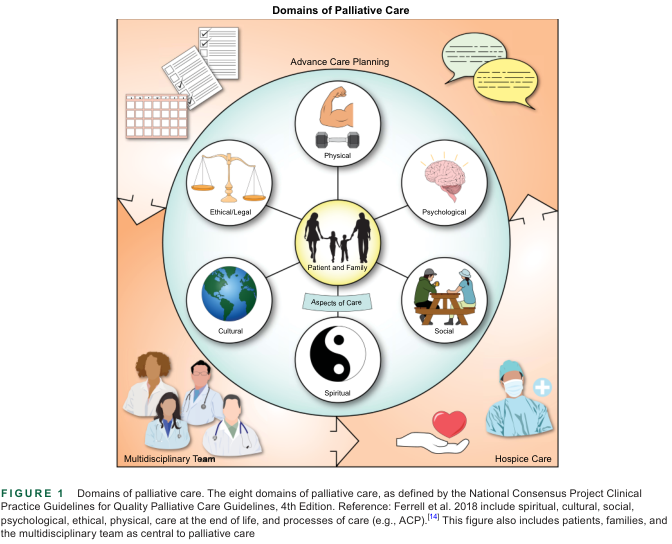
Summary : This figure illustrates the eight domains of palliative care as defined by the National Consensus Project Clinical Practice Guidelines for Quality Palliative Care, 4th Edition. It visually organizes the domains around the central role of the patient and family, and highlights the importance of advance care planning, multidisciplinary teams, and hospice care. illustration: # Central Theme : • Patient and Family are depicted at the center of the diagram, emphasizing their central role in palliative care. # Domains of Palliative Care : • Physical (represented by a flexed arm and dumbbell) • Psychological (represented by a brain) • Social (represented by two people at a picnic table) • Spiritual (represented by a yin-yang symbol) • Cultural (represented by a globe) • Ethical/Legal (represented by a balance scale) • Advance Care Planning (represented by checklists and a calendar) • Aspects of Care (labelled near the center) # Supporting Elements : • Multidisciplinary Team (depicted by illustrated healthcare professionals in the lower left) • Hospice Care (depicted by a healthcare worker, heart-in-hand, and medical cross in the lower right) # Layout : • Circular arrangement with domains radiating from the central patient and family node. • Advance Care Planning and communication bubbles are shown at the top. • Multidisciplinary Team and Hospice Care are shown at the bottom corners, outside the main circle. # Design Encodings : • Each domain is represented by a distinct icon and label. • Soft pastel background with a gradient from peach to white. • Arrows and connectors visually link the domains to the central patient and family. # Caption and Reference : • Figure caption below the image explains the domains and references Ferrill et al. 2018. • Notes that the figure includes patients, families, and the multidisciplinary team as central to palliative care. # Analysis : • The figure emphasizes a holistic, patient- and family-centered approach to palliative care, integrating physical, psychological, social, spiritual, cultural, and ethical/legal domains. • Advance care planning and multidisciplinary teamwork are highlighted as essential processes. • The circular layout visually reinforces the interconnectedness of all domains and the centrality of the patient and family in care decisions.
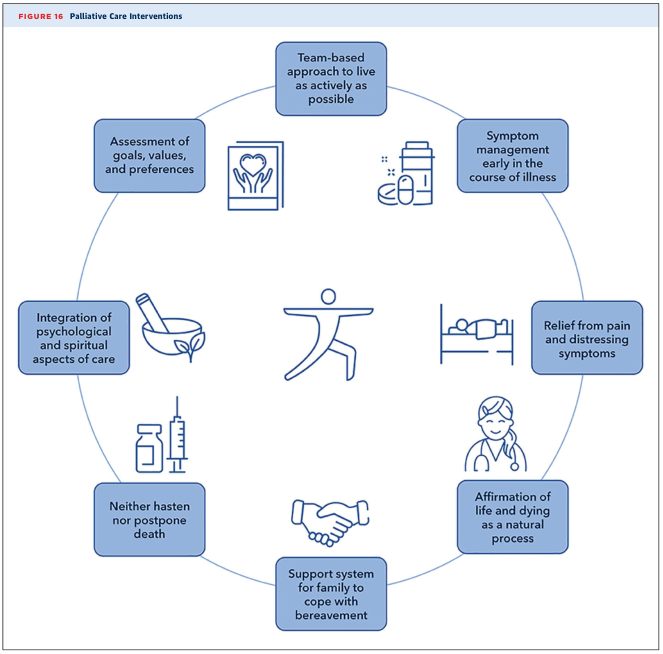
Summary : This figure presents the key interventions and principles of palliative care, organized in a circular diagram to emphasize their interconnectedness and holistic approach. conceptual diagram: # Central Theme : • A stylized human figure in a yoga pose at the center, symbolizing holistic well-being and active living. # Palliative Care Interventions (Nodes) : • Team-based approach to live as actively as possible • Symptom management early in the course of illness • Relief from pain and distressing symptoms • Affirmation of life and dying as a natural process • Support system for family to cope with bereavement • Neither hasten nor postpone death • Integration of psychological and spiritual aspects of care • Assessment of goals, values, and preferences # Layout : • Circular arrangement of eight blue boxes, each with an icon representing the intervention. • Boxes are evenly spaced around the central figure, visually connecting all aspects of care. # Design Encodings : • Blue color scheme for all boxes and icons. • Simple line icons for each intervention (e.g., handshake, medicine, mortar and pestle, bed, heart in hands). • No arrows; the circular layout implies equal importance and interrelation. # Analysis : • The diagram emphasizes that palliative care is multidimensional, involving medical, psychological, spiritual, and family support. • The circular structure suggests that all interventions are equally important and work together to support both patients and families. • The central figure highlights the goal of maintaining quality of life and active living, even in the context of serious illness.
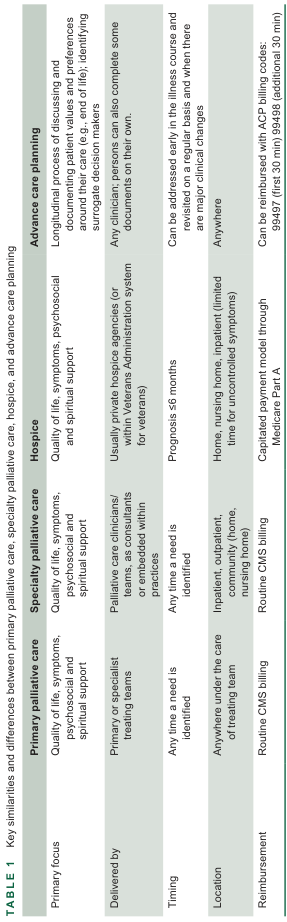
TABLE 1 Key similarities and differences between primary palliative care, specialty palliative care, hospice, and advance care planning <table><thead><tr><th>Primary focus</th><th>Primary palliative care</th><th>Specialty palliative care</th><th>Hospice</th><th>Advance care planning</th></tr></thead><tbody><tr><td>Quality of life, symptoms, psychosocial and spiritual support</td><td>Quality of life, symptoms, psychosocial and spiritual support</td><td>Quality of life, symptoms, psychosocial and spiritual support</td><td>Quality of life, symptoms, psychosocial and spiritual support</td><td>Longitudinal process of discussing and documenting patient values and preferences around their care (e.g., end of life); identifying surrogate decision makers</td></tr><tr><td>Delivered by</td><td>Primary or specialist treating teams</td><td>Palliative care clinicians/ teams, as consultants or embedded within practices</td><td>Usually private hospice agencies (or within Veterans Administration system for veterans)</td><td>Any clinician positions can also complete some documents on their own.</td></tr><tr><td>Timing</td><td>Any time a need is identified</td><td>Any time a need is identified</td><td>Prognosis ≤6 months</td><td>Can be addressed early in the illness course and revisited on a regular basis and when there are major clinical changes</td></tr><tr><td>Location</td><td>Anywhere under the care of treating team</td><td>Inpatient, outpatient, clinic, home, nursing home, time for uncontrolled symptoms)</td><td>Home, nursing home, inpatient (limited time for uncontrolled symptoms)</td><td>Anywhere</td></tr><tr><td>Reimbursement</td><td>Routine CMS billing</td><td>Routine CMS billing</td><td>Capitated payment model through Medicare Part A</td><td>Can be reimbursed with ACP billing codes: 99497 (first 30 min) 99498 (additional 30 min)</td></tr></tbody></table>
pandemic COVID-19 hospital healthcare crisis resource allocation
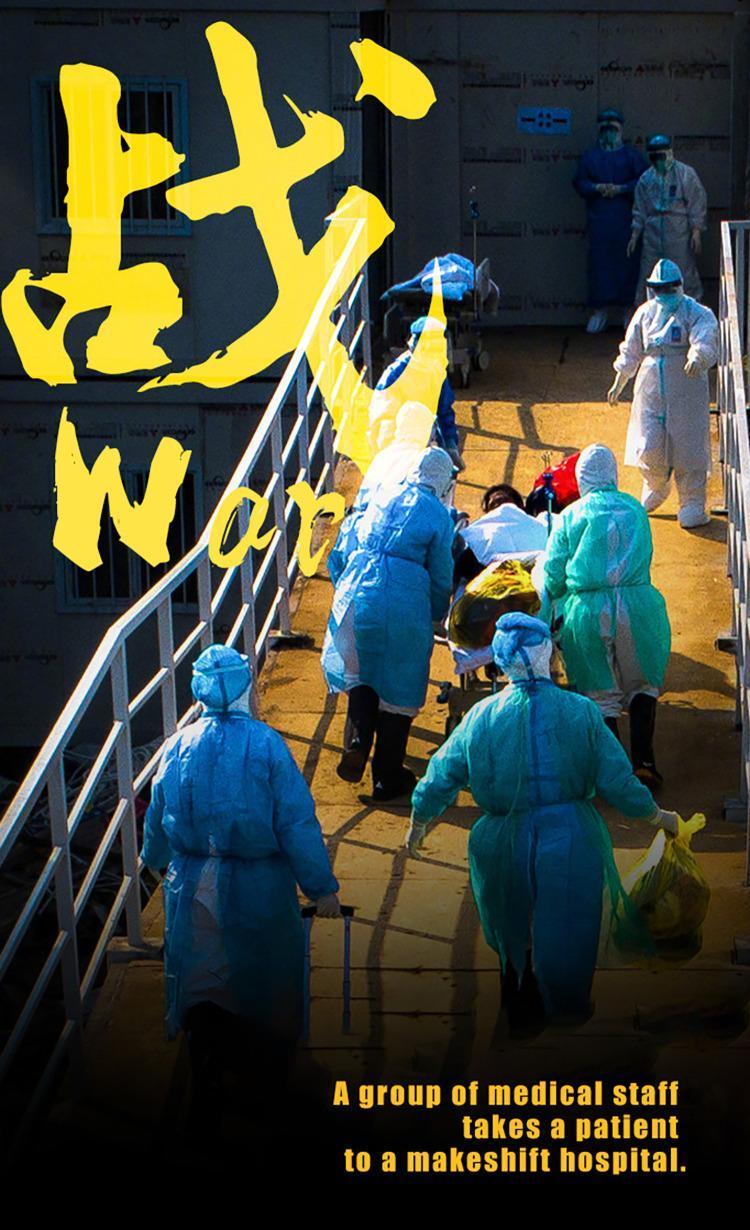
A clinical photograph depicting the transport of a patient during a public health crisis, specifically within the context of the COVID-19 pandemic. The image shows a multi-person medical team dressed in full Personal Protective Equipment (PPE), including disposable gowns, gloves, surgical caps, and respirators. They are maneuvering a patient on a mobile stretcher or gurney up an outdoor ramp toward the entrance of a temporary modular building, identified as a makeshift hospital. The setting reflects emergency medical mobilization and infection control protocols in a high-contagion environment. Stylized yellow text overlays the image, featuring the word 'War' in English and Chinese characters, framing disease treatment as a high-stakes clinical battle. The scene illustrates the logistical and operational aspects of acute patient management, medical team coordination, and the utilization of temporary healthcare infrastructure during an epidemic or pandemic scenario.
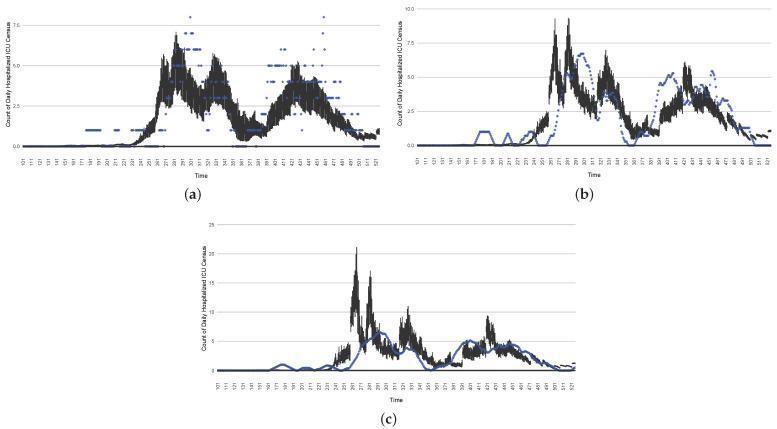
This Comparison Chart consists of three subplots (a, b, and c) illustrating time-series data for COVID-19 healthcare resource utilization. Each graph plots 'Time' on the x-axis against the 'Count of Daily Hospitalized ICU Census' on the y-axis, depicting different projection scales and data smoothing techniques. Subplot (a) shows next-day projection results, represented by a dark shaded boxplot area, compared against individual empirical data points shown as blue dots. Subplot (b) presents 7-day time-window-averaged results, where the empirical data is represented as a blue line and the model projection as a dashed line. Subplot (c) displays 14-day time-window-averaged results, comparing the empirical data (blue line) against jagged projection lines. Clinically, this figure demonstrates the performance of a particle-filtered compartmental model in estimating critical care burden. The progression from scattered points in (a) to smoothed lines in (b) and (c) highlights how time-window averaging can clarify long-term trends in ICU hospitalization counts, which is vital for hospital capacity planning and epidemiological surveillance during a pandemic.
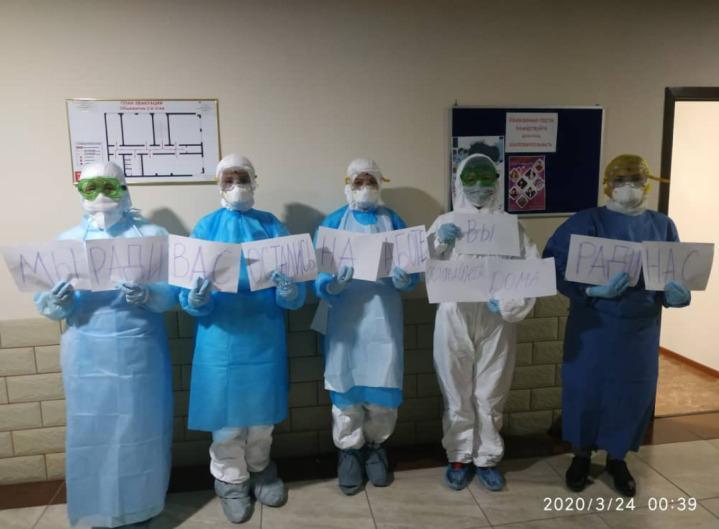
A clinical photograph depicting five healthcare workers in a medical facility during the COVID-19 pandemic, illustrating standard and enhanced personal protective equipment (PPE) protocols. The workers are wearing a variety of PPE configurations, including disposable fluid-resistant gowns in light and dark blue, white full-body coveralls (tyvek suits), surgical caps, and hoods. Essential infection control components visible include N95 or surgical face masks, protective goggles, face shields, and blue nitrile gloves. The photograph is set in a hospital corridor, featuring a wall-mounted evacuation floor plan and a bulletin board in the background. The image serves as a visual record of public health frontline response, highlighting the variability in PPE styles and the utilization of contact and airborne precautions in a clinical setting during a global respiratory viral outbreak.
advance care planning end of life goals of care
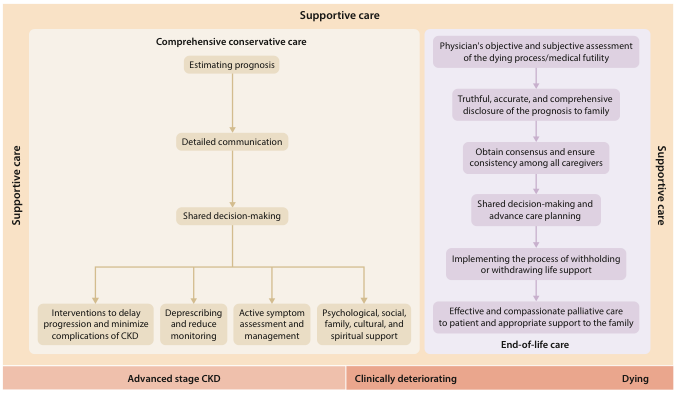
Summary : This figure presents a dual-pathway flowchart outlining supportive care for patients with advanced stage chronic kidney disease (CKD), clinical deterioration, and dying, distinguishing between comprehensive conservative care and end-of-life care processes. flowchart: # Comprehensive Conservative Care Pathway (Left Panel) : Nodes : • Comprehensive conservative care (rectangle) • Estimating prognosis (rectangle) • Detailed communication (rectangle) • Shared decision-making (rectangle) • Interventions to delay progression and minimize complications of CKD (rectangle) • Deprescribing and reduce monitoring (rectangle) • Active symptom assessment and management (rectangle) • Psychological, social, family, cultural, and spiritual support (rectangle) Connectors : • Downward arrows connect each step sequentially: Comprehensive conservative care → Estimating prognosis → Detailed communication → Shared decision-making. • From Shared decision-making, four parallel arrows branch to the four supportive interventions listed above. Layout : • Vertical sequence for initial steps, then horizontal branching to four parallel end-nodes. # End-of-life Care Pathway (Right Panel) : Nodes : • Physician's objective and subjective assessment of the dying process/medical futility (rectangle) • Truthful, accurate, and comprehensive disclosure of the prognosis to family (rectangle) • Obtain consensus and ensure consistency among all caregivers (rectangle) • Shared decision-making and advance care planning (rectangle) • Implementing the process of withholding or withdrawing life support (rectangle) • Effective and compassionate palliative care to patient and appropriate support to the family (rectangle) Connectors : • Downward arrows connect each step sequentially from assessment to palliative care. Layout : • Vertical sequence of six steps, all in a single column. # Timeline and Context : • The bottom of the figure shows a horizontal bar divided into three stages: "Advanced stage CKD" (left, under conservative care), "Clinically deteriorating" (middle), and "Dying" (right, under end-of-life care). • Both pathways are labeled as "Supportive care" on the vertical axis, with "End-of-life care" specifically noted at the bottom of the right panel. # Analysis : • The figure visually distinguishes two main supportive care approaches for CKD patients: a proactive, multi-faceted conservative care pathway for advanced CKD, and a structured, consensus-driven end-of-life care pathway for dying patients. • Both pathways emphasize shared decision-making, communication, and support, but the left focuses on ongoing management and symptom control, while the right centers on palliative measures and family support during the dying process. • The timeline at the bottom clarifies the transition from advanced CKD through clinical deterioration to dying, mapping each care approach to the appropriate disease stage.
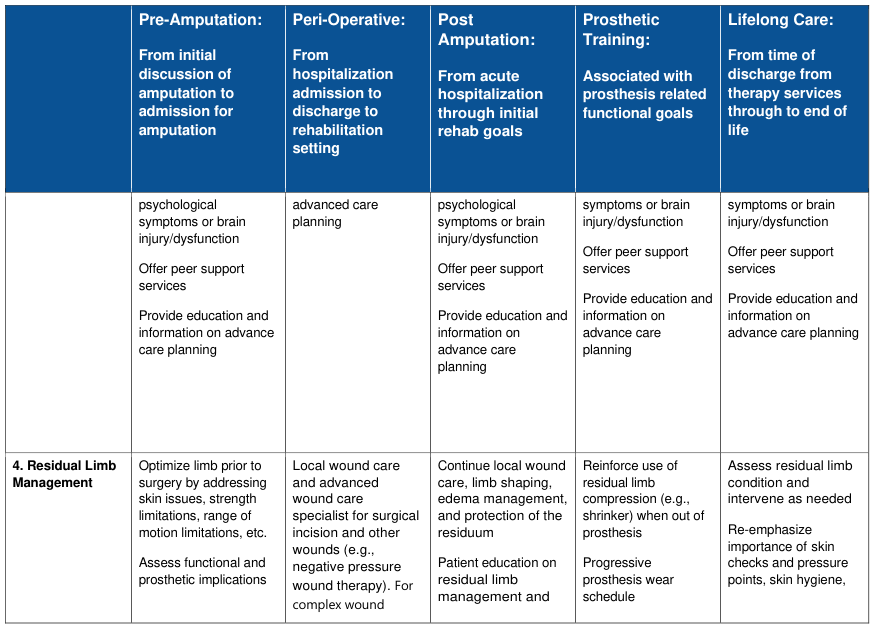
<table><thead><tr><th></th><th>Pre-Amputation: From initial discussion of amputation to admission for amputation</th><th>Peri-Operative: From hospitalization admission to discharge to rehabilitation setting</th><th>Post Amputation: From acute hospitalization through initial rehab goals</th><th>Prosthetic Training: Associated with prosthesis related functional goals</th><th>Lifelong Care: From time of discharge from therapy services through to end of life</th></tr></thead><tbody><tr><td></td><td>psychological symptoms or brain injury/dysfunction<br><br>Offer peer support services<br><br>Provide education and information on advance care planning</td><td>advanced care planning</td><td>psychological symptoms or brain injury/dysfunction<br><br>Offer peer support services<br><br>Provide education and information on advance care planning</td><td>symptoms or brain injury/dysfunction<br><br>Offer peer support services<br><br>Provide education and information on advance care planning</td><td>symptoms or brain injury/dysfunction<br><br>Offer peer support services<br><br>Provide education and information on advance care planning</td></tr><tr><td>4. Residual Limb Management</td><td>Optimize limb prior to surgery by addressing skin issues, strength limitations, range of motion limitations, etc.<br><br>Assess functional and prosthetic implications</td><td>Local wound care and advanced wound care specialist for surgical incision and other wounds (e.g., negative pressure wound therapy). For complex wound</td><td>Continue local wound care, limb shaping, edema management, and protection of the residuum<br><br>Patient education on residual limb management and</td><td>Reinforce use of residual limb compression (e.g., shrinker) when out of prosthesis<br><br>Progressive prosthesis wear schedule</td><td>Assess residual limb condition and intervene as needed<br><br>Re-emphasize importance of skin checks and pressure points, skin hygiene,</td></tr></tbody></table>
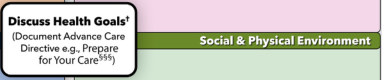
Summary : This image is a segment of a process or workflow diagram related to health care planning, specifically focusing on discussing health goals and documenting advance care directives within the context of the social and physical environment. flowchart: Nodes : • "Discuss Health Goals† (Document Advance Care Directive e.g., Prepare for Your Care§§§)" (rounded rectangle) • "Social & Physical Environment" (horizontal bar, green background) Connectors : • The "Discuss Health Goals" node is visually aligned with the "Social & Physical Environment" bar, suggesting a relationship or context but no explicit arrows or branching are visible in this crop. Layout : • The "Discuss Health Goals" node is positioned to the left, overlapping or adjacent to a horizontal bar labeled "Social & Physical Environment" that spans the width of the image. • The background is divided into two color bands (pink above, green below), with the green band corresponding to the "Social & Physical Environment" label. Analysis : • The diagram segment emphasizes the importance of discussing and documenting health goals (such as advance care directives) within the broader context of a patient's social and physical environment. The visual structure suggests integration of personal health planning with environmental factors, but no decision logic or process flow is fully visible in this crop.
ls -la /tmp/workspace/ 2>/dev/null || mkdir -p /tmp/workspace
mkdir -p /tmp/workspace/palliative-care-pandemic
~/palliative-care-pandemic/build_pptx.py
import subprocess, json, base64
from io import BytesIO
from pptx import Presentation
from pptx.util import Inches, Pt, Emu
from pptx.dml.color import RGBColor
from pptx.enum.text import PP_ALIGN, MSO_ANCHOR

# ── Colour palette ──────────────────────────────────────────────
TEAL_DARK   = RGBColor(0x00, 0x5F, 0x73)   # deep teal
TEAL_MID    = RGBColor(0x00, 0x96, 0x88)   # mid teal
TEAL_LIGHT  = RGBColor(0xE0, 0xF2, 0xF1)   # pale teal
ACCENT      = RGBColor(0xFF, 0x85, 0x00)   # warm amber
WHITE       = RGBColor(0xFF, 0xFF, 0xFF)
DARK_GRAY   = RGBColor(0x21, 0x21, 0x21)
MED_GRAY    = RGBColor(0x55, 0x55, 0x55)
LIGHT_GRAY  = RGBColor(0xF5, 0xF5, 0xF5)
ICON_BG     = RGBColor(0x00, 0x77, 0x7A)

# ── Presentation setup ──────────────────────────────────────────
prs = Presentation()
prs.slide_width  = Inches(13.333)
prs.slide_height = Inches(7.5)
blank = prs.slide_layouts[6]

# ── Helper functions ─────────────────────────────────────────────

def bg(slide, color):
    """Fill slide background with a solid color."""
    from pptx.oxml.ns import qn
    from lxml import etree
    bg_elem = slide.background
    fill = bg_elem.fill
    fill.solid()
    fill.fore_color.rgb = color

def rect(slide, x, y, w, h, color, alpha=None):
    shape = slide.shapes.add_shape(1, Inches(x), Inches(y), Inches(w), Inches(h))
    shape.fill.solid()
    shape.fill.fore_color.rgb = color
    shape.line.fill.background()
    return shape

def textbox(slide, text, x, y, w, h,
            font_name="Calibri", size=18, bold=False, italic=False,
            color=DARK_GRAY, align=PP_ALIGN.LEFT, wrap=True,
            v_anchor=MSO_ANCHOR.TOP):
    tb = slide.shapes.add_textbox(Inches(x), Inches(y), Inches(w), Inches(h))
    tf = tb.text_frame
    tf.word_wrap = wrap
    tf.vertical_anchor = v_anchor
    tf.margin_left = 0; tf.margin_right = 0
    tf.margin_top = 0;  tf.margin_bottom = 0
    p = tf.paragraphs[0]
    p.alignment = align
    r = p.add_run()
    r.text = text
    r.font.name = font_name
    r.font.size = Pt(size)
    r.font.bold = bold
    r.font.italic = italic
    r.font.color.rgb = color
    return tf

def add_para(tf, text, font_name="Calibri", size=16, bold=False,
             color=DARK_GRAY, align=PP_ALIGN.LEFT, space_before=4):
    from pptx.util import Pt
    p = tf.add_paragraph()
    p.alignment = align
    p.space_before = Pt(space_before)
    r = p.add_run()
    r.text = text
    r.font.name = font_name
    r.font.size = Pt(size)
    r.font.bold = bold
    r.font.color.rgb = color
    return p

def bullet_para(tf, text, font_name="Calibri", size=15, color=DARK_GRAY, indent=0, space_before=6):
    from pptx.util import Pt
    p = tf.add_paragraph()
    p.level = indent
    p.space_before = Pt(space_before)
    r = p.add_run()
    r.text = text
    r.font.name = font_name
    r.font.size = Pt(size)
    r.font.color.rgb = color
    return p

def divider(slide, x, y, w, color, thickness=0.04):
    shape = slide.shapes.add_shape(1, Inches(x), Inches(y), Inches(w), Inches(thickness))
    shape.fill.solid()
    shape.fill.fore_color.rgb = color
    shape.line.fill.background()

def icon_box(slide, label, x, y, w=2.0, h=1.1, bg_color=TEAL_DARK, text_color=WHITE):
    rect(slide, x, y, w, h, bg_color)
    tb = slide.shapes.add_textbox(Inches(x+0.08), Inches(y+0.08), Inches(w-0.16), Inches(h-0.16))
    tf = tb.text_frame
    tf.word_wrap = True
    tf.vertical_anchor = MSO_ANCHOR.MIDDLE
    tf.margin_left = 0; tf.margin_right = 0
    tf.margin_top = 0;  tf.margin_bottom = 0
    p = tf.paragraphs[0]
    p.alignment = PP_ALIGN.CENTER
    r = p.add_run()
    r.text = label
    r.font.name = "Calibri"
    r.font.size = Pt(13)
    r.font.bold = True
    r.font.color.rgb = text_color

def fetch_img(url):
    result = json.loads(subprocess.check_output(
        ["python", "/tmp/skills/shared/scripts/fetch_images.py", url]
    ))
    item = result[0]
    if item["base64"]:
        mime, data = item["base64"].split(";base64,", 1)
        return BytesIO(base64.b64decode(data))
    return None

def add_image(slide, url, x, y, w):
    buf = fetch_img(url)
    if buf:
        slide.shapes.add_picture(buf, Inches(x), Inches(y), width=Inches(w))

# ═══════════════════════════════════════════════════════════════
# SLIDE 1 — Title
# ═══════════════════════════════════════════════════════════════
slide = prs.slides.add_slide(blank)
bg(slide, TEAL_DARK)

# Large left accent bar
rect(slide, 0, 0, 0.5, 7.5, ACCENT)

# White content area
rect(slide, 0.5, 0, 12.833, 7.5, TEAL_DARK)

# Bottom strip
rect(slide, 0.5, 6.3, 12.833, 1.2, RGBColor(0x00, 0x48, 0x5A))

# Title
textbox(slide, "Palliative Care", 1.1, 1.4, 11.5, 1.4,
        size=54, bold=True, color=WHITE, align=PP_ALIGN.LEFT)
textbox(slide, "During Pandemics", 1.1, 2.7, 11.5, 1.2,
        size=44, bold=False, color=RGBColor(0xB2, 0xEB, 0xF2), align=PP_ALIGN.LEFT)
divider(slide, 1.1, 4.0, 7.0, ACCENT, thickness=0.06)
textbox(slide, "Principles, Challenges & Compassionate Response", 1.1, 4.25, 11.0, 0.7,
        size=20, italic=True, color=RGBColor(0xE0, 0xF7, 0xFA), align=PP_ALIGN.LEFT)
textbox(slide, "July 2026", 1.1, 6.45, 5.0, 0.5,
        size=14, color=RGBColor(0xB2, 0xEB, 0xF2), align=PP_ALIGN.LEFT)

# ═══════════════════════════════════════════════════════════════
# SLIDE 2 — What is Palliative Care?
# ═══════════════════════════════════════════════════════════════
slide = prs.slides.add_slide(blank)
bg(slide, LIGHT_GRAY)
rect(slide, 0, 0, 13.333, 1.35, TEAL_DARK)

textbox(slide, "What is Palliative Care?", 0.4, 0.2, 12.5, 1.0,
        size=32, bold=True, color=WHITE, align=PP_ALIGN.LEFT)

# Left column - definition
rect(slide, 0.35, 1.55, 6.1, 5.5, WHITE)
tb = slide.shapes.add_textbox(Inches(0.55), Inches(1.75), Inches(5.7), Inches(5.0))
tf = tb.text_frame; tf.word_wrap = True
tf.margin_left = 0; tf.margin_right = 0; tf.margin_top = 0; tf.margin_bottom = 0
p = tf.paragraphs[0]; r = p.add_run()
r.text = "Definition"
r.font.name = "Calibri"; r.font.size = Pt(18); r.font.bold = True; r.font.color.rgb = TEAL_DARK

bullets_def = [
    "A team-based approach to relieve suffering and improve quality of life for patients with serious illness and their families.",
    "Addresses physical, psychological, social, spiritual, cultural, and ethical dimensions of care.",
    "Appropriate at any age and any stage — can run alongside curative treatment.",
    "Recognized as a subspecialty of medicine since 2006.",
    "Explicitly recognized under the human right to health (WHO).",
]
for b in bullets_def:
    add_para(tf, f"• {b}", size=13.5, color=DARK_GRAY, space_before=7)

# Right column - team
rect(slide, 6.85, 1.55, 6.1, 5.5, WHITE)
tb2 = slide.shapes.add_textbox(Inches(7.05), Inches(1.75), Inches(5.7), Inches(5.0))
tf2 = tb2.text_frame; tf2.word_wrap = True
tf2.margin_left = 0; tf2.margin_right = 0; tf2.margin_top = 0; tf2.margin_bottom = 0
p2 = tf2.paragraphs[0]; r2 = p2.add_run()
r2.text = "The Interdisciplinary Team"
r2.font.name = "Calibri"; r2.font.size = Pt(18); r2.font.bold = True; r2.font.color.rgb = TEAL_DARK

team_members = [
    "Physicians & Advanced Practice Nurses",
    "Psychologists & Social Workers",
    "Chaplains & Spiritual Care Providers",
    "Art & Music Therapists",
    "Pharmacists & Physical Therapists",
    "Community Volunteers",
    "Family Members as Partners in Care",
]
for m in team_members:
    add_para(tf2, f"• {m}", size=13.5, color=DARK_GRAY, space_before=7)

# Bottom caption
textbox(slide, "\"Competence by itself is not enough — it must be paired with compassion.\"  — Katherine Foley",
        0.35, 7.1, 12.7, 0.35, size=11, italic=True, color=MED_GRAY, align=PP_ALIGN.CENTER)

# ═══════════════════════════════════════════════════════════════
# SLIDE 3 — Pandemics & Palliative Care: The Intersection
# ═══════════════════════════════════════════════════════════════
slide = prs.slides.add_slide(blank)
bg(slide, WHITE)
rect(slide, 0, 0, 13.333, 1.35, TEAL_MID)
textbox(slide, "Pandemics & Palliative Care: The Intersection", 0.4, 0.2, 12.5, 1.0,
        size=30, bold=True, color=WHITE, align=PP_ALIGN.LEFT)

# Stat callout box
rect(slide, 0.35, 1.55, 3.9, 2.6, TEAL_DARK)
textbox(slide, "+59%", 0.45, 1.7, 3.7, 1.2, size=52, bold=True, color=WHITE, align=PP_ALIGN.CENTER)
textbox(slide, "Increase in palliative care consults in NYC-area hospitals\nduring COVID-19 (pre- vs. early pandemic)",
        0.45, 2.85, 3.7, 0.9, size=11.5, color=RGBColor(0xB2, 0xEB, 0xF2), align=PP_ALIGN.CENTER)

# Points
tb3 = slide.shapes.add_textbox(Inches(4.55), Inches(1.55), Inches(8.5), Inches(5.6))
tf3 = tb3.text_frame; tf3.word_wrap = True
tf3.margin_left = 0; tf3.margin_right = 0; tf3.margin_top = 0; tf3.margin_bottom = 0
p3 = tf3.paragraphs[0]; r3 = p3.add_run()
r3.text = "Why Pandemics Amplify Palliative Care Needs"
r3.font.name = "Calibri"; r3.font.size = Pt(20); r3.font.bold = True; r3.font.color.rgb = TEAL_DARK

intersect_points = [
    "Sudden surge in critically ill patients overwhelms healthcare capacity.",
    "Mass casualty events demand rapid triage and goals-of-care conversations.",
    "Visitor restrictions isolate dying patients from family — increasing emotional suffering.",
    "Shortage of ICU beds forces re-evaluation of treatment goals.",
    "Healthcare workers face moral distress from impossible choices.",
    "Pre-existing palliative care shortages become critically apparent.",
    "Vulnerable populations (elderly, disabled, marginalized) disproportionately affected.",
]
for pt in intersect_points:
    add_para(tf3, f"▸  {pt}", size=14, color=DARK_GRAY, space_before=8)

# Bottom bar
rect(slide, 0, 7.1, 13.333, 0.4, TEAL_LIGHT)
textbox(slide, "Source: Kaplan & Sadock's Comprehensive Textbook of Psychiatry | NYC Hospital Study, 2020",
        0.3, 7.12, 12.5, 0.28, size=10, color=MED_GRAY, align=PP_ALIGN.LEFT)

# ═══════════════════════════════════════════════════════════════
# SLIDE 4 — Key Ethical Principles
# ═══════════════════════════════════════════════════════════════
slide = prs.slides.add_slide(blank)
bg(slide, LIGHT_GRAY)
rect(slide, 0, 0, 13.333, 1.35, TEAL_DARK)
textbox(slide, "Key Ethical Principles During a Pandemic", 0.4, 0.2, 12.5, 1.0,
        size=30, bold=True, color=WHITE, align=PP_ALIGN.LEFT)

principles = [
    ("Human Dignity", "Every patient deserves respectful, humane care regardless of prognosis or resource scarcity."),
    ("Equity & Access", "Palliative care must reach all people — regardless of age, ethnicity, income, or diagnosis."),
    ("Non-Abandonment", "Switching from curative to palliative intent does NOT mean abandoning the patient."),
    ("Transparency", "Honest, compassionate communication about resource constraints and treatment limits."),
    ("Proportionality", "Interventions should match patient goals and values — not simply what technology allows."),
    ("Solidarity", "Society and health systems share responsibility for protecting vulnerable persons."),
]

cols = [(0.35, 1.55), (4.65, 1.55), (8.95, 1.55),
        (0.35, 4.2),  (4.65, 4.2),  (8.95, 4.2)]
for (title, desc), (cx, cy) in zip(principles, cols):
    rect(slide, cx, cy, 3.95, 2.4, WHITE)
    rect(slide, cx, cy, 3.95, 0.5, TEAL_MID)
    textbox(slide, title, cx+0.1, cy+0.05, 3.75, 0.4,
            size=14, bold=True, color=WHITE, align=PP_ALIGN.LEFT)
    textbox(slide, desc, cx+0.12, cy+0.6, 3.71, 1.7,
            size=12.5, color=DARK_GRAY, align=PP_ALIGN.LEFT, wrap=True)

textbox(slide, "Source: International Association for Hospice and Palliative Care | Queensland Health COVID-19 Palliative Care Guidelines, 2024",
        0.3, 7.2, 12.7, 0.28, size=9.5, color=MED_GRAY, align=PP_ALIGN.LEFT)

# ═══════════════════════════════════════════════════════════════
# SLIDE 5 — Challenges to Palliative Care Delivery
# ═══════════════════════════════════════════════════════════════
slide = prs.slides.add_slide(blank)
bg(slide, WHITE)
rect(slide, 0, 0, 13.333, 1.35, RGBColor(0x00, 0x4D, 0x5E))
textbox(slide, "Challenges to Palliative Care Delivery in Pandemics", 0.4, 0.2, 12.5, 1.0,
        size=29, bold=True, color=WHITE, align=PP_ALIGN.LEFT)

challenge_rows = [
    ("System-Level", [
        "Healthcare infrastructure overwhelmed — no space, staff, or supplies",
        "Shortage of trained palliative care specialists (pre-existing gap worsens)",
        "Disconnected IT systems hinder coordinated care",
    ]),
    ("Clinical", [
        "Rapid disease progression leaves little time for goals-of-care conversations",
        "Symptom burden (dyspnea, pain, delirium, anxiety) difficult to manage at scale",
        "Withdrawal of life support decisions complicated by uncertainty",
    ]),
    ("Communication", [
        "Visitor bans prevent family from being present at end of life",
        "PPE impedes empathetic non-verbal communication",
        "Language and cultural barriers remain even in crisis",
    ]),
    ("Psychological", [
        "Moral distress and burnout among healthcare workers",
        "Complicated grief for families unable to perform last rites",
        "Anticipatory grief and anxiety across communities",
    ]),
]

row_y = [1.55, 2.85, 4.15, 5.45]
for (cat, items), ry in zip(challenge_rows, row_y):
    rect(slide, 0.35, ry, 2.2, 1.15, TEAL_DARK)
    textbox(slide, cat, 0.4, ry+0.25, 2.1, 0.65,
            size=14, bold=True, color=WHITE, align=PP_ALIGN.CENTER, v_anchor=MSO_ANCHOR.MIDDLE)
    rect(slide, 2.65, ry, 10.35, 1.15, LIGHT_GRAY)
    txt = "   |   ".join(items)
    textbox(slide, txt, 2.78, ry+0.1, 10.1, 0.95,
            size=12.5, color=DARK_GRAY, align=PP_ALIGN.LEFT, wrap=True)

# ═══════════════════════════════════════════════════════════════
# SLIDE 6 — Symptom Management
# ═══════════════════════════════════════════════════════════════
slide = prs.slides.add_slide(blank)
bg(slide, LIGHT_GRAY)
rect(slide, 0, 0, 13.333, 1.35, TEAL_MID)
textbox(slide, "Symptom Management in Pandemic Palliative Care", 0.4, 0.2, 12.5, 1.0,
        size=30, bold=True, color=WHITE, align=PP_ALIGN.LEFT)

symptoms = [
    ("Dyspnea / Breathlessness", "Low-dose opioids, anxiolytics, fan therapy, positioning. Avoid unnecessary escalation to intubation when not goal-aligned."),
    ("Pain", "Opioid rotation, non-pharmacological adjuncts. In opioid-dependent patients, maintain baseline + titrate for palliation."),
    ("Delirium", "Identify reversible causes; consider low-dose antipsychotics. Minimize restraints; human orientation."),
    ("Anxiety & Psychological Distress", "Benzodiazepines, SSRIs; psychological support; virtual chaplaincy; peer support groups."),
    ("Nausea & Anorexia", "Antiemetics, small frequent meals, appetite stimulants if consistent with goals."),
    ("Existential Suffering", "Dignity therapy, life review, meaning-centred interventions, spiritual care across faiths."),
]

sym_x = [0.35, 4.55, 8.75]
sym_y = [1.55, 4.2]
i = 0
for sy in sym_y:
    for sx in sym_x:
        if i < len(symptoms):
            title, desc = symptoms[i]
            rect(slide, sx, sy, 3.85, 2.5, WHITE)
            rect(slide, sx, sy, 3.85, 0.48, ACCENT)
            textbox(slide, title, sx+0.1, sy+0.04, 3.65, 0.4,
                    size=12.5, bold=True, color=WHITE, align=PP_ALIGN.LEFT)
            textbox(slide, desc, sx+0.12, sy+0.58, 3.62, 1.8,
                    size=12, color=DARK_GRAY, align=PP_ALIGN.LEFT, wrap=True)
            i += 1

# ═══════════════════════════════════════════════════════════════
# SLIDE 7 — Communication & Advance Care Planning
# ═══════════════════════════════════════════════════════════════
slide = prs.slides.add_slide(blank)
bg(slide, WHITE)
rect(slide, 0, 0, 13.333, 1.35, TEAL_DARK)
textbox(slide, "Communication & Advance Care Planning", 0.4, 0.2, 12.5, 1.0,
        size=32, bold=True, color=WHITE, align=PP_ALIGN.LEFT)

# Left panel
rect(slide, 0.35, 1.55, 6.1, 5.6, TEAL_LIGHT)
tb = slide.shapes.add_textbox(Inches(0.55), Inches(1.75), Inches(5.7), Inches(5.2))
tf = tb.text_frame; tf.word_wrap = True
tf.margin_left = 0; tf.margin_right = 0; tf.margin_top = 0; tf.margin_bottom = 0
p = tf.paragraphs[0]; r = p.add_run()
r.text = "Goals-of-Care Conversations"
r.font.name = "Calibri"; r.font.size = Pt(18); r.font.bold = True; r.font.color.rgb = TEAL_DARK

comm_bullets = [
    "Initiate early — before crisis hits. Do not wait for ICU admission.",
    "Explore patient values, fears, and priorities (not just medical preferences).",
    "Use plain language free of jargon.",
    "Acknowledge resource constraints with honesty and compassion.",
    "Reassure patients decisions are never based on their 'worth'.",
    "Document advance directives (DNR/DNAR, healthcare proxy, living will).",
    "Revisit and update as clinical status evolves.",
]
for b in comm_bullets:
    add_para(tf, f"• {b}", size=13, color=DARK_GRAY, space_before=7)

# Right panel
rect(slide, 6.85, 1.55, 6.1, 5.6, WHITE)
tb2 = slide.shapes.add_textbox(Inches(7.05), Inches(1.75), Inches(5.7), Inches(5.2))
tf2 = tb2.text_frame; tf2.word_wrap = True
tf2.margin_left = 0; tf2.margin_right = 0; tf2.margin_top = 0; tf2.margin_bottom = 0
p2 = tf2.paragraphs[0]; r2 = p2.add_run()
r2.text = "Technology & Remote Communication"
r2.font.name = "Calibri"; r2.font.size = Pt(18); r2.font.bold = True; r2.font.color.rgb = TEAL_DARK

tech_bullets = [
    "Video consultations (tablet/phone) to connect isolated patients with family.",
    "Virtual palliative care rounds — reduces PPE usage and exposure.",
    "Telehealth follow-up for home-based and community patients.",
    "Digital advance care planning platforms (e.g. Prepare for Your Care).",
    "Remote bereavement counselling by trained social workers.",
    "Online support groups for bereaved families.",
]
for b in tech_bullets:
    add_para(tf2, f"• {b}", size=13, color=DARK_GRAY, space_before=8)

# ═══════════════════════════════════════════════════════════════
# SLIDE 8 — Special Populations
# ═══════════════════════════════════════════════════════════════
slide = prs.slides.add_slide(blank)
bg(slide, LIGHT_GRAY)
rect(slide, 0, 0, 13.333, 1.35, TEAL_MID)
textbox(slide, "Special & Vulnerable Populations", 0.4, 0.2, 12.5, 1.0,
        size=32, bold=True, color=WHITE, align=PP_ALIGN.LEFT)

pops = [
    ("Elderly & Residential\nAged Care", TEAL_DARK,
     "Highest mortality risk. On-site palliative assessment critical. Facility-specific protocols needed. Early ACP discussions."),
    ("Children & Paediatric\nPalliative Care", RGBColor(0x00, 0x77, 0x8B),
     "Specialist cohort requiring age-appropriate communication. Family-centred care. Sibling/parent support essential."),
    ("Indigenous & Marginalised\nCommunities", RGBColor(0x00, 0x5F, 0x73),
     "Compounded social disadvantage. Cultural safety must be maintained. Community liaison workers needed."),
    ("ICU & Critically Ill\nPatients", RGBColor(0x00, 0x48, 0x5A),
     "Palliative care consults rose 59% in COVID-19 surge. Early integration of PC reduces unwanted aggressive treatment."),
    ("Mental Health &\nSubstance Use Disorders", RGBColor(0x00, 0x6E, 0x7F),
     "Opioid-dependent patients need baseline maintenance + titration for pain. Extra liaison with specialist services."),
    ("Healthcare Workers", ACCENT,
     "Providers face moral distress, burnout, and grief. Peer support, psychological safety, and debriefing programmes essential."),
]

px = [0.35, 4.55, 8.75]
py = [1.55, 4.25]
i = 0
for sy in py:
    for sx in px:
        if i < len(pops):
            title, col, desc = pops[i]
            rect(slide, sx, sy, 3.85, 2.7, WHITE)
            rect(slide, sx, sy, 3.85, 0.55, col)
            textbox(slide, title, sx+0.1, sy+0.04, 3.65, 0.47,
                    size=12, bold=True, color=WHITE, align=PP_ALIGN.LEFT)
            textbox(slide, desc, sx+0.12, sy+0.62, 3.62, 1.9,
                    size=12, color=DARK_GRAY, align=PP_ALIGN.LEFT, wrap=True)
            i += 1

# ═══════════════════════════════════════════════════════════════
# SLIDE 9 — Grief, Bereavement & Psychological Support
# ═══════════════════════════════════════════════════════════════
slide = prs.slides.add_slide(blank)
bg(slide, WHITE)
rect(slide, 0, 0, 13.333, 1.35, TEAL_DARK)
textbox(slide, "Grief, Bereavement & Psychological Support", 0.4, 0.2, 12.5, 1.0,
        size=31, bold=True, color=WHITE, align=PP_ALIGN.LEFT)

# Large left quote box
rect(slide, 0.35, 1.55, 5.7, 3.2, TEAL_LIGHT)
textbox(slide,
        "\"Groups have been helpful to residents and fellows in many guises, including T-groups and journal clubs. Participants have voted with their feet and described improved mood and enriched lives.\"\n\n— Kaplan & Sadock's Comprehensive Textbook of Psychiatry",
        0.55, 1.7, 5.3, 2.9, size=13.5, italic=True, color=TEAL_DARK,
        align=PP_ALIGN.LEFT, wrap=True, v_anchor=MSO_ANCHOR.MIDDLE)

# Right: grief types
rect(slide, 6.45, 1.55, 6.55, 3.2, LIGHT_GRAY)
tb = slide.shapes.add_textbox(Inches(6.65), Inches(1.7), Inches(6.1), Inches(2.9))
tf = tb.text_frame; tf.word_wrap = True
tf.margin_left = 0; tf.margin_right = 0; tf.margin_top = 0; tf.margin_bottom = 0
p = tf.paragraphs[0]; r = p.add_run()
r.text = "Types of Grief in Pandemics"
r.font.name = "Calibri"; r.font.size = Pt(18); r.font.bold = True; r.font.color.rgb = TEAL_DARK
grief_types = [
    ("Anticipatory Grief", "Anxiety and mourning before an expected loss"),
    ("Disenfranchised Grief", "Loss not openly acknowledged — visitor bans prevent goodbyes"),
    ("Complicated Grief", "Prolonged, impairing grief requiring specialist intervention"),
    ("Mass Grief", "Community-wide loss; collective mourning rituals disrupted"),
    ("Moral Injury", "Distress when providers feel they violated core values"),
]
for gt, gd in grief_types:
    p2 = add_para(tf, f"• ", size=13, color=TEAL_DARK, space_before=5)
    r2 = p2.runs[0]
    r2.font.bold = True
    r3 = p2.add_run()
    r3.text = f"{gt}: {gd}"
    r3.font.name = "Calibri"; r3.font.size = Pt(13); r3.font.color.rgb = DARK_GRAY

# Bottom support strategies
rect(slide, 0.35, 4.95, 12.65, 2.2, TEAL_DARK)
textbox(slide, "Bereavement Support Strategies", 0.55, 5.05, 12.2, 0.5,
        size=16, bold=True, color=WHITE, align=PP_ALIGN.LEFT)
strats = ["  • Individual counselling by trained social workers and psychologists",
          "  • Peer support and community-led grief groups",
          "  • Memorial services adapted for infection control (virtual vigils)",
          "  • Occupational/emotional support programmes for frontline staff",
          "  • Culturally sensitive bereavement rituals — even in restricted settings"]
strat_text = "\n".join(strats)
textbox(slide, strat_text, 0.55, 5.55, 12.2, 1.5, size=12.5, color=RGBColor(0xE0, 0xF7, 0xFA),
        align=PP_ALIGN.LEFT, wrap=True)

# ═══════════════════════════════════════════════════════════════
# SLIDE 10 — Equity & Access
# ═══════════════════════════════════════════════════════════════
slide = prs.slides.add_slide(blank)
bg(slide, LIGHT_GRAY)
rect(slide, 0, 0, 13.333, 1.35, TEAL_MID)
textbox(slide, "Health Equity & Access to Palliative Care", 0.4, 0.2, 12.5, 1.0,
        size=31, bold=True, color=WHITE, align=PP_ALIGN.LEFT)

# Three columns
cols_data = [
    ("The Problem", TEAL_DARK, [
        "Palliative care access is deeply unequal globally.",
        "Low- and middle-income countries have fewest resources during surges.",
        "Racial/ethnic minorities face disproportionate pandemic mortality.",
        "Rural populations lack specialists and telemedicine infrastructure.",
        "Disability and age-based discrimination in triage decisions.",
    ]),
    ("The Principles", TEAL_MID, [
        "Universal health coverage must include palliative care as a core service.",
        "Palliative care by its very nature is grounded in health equity.",
        "Financial and social protection for poor and marginalised groups.",
        "Cultural humility — develop trust with diverse communities.",
        "Disaggregate data by race, ethnicity, and socioeconomic status.",
    ]),
    ("Solutions", ACCENT, [
        "Train primary care teams in basic palliative skills.",
        "Integrate PC into community and home-based care models.",
        "Deploy mobile/home-visit palliative teams during surge.",
        "Virtual visits expand reach to underserved populations.",
        "Advocate for equitable resource allocation policies.",
    ]),
]
col_xs = [0.35, 4.55, 8.75]
for (col_title, col_color, items), cx in zip(cols_data, col_xs):
    rect(slide, cx, 1.55, 3.85, 5.6, WHITE)
    rect(slide, cx, 1.55, 3.85, 0.55, col_color)
    textbox(slide, col_title, cx+0.1, 1.6, 3.65, 0.45,
            size=16, bold=True, color=WHITE, align=PP_ALIGN.CENTER)
    tb = slide.shapes.add_textbox(Inches(cx+0.15), Inches(2.2), Inches(3.55), Inches(4.8))
    tf = tb.text_frame; tf.word_wrap = True
    tf.margin_left = 0; tf.margin_right = 0; tf.margin_top = 0; tf.margin_bottom = 0
    p = tf.paragraphs[0]; r = p.add_run(); r.text = ""
    for item in items:
        add_para(tf, f"• {item}", size=12.5, color=DARK_GRAY, space_before=8)

textbox(slide, "Source: CAPC Guidelines | WHO Fact Sheet on Palliative Care | National Consensus Project, 4th Edition",
        0.3, 7.2, 12.7, 0.28, size=9.5, color=MED_GRAY, align=PP_ALIGN.LEFT)

# ═══════════════════════════════════════════════════════════════
# SLIDE 11 — Healthcare Worker Well-being
# ═══════════════════════════════════════════════════════════════
slide = prs.slides.add_slide(blank)
bg(slide, WHITE)
rect(slide, 0, 0, 13.333, 1.35, TEAL_DARK)
textbox(slide, "Healthcare Worker Well-being in Pandemic Palliative Care", 0.4, 0.2, 12.5, 1.0,
        size=27, bold=True, color=WHITE, align=PP_ALIGN.LEFT)

# Left column
rect(slide, 0.35, 1.55, 5.9, 5.6, LIGHT_GRAY)
tb = slide.shapes.add_textbox(Inches(0.55), Inches(1.75), Inches(5.5), Inches(5.2))
tf = tb.text_frame; tf.word_wrap = True
tf.margin_left = 0; tf.margin_right = 0; tf.margin_top = 0; tf.margin_bottom = 0
p = tf.paragraphs[0]; r = p.add_run()
r.text = "The Burden on Providers"
r.font.name = "Calibri"; r.font.size = Pt(18); r.font.bold = True; r.font.color.rgb = TEAL_DARK
burden_items = [
    "Repeated traumatic exposure to death and dying.",
    "Decision fatigue from endless triage choices in resource scarcity.",
    "Guilt and moral injury from decisions that feel ethically compromising.",
    "Isolation — PPE, shift patterns, and pandemic restrictions reduce peer contact.",
    "Fear of personal infection or transmitting illness to family.",
    "Grief for colleagues, patients, and communities.",
    "Post-traumatic stress disorder (PTSD) — elevated rates in ICU/palliative staff post-pandemic.",
]
for b in burden_items:
    add_para(tf, f"• {b}", size=13, color=DARK_GRAY, space_before=7)

# Right column
rect(slide, 6.65, 1.55, 6.3, 5.6, TEAL_LIGHT)
tb2 = slide.shapes.add_textbox(Inches(6.85), Inches(1.75), Inches(5.9), Inches(5.2))
tf2 = tb2.text_frame; tf2.word_wrap = True
tf2.margin_left = 0; tf2.margin_right = 0; tf2.margin_top = 0; tf2.margin_bottom = 0
p2 = tf2.paragraphs[0]; r2 = p2.add_run()
r2.text = "Supporting the Providers"
r2.font.name = "Calibri"; r2.font.size = Pt(18); r2.font.bold = True; r2.font.color.rgb = TEAL_DARK
support_items = [
    "Structured psychological debriefs after difficult patient events.",
    "Access to mental health support — proactive, not reactive.",
    "Peer support programmes and mentoring circles.",
    "Regular supervision for palliative care specialists.",
    "Meaningful recognition of emotional and moral work.",
    "Education: communication skills, ethics, self-care.",
    "Protected time away from direct patient care during surges.",
    "Institutional policies that create psychologically safe workplaces.",
]
for b in support_items:
    add_para(tf2, f"• {b}", size=13, color=DARK_GRAY, space_before=6)

# ═══════════════════════════════════════════════════════════════
# SLIDE 12 — Lessons from COVID-19
# ═══════════════════════════════════════════════════════════════
slide = prs.slides.add_slide(blank)
bg(slide, LIGHT_GRAY)
rect(slide, 0, 0, 13.333, 1.35, RGBColor(0x00, 0x4D, 0x5E))
textbox(slide, "Lessons Learned from COVID-19", 0.4, 0.2, 12.5, 1.0,
        size=33, bold=True, color=WHITE, align=PP_ALIGN.LEFT)

lessons = [
    ("01", "Integrate Early", "Palliative care embedded from the moment of serious diagnosis — not as a last resort."),
    ("02", "Build the Workforce", "Chronic shortage of palliative specialists must be addressed inter-pandemic."),
    ("03", "Harness Technology", "Telehealth and virtual visits proved viable and must be standardised."),
    ("04", "Plan Ahead", "Population-level advance care planning should be normalised before the next pandemic."),
    ("05", "Protect Equity", "Pandemic responses must actively counteract structural inequities in care access."),
    ("06", "Care for Carers", "Healthcare worker mental health is a public health priority, not an afterthought."),
]

lx = [0.35, 4.55, 8.75]
ly = [1.55, 4.3]
i = 0
for sy in ly:
    for sx in lx:
        if i < len(lessons):
            num, title, desc = lessons[i]
            rect(slide, sx, sy, 3.85, 2.6, WHITE)
            rect(slide, sx, sy, 0.75, 2.6, TEAL_MID)
            textbox(slide, num, sx+0.05, sy+0.85, 0.65, 0.9,
                    size=22, bold=True, color=WHITE, align=PP_ALIGN.CENTER)
            textbox(slide, title, sx+0.88, sy+0.2, 2.85, 0.55,
                    size=14, bold=True, color=TEAL_DARK, align=PP_ALIGN.LEFT)
            textbox(slide, desc, sx+0.88, sy+0.82, 2.85, 1.65,
                    size=12, color=DARK_GRAY, align=PP_ALIGN.LEFT, wrap=True)
            i += 1

# ═══════════════════════════════════════════════════════════════
# SLIDE 13 — Key Recommendations
# ═══════════════════════════════════════════════════════════════
slide = prs.slides.add_slide(blank)
bg(slide, WHITE)
rect(slide, 0, 0, 13.333, 1.35, TEAL_DARK)
textbox(slide, "Key Recommendations for Pandemic Preparedness", 0.4, 0.2, 12.5, 1.0,
        size=30, bold=True, color=WHITE, align=PP_ALIGN.LEFT)

recs = [
    "Develop and maintain a national Pandemic Palliative Care Plan — including triage protocols, ethical frameworks, and staffing contingencies.",
    "Train ALL frontline clinicians in primary palliative care skills: symptom management, goals-of-care communication, and bereavement basics.",
    "Establish rapid-deployment specialist palliative care teams that can be mobilised to surge sites.",
    "Mandate advance care planning conversations for at-risk populations as part of routine pre-pandemic healthcare.",
    "Protect opioid and sedative supply chains — these are essential palliative medicines, not luxuries.",
    "Create standardised PPE-compatible communication protocols for end-of-life settings.",
    "Fund community-based bereavement services capable of scaling during mass casualty events.",
    "Collect and report disaggregated outcomes data to identify and address inequities in palliative care access.",
]

tb = slide.shapes.add_textbox(Inches(0.5), Inches(1.6), Inches(12.4), Inches(5.7))
tf = tb.text_frame; tf.word_wrap = True
tf.margin_left = 0; tf.margin_right = 0; tf.margin_top = 0; tf.margin_bottom = 0
p = tf.paragraphs[0]; r = p.add_run(); r.text = ""
for i, rec in enumerate(recs, 1):
    add_para(tf, f"{i}.  {rec}", size=14, color=DARK_GRAY, space_before=9)

rect(slide, 0, 7.08, 13.333, 0.42, TEAL_LIGHT)
textbox(slide, "Sources: WHO Palliative Care Fact Sheet | Queensland Health COVID-19 Palliative Care Guidelines 2024 | CAPC | NCP Clinical Practice Guidelines 4th Edition",
        0.3, 7.12, 12.8, 0.28, size=9.5, color=MED_GRAY, align=PP_ALIGN.LEFT)

# ═══════════════════════════════════════════════════════════════
# SLIDE 14 — Closing / Summary
# ═══════════════════════════════════════════════════════════════
slide = prs.slides.add_slide(blank)
bg(slide, TEAL_DARK)
rect(slide, 0, 0, 0.5, 7.5, ACCENT)
rect(slide, 12.833, 0, 0.5, 7.5, ACCENT)

textbox(slide, "Summary", 1.0, 0.7, 11.3, 1.0,
        size=38, bold=True, color=WHITE, align=PP_ALIGN.CENTER)
divider(slide, 2.0, 1.65, 9.333, WHITE, thickness=0.05)

summary_points = [
    "Palliative care is essential — not optional — in pandemic response.",
    "COVID-19 exposed the cost of under-resourced, inequitable palliative systems.",
    "Early integration, honest communication, and ethical frameworks save lives and reduce suffering.",
    "Protecting healthcare workers is inseparable from protecting patients.",
    "The next pandemic will come. Preparing palliative care capacity now is a moral imperative.",
]

tb = slide.shapes.add_textbox(Inches(1.5), Inches(2.0), Inches(10.3), Inches(4.5))
tf = tb.text_frame; tf.word_wrap = True
tf.margin_left = 0; tf.margin_right = 0; tf.margin_top = 0; tf.margin_bottom = 0
p = tf.paragraphs[0]; r = p.add_run(); r.text = ""
for pt in summary_points:
    add_para(tf, f"✦  {pt}", size=16, color=RGBColor(0xE0, 0xF7, 0xFA), space_before=14)

textbox(slide,
        "\"Palliative care is explicitly recognized under the human right to health.\" — WHO",
        1.0, 6.5, 11.3, 0.6, size=13.5, italic=True,
        color=RGBColor(0xB2, 0xEB, 0xF2), align=PP_ALIGN.CENTER)

# ─── Save ──────────────────────────────────────────────────────
out_path = "/tmp/workspace/palliative-care-pandemic/Palliative_Care_During_Pandemics.pptx"
buf = BytesIO()
prs.save(buf)
with open(out_path, "wb") as f:
    f.write(buf.getvalue())
print(f"Saved: {out_path}")
cd /tmp/workspace/palliative-care-pandemic && python build_pptx.py 2>&1
ls -lh /tmp/workspace/palliative-care-pandemic/Palliative_Care_During_Pandemics.pptx
Palliative Care During Pandemics
Presentation · PPTX
| # | Slide | Key Content |
|---|---|---|
| 1 | Title | "Palliative Care During Pandemics" — full-bleed design |
| 2 | What is Palliative Care? | Definition, the interdisciplinary team, Foley quote |
| 3 | Pandemics & Palliative Care | Stat callout: +59% consults during COVID-19 (NYC hospitals); 7 intersection points |
| 4 | Key Ethical Principles | Human Dignity, Equity, Non-Abandonment, Transparency, Proportionality, Solidarity |
| 5 | Challenges to Delivery | System, clinical, communication, and psychological barriers |
| 6 | Symptom Management | Dyspnea, pain, delirium, anxiety, nausea, existential suffering |
| 7 | Communication & ACP | Goals-of-care conversations, advance directives, telehealth tools |
| 8 | Special Populations | Elderly, children, indigenous/marginalised, ICU, mental health/SUD, HCWs |
| 9 | Grief & Bereavement | Types of pandemic grief; bereavement support strategies |
| 10 | Health Equity & Access | The problem, principles, and solutions (3-column layout) |
| 11 | HCW Well-being | Burden on providers; structured support strategies |
| 12 | Lessons from COVID-19 | 6 numbered lessons in a grid layout |
| 13 | Recommendations | 8 actionable recommendations for pandemic preparedness |
| 14 | Summary / Closing | 5 key takeaways; closing WHO quote on palliative care as a human right |