
Second gas effect on detail
The second gas effect is a pharmacological phenomenon in inhalational anaesthesia. Briefly:
When a large volume of a first gas (typically N₂O) is rapidly absorbed from the alveoli, it creates a "concentrating effect" on any second gas (e.g., a volatile anaesthetic like halothane/sevoflurane) present alongside it. This accelerates the uptake of the second gas beyond what its partial pressure alone would predict, speeding induction.
Searching sources...
Reading File
Finding Sources
Searching PubMed
"second gas effect" nitrous oxide anaesthesia
Good hits. Let me read the dedicated sections from Barash and Miller now, and also fetch the figure.
Reading File
Reading File
Reading File
Now let me also read the Miller section a bit further to capture their full explanation, and get the Goodman & Gilman passage, plus fetch the Barash figure:
Reading File
Reading File
Loading Image
I now have comprehensive information from multiple textbooks and the figure. Here is the detailed explanation:
Second Gas Effect - Detailed Explanation
Definition
The second gas effect is a special case of the concentration effect that occurs when a potent volatile anaesthetic (the "second gas") is administered simultaneously with a high concentration of N₂O (the "first gas"). The rapid, large-volume uptake of N₂O from the alveoli concentrates the co-administered volatile agent in the alveolus, raising its alveolar partial pressure (FA) faster than it would rise on its own.
- Barash, Clinical Anesthesia, 9e, p. 1395
Prerequisite: Understanding the Concentration Effect
To understand the second gas effect, the concentration effect must be understood first.
When a gas is present at a high alveolar concentration, its rapid uptake into blood reduces the total alveolar gas volume. This reduction has two consequences:
- Concentrating effect: The remaining gas is compressed into a smaller volume, so its fractional concentration rises above what simple uptake would predict.
- Augmented gas inflow: As alveolar gas is absorbed, fresh gas at the original inspired fraction (FI) flows in to replace it, further augmenting the alveolar concentration.
These two mechanisms together mean a higher FA/FI ratio is achieved faster for a gas at high concentration - this is the concentration effect. It is most prominent with N₂O because N₂O is administered at very high concentrations (50-70%).
- Barash, Clinical Anesthesia, 9e, p. 1394
Mechanism of the Second Gas Effect
When a potent volatile agent (e.g., 2% sevoflurane) is administered alongside 70% N₂O:
- N₂O, due to its very high partial pressure gradient and large administered volume, is taken up rapidly from the alveoli into blood - at a rate of ~1550 mL/min in a typical patient.
- This massive N₂O absorption shrinks the total alveolar gas volume dramatically.
- The volatile agent (present at a small fraction, e.g. 2%) is now dissolved in a smaller total gas volume, so its fractional concentration rises - for example from 2% to ~3.1%.
- Simultaneously, fresh gas continues to flow from the breathing circuit into the alveoli (augmented inflow), and this fresh gas still contains the volatile agent at the set vaporizer concentration - further boosting alveolar levels.
Net result: The alveolar partial pressure of the second gas rises faster than it would if N₂O were absent, speeding its diffusion into blood and then the CNS.
Worked example (from Barash):
-
Administer 2% potent agent + 70% N₂O + 28% O₂
-
N₂O uptake reduces alveolar N₂O from 70% by 50% (35 parts absorbed)
-
Remaining alveolar mix: 35 parts N₂O + 28 parts O₂ + 2 parts agent = 65 parts total
-
New alveolar concentration of agent = 2/65 = 3.1% (up from 2%)
-
Barash, Clinical Anesthesia, 9e, p. 1395
The Figure
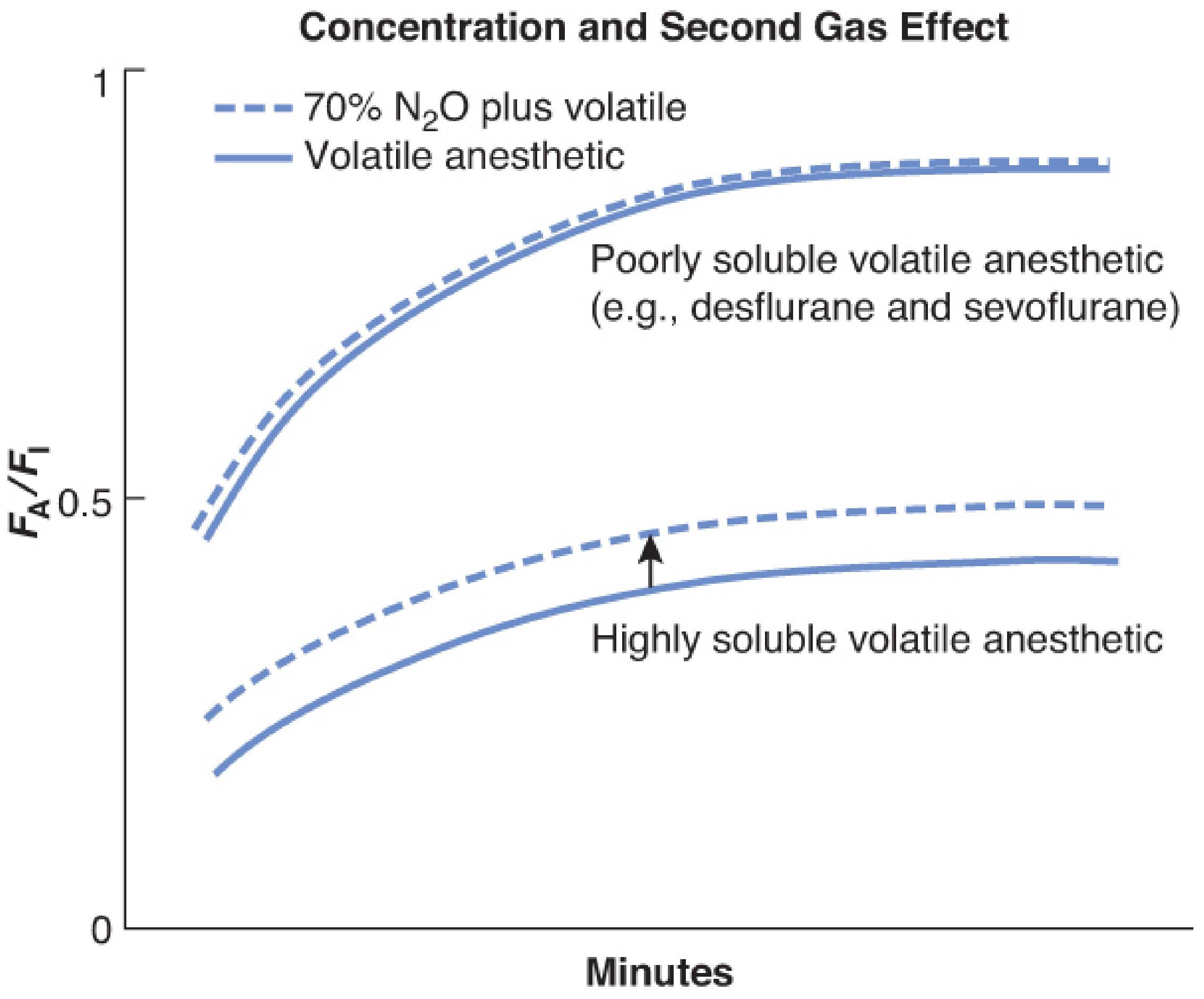
Reading the graph: The dashed lines (volatile + 70% N₂O) sit above the solid lines (volatile alone) for both poorly soluble and highly soluble agents. The FA/FI ratio rises faster when N₂O is co-administered, demonstrating the second gas effect. The gap between solid and dashed is proportionally larger for the highly soluble agent (e.g., halothane) because highly soluble agents have a lower FA/FI baseline - making the concentrating boost more relatively impactful.
- Barash, Clinical Anesthesia, 9e, Figure 18-3 (Epstein et al., Anesthesiology, 1964)
Two Components of the Second Gas Effect
| Component | Mechanism | Effect |
|---|---|---|
| Concentrating effect | Alveolar volume shrinks as N₂O is absorbed; second gas fraction rises | Raises FA of volatile agent |
| Augmented inflow | Fresh circuit gas rushes in to fill the reduced alveolar volume; still carries the second gas at FI concentration | Further raises FA of volatile agent |
Both components act together continuously throughout the early induction phase.
Magnitude and Clinical Significance
The second gas effect is real but modest in clinical practice.
- Miller's Anesthesia (10e) confirms the effect is "evident" mathematically, with rapid N₂O uptake increasing alveolar Piso (isoflurane partial pressure) and PO₂.
- Barash states: "Clinically, the second gas effect acts minimally to speed induction."
- Goodman & Gilman confirms: "The rapid uptake of N₂O from alveolar gas serves to concentrate co-administered halogenated anaesthetics; this effect speeds induction of anaesthesia."
- Notably, one reference (Morgan & Mikhail, 7e, citing Hendrickx et al., 1999) argues the second gas effect "is not a valid concept" - reflecting ongoing academic debate about its true magnitude under real clinical conditions.
The effect is greater with:
- Higher concentration of N₂O (70% > 30%)
- More soluble second gases (halothane > sevoflurane > desflurane) - paradoxically, the effect is more noticeable proportionally, even though poorly soluble agents already achieve high FA/FI rapidly on their own
- Early in induction, when the N₂O concentration gradient and uptake rate are highest
Reversal: Diffusion Hypoxia (Fink Effect)
The second gas effect has a clinically important reversal at the end of anaesthesia. When N₂O is discontinued, it rapidly diffuses from blood back into the alveoli, diluting alveolar O₂ and CO₂. This is diffusion hypoxia (Fink effect):
-
Alveolar O₂ is diluted by outflowing N₂O
-
SpO₂ can drop transiently
-
Prevented by administering 100% O₂ for 5-10 minutes at the end of N₂O anaesthesia
-
Goodman & Gilman, Pharmacological Basis of Therapeutics, p. N₂O section
Summary Table
| Feature | Detail |
|---|---|
| First gas | N₂O (given at 50-70%) |
| Second gas | Volatile agent (sevoflurane, desflurane, isoflurane, halothane) |
| Mechanism | Rapid N₂O absorption shrinks alveolar volume → concentrates co-administered agent + augments fresh gas inflow |
| Effect | Faster rise in FA/FI of volatile agent → faster induction |
| Magnitude | Mathematically real; clinically modest |
| Greatest when | High N₂O%, early induction, more soluble second gas |
| Opposite at emergence | Diffusion hypoxia (N₂O floods alveoli, dilutes O₂) |
This is a shared conversation. Sign in to Orris to start your own chat.