
COPD management and lastest guidelines plus harrison imp points also provide simplifiesd flowchart for management at last
Reading File
Now let me search the medical library and PubMed simultaneously for comprehensive COPD coverage.
Finding Sources
Searching PubMed
"COPD" AND "management guidelines"
Searching the Web
GOLD 2025 COPD guidelines management updates
Now let me get the detailed Harrison's content and more textbook data in parallel:
Finding Sources
Reading Web Page
https://www.ajmc.com/view/updated-gold-guidelines-and-novel-…
Now let me read the key COPD sections from the textbooks in parallel:
Finding Sources
Reading File
Reading File
Now let me read Harrison's 22E COPD sections directly:
Reading File
Finding Sources
Excellent! I found great Harrison's content. Let me read more of this block plus the exacerbations section:
Reading File
Now let me read the exacerbations section from Harrison's and fetch key images:
Reading File
Searching Images
COPD management algorithm GOLD grades flowchart
I now have comprehensive information. Let me also fetch the Harrison's flowchart image that was referenced:
Loading Image
Finding Sources
Reading File
Excellent! I now have all the key content. Let me fetch the Harrison's COPD assessment flowchart image:
Loading Image
Now I have everything I need. Let me compile the comprehensive response with the flowchart:
COPD: Management, Latest Guidelines & Harrison's Key Points
1. DEFINITION & EPIDEMIOLOGY
COPD is an umbrella term for conditions causing persistent, largely irreversible airflow limitation (FEV1/FVC <0.7 post-bronchodilator) due to airway or alveolar abnormalities from noxious particle/gas exposure. It encompasses emphysema (air-space destruction) and chronic bronchitis (cough + sputum ≥3 months/year for ≥2 years). Global prevalence is ~175 million; ~3.2 million deaths/year make it the 3rd leading cause of death worldwide (Goldman-Cecil Medicine).
2. DIAGNOSIS
| Step | Detail |
|---|---|
| Spirometry (mandatory) | Post-bronchodilator FEV1/FVC <0.7 confirms diagnosis |
| GOLD 2025/2026 update | Pre-bronchodilator FEV1/FVC <0.7 is now highly indicative (simplifies early diagnosis); ≥0.7 effectively rules out COPD |
| GOLD Grades (severity) | Grade 1: FEV1 ≥80% / Grade 2: 50-79% / Grade 3: 30-49% / Grade 4: <30% |
| Symptom tools | mMRC dyspnea scale (0-4) and CAT score (0-40, significant ≥10) |
3. GOLD ABE ASSESSMENT TOOL (Harrison's 22E Fig. 303-5)
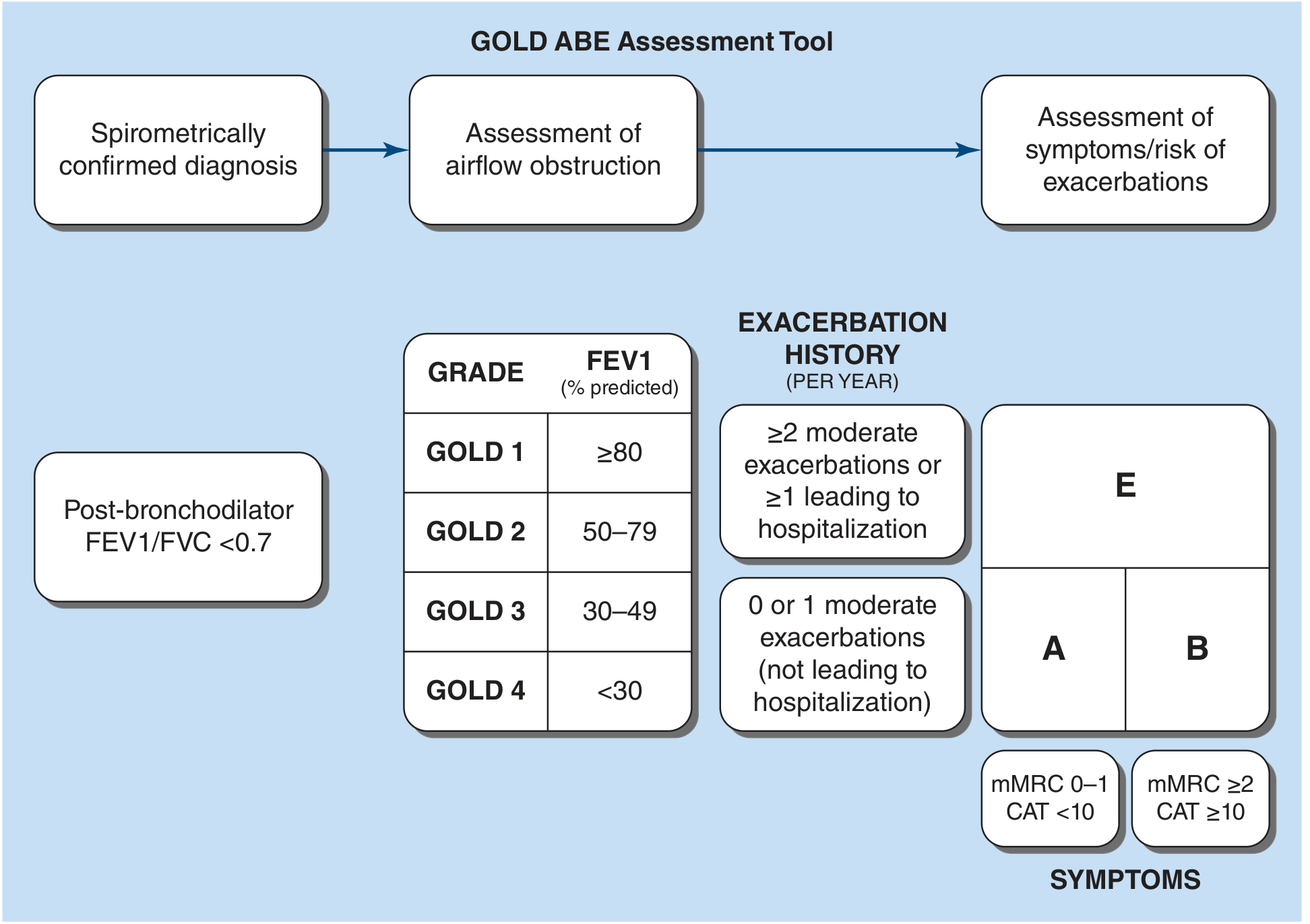
| Group | Exacerbations | Symptoms | First-line Tx |
|---|---|---|---|
| A | 0-1 moderate (no hospitalization) | mMRC 0-1, CAT <10 | Single bronchodilator (LAMA or LABA) |
| B | 0-1 moderate (no hospitalization) | mMRC ≥2, CAT ≥10 | LABA + LAMA (dual bronchodilator) |
| E | ≥1 moderate/severe OR ≥1 hospitalization | Any | LABA + LAMA ± ICS |
GOLD 2026 key change: Group E threshold is now ≥1 moderate/severe exacerbation (previously ≥2 moderate or ≥1 hospitalization). This lowers the bar for triple therapy initiation.
4. PHARMACOTHERAPY (Harrison's 22E + GOLD 2025/2026)
Bronchodilators (cornerstone of therapy)
Short-acting (SABA/SAMA) - as needed:
- Salbutamol/albuterol (SABA), ipratropium (SAMA)
- For acute symptom relief
Long-acting Muscarinic Antagonists (LAMA):
- Tiotropium, umeclidinium, glycopyrronium, aclidinium, revefenacin
- Reduce symptoms + exacerbations (superior to LABA alone)
- Side effect: dry mouth
Long-acting Beta Agonists (LABA):
- Salmeterol, formoterol, indacaterol, olodaterol, vilanterol, arformoterol
- Symptomatic benefit + exacerbation reduction
- Side effects: tremor, tachycardia
LABA + LAMA combination - Greater FEV1 improvement than either alone; recommended as first-line for Group B and E patients
Inhaled Corticosteroids (ICS)
- Never used as monotherapy in COPD
- Role: reduce exacerbations, not primarily for symptoms
- Blood eosinophil count (BEC) guides use:
- BEC <100/µL: no benefit
- BEC 100-300/µL: add ICS if ongoing exacerbations on dual therapy
- BEC ≥300/µL: ICS recommended from the start in Group E
- Triple therapy (LABA + LAMA + ICS) reduces mortality in selected patients
- Risks: oropharyngeal candidiasis, pneumonia, bone density loss, cataracts
- ICS withdrawal in stable patients without exacerbations is safe (minor FEV1 decline possible)
PDE4 Inhibitors
- Roflumilast (oral): reduces exacerbations in severe COPD with chronic bronchitis + prior exacerbation history; modest effect on airflow; SE: nausea, diarrhea, weight loss
- Ensifentrine (inhaled PDE3/4 inhibitor - GOLD 2025 NEW): first new drug class in 30 years; nebulized; reduces dyspnea and exacerbations
Biologics (NEW - GOLD 2025/2026)
- Dupilumab (IL-4/IL-13 antagonist): approved for COPD with chronic bronchitis; reduces exacerbations; first approved biologic for COPD
- Mepolizumab (IL-5 antagonist - GOLD 2026 NEW): for eosinophilic COPD (can be used with or without chronic bronchitis); dosed less frequently than dupilumab
Methylxanthines
- Theophylline: modest bronchodilator effect; narrow therapeutic window; may benefit OSA-COPD overlap
- Role is secondary; used when inhaled therapy is not possible/affordable
Macrolide Antibiotics
- Azithromycin daily: reduces exacerbation frequency in patients with history of exacerbations in past 6 months; chosen for anti-inflammatory + antimicrobial properties
- Risks: hearing loss, cardiac arrhythmia (QT prolongation), antimicrobial resistance
Mucolytics
- N-acetylcysteine, erdosteine: modest reduction in exacerbation frequency in patients not on ICS
5. NON-PHARMACOLOGICAL MANAGEMENT
Smoking Cessation (MOST IMPORTANT - improves survival)
- Nicotine replacement therapy (patch, gum, lozenge, inhaler, nasal spray)
- Varenicline (nicotinic receptor partial agonist) - most effective
- Bupropion
- Counseling + pharmacotherapy combination has greatest success
Oxygen Therapy
- Long-term O2 (LTOT): improves survival when resting PaO2 ≤55 mmHg, or PaO2 56-60 mmHg with polycythemia/cor pulmonale
- Goal: SpO2 88-92% (avoid hypercapnia)
- Does NOT benefit patients with moderate resting desaturation (PaO2 56-65 mmHg) - LOTT trial
Pulmonary Rehabilitation
- Improves dyspnea, exercise capacity, and quality of life
- Reduces hospitalizations post-exacerbation
- Indicated for all patients with mMRC ≥2 or CAT ≥10
Lung Volume Reduction Surgery (LVRS)
- Improves survival in upper-lobe predominant emphysema with low exercise capacity (NETT trial)
- Bronchoscopic valve placement (endobronchial valves): for patients not fit for surgery
Vaccination (GOLD 2025 updated schedule)
- Influenza - annual
- Pneumococcal (PCV15/PCV20 + PPSV23)
- COVID-19 (SARS-CoV-2)
- RSV vaccine (newly added)
- Tdap (if not vaccinated as adolescent)
- Herpes zoster vaccine
Non-Invasive Positive Pressure Ventilation (NIPPV)
- Acute: NIV/BiPAP in exacerbations with pH <7.35 and PCO2 >45 mmHg
- Chronic: reduces mortality in severe hypercapnia (PaCO2 >52 mmHg at rest)
Lung Transplantation
- For end-stage COPD (GOLD 3-4, BODE index ≥7, severe hypercapnia, hospitalized exacerbations)
6. EXACERBATION MANAGEMENT (Harrison's 22E)
Definition: Acute worsening of dyspnea, cough, and/or sputum over <14 days.
Strongest predictor: Prior exacerbation history. Severe obstruction (FEV1 <50%) → 1-3 exacerbations/year.
Precipitants: Viral infections (>50%), bacterial (new strain acquisition), air pollution, PE, medication non-adherence.
Outpatient Management (mild-moderate)
- Increase bronchodilator frequency (SABA ± SAMA)
- Short course oral corticosteroids (5 days prednisone 40 mg/day)
- Antibiotics if purulent sputum/respiratory acidosis: amoxicillin-clavulanate, azithromycin, doxycycline, fluoroquinolones
Inpatient Indications
- Respiratory acidosis (pH <7.35, PCO2 >45)
- New/worsening hypoxemia
- Severe underlying COPD
- Significant comorbidities
- Inability to manage at home
Hospital Management (Goldman-Cecil Table 76-3)
- Controlled O2: target SpO2 88-92%
- Systemic corticosteroids: 5-day course (equivalent outcomes to 14 days)
- Antibiotics if indicated
- NIV/BiPAP first-line for hypercapnic respiratory failure (pH 7.25-7.35)
- Intubation if NIV fails or severe acidosis
7. HARRISON'S 22E KEY POINTS (COPD Chapter 303)
- Three survival-improving interventions: smoking cessation, LTOT in hypoxemic patients, LVRS in selected emphysema patients
- Triple inhaled therapy (LABA+LAMA+ICS) reduces mortality in selected COPD patients
- ICS benefit is eosinophil-dependent - BEC <100 = no benefit; BEC ≥300 = start with triple therapy
- Dual bronchodilators (LABA+LAMA) are first-line for symptomatic Group B/E patients - superior to monotherapy
- Macrolide prophylaxis: azithromycin daily reduces exacerbations but monitor for QT prolongation and hearing loss
- Oral steroids are NOT recommended for long-term COPD management (unfavorable risk/benefit ratio)
- Exacerbation predictor: single greatest risk for hospitalization = prior hospitalization for exacerbation
- Pulmonary embolism must be considered in exacerbations (increased incidence)
- ASTHMA-COPD Overlap (ACO): requires ICS - never withhold in eosinophilic features
- Chronic hypercapnic COPD: nocturnal NIV can improve survival
8. LATEST UPDATES (GOLD 2025/2026)
| Update | Detail |
|---|---|
| New diagnostic approach | Pre-bronchodilator spirometry emphasized; FEV1/FVC <0.7 pre-BD highly indicative |
| Group E threshold lowered | ≥1 moderate/severe exacerbation now = Group E (was ≥2 or hospitalization) |
| Ensifentrine (PDE3/4) | First new drug class in 30 years; nebulized; add-on for persistent dyspnea |
| Dupilumab | First approved biologic for COPD with chronic bronchitis |
| Mepolizumab (2026) | Anti-IL-5; for eosinophilic COPD; added alongside dupilumab as biologic option |
| Expanded vaccination | RSV vaccine + herpes zoster vaccine now included |
| Monitoring refinement | New methods for periodic reassessment integrated |
9. SIMPLIFIED MANAGEMENT FLOWCHART
SUSPECTED COPD
      │
      ▼
Spirometry (post-BD FEV1/FVC < 0.7)
      │
      ▼
CONFIRMED COPD
      │
      ├──── Assign GOLD Grade (1-4) by FEV1%
      │
      ▼
ABE GROUP ASSESSMENT
      │
      ├── Exacerbations ≥1 moderate/severe or ≥1 hospitalization? ──► GROUP E
      │                                                                    │
      ├── 0 exacerbations + mMRC 0-1 / CAT <10 ──────────────────── GROUP A
      │                                                                    │
      └── 0 exacerbations + mMRC ≥2 / CAT ≥10 ──────────────────── GROUP B

━━━━━━━━━━━━━━━━━━━━━━━━━━━━━━━━━━━━━━━━━━━━━━━━━
INITIAL PHARMACOTHERAPY:

GROUP A  →  Single bronchodilator (LAMA or LABA)
GROUP B  →  LABA + LAMA (dual bronchodilator)
GROUP E  →  LABA + LAMA ± ICS (add ICS if BEC ≥300)

━━━━━━━━━━━━━━━━━━━━━━━━━━━━━━━━━━━━━━━━━━━━━━━━━
FOLLOW-UP: REASSESS SYMPTOMS & EXACERBATIONS
      │
      ├── Still dyspneic on dual therapy? ──► Review inhaler technique/adherence
      │                                       Consider ensifentrine or triple therapy
      │
      ├── Still exacerbating on dual therapy?
      │       └── BEC ≥100-300 → Add ICS (triple therapy)
      │           BEC <100 → Add roflumilast (if chronic bronchitis)
      │           Consider azithromycin prophylaxis
      │           Consider biologics (dupilumab/mepolizumab if eosinophilic)
      │
      └── STILL SEVERE / GOLD 3-4?
              └── Pulmonary rehab + assess for LVRS / bronchoscopic valves / transplant

━━━━━━━━━━━━━━━━━━━━━━━━━━━━━━━━━━━━━━━━━━━━━━━━━
NON-PHARMACOLOGICAL (ALL PATIENTS):
  ✓ Smoking cessation (varenicline preferred)
  ✓ Vaccinations (flu, pneumo, COVID, RSV, Tdap, zoster)
  ✓ Pulmonary rehab (mMRC ≥2)
  ✓ LTOT if PaO2 ≤55 mmHg or SpO2 ≤88%

━━━━━━━━━━━━━━━━━━━━━━━━━━━━━━━━━━━━━━━━━━━━━━━━━
EXACERBATION?
      │
      ├── MILD (home) → SABA ± SAMA + 5-day oral steroids + antibiotics if purulent
      │
      └── SEVERE (hospital) → Controlled O2 (SpO2 88-92%)
                               + IV/oral steroids
                               + Antibiotics
                               + NIV/BiPAP if pH <7.35 & PCO2 >45
                               + Intubate if NIV fails
Key Sources: Harrison's Principles of Internal Medicine 22E (2025), GOLD 2025 Report, GOLD 2026 updates, AJMC GOLD 2025 summary
This is a shared conversation. Sign in to Orris to start your own chat.