
For a medical student studying mbbs . Tell me all about anemia in pregnancy
Reading File
Now let me search the medical library for comprehensive content on anemia in pregnancy, running parallel queries:
Finding Sources
Finding Sources
Searching PubMed
"anemia in pregnancy"[MeSH Terms] AND management
Excellent results. Now let me read the key sections from Creasy & Resnik's Maternal-Fetal Medicine (the most comprehensive obstetrics textbook) and Goldman-Cecil in parallel:
Reading File
Reading File
I got the wrong offset for Creasy & Resnik. Let me find the correct location for the anemia in pregnancy chapter:
Finding Sources
Finding Sources
Reading File
Excellent — I have very rich content from Creasy & Resnik. Let me read more to get treatment details and other types of anemia:
Reading File
I now have comprehensive content. Let me also search for an image of the peripheral blood smear in iron deficiency anemia in pregnancy:
Searching Images
iron deficiency anemia peripheral blood smear microcytic hypochromic
Searching PubMed
"iron deficiency anemia" AND pregnancy AND treatment
I now have all the material needed to write a comprehensive, textbook-grade answer. Let me compile the full response:
Loading Image
Loading Image
Here is a comprehensive, MBBS-level guide to Anemia in Pregnancy:
Anemia in Pregnancy — Complete MBBS Study Guide
1. Definition
Anemia = hemoglobin (Hb) value below the lower limit of normal, not explained by hydration status.
The normal Hb for adult females is 14.0 ± 2.0 g/dL. In pregnancy, due to hemodilution (plasma volume expands ~40–50%, red cell mass only ~15–25%), the CDC defines anemia in pregnancy as:
| Trimester | Hb threshold |
|---|---|
| First trimester | < 11.0 g/dL |
| Second trimester | < 10.5 g/dL |
| Third trimester | < 11.0 g/dL |
Globally, anemia affects ~38% of pregnant women; about half of these are due to iron deficiency. In the United States, the prevalence is ~17%, with a 4–7× higher incidence in Black women than White women.
2. Physiologic Anemia of Pregnancy
This is not true pathological anemia — it is a normal physiologic adaptation:
- Plasma volume expands 40–50% above baseline (peaks at weeks 16–24)
- Red cell mass expands only 15–25%
- Net result: dilutional decrease in Hb — normocytic, normochronic
Key point: A normocytic anemia with Hb > 11 g/dL (first/third trimester) or > 10 g/dL (second trimester) in an uncomplicated pregnancy can be attributed to physiologic anemia without further workup. Lower values or microcytic/macrocytic anemia require investigation.
3. Classification & Causes
By MCV:
| Type | MCV | Common Causes in Pregnancy |
|---|---|---|
| Microcytic (↓ MCV) | < 80 fL | Iron deficiency (most common), α-thalassemia, β-thalassemia |
| Normocytic (normal MCV) | 80–100 fL | Acute blood loss, anemia of chronic disease, aplastic anemia |
| Macrocytic (↑ MCV) | > 100 fL | Folate deficiency, B12 deficiency, megaloblastic anemia |
4. Iron Deficiency Anemia (IDA) — The Most Common
Why IDA is common in pregnancy:
- Fetal and placental iron needs: ~300 mg
- Expansion of maternal red cell mass: ~500 mg
- Basal losses: ~200 mg
- Total iron demand: ~1,000 mg over pregnancy
- Daily iron requirement rises from ~0.8 mg/day (non-pregnant) to 6–7 mg/day (third trimester)
Clinical Features:
- Symptoms: Fatigue, weakness, lightheadedness, exertional dyspnea, palpitations
- Signs: Pallor (conjunctiva, palms, mucous membranes), tachycardia, angular stomatitis, koilonychia (spoon nails), glossitis, brittle nails
- Pica (craving non-food items — ice, clay, starch) is pathognomonic
- Often discovered incidentally on routine CBC
Stages of Iron Deficiency:
- Iron depletion — Ferritin ↓, iron stores exhausted, no anemia yet
- Iron-deficient erythropoiesis — Serum iron ↓, TIBC ↑, transferrin saturation ↓, no anemia yet
- Iron deficiency anemia — Hb ↓, microcytic hypochromic RBCs on smear
Peripheral Blood Smear in IDA vs Normal:
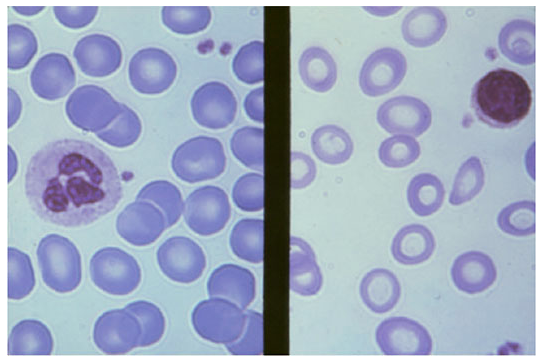
Lab Findings in IDA:
| Investigation | Iron Deficiency | Thalassemia | Anemia of Inflammation |
|---|---|---|---|
| Smear | Micro/hypo | Micro/hypo + target cells | Normal or mild micro/hypo |
| Serum iron | ↓ (<30 μg/dL) | Normal–high | ↓ (<50 μg/dL) |
| TIBC | ↑ (>360 μg/dL) | Normal | ↓ (<300 μg/dL) |
| Transferrin saturation | ↓ (<10%) | 30–80% | 10–20% |
| Serum ferritin | ↓ (<15 μg/L) | Normal–high | ↑ (30–200 μg/L) |
| Hb electrophoresis | Normal | Abnormal (β-thal) | Normal |
Serum ferritin is the single most accurate lab value for diagnosing IDA in pregnancy. — Rosen's Emergency Medicine
Treatment of IDA:
Oral Iron (first-line):
- Ferrous sulfate 325 mg (60 mg elemental iron) — one tablet once or twice daily
- Take on empty stomach for best absorption; vitamin C enhances absorption
- Side effects: nausea, constipation, dark stools — take with food if needed
- Hemoglobin should rise ~1 g/dL per week with adequate therapy
- Continue therapy for 3 months postpartum to replete stores
Intravenous Iron (when oral fails or is not tolerated):
- Indications: intolerance to oral iron, non-compliance, malabsorption, severe or late anemia
- Agents: ferric carboxymaltose, iron sucrose, low molecular weight iron dextran
- IV iron replenishes stores faster and more effectively than oral iron
- A 2024 JAMA systematic review for the USPSTF confirmed iron supplementation reduces IDA in pregnancy but ongoing research examines optimal dosing strategies (PMID: 39163033)
Recombinant erythropoietin: Reserved for refractory cases; a 2025 systematic review (PMID: 39087437) found limited evidence for its routine use in pregnancy.
5. Folate Deficiency Anemia (Megaloblastic)
Why common in pregnancy:
- Folate requirements nearly double during pregnancy (from 400 μg to 600–800 μg/day)
- Increased cell proliferation demands more folate for DNA synthesis
- Poor dietary intake, multiple pregnancy, hemolytic states all increase risk
Clinical Features:
- Megaloblastic anemia: macrocytic (MCV > 100), hypersegmented neutrophils
- Glossitis, angular stomatitis, mild jaundice
- No neurological deficits (unlike B12 deficiency)
- Increased risk of neural tube defects in the fetus if deficiency is in early pregnancy
Peripheral Smear in Megaloblastic Anemia:
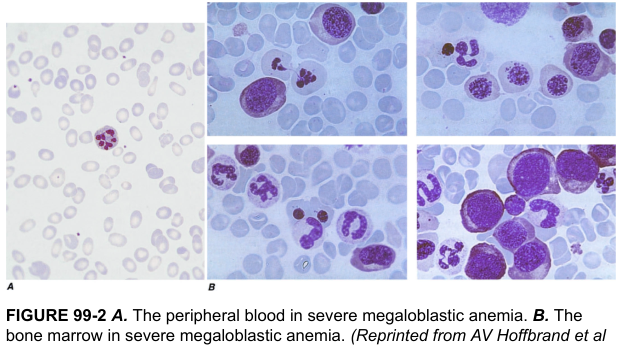
Lab Findings:
- Hb ↓, MCV ↑ (>100 fL), MCHC normal
- Hypersegmented neutrophils (>5 lobes in >5% of neutrophils)
- Serum folate ↓, RBC folate ↓ (more reliable)
- LDH ↑, indirect bilirubin ↑ (ineffective erythropoiesis)
- Megaloblasts in bone marrow
Treatment:
- Folic acid 5 mg/day orally until recovery, then maintenance
- Prevention (all pregnancies): Folic acid 0.4–0.5 mg/day from at least 4 weeks before conception to 12 weeks gestation → reduces neural tube defect risk by ~70%
- High-risk women (prior NTD, anticonvulsants): 4–5 mg/day
6. Vitamin B12 Deficiency
- Less common than folate deficiency in pregnancy
- Causes: strict vegetarianism/veganism, pernicious anemia (autoimmune), post-gastric surgery
- Macrocytic anemia + subacute combined degeneration of spinal cord (posterior and lateral column demyelination — neurological feature that distinguishes B12 from folate deficiency)
- Treatment: Hydroxocobalamin or cyanocobalamin IM injections
7. Sickle Cell Anemia in Pregnancy
- HbSS carries the highest risk — maternal mortality significantly elevated
- Complications:
- Increased vaso-occlusive crises (due to hyperviscosity, dehydration, infection)
- Preeclampsia, placental abruption
- Preterm labor, fetal growth restriction, stillbirth
- Acute chest syndrome
- Management:
- Prophylactic folic acid (5 mg/day — higher doses due to hemolysis)
- Hydration, analgesia for crises
- Avoid hydroxyurea in pregnancy (teratogenic)
- Exchange transfusion for severe complications (acute chest, stroke)
- Serial ultrasound for fetal growth
- Genetic counseling — partner screening for HbS trait
8. Thalassemia in Pregnancy
α-Thalassemia:
| Genotype | Genes deleted | Clinical status |
|---|---|---|
| Silent carrier | 1 gene | Normal, undetectable |
| α-Thal trait (minor) | 2 genes | Mild microcytic anemia, no symptoms |
| HbH disease | 3 genes | Moderate hemolytic anemia |
| Hb Bart's (hydrops fetalis) | 4 genes | Incompatible with life; intrauterine or neonatal death |
- α-Thal trait: mild microcytic anemia → must distinguish from IDA (normal ferritin, no response to iron)
- If both partners carry α-thal trait in cis (--/αα) conformation → 25% risk of Hb Bart's → offer prenatal diagnosis
β-Thalassemia:
- β-Thal minor (trait): Mild anemia, microcytic; elevated HbA2 >3.5% on electrophoresis; well tolerated in pregnancy; folic acid supplementation
- β-Thal major (Cooley's anemia): Rarely pregnant without transfusion support; managed with regular transfusions, chelation (avoid deferoxamine in first trimester), and careful monitoring
- β-Thal intermedia: Variable; may worsen in pregnancy; manage as per severity
9. Aplastic Anemia in Pregnancy
- Rare but life-threatening
- Pancytopenia: anemia + neutropenia + thrombocytopenia
- Most serious complications: hemorrhage and sepsis — leading causes of maternal death in aplastic anemia
- Bone marrow biopsy: hypocellular marrow
- Management:
- Supportive transfusions (packed RBCs, platelets)
- Immunosuppression (antithymocyte globulin, cyclosporine)
- Bone marrow transplantation ideally deferred until after delivery
- High-dose corticosteroids considered in some cases
10. Anemia of Chronic Disease / Infection
- Normocytic, normochromic anemia
- Associated with chronic infections (HIV, TB, pyelonephritis), chronic renal disease, chronic liver disease, autoimmune conditions
- Pathophysiology: ↑ hepcidin → ↓ iron release from macrophages → functional iron deficiency
- Distinguish from IDA: ferritin is normal or elevated in ACD
- HIV-associated moderate–severe anemia in pregnancy → workup for tuberculosis (per Rosen's)
- Treatment: treat underlying condition; iron supplementation only if concurrent IDA confirmed
11. Maternal and Fetal Consequences of Anemia
Maternal Effects:
- Fatigue, impaired work capacity
- Cardiac decompensation (high-output heart failure in severe anemia)
- Increased susceptibility to infection
- Postpartum hemorrhage poorly tolerated
- Peripartum cardiomyopathy risk
- Increased maternal mortality (severe anemia, Hb < 6 g/dL)
Fetal/Neonatal Effects:
- Fetal growth restriction (FGR)
- Preterm birth
- Low birth weight
- Neonatal anemia
- Increased perinatal morbidity and mortality
- Neural tube defects (folate deficiency in first trimester)
12. Screening and Routine Evaluation
- CBC at booking (first antenatal visit) and again at 28–32 weeks
- WHO and most national guidelines recommend screening all pregnant women
- Additional tests based on CBC morphology (see Table below)
Evaluation Algorithm:
CBC with differential + reticulocyte count
         ↓
  MCV < 80 (Microcytic)      MCV 80-100 (Normocytic)     MCV > 100 (Macrocytic)
         ↓                          ↓                            ↓
Serum ferritin, TIBC,         Reticulocyte count          Serum folate, B12,
serum iron, Hb electrophoresis  ± bone marrow            LDH, PBS
         ↓
Ferritin ↓ → IDA
Ferritin normal + micro → Thalassemia (electrophoresis)
Ferritin ↑ → ACD
13. Prevention
| Intervention | Details |
|---|---|
| Iron supplementation | Universal supplementation in high-prevalence areas; selective in low-prevalence settings |
| Folic acid supplementation | 0.4–0.5 mg/day starting pre-conception; 4–5 mg/day in high-risk women |
| Dietary advice | Iron-rich foods (meat, legumes, green leafy vegetables), vitamin C-rich foods to enhance iron absorption |
| Deworming | In endemic areas — helminth infections cause blood loss and impair iron absorption |
| Malaria prophylaxis | In endemic areas — malaria is a major cause of anemia in pregnancy |
14. High-Yield Summary for Exams
| Feature | IDA | Folate deficiency | B12 deficiency | Thalassemia trait |
|---|---|---|---|---|
| MCV | ↓ | ↑ | ↑ | ↓ |
| Ferritin | ↓ | Normal | Normal | Normal/↑ |
| TIBC | ↑ | Normal | Normal | Normal |
| Smear | Micro, hypochromic | Macrocytic, hyperseg neutrophils | Macrocytic, hyperseg neutrophils | Micro, hypochromic + target cells |
| Hb electrophoresis | Normal | Normal | Normal | Abnormal (β-thal) / normal (α-thal) |
| Neuro signs | No | No | Yes (SACD) | No |
| Treatment | Ferrous sulfate / IV iron | Folic acid 5 mg | Vit B12 IM | Folic acid; genetic counseling |
Key Sources
- Creasy & Resnik's Maternal-Fetal Medicine: Principles and Practice, Chapter 55 (Anemia in Pregnancy), pp. 1329–1344
- Goldman-Cecil Medicine, Section on Physiologic Anemia of Pregnancy, p. 1676
- Harrison's Principles of Internal Medicine, 21st ed., pp. 1721, 2889
- Recent USPSTF systematic review on iron supplementation in pregnancy: JAMA 2024 (PMID 39163033)
This is a shared conversation. Sign in to Orris to start your own chat.