
3705. A patient involved in a road traffic accident had difficulty in breathing and multiple bone fractures. Chest X-Ray revealed a pneumothorax and an emergency needle thoracostomy is performed. The patient was shifted to the operation theatre for management of the fractures. #NEXTRX 2.2K 6:37 PM Forwarded from Next Rx Which of the following inhalational agents would you avoid in this patient? #NEXTRX Anonymous Quiz 21% Desflurane 61 e 28% Halothane 19% Sevoflurane 32% Nitrous oxide 1 289 answered
Nitrous oxide (N₂O) is the correct answer.
Searching sources...
Reading File
Finding Sources
Finding Sources
Reading File
Reading File
Loading Image
Answer: Nitrous Oxide (N₂O) - Correct (32% - the right choice)
Why N₂O is Contraindicated in Pneumothorax
The key is differential solubility. Nitrous oxide is 35 times more soluble in blood than nitrogen (the main component of air). This creates a dangerous imbalance:
- N₂O diffuses into the closed pleural air space much faster than the nitrogen already there can diffuse out
- The result: the pneumothorax expands rapidly in volume (if the walls are compliant) or pressure rises dangerously (if walls are rigid - as seen post-needle thoracostomy)
Classic example from Morgan & Mikhail's Clinical Anesthesiology:
"If a patient with a 100-mL pneumothorax inhales 50% nitrous oxide, the gas content of the pneumothorax will tend to approach that of the bloodstream... the pneumothorax expands until it contains roughly 100 mL of air AND 100 mL of nitrous oxide."
The graph from Miller's Anesthesia below shows how rapidly pneumothorax volume expands during N₂O administration compared to GI tract air:
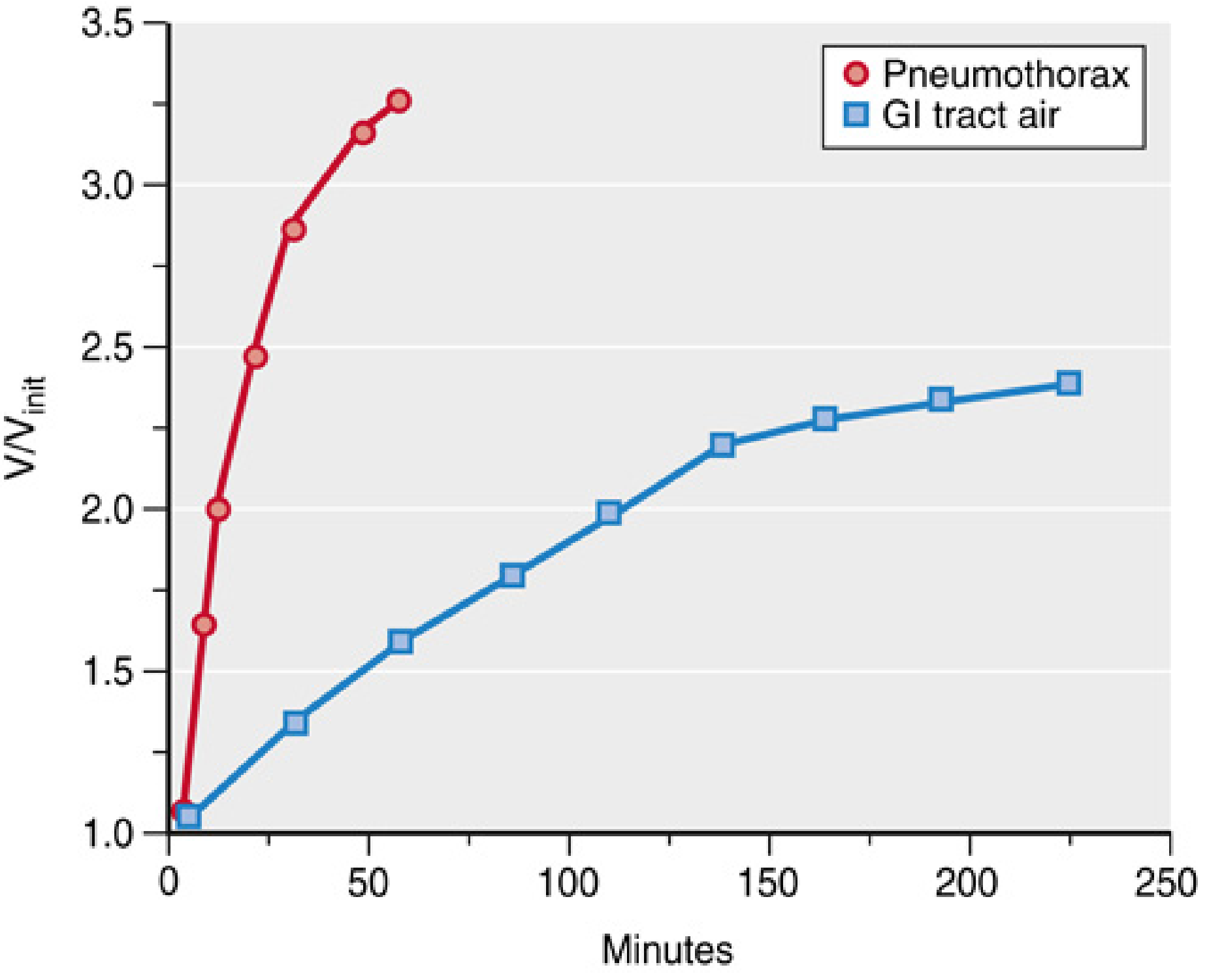
The pneumothorax triples in size within ~60 minutes, which could convert a simple pneumothorax into a tension pneumothorax - rapidly fatal.
Why the Other Options Are Acceptable
| Agent | Why it's safe here |
|---|---|
| Desflurane | Volatile agent - does not expand closed gas spaces; no contraindication in pneumothorax |
| Halothane | Volatile agent - same reasoning; though largely obsolete, no pneumothorax contraindication |
| Sevoflurane | Volatile agent - preferred for inhalational induction; safe in pneumothorax |
Other Conditions Where N₂O Must Be Avoided
The same mechanism (diffusion into closed gas spaces) makes N₂O dangerous in:
- Bowel obstruction (distended gut)
- Pneumocephalus (intracranial air after neurosurgery)
- Intraocular air bubbles (retinal surgery - gas tamponade)
- Venous or arterial air embolism
- Middle ear surgery (tympanic membrane grafting)
Bottom line: This patient has a confirmed pneumothorax (even after needle thoracostomy, residual air remains). Administering N₂O would rapidly expand this space and risk tension pneumothorax on the table. All volatile agents (desflurane, halothane, sevoflurane) are safe to use.
Sources: Morgan & Mikhail's Clinical Anesthesiology 7e; Sabiston Textbook of Surgery; Miller's Anesthesia 10e; Bailey & Love's Short Practice of Surgery 28e
This is a shared conversation. Sign in to Orris to start your own chat.