
Enteric fever in 5 years old
Reading File
This is a broad clinical question about a special population (pediatric), so I'll run the three-layer search in parallel.
Finding Sources
Finding Sources
Searching PubMed
"enteric fever" AND children
Excellent sources found. Now reading the most pediatric-specific and comprehensive sources in parallel.
Reading File
Reading File
Reading File
Good content retrieved. Now reading the Red Book (AAP, pediatric-specific) section more fully and Harrison's clinical/treatment section.
Reading File
Reading File
Now I need the clinical features, diagnosis, and treatment sections from Harrison's and the Red Book specifically for the pediatric context.
Reading File
Reading File
I now have excellent content. Let me also get the diagnosis and antibiotic treatment details from Harrison's.
Reading File
I now have comprehensive information. Let me compose the full, well-structured answer.
Loading Image
Here is a comprehensive, pediatric-focused review of enteric fever in a 5-year-old child.
Enteric Fever in a 5-Year-Old Child
Definition and Causative Organisms
Enteric fever is a systemic illness caused by dissemination of Salmonella enterica serovar Typhi (typhoid fever) or serovars Paratyphi A, B, and C (paratyphoid fever). S. Typhi and S. Paratyphi have no animal reservoir - humans are the only host, which is key to its epidemiology. The disease was historically termed "typhoid" due to clinical similarity to typhus, but "enteric fever" was proposed in 1869 to reflect the anatomical site of infection.
- Harrison's Principles of Internal Medicine 22E, p. 1359
Epidemiology
- Global burden: ~9.2-21 million typhoid cases and ~5 million paratyphoid cases per year, causing 110,000-280,000 deaths annually.
- Highest incidence is in the Indian subcontinent (Pakistan, Bangladesh, Nepal, India), Eastern Mediterranean, and Africa - exceeding 1,000 cases per 100,000 children in some urban areas.
- In endemic regions, enteric fever preferentially affects young children and adolescents. A 5-year-old in an endemic zone carries significant risk.
- Risk factors in children: fecally contaminated drinking water or ice, food from street vendors, raw produce grown in sewage-fertilized fields, ill household contacts, poor hand hygiene, and reduced gastric acidity (e.g., from prior H. pylori infection).
- Transmission is feco-oral - from contaminated food/water, or from chronic carriers.
- Harrison's Principles of Internal Medicine 22E, p. 1359; Red Book 2021, p. 1018
Pediatric-Specific Clinical Features
In a 5-year-old, the presentation of enteric fever differs somewhat from classic adult disease:
| Feature | In Children (esp. <5 years) | Adult Pattern |
|---|---|---|
| Onset | Often abrupt or nondescript febrile illness | Gradual, stepwise fever |
| Fever | Prolonged, high (38.8-40.5°C) | Stepwise rise over 1 week |
| GI symptoms | Diarrhea ("pea soup") OR constipation | Constipation more common |
| Rose spots | Present in ~30% (harder to see in dark skin) | Similar frequency |
| Relative bradycardia | NOT a reliable feature in children | Seen in up to 50% of adults |
| Hepatosplenomegaly | Common | ~50% of cases |
| Meningitis | Can occur, especially in infants/toddlers | Rare |
| Severity | Can range from mild self-limited bacteremia to severe systemic illness | More classic presentation |
Classic symptom progression (older children, including 5-year-olds):
- Week 1: Gradual-onset fever, headache, malaise, anorexia, lethargy, abdominal pain, dry cough. Diarrhea or constipation may appear. Fever rises in stepwise fashion to 39.4-40°C.
- Week 2: Sustained high fever, rose spots on trunk/chest (~30%), hepatosplenomegaly, worsening abdominal distention and pain. Altered sensorium possible.
- Week 3-4: Risk of life-threatening complications - intestinal perforation (~1%), GI bleeding (~6%), altered mental status ("muttering delirium").
Rose Spots (Classic Sign)
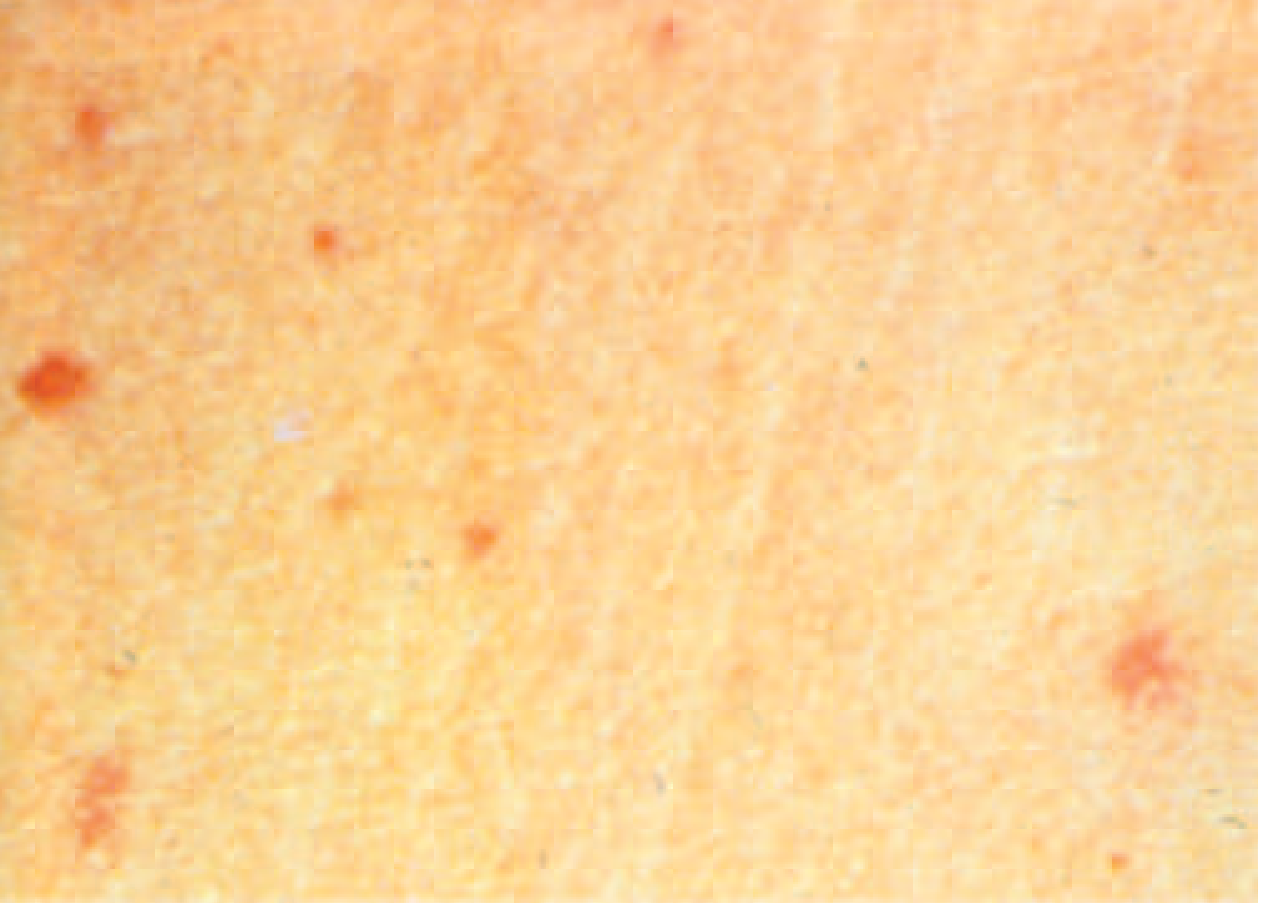
Rose spots: Faint, salmon-colored, blanching maculopapular lesions on the trunk and chest, seen in ~30% of patients. They may be very difficult to see in dark-skinned children. - Harrison's 22E, Fig. 171-2
- Red Book 2021 (AAP), p. 1018; Harrison's 22E, p. 1360; Goldman-Cecil Medicine, p. 1910
Complications
Occur in ~27% of hospitalized patients and are more likely when diagnosis/treatment is delayed:
- Intestinal perforation (~1%): Occurs in weeks 3-4 from necrosis of Peyer's patches in the terminal ileum. Requires urgent surgery + broad-spectrum antibiotics.
- GI hemorrhage (~6%): Erosion of Peyer's patches; may need transfusion or surgery.
- Neurological (2-40%): Meningitis (especially infants), encephalopathy, Guillain-Barré syndrome, "muttering delirium."
- Hepatitis/hepatic abscess: Abnormal liver function tests common.
- Myocarditis/endocarditis: Rare.
- Hemophagocytic lymphohistiocytosis (HLH): A rare but serious complication - a 2024 systematic review (PMID 38579699) highlights its association with enteric fever.
- Relapse: Occurs in up to 10-17% of patients, typically 2-3 weeks after apparent recovery.
- Chronic carriage is uncommon in children and increases with age.
Diagnosis
A high index of suspicion is required, as the presentation is nonspecific. In a febrile child with travel history to endemic areas, always consider enteric fever.
Culture (Gold Standard)
| Sample | Sensitivity | Notes |
|---|---|---|
| Bone marrow culture | ~90% (best) | Positive even after antibiotic start |
| Blood culture | 40-80% | Best in week 1; yield falls with antibiotics |
| Stool culture | 30% (week 1) → 75% (week 3) | Useful later in disease |
| Urine culture | ~25% | Less useful |
| Rose spot biopsy | High if lesions present | Culture of punch biopsy |
- Blood cultures should be drawn in large volumes (minimum 15 mL in adults; proportionally adjusted in children) to improve yield.
- Multiple culture sets improve sensitivity.
Serology
- Widal test: Measures agglutinating antibodies against S. Typhi O and H antigens. Widely used in endemic areas due to availability, but has poor sensitivity and specificity - it is not recommended as the sole diagnostic method. Background seropositivity is high in endemic populations.
- Rapid antigen/antibody tests (e.g., Typhidot, TUBEX): Used in low-resource settings; variable sensitivity.
Blood Work
-
CBC: Leukopenia/neutropenia in ~15-25% of cases. Leukocytosis is actually more common in children and in early illness (first 10 days).
-
Elevated liver enzymes (transaminases, alkaline phosphatase) - common and nonspecific.
-
Anemia, thrombocytopenia possible in severe disease.
-
Harrison's 22E, p. 1360-1361; Red Book 2021, p. 1022
Treatment
Antibiotic Choice - Guided by Resistance Pattern
The treatment landscape has changed dramatically due to drug resistance. Travel history determines empiric choice.
Drug Resistance Patterns (Critical to Know in 2025):
- Multidrug-resistant (MDR) S. Typhi: Resistant to chloramphenicol, ampicillin, trimethoprim-sulfamethoxazole. Emerged in the 1980s.
- Decreased susceptibility to ciprofloxacin (DSC): Predominant pattern from the Indian subcontinent. Most US cases are now fluoroquinolone non-susceptible.
- Extensively drug-resistant (XDR) S. Typhi: Since 2016 in Pakistan - resistant to ceftriaxone + all above. Susceptible only to azithromycin and carbapenems. Multiple travel-associated XDR cases reported in the USA and UK.
Empiric Antibiotic Recommendations (Red Book 2021, Harrison's 22E):
| Clinical Setting | First-Line | Duration |
|---|---|---|
| Travel from South Asia (MDR suspected) | Ceftriaxone IV (parenteral) or Azithromycin (oral, uncomplicated) | 7-14 days |
| XDR S. Typhi (travel from Pakistan) | Azithromycin (mild/moderate) or Meropenem (severe) | 7-14 days |
| Susceptible strain confirmed | Amoxicillin, TMP-SMX, or fluoroquinolone (if susceptible) | 14 days for amoxicillin/TMP-SMX |
| Fluoroquinolones (e.g., ciprofloxacin) | Do NOT use empirically from South Asia | - |
Do NOT use fluoroquinolones empirically for travelers from South Asia given widespread DSC/resistance.
Azithromycin dosing in children: Typically 10-20 mg/kg/day orally (max 1 g/day) for uncomplicated disease.
Ceftriaxone dosing in children: 50-75 mg/kg/day IV/IM (max 2 g/day).
Severe Enteric Fever - Corticosteroids
In children with severe enteric fever (delirium, obtundation, stupor, coma, or shock), high-dose dexamethasone can be lifesaving:
- Initial dose: 3 mg/kg IV, then 1 mg/kg IV every 6 hours for a total course of 48 hours.
- Reserved only for critically ill patients.
- Red Book 2021 (AAP), p. 1024
Intestinal Perforation
Requires immediate surgical intervention + fluid resuscitation + broad-spectrum antibiotics covering polymicrobial peritonitis.
Isolation and Infection Control
- Standard + contact precautions for diapered/incontinent children (i.e., virtually all 5-year-olds).
- Contact precautions continued until 3 consecutive negative stool cultures, each obtained ≥48 hours after stopping antibiotics.
- For XDR typhoid: contact precautions throughout hospitalization per MDR organism guidelines.
- Red Book 2021, p. 1024
Vaccination (Key Pediatric Point)
| Vaccine | Type | Route | Minimum Age | Doses | Booster |
|---|---|---|---|---|---|
| Ty21a | Live attenuated | Oral | 6 years | 4 doses (days 1, 3, 5, 7) | Every 5 years |
| Vi CPS | Polysaccharide | IM | 2 years | 1 dose | Every 2 years |
| Typhoid Conjugate Vaccine (TCV) - Typbar TCV, TYPHIBEV | Vi conjugate | IM | 6 months | 1 dose | Up to 7 years protection |
For a 5-year-old:
- Vi CPS (polysaccharide) is appropriate (minimum age 2 years).
- Ty21a is not appropriate - minimum age is 6 years.
- Typhoid Conjugate Vaccines (TCV) are WHO-recommended for endemic countries and are 79-95% effective, approved from 6 months of age - preferred for young children in high-burden settings.
- Unconjugated vaccines are poorly immunogenic in children <5 years; conjugate vaccines are preferred in this age group.
- Efficacy of licensed vaccines ranges from 50-80%; vaccines are an adjunct to food/water precautions, not a substitute.
- A 2025 Cochrane meta-analysis (PMID 40326553) confirms typhoid conjugate vaccines are effective for preventing enteric fever.
Differential Diagnosis
In a febrile 5-year-old returning from endemic areas, consider:
- Malaria (most important to exclude)
- Viral hepatitis A/E
- Bacterial enteritis (Shigella, Campylobacter, ETEC)
- Dengue fever
- Rickettsial infections
- Leptospirosis
- Amoebic liver abscess
- Acute HIV infection
Summary for Clinical Practice
| Aspect | Key Point |
|---|---|
| Suspect | Prolonged fever + travel to South Asia/Africa in a child |
| Diagnosis | Blood culture (multiple, large volume) is first-line; bone marrow if antibiotics already started |
| Do NOT rely on | Widal test alone |
| Empiric treatment | Ceftriaxone IV (or azithromycin oral if mild, from non-Pakistan areas) |
| Pakistan travel | XDR risk - use azithromycin (mild) or meropenem (severe) |
| Do NOT use | Fluoroquinolones empirically from South Asia |
| Severe disease | Add dexamethasone (3 mg/kg then 1 mg/kg q6h x 48h) |
| Complications | Watch for perforation, GI bleed, altered consciousness |
| Vaccine for this age | Vi CPS (IM, from 2 yrs) or TCV (preferred in endemic regions) |
Sources:
- Red Book 2021 - Report of the Committee on Infectious Diseases (AAP), pp. 1018-1026
- Harrison's Principles of Internal Medicine 22E (2025), pp. 1359-1362
- Goldman-Cecil Medicine, pp. 1908-1916
- Recent evidence: Cochrane meta-analysis on typhoid conjugate vaccines, 2025 (PMID 40326553); HLH complication systematic review, 2024 (PMID 38579699)
This is a shared conversation. Sign in to Orris to start your own chat.