
Pathways of the brain and spinal cord. The autonomic nervous system. Regularities of innervation of internal organs. I want this anatomy topic for viva it should be in easy language and grasp it earlier in few words bur quality content
Reading File
Finding Sources
Finding Sources
Finding Sources
Reading File
Reading File
Reading File
Reading File
Finding Sources
Reading File
Finding Sources
Finding Sources
Reading File
Finding Sources
Reading File
Reading File
I now have all the core content needed. Let me fetch the key diagrams and compile the viva answer.
Loading Image
Loading Image
Loading Image
Here is your complete viva-ready guide — concise, clear, and easy to remember.
🧠 Pathways of the Brain & Spinal Cord + Autonomic Nervous System
Viva Guide | Easy Language | High Yield
PART 1 — PATHWAYS OF THE BRAIN & SPINAL CORD
Simple Rule to Remember
Ascending = Sensory (going UP to brain) | Descending = Motor (coming DOWN from brain)
🔼 ASCENDING (Sensory) Tracts
| Tract | What it carries | Path |
|---|---|---|
| Lateral Spinothalamic | Pain & Temperature | Dorsal horn → crosses → lateral funiculus → thalamus → cortex |
| Anterior Spinothalamic | Crude touch, pressure | Same route but in anterior funiculus |
| Dorsal Columns (Fasciculus Gracilis + Cuneatus) | Fine touch, vibration, proprioception | Stays ipsilateral → decussates in medulla → thalamus → cortex |
| Spinocerebellar (dorsal + ventral) | Unconscious proprioception | To cerebellum (not cortex) |
Memory trick: "Pain crosses immediately; fine touch crosses late (in medulla)"
🔽 DESCENDING (Motor) Tracts
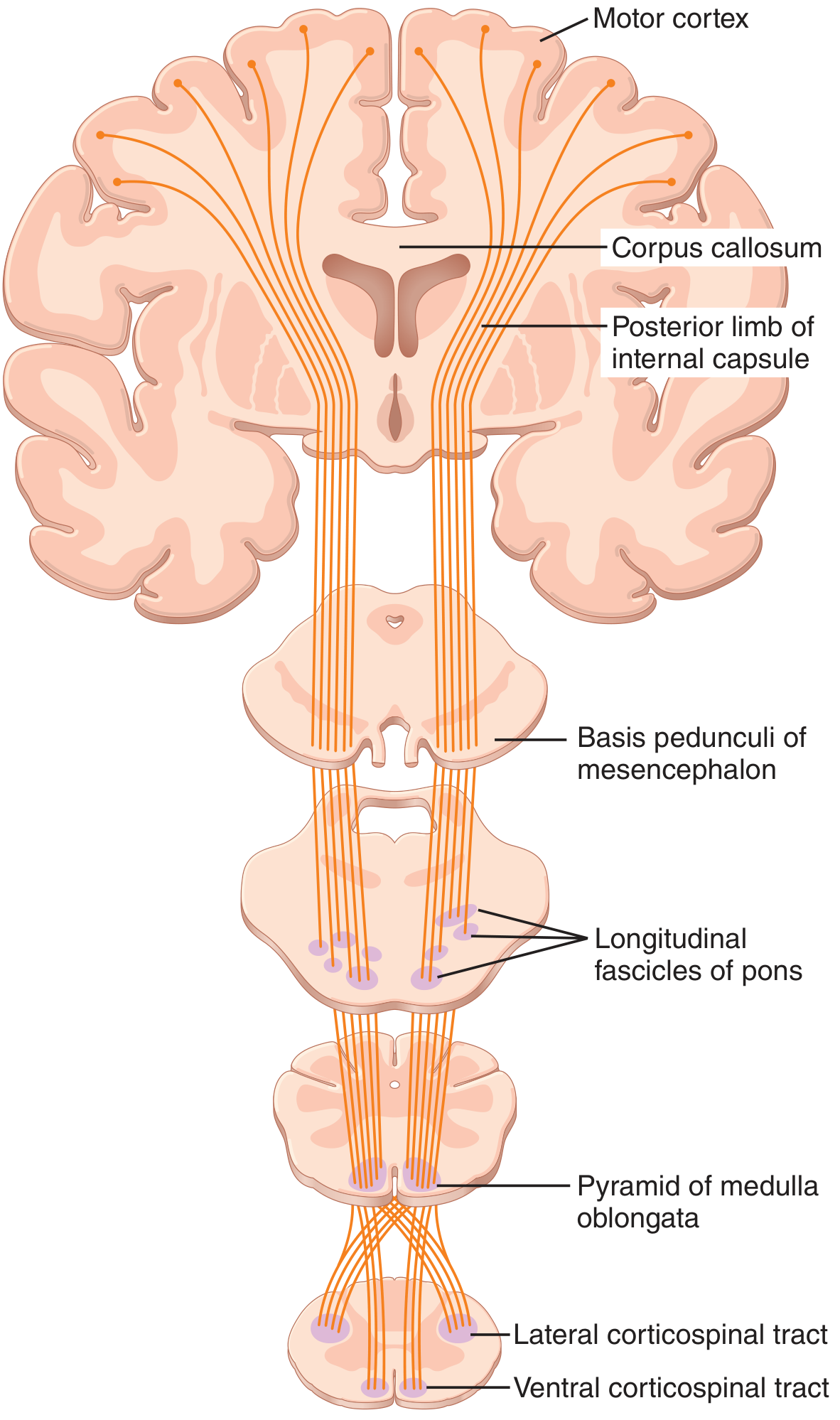
1. Corticospinal (Pyramidal) Tract — Most Important
This is the main voluntary motor pathway.
- Origin: Motor cortex (primary motor cortex 30%, premotor + supplementary 30%, somatosensory cortex 40%)
- Route: Motor cortex → posterior limb of internal capsule → basis pedunculi (midbrain) → longitudinal fascicles of pons → pyramids of medulla
- Decussation: ~85% of fibres cross at the lower medulla → become lateral corticospinal tract
- Remaining 15% stay ipsilateral → become ventral corticospinal tract (cross later in cord)
- End: Interneurons in anterior horn → lower motor neurons → muscles
Key facts for viva:
- Largest fibres = Betz cells (giant pyramidal cells, 60 µm wide) — only in primary motor cortex
- Betz cell axons conduct at 70 m/sec — fastest in the motor system
- Total fibres per tract: >1 million; Betz cell fibres = only 34,000 (~3%)
2. Other Descending Tracts (Extrapyramidal)
| Tract | Origin | Function |
|---|---|---|
| Rubrospinal | Red nucleus (midbrain) | Limb coordination |
| Reticulospinal | Reticular formation | Posture, muscle tone, autonomic |
| Vestibulospinal | Vestibular nuclei | Balance, antigravity muscles |
| Tectospinal | Superior colliculus | Head-turning to visual/auditory stimuli |
Spinal Cord Cross-Section — Tract Map
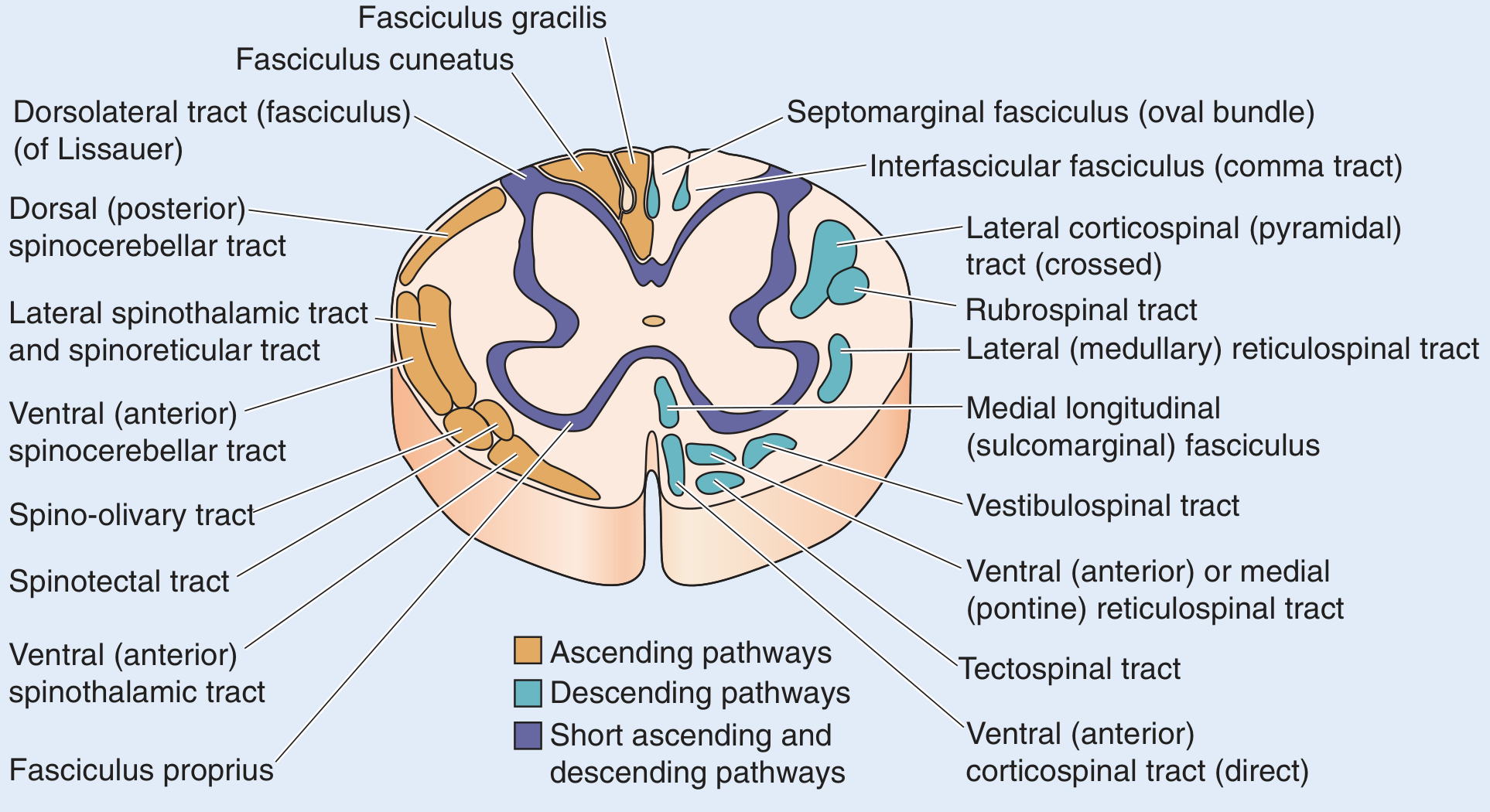
Quick memory:
- Posterior = Sensory (dorsal columns)
- Lateral = Mixed (lateral CST descending + spinothalamic ascending)
- Anterior = Motor (anterior CST)
UMN vs LMN — Viva Favourite
| Feature | UMN Lesion | LMN Lesion |
|---|---|---|
| Weakness | Yes | Yes |
| Tone | Increased (spasticity) | Decreased (flaccid) |
| Reflexes | Hyperreflexia | Hyporeflexia |
| Atrophy | No (or late, disuse) | Yes (early, prominent) |
| Fasciculations | No | Yes |
| Babinski sign | Positive | Negative |
PART 2 — THE AUTONOMIC NERVOUS SYSTEM (ANS)
What is ANS?
Controls automatic/visceral functions (heart, gut, glands, blood vessels). Unlike somatic nerves (1 neuron direct to muscle), ANS always has 2 neurons: preganglionic → ganglion → postganglionic → organ.
TWO DIVISIONS — The Big Picture
| Feature | Sympathetic | Parasympathetic |
|---|---|---|
| Nickname | Fight or Flight | Rest & Digest |
| Origin | T1–L2/L3 (thoracolumbar) | CN III, VII, IX, X + S2–S4 (craniosacral) |
| Preganglionic cell body | Intermediolateral cell column (lamina VII) | Brainstem nuclei (CN III, VII, IX, X) or sacral cord |
| Ganglion location | Near spinal cord (paravertebral or prevertebral) | Near/in the organ |
| Preganglionic fibre | Short | Long |
| Postganglionic fibre | Long | Short |
| Neurotransmitter (preganglionic) | ACh (nicotinic) | ACh (nicotinic) |
| Neurotransmitter (postganglionic) | Norepinephrine (adrenergic) | ACh (muscarinic) |
| Exception! | Sweat glands — sympathetic but uses ACh | — |
Sympathetic Ganglia — 2 Types
- Paravertebral ganglia = Sympathetic chain/trunk (runs alongside vertebral column, C to S)
- Provides sympathetics to head/neck via superior, middle (often absent), inferior (stellate) cervical ganglia
- Prevertebral ganglia = Near aorta
- Celiac ganglion → gut (foregut)
- Superior mesenteric ganglion → midgut
- Inferior mesenteric ganglion → hindgut + pelvic organs
Parasympathetic Cranial Nerve Outflows
| CN | Nucleus | Target |
|---|---|---|
| CN III | Edinger-Westphal nucleus | Pupil constriction, lens accommodation |
| CN VII | Superior salivatory nucleus | Lacrimal gland, submandibular & sublingual glands |
| CN IX | Inferior salivatory nucleus | Parotid gland |
| CN X (Vagus) | Dorsal motor nucleus | Heart, lungs, entire GI tract to splenic flexure |
Sacral S2-S4 → Pelvic nerves → Descending colon, rectum, bladder, genitalia
PART 3 — REGULARITIES OF INNERVATION OF INTERNAL ORGANS
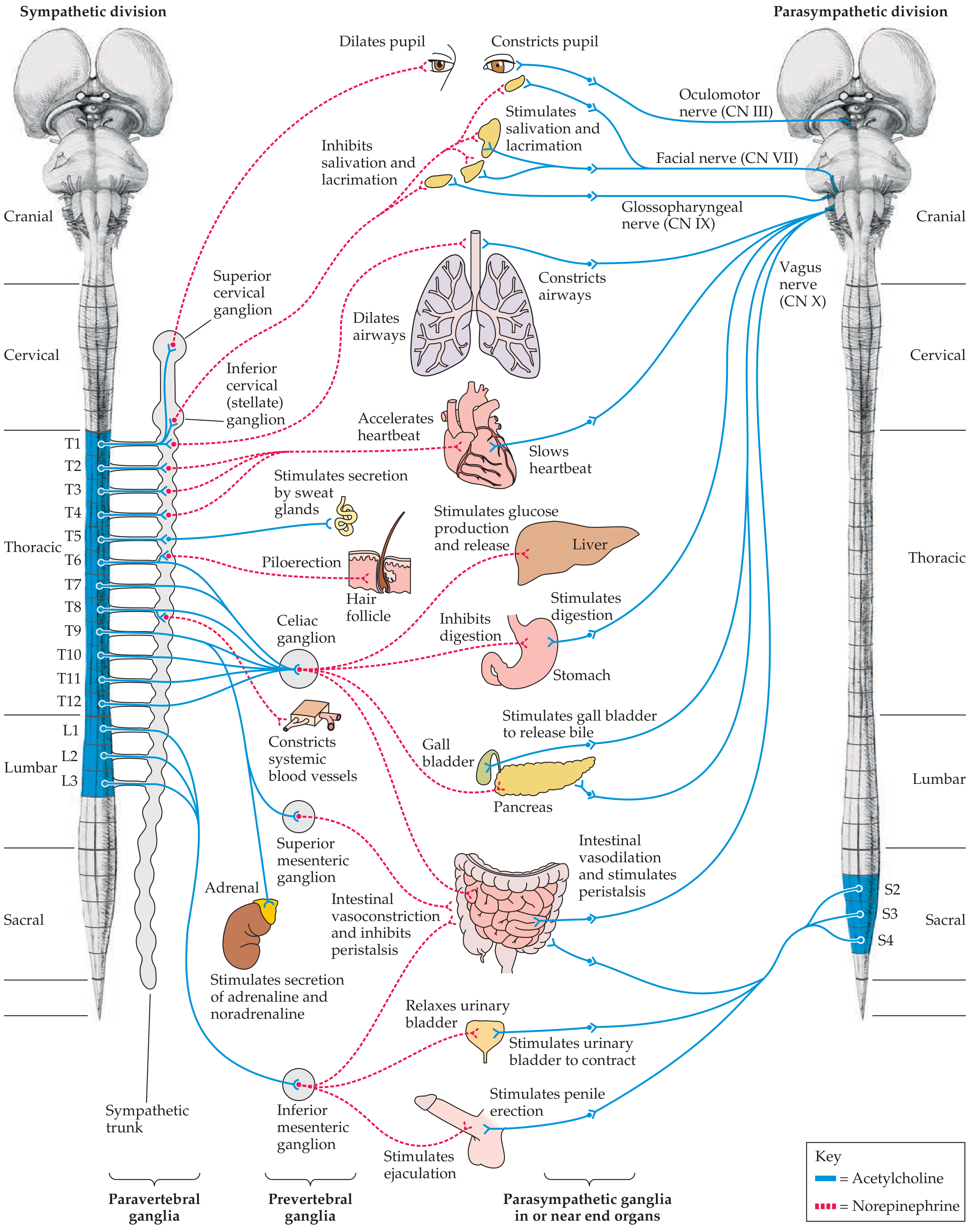
The General Rules (Regularities)
1. Dual Innervation — Most organs get BOTH sympathetic and parasympathetic. They work antagonistically.
2. Reciprocal Effects — One excites, other inhibits:
- Heart: Sympathetic ↑HR & contractility | Parasympathetic ↓HR
- Airways: Sympathetic → bronchodilation | Parasympathetic → bronchoconstriction
- GI tract: Sympathetic → inhibits peristalsis | Parasympathetic → promotes peristalsis
- Pupils: Sympathetic → dilates | Parasympathetic → constricts
- Bladder: Sympathetic → relaxes detrusor, contracts sphincter (retention) | Parasympathetic → contracts detrusor, relaxes sphincter (urination)
3. Single Innervation exceptions — Some organs have only sympathetic:
- Sweat glands, piloerector muscles, most blood vessels, adrenal medulla
4. Dominant tone — At rest, one system usually dominates:
- Heart and GI → parasympathetic dominant at rest
- Blood vessels → sympathetic dominant at rest (maintains vascular tone)
5. Organ-by-organ summary (high yield):
| Organ | Sympathetic | Parasympathetic |
|---|---|---|
| Heart | ↑HR, ↑contractility (β1) | ↓HR (vagus) |
| Lungs | Bronchodilation (β2) | Bronchoconstriction |
| Eye (pupil) | Dilation (α1) | Constriction |
| GI motility | Inhibits (α2, β2) | Stimulates |
| Salivary glands | Thick, mucous saliva | Watery, copious saliva |
| Liver | Glycogenolysis → ↑glucose | — |
| Adrenal medulla | Releases Adrenaline + Noradrenaline | — |
| Bladder | Relaxes wall, closes sphincter | Contracts wall, opens sphincter |
| Penis/Genitalia | Ejaculation | Erection |
Mnemonic: "Parasympathetics point, sympathetics shoot" → Parasympathetic = erection (point); Sympathetic = ejaculation (shoot)
Higher Control of ANS
ANS is regulated by:
- Hypothalamus — master controller
- Nucleus tractus solitarius (NTS) in medulla — cardiovascular/respiratory reflexes
- Amygdala + limbic cortex — emotional responses (fear, anxiety triggering sympathetic)
- Baroreceptors, chemoreceptors, osmoreceptors — peripheral feedback
Quick Viva Summary Card
| Sympathetic | Parasympathetic | |
|---|---|---|
| Origin | T1–L2 | CN III/VII/IX/X + S2–S4 |
| Pre-ganglionic | Short | Long |
| Ganglion site | Near cord | Near/in organ |
| Post-ganglionic NT | Norepinephrine | ACh |
| Effect | Fight-or-flight | Rest-and-digest |
Sources: Neuroanatomy through Clinical Cases 3rd Ed. • Guyton & Hall Medical Physiology • Costanzo Physiology 7th Ed. • Medical Physiology (Boron & Boulpaep)
This is a shared conversation. Sign in to Orris to start your own chat.