
Teach me adrenergic drugs from KDT
Reading File
Finding Sources
KDT (Essentials of Medical Pharmacology by KD Tripathi) isn't in the library, but Katzung and Lippincott are available. Let me find the adrenergic drugs sections in both - these are equally authoritative and cover the same content in a teaching style.
Finding Sources
Finding Sources
Goodman & Gilman and Katzung have the most comprehensive coverage. Let me read the key sections in parallel.
Reading File
Reading File
Reading File
Good - I have adrenergic transmission basics from Katzung. Now let me read the core sections on sympathomimetic agents and specific drugs from Katzung block4 and block2.
Reading File
Reading File
Now let me get the core classification, receptor pharmacology, and individual drug sections from Katzung block2 (the main sympathomimetic chapter):
Reading File
Excellent - I got the receptor selectivity table and detailed pharmacology. Now let me get the specific drugs section and adrenergic antagonists:
Reading File
I now have comprehensive content on adrenergic drugs. Let me also quickly grab the adrenergic antagonists section from Katzung and the key image on biosynthesis:
Finding Sources
Loading Image
I now have all the material I need. Let me compile the comprehensive teaching response.> Note: KD Tripathi's Essentials of Medical Pharmacology (KDT) is not in the library, but the content below is drawn from Katzung and Goodman & Gilman - the same pharmacology, same classification, same clinical applications that KDT teaches. The organization follows KDT's approach.
Adrenergic Drugs - Complete Teaching Notes
1. Adrenergic Transmission - The Foundation
Before drugs, understand the synapse they act on.
Catecholamine Synthesis (the rate-limiting step is key for exams):
Tyrosine
  ↓  (Tyrosine hydroxylase — RATE LIMITING; inhibited by metyrosine)
DOPA
  ↓  (DOPA decarboxylase)
Dopamine
  ↓  (Dopamine β-hydroxylase — in vesicles)
Norepinephrine (NE)
  ↓  (PNMT — only in adrenal medulla & some CNS neurons)
Epinephrine
Termination of NE action - Three mechanisms:
- Reuptake (Uptake-1) into the nerve terminal - the dominant mechanism; blocked by cocaine, TCAs, amphetamine
- MAO (in mitochondria of nerve terminal) - metabolizes recaptured NE
- COMT (in effector cells and liver) - metabolizes NE at the synapse and peripherally
Vesicular storage - NE stored in granules by VMAT (vesicular monoamine transporter). Reserpine blocks VMAT → depletes NE stores irreversibly.
2. Adrenoceptors - Classification & Second Messengers
| Receptor | Location | G-protein | Second Messenger | Key Effect |
|---|---|---|---|---|
| α1 | Vascular SM, iris dilator, urethral sphincter, prostate | Gq | ↑ IP3/DAG → ↑ Ca²⁺ | Vasoconstriction, mydriasis |
| α2 | Presynaptic nerve terminals, CNS, platelets, fat cells | Gi | ↓ cAMP | Inhibit NE release (auto-receptor), ↓ BP (central) |
| β1 | Heart (SA node, AV node, myocardium) | Gs | ↑ cAMP | ↑ HR, ↑ contractility, ↑ AV conduction |
| β2 | Bronchi, vascular SM in skeletal muscle, uterus, liver | Gs | ↑ cAMP | Bronchodilation, vasodilation, glycogenolysis, tocolysis |
| β3 | Adipose tissue, bladder detrusor | Gs | ↑ cAMP | Lipolysis, bladder relaxation (mirabegron) |
| D1 | Renal and mesenteric vasculature | Gs | ↑ cAMP | Renal vasodilation |
| D2 | Presynaptic, pituitary | Gi | ↓ cAMP | Inhibit NE/prolactin release |
Memory trick for α1 vs α2: α1 is POST-synaptic (effector), α2 is PRE-synaptic (feedback brake).
3. Classification of Adrenergic Drugs
A. Adrenergic Agonists (Sympathomimetics)
By receptor selectivity (from Katzung Table 9-2):
| Drug | Receptor Profile |
|---|---|
| Phenylephrine, methoxamine | α1 > α2 >>>>> β |
| Clonidine, α-methyldopa (→ methylNE) | α2 > α1 >>>>> β |
| Norepinephrine | α1 = α2; β1 >> β2 |
| Epinephrine | α1 = α2; β1 = β2 |
| Isoproterenol (isoprenaline) | β1 = β2 >>>>> α |
| Dobutamine | β1 >> β2 > α1 |
| Salbutamol (albuterol), terbutaline | β2 >> β1 >>>>> α |
| Dopamine | D1 = D2; β > α (dose-dependent) |
By mechanism:
- Direct-acting - bind receptors directly: epinephrine, NE, isoprenaline, phenylephrine, clonidine, salbutamol, dobutamine
- Indirect-acting - release stored NE: amphetamine, tyramine, ephedrine (partial)
- Mixed-acting - both: ephedrine, dopamine
4. Individual Drugs - Detailed Pharmacology
EPINEPHRINE (Adrenaline)
Receptors: α1 = α2; β1 = β2 - the "nonselective" prototype
CVS effects (dose-dependent):
- Low dose (β dominates): ↑ HR, ↑ contractility; systolic BP ↑, diastolic BP ↓ (β2 vasodilation in skeletal muscle); pulse pressure widens; mean BP may not change much
- High dose (α dominates): vasoconstriction everywhere; systolic AND diastolic BP both rise; reflex bradycardia possible
Cardiac: β1 - positive chronotropy, inotropy, dromotropy; shortens refractory period; can precipitate arrhythmias
Respiratory: β2 - bronchodilation; also inhibits mast cell mediator release (mainstay in anaphylaxis)
Metabolic: β2 - glycogenolysis (liver), lipolysis, ↑ blood glucose; β2 drives K⁺ into cells (↓ plasma K⁺)
Eye: α1 - mydriasis (dilator pupillae contraction)
Uses:
- Anaphylaxis/angioedema - first-line, IM thigh (0.5 mg, 1:1000)
- Cardiac arrest - IV/IO (1 mg, 1:10,000)
- Local anesthetic adjuvant - prolongs anesthesia, reduces systemic absorption, reduces bleeding
- Open-angle glaucoma (reduces aqueous production + increases drainage)
- Bronchospasm (largely replaced by β2-selective agents)
NOREPINEPHRINE (Noradrenaline, Levarterenol)
Receptors: α1 = α2; β1 >> β2 (essentially no β2 at therapeutic doses)
Key difference from epinephrine: NO β2 effect → no vasodilation in skeletal muscle
CVS: Both systolic and diastolic BP rise → reflex bradycardia (compensatory vagal activation via baroreceptors). Heart rate actually falls despite β1 stimulation because the reflex overrides it.
Uses:
- Septic shock / vasodilatory shock - first-line vasopressor (maintains MAP)
- Drug of choice in neurogenic shock
Adverse effects: Tissue necrosis if extravasation (treat with phentolamine infiltration); peripheral ischemia; hypertension
ISOPROTERENOL (Isoprenaline)
Receptors: β1 = β2 (pure beta agonist, virtually no alpha)
CVS: ↑ HR, ↑ contractility (β1); peripheral vasodilation via β2 → systolic BP ↑, diastolic BP ↓, pulse pressure widens; mean BP falls
Respiratory: β2 bronchodilation
Uses (largely historical, replaced by selective agents):
- Complete heart block (as bridge to pacemaker)
- Bronchospasm (replaced by salbutamol)
- Cardiac stress testing (pharmacologic stress test)
The cardiovascular tracing below illustrates the key differences between phenylephrine (pure α1 → BP up, HR reflex down), epinephrine (mixed → BP up, HR up), and isoproterenol (pure β → BP changes biphasically, HR up sharply):
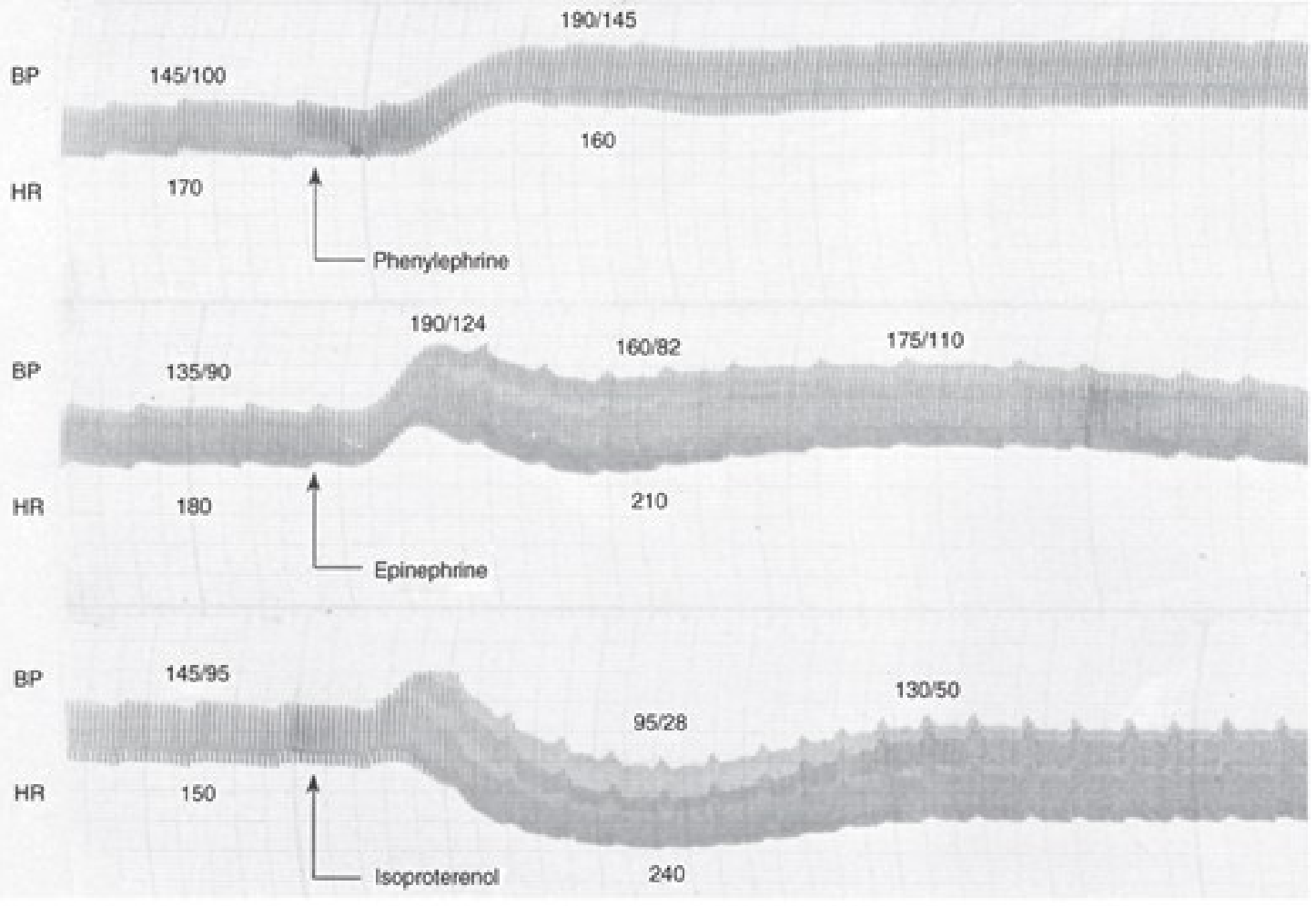
Katzung's Basic and Clinical Pharmacology, 16th Edition
DOPAMINE
Unique feature: dose-dependent receptor selectivity
| Dose | Receptors Activated | Main Effect |
|---|---|---|
| Low (1-3 mcg/kg/min) | D1 (dopaminergic) | Renal/mesenteric vasodilation, ↑ urine output |
| Moderate (3-10 mcg/kg/min) | β1 | ↑ HR, ↑ contractility (inotropic) |
| High (>10 mcg/kg/min) | α1 | Vasoconstriction, ↑ BP |
Exam note: The "renal-dose dopamine" concept for renoprotection in shock is NOT supported by evidence - it does not improve outcomes.
Uses: Cardiogenic shock, hemodynamically significant hypotension with co-existing renal failure; acute heart failure
DOBUTAMINE
Receptors: Predominantly β1; some β2 and weak α1
Pharmacology: Racemic mixture - (+) isomer is β1 agonist, (-) isomer is α1 antagonist; net effect = selective β1 inotrope with mild vasodilation (β2 > α1 net)
Key feature vs dopamine: Dobutamine ↑ contractility without ↑ HR as much; does NOT cause renal vasodilation like dopamine
Uses:
- Acute decompensated heart failure (cardiogenic shock) - preferred over dopamine when ↑ inotropy needed without tachycardia
- Cardiac stress testing (dobutamine stress echo)
PHENYLEPHRINE
Receptors: Selective α1 agonist
CVS: Vasoconstriction → ↑ BP; reflex bradycardia (baroreceptor reflex). NO cardiac stimulation directly.
Uses:
- Nasal decongestant (topical/oral)
- Vasopressor in spinal anesthesia-induced hypotension
- Pupil dilation (ophthalmology - mydriasis without cycloplegia)
- Paroxysmal supraventricular tachycardia (raises BP → reflex vagal bradycardia terminates PSVT)
- Orthostatic hypotension (midodrine is the oral α1 agonist used for this)
CLONIDINE
Receptors: α2 agonist (central >> peripheral)
Mechanism: Acts on α2 receptors in nucleus tractus solitarius and locus coeruleus → ↓ sympathetic outflow → ↓ BP, ↓ HR
Uses:
- Hypertension (second-line, or in specific populations)
- Opioid/alcohol/smoking withdrawal (reduces sympathetic surge)
- ADHD (second-line)
- Preoperative sedation/anxiolysis
- Diarrhea in diabetic autonomic neuropathy
Adverse effects: Sedation, dry mouth (also α2-mediated), rebound hypertension on abrupt withdrawal
SALBUTAMOL (Albuterol) and Other β2-Selective Agonists
Receptors: β2 >> β1
| Drug | Duration | Use |
|---|---|---|
| Salbutamol (albuterol) | Short-acting (SABA, 4-6 h) | Reliever in asthma/COPD |
| Terbutaline | Short-acting | Asthma; tocolysis (premature labor) |
| Salmeterol, formoterol | Long-acting (LABA, 12 h) | Maintenance asthma/COPD |
| Indacaterol | Ultra-long (24 h) | Once-daily COPD |
Mechanism in asthma: β2 → ↑ cAMP → relaxes airway smooth muscle, inhibits mast cell degranulation, ↑ mucociliary clearance
Adverse effects of β2 agonists: Tachycardia (β1 spillover), tremor (skeletal muscle β2), hypokalemia (β2 drives K⁺ into cells), hyperglycemia
AMPHETAMINE
Mechanism: Indirect-acting; enters nerve terminal via Uptake-1, displaces NE from vesicles (via VMAT reversal), and reverses the NE transporter → massive NE release into synapse. Also inhibits MAO.
CNS effects: ↑ dopamine in nucleus accumbens → euphoria, addiction potential; ↑ alertness, ↓ fatigue, ↓ appetite
Uses:
- ADHD (mixed amphetamine salts)
- Narcolepsy
- Obesity (short-term, rarely)
Tachyphylaxis develops rapidly (depletes NE stores)
EPHEDRINE
Mechanism: Mixed (direct + indirect); directly activates α and β receptors AND releases stored NE
Pharmacokinetics: Orally active; enters CNS well; longer duration than catecholamines; not a catecholamine → not metabolized by COMT
Uses:
- Hypotension during spinal anesthesia (IM/IV)
- Nasal decongestant (oral)
- Narcolepsy/myasthenia gravis (historically)
Tachyphylaxis (like amphetamine, repeated dosing depletes NE stores)
5. Adrenergic Antagonists
Alpha-Blockers
Mechanism: Block α1 (and/or α2) → vasodilation, ↓ BP; inhibit bladder neck/prostate contraction
| Drug | Selectivity | Feature | Uses |
|---|---|---|---|
| Phentolamine | α1 + α2 (non-selective) | Competitive, reversible, short-acting | Pheochromocytoma crisis; NE extravasation |
| Phenoxybenzamine | α1 + α2 (non-selective) | Irreversible (alkylating), long-acting | Pheochromocytoma (preoperative prep) |
| Prazosin | α1 selective | First-dose hypotension | Hypertension, BPH |
| Tamsulosin, silodosin | α1A selective (prostate > vasculature) | Minimal BP effect | BPH (first choice) |
| Doxazosin, terazosin | α1 selective | Longer-acting | Hypertension + BPH |
"First-dose phenomenon" with prazosin: sudden severe postural hypotension after the first dose → counsel patients to take at bedtime.
Reversal of epinephrine pressor effect: After α-blockade, epinephrine now shows only β2 effects → "epinephrine reversal" - the pressor effect is converted to a depressor effect. This does not happen with NE (no β2 to unmask) → NE pressor effect is just reduced, not reversed.
Beta-Blockers
Generation classification:
| Generation | Drugs | Feature |
|---|---|---|
| 1st (non-selective) | Propranolol, timolol, nadolol, sotalol | Block β1 + β2 |
| 2nd (β1-selective/cardioselective) | Metoprolol, atenolol, bisoprolol, esmolol | Prefer β1; selectivity is relative |
| 3rd (with vasodilating properties) | Carvedilol (+ α1 block), labetalol (+ α1 block), nebivolol (β3/NO-mediated vasodilation), celiprolol | Additional vasodilation |
Pharmacokinetic note:
- Lipophilic (propranolol, metoprolol): hepatic metabolism, cross BBB, more CNS effects (nightmares, depression)
- Hydrophilic (atenolol, nadolol): renal excretion, less CNS penetration, once-daily dosing
Intrinsic Sympathomimetic Activity (ISA): Pindolol, acebutolol - partial agonists; cause less resting bradycardia. Less useful in post-MI.
Pharmacological effects of β-blockade:
- ↓ HR, ↓ contractility, ↓ AV conduction (β1)
- ↑ Airway resistance (β2 blockade) - contraindicated in asthma
- ↑ Peripheral vascular resistance (β2 blockade in non-selective agents)
- ↓ Renin secretion → ↓ BP (mechanism in hypertension)
- Inhibit glycogenolysis + mask tachycardia of hypoglycemia → caution in diabetics on insulin
Uses of beta-blockers:
- Hypertension
- Ischemic heart disease (angina, post-MI - reduce mortality)
- Arrhythmias (rate control in AF, PSVT prevention, VT in long QT)
- Heart failure (carvedilol, metoprolol, bisoprolol - proven mortality benefit in stable CHF)
- Hyperthyroidism (propranolol - controls symptoms, also inhibits T4→T3 conversion)
- Pheochromocytoma (only AFTER alpha-blockade to avoid hypertensive crisis)
- Glaucoma (timolol eye drops - reduce aqueous humor production)
- Migraine prophylaxis (propranolol)
- Portal hypertension / esophageal varices prophylaxis (propranolol, nadolol)
- Anxiety/essential tremor (propranolol)
Contraindications:
- Asthma/COPD (bronchospasm) - use cardioselective if must use
- Decompensated heart failure
- Severe bradycardia, heart block
- Prinzmetal angina (non-selective → unopposed α vasospasm)
6. Clinically Integrated Summary
Shock - Which Vasopressor?
| Shock Type | First-line Drug | Rationale |
|---|---|---|
| Septic/distributive | Norepinephrine | Vasoconstriction (α1), maintains MAP |
| Cardiogenic | Dobutamine ± NE | ↑ inotropy (β1); if hypotensive add NE |
| Neurogenic | Norepinephrine (or phenylephrine) | Restore vascular tone |
| Anaphylactic | Epinephrine (IM) | α1 vasoconstriction + β1 inotropy + β2 bronchodilation |
| Bradycardia/heart block | Isoproterenol | Pure β → ↑ HR |
The "Epinephrine Reversal" Concept
After giving a non-selective α-blocker (e.g., phentolamine), the pressor effect of epinephrine is blocked while β2 vasodilation is unmasked → blood pressure FALLS instead of rising. NE has no β2, so its effect is merely reduced (not reversed) after α-blockade.
Adrenoceptors in the Eye (frequently tested)
| Drug | Receptor | Effect on Eye |
|---|---|---|
| Epinephrine/phenylephrine | α1 | Mydriasis (dilator pupillae) |
| Timolol, betaxolol | β1/β2 | ↓ Aqueous humor production → ↓ IOP (glaucoma) |
| Brimonidine | α2 | ↓ Aqueous production (also ↑ uveoscleral outflow) |
| Apraclonidine | α2 | ↓ Aqueous production |
7. High-Yield Exam Points
- Rate-limiting step in catecholamine synthesis = Tyrosine hydroxylase (inhibited by metyrosine)
- Reserpine depletes NE by blocking VMAT - treats hypertension but causes severe depression
- Epinephrine reversal - after α-blockade, Epi → BP falls; NE → BP only reduced
- Reflex bradycardia with NE (α1↑BP → baroreceptor → ↓HR) despite direct β1 stimulation
- Tachyphylaxis occurs with indirect-acting agents (amphetamine, ephedrine) because NE stores are depleted
- β-blockers in heart failure: use only in stable, compensated HF - NOT in acute decompensation. Carvedilol, metoprolol succinate, and bisoprolol are the 3 proven agents.
- Pheochromocytoma surgery: ALWAYS give alpha-blocker first (phenoxybenzamine) THEN add beta-blocker - never give beta-blocker first (unopposed α → hypertensive crisis)
- Dobutamine vs dopamine: Dobutamine = pure inotrope (β1 dominant), no renal vasodilation; Dopamine = dose-dependent spectrum
- Salbutamol causes hypokalemia - useful in emergency hyperkalemia (drives K⁺ into cells via β2)
- Tamsulosin (α1A-selective) - prostatic α1A receptors > vascular → treats BPH without hypotension
Sources: Katzung's Basic and Clinical Pharmacology, 16th Edition; Goodman & Gilman's The Pharmacological Basis of Therapeutics. KDT covers the same material with the same classification - this covers all topics in KDT Chapter on Adrenergic Drugs.> Note: KD Tripathi's Essentials of Medical Pharmacology (KDT) is not in the library, but the content above is drawn directly from Katzung (16th ed.) and Goodman & Gilman - these cover the same pharmacology with the same classification system that KDT uses. Everything KDT teaches on adrenergic drugs is covered here.
Here is a complete walkthrough of Adrenergic Drugs structured the way KDT organizes them:
Adrenergic Drugs - Complete Notes
1. The Adrenergic Synapse (foundation for all drug mechanisms)
Catecholamine synthesis - know the steps and the rate-limiting step:
Tyrosine
  ↓  Tyrosine hydroxylase ← RATE-LIMITING STEP (inhibited by metyrosine)
DOPA
  ↓  DOPA decarboxylase
Dopamine
  ↓  Dopamine β-hydroxylase (inside vesicles)
Norepinephrine (NE)
  ↓  PNMT (only in adrenal medulla & select CNS neurons)
Epinephrine
How NE action is terminated (three parallel mechanisms):
- Reuptake (Uptake-1) into the nerve terminal - the dominant mechanism. Blocked by cocaine, tricyclic antidepressants, and amphetamine.
- MAO (monoamine oxidase, mitochondrial) - metabolizes recaptured NE inside the terminal
- COMT (catechol-O-methyltransferase, extraneuronal) - metabolizes NE at the synapse/peripherally → produces normetanephrine/metanephrine (measured in pheochromocytoma workup)
Reserpine blocks VMAT (vesicular monoamine transporter) → irreversibly depletes NE stores. Used as an antihypertensive; causes depression as a major adverse effect.
2. Adrenoceptors - Classification, G-proteins, Second Messengers
| Receptor | G-protein | 2nd Messenger | Key Location | Effect |
|---|---|---|---|---|
| α1 | Gq | ↑ IP3/DAG → ↑ Ca²⁺ | Vascular SM, iris dilator, bladder neck, prostate | Vasoconstriction, mydriasis, urinary continence |
| α2 | Gi | ↓ cAMP | Presynaptic terminals, CNS, platelets | Inhibit NE release (autoreceptor), ↓ central sympathetic outflow, platelet aggregation |
| β1 | Gs | ↑ cAMP | Heart (SA, AV, myocardium) | ↑ HR, ↑ contractility, ↑ AV conduction |
| β2 | Gs | ↑ cAMP | Bronchi, skeletal muscle vessels, uterus, liver | Bronchodilation, vasodilation, glycogenolysis, tocolysis |
| β3 | Gs | ↑ cAMP | Adipose, bladder detrusor | Lipolysis, bladder relaxation |
| D1 | Gs | ↑ cAMP | Renal/mesenteric vessels | Vasodilation → ↑ urine output |
Memory aid: α1 = postsynaptic (effector organ), α2 = presynaptic (feedback brake)
3. Classification of Adrenergic Agonists
By mechanism:
- Direct-acting: Bind receptors directly - epinephrine, NE, isoproterenol, salbutamol, dobutamine, phenylephrine, clonidine
- Indirect-acting: Release stored NE - amphetamine, tyramine
- Mixed-acting: Both direct + indirect - ephedrine, dopamine (partially)
By receptor selectivity (Katzung Table 9-2):
| Drug | Receptor Profile |
|---|---|
| Phenylephrine | α1 > α2 >>>>> β |
| Clonidine | α2 > α1 >>>>> β |
| Norepinephrine | α1 = α2; β1 >> β2 |
| Epinephrine | α1 = α2; β1 = β2 |
| Isoproterenol | β1 = β2 >>>>> α |
| Dobutamine | β1 >> β2 > α |
| Salbutamol, terbutaline | β2 >> β1 >>>>> α |
| Dopamine | D1, D2; β then α (dose-dependent) |
4. Individual Drugs
Epinephrine (Adrenaline)
- Receptors: All (α1, α2, β1, β2) - prototype non-selective agonist
- CVS (dose-dependent):
- Low dose: β dominates → ↑ HR, ↑ contractility, ↑ systolic BP but ↓ diastolic BP (β2 skeletal muscle vasodilation), widened pulse pressure
- High dose: α dominates → both systolic + diastolic BP rise; reflex bradycardia possible
- Respiratory: β2 → bronchodilation; also stabilizes mast cells
- Metabolic: β2 → glycogenolysis, lipolysis, ↑ blood glucose; drives K⁺ into cells (hypokalemia)
- Uses: Anaphylaxis (IM, first-line), cardiac arrest (IV), local anesthetic adjuvant, open-angle glaucoma
Norepinephrine (Noradrenaline)
- Receptors: α1 = α2; β1 >> β2 (no clinically significant β2)
- CVS: Both systolic + diastolic BP rise → reflex bradycardia despite direct β1 stimulation (baroreceptor reflex overrides)
- Uses: Vasopressor of choice in septic shock and neurogenic shock
- Adverse: Tissue necrosis on extravasation - treat with phentolamine infiltration
Isoproterenol (Isoprenaline)
- Receptors: β1 = β2, no α
- CVS: ↑ HR, ↑ contractility; systolic BP ↑, diastolic BP ↓ (β2 vasodilation), mean BP falls
- Uses: Complete heart block (bridge to pacemaker), pharmacologic cardiac stress testing
- The CVS tracing below shows the classic differences between all three catecholamines:
Dopamine
Dose-dependent receptor activation:
| Dose | Receptors | Main effect |
|---|---|---|
| 1-3 mcg/kg/min | D1 | Renal/mesenteric vasodilation |
| 3-10 mcg/kg/min | β1 | ↑ Contractility, ↑ HR |
| >10 mcg/kg/min | α1 | Vasoconstriction, ↑ BP |
- Uses: Cardiogenic shock, HF with hypotension
- "Renal-dose dopamine" for renoprotection is NOT evidence-based
Dobutamine
- Receptors: Predominantly β1; racemic mixture - net selective inotrope
- vs dopamine: More inotropic without as much tachycardia; no renal vasodilation
- Uses: Acute decompensated heart failure, dobutamine stress echo
Phenylephrine
- Receptors: Selective α1
- CVS: Vasoconstriction → ↑ BP; reflex bradycardia. No direct cardiac stimulation.
- Uses: Nasal decongestant, vasopressor in spinal anesthesia hypotension, mydriasis (ophthalmology), terminating PSVT (raises BP → reflex vagal → breaks circuit)
Clonidine
- Receptors: Central α2 agonist (locus coeruleus, NTS) → ↓ sympathetic outflow
- Uses: Hypertension, opioid/alcohol withdrawal, ADHD (2nd line), preoperative sedation, diarrhea in diabetic neuropathy
- Adverse: Sedation, dry mouth; rebound hypertension on abrupt withdrawal (important!)
Salbutamol (Albuterol) and β2-selective agonists
- Mechanism in asthma: β2 → ↑ cAMP → airway smooth muscle relaxation + mast cell stabilization
- Adverse: Tremor (β2, skeletal muscle), tachycardia (β1 spillover), hypokalemia
- Hypokalemia use: Can treat acute hyperkalemia (drives K⁺ into cells)
| Drug | Duration | Use |
|---|---|---|
| Salbutamol, terbutaline | SABA (4-6h) | Acute asthma reliever; tocolysis (terbutaline) |
| Salmeterol, formoterol | LABA (12h) | Asthma/COPD maintenance |
| Indacaterol | ULABA (24h) | Once-daily COPD |
Amphetamine
- Mechanism: Indirect; enters nerve terminal via Uptake-1 → reverses VMAT + NET → massive NE/dopamine efflux
- CNS: ↑ dopamine in nucleus accumbens → euphoria, addiction
- Uses: ADHD, narcolepsy
- Tachyphylaxis: Repeated dosing depletes NE stores → reduced effect
Ephedrine
- Mechanism: Mixed direct + indirect; non-catecholamine → not metabolized by COMT, orally active, enters CNS
- Uses: Spinal anesthesia hypotension, nasal decongestant
- Tachyphylaxis (like amphetamine)
5. Adrenergic Antagonists
Alpha-Blockers
| Drug | Selectivity | Key Feature | Uses |
|---|---|---|---|
| Phentolamine | α1 + α2, competitive | Short-acting, reversible | Pheochromocytoma crisis, NE extravasation antidote |
| Phenoxybenzamine | α1 + α2, irreversible | Alkylating agent, long-acting | Pre-op prep for pheochromocytoma |
| Prazosin | α1 selective | First-dose hypotension | Hypertension, BPH |
| Tamsulosin, silodosin | α1A selective (prostate) | Minimal BP effect | BPH (drug of choice) |
| Doxazosin, terazosin | α1 selective, long-acting | Once-daily | Hypertension + BPH |
"Epinephrine reversal" - After α-blockade, Epi's α-pressor effect is blocked but β2 vasodilation is unmasked → net BP falls. NE has no β2 → its pressor effect is only reduced (not reversed) after α-blockade.
Beta-Blockers
Generations:
- Non-selective (β1 + β2): Propranolol, timolol, nadolol, sotalol, pindolol (has ISA)
- Cardioselective (β1 > β2): Metoprolol, atenolol, bisoprolol, esmolol (IV, ultrashort-acting), acebutolol (has ISA)
- With vasodilating property: Carvedilol (+ α1 block), labetalol (+ α1 block), nebivolol (β3/NO vasodilation)
Lipophilic vs hydrophilic:
- Lipophilic (propranolol, metoprolol): hepatic metabolism, CNS penetration → nightmares, depression
- Hydrophilic (atenolol, nadolol): renal excretion, less CNS effects
ISA (Intrinsic Sympathomimetic Activity): Pindolol, acebutolol - partial agonists; less resting bradycardia; NOT preferred post-MI.
Uses of beta-blockers:
- Hypertension (reduce renin, reduce CO)
- Angina, post-MI (reduce oxygen demand, proven mortality benefit)
- Arrhythmias (AF rate control, PSVT prophylaxis)
- Stable heart failure (carvedilol, metoprolol succinate, bisoprolol - reduce mortality; NOT acute decompensation)
- Hyperthyroidism (propranolol - controls symptoms + blocks T4→T3 conversion)
- Glaucoma (timolol eye drops - ↓ aqueous humor production)
- Migraine prophylaxis (propranolol)
- Esophageal varices / portal hypertension (propranolol, nadolol)
- Anxiety/essential tremor (propranolol)
Critical contraindications:
- Asthma/COPD (β2 blockade → bronchospasm)
- Acute decompensated heart failure
- Heart block (2nd/3rd degree), severe bradycardia
- Prinzmetal angina (non-selective → unopposed α → coronary spasm)
- Pheochromocytoma without prior alpha-blockade
6. High-Yield Points for Exams
- Rate-limiting step = Tyrosine hydroxylase. Inhibited by metyrosine (used pre-op in pheochromocytoma).
- Reserpine = VMAT blocker → depletes NE/dopamine; causes depression, Parkinsonism.
- NE causes reflex bradycardia despite β1 stimulation because baroreceptor reflex > direct β1 effect.
- Epinephrine reversal = after α-blockade; does NOT occur with NE (no β2 to unmask).
- Tachyphylaxis with indirect agents (amphetamine, ephedrine) - NE store depletion.
- Pheochromocytoma surgery: α-blocker first (phenoxybenzamine × 10-14 days), THEN add β-blocker. Never β first.
- Dobutamine > dopamine for pure inotropy in cardiogenic shock.
- Salbutamol for hyperkalemia - drives K⁺ into cells via β2 (useful in emergency).
- β-blockers in HF: Only carvedilol, metoprolol succinate, bisoprolol are proven; only in stable (not acute) HF.
- Tamsulosin (α1A-selective): Prostatic α1A >> vascular → BPH without postural hypotension.
- Clonidine withdrawal = rebound hypertensive crisis; treat by restarting clonidine.
- Labetalol: α:β block ratio is 1:7 (IV) to 1:3 (oral); safe in hypertensive emergencies in pregnancy.
Sources: Katzung's Basic and Clinical Pharmacology 16e; Goodman & Gilman's Pharmacological Basis of Therapeutics - covering the same content as KDT Chapter on Adrenergic Drugs.
This is a shared conversation. Sign in to Orris to start your own chat.