
PENG Block
Reading File
The PENG block (also called the Pectoral Nerve block or Pericapsular Nerve Group block) is a regional anesthesia technique. Let me search the medical library for detailed information.
Searching sources...
Finding Sources
Finding Sources
Searching the Web
PENG block pericapsular nerve group block hip fracture anesthesia technique
Good - I found dedicated sections in both Miller's Anesthesia and Morgan & Mikhail. Let me read both sections in parallel.
Reading File
Reading File
Let me get the full PENG block section from Miller's, which has the most detail:
Reading File
Loading Image
Searching PubMed
"PENG block" OR "pericapsular nerve group" hip fracture
I have rich content from the textbooks and current evidence. Here is the complete summary:
PENG Block (Pericapsular Nerve Group Block)
Overview
The PENG block is a fascial plane block for hip analgesia first described in 2018 by Girón-Arango et al. at Toronto Western Hospital. The name reflects both the acronym (Pericapsular Nerve Group) and its pioneer, Dr. Philip Peng. It is performed under ultrasound guidance as a single injection into the musculofascial plane between the psoas tendon (anteriorly) and the pubic ramus (posteriorly).
Mechanism & Target Nerves
The PENG block targets the sensory articular branches of three nerves that innervate the anterior hip joint capsule:
| Nerve | Contribution |
|---|---|
| Femoral nerve | Articular branches to anterior capsule |
| Accessory obturator nerve | Branches near iliopubic eminence |
| Obturator nerve | Articular branches to medial/inferior capsule |
By targeting only articular (sensory) branches rather than the main nerve trunks, the block provides analgesia while sparing motor function - a key advantage over femoral nerve block (FNB) and fascia iliaca compartment block (FICB).
- Miller's Anesthesia, 10e - p. 11122
Indications
- Hip fractures (pre- and peri-operatively) - primary indication
- Total hip arthroplasty (especially anterior approach)
- Hip arthroscopy
- Chronic hip pain (via denervation)
- Multimodal analgesia component for hip surgery
Ultrasound-Guided Technique
Patient position: Supine
Probe: Linear high-frequency probe placed along the inguinal ligament, in the same direction as the inguinal crease, between the pubic ramus and the ASIS.
Sonographic landmarks identified:
- Anterior inferior iliac spine (AIIS)
- Iliopubic eminence (IPE)
- Femoral artery (medially)
- Psoas muscle and psoas tendon
- Superior pubic ramus (floor)
Needle: 22-gauge, inserted in-plane, lateral to medial, until it contacts the pubic ramus lateral to the psoas tendon.
Injection: After negative aspiration and confirming the tip is not intramuscular, local anesthetic is deposited into the musculofascial plane deep to the psoas tendon.
Local anesthetic:
- Ropivacaine 0.2-0.5%, 3 mg/kg, up to 20 mL
- Alternatively: bupivacaine or levobupivacaine
- 15-20 mL of 0.375% ropivacaine commonly used
The PENG block has been successfully performed in both adult and pediatric patients.
- Miller's Anesthesia, 10e - p. 11122
Ultrasound Image (PENG Block - Sonoanatomy)
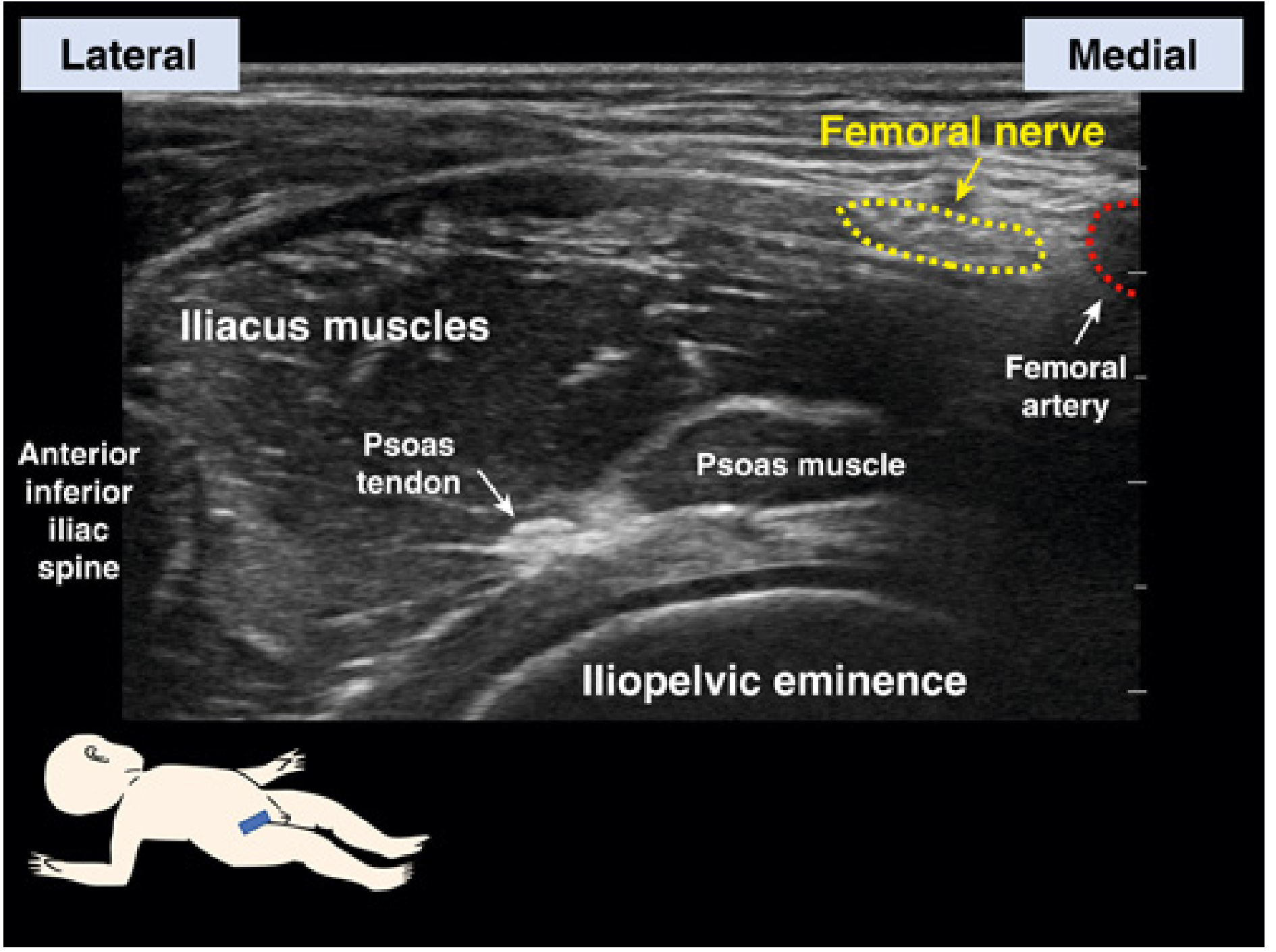
The needle is inserted lateral to medial, targeting the plane lateral to the psoas tendon and posterior to the pubic ramus. The femoral nerve and artery are visible medially.
Advantages Over Other Hip Blocks
| Feature | PENG Block | Femoral Nerve Block | FICB |
|---|---|---|---|
| Motor sparing | Yes (articular branches only) | No (main trunk) | Partial |
| Injection sites | 1 | 1 | 1-2 |
| Obturator coverage | Yes (accessory obturator) | Minimal | Variable |
| Posterior capsule | Limited | No | No |
| Complexity | Low-moderate | Low | Low |
Compared to FNB, the PENG block avoids quadriceps weakness, which is particularly important for early mobilization and fall prevention in hip fracture patients. It is often combined with a lateral femoral cutaneous nerve (LFCN) block for more complete coverage when used as a surgical anesthetic adjunct.
- Barash Clinical Anesthesia, 9e - p. 1476
Limitations
- Does not cover the posterior hip capsule (innervated by sciatic/superior gluteal nerves)
- Cannot serve as the sole anesthetic for hip surgery - must be combined with other blocks or neuraxial techniques
- Limited evidence at time of Morgan & Mikhail (7e) writing; however, recent RCTs and meta-analyses now strongly support its use
Current Evidence (2023-2025)
Recent high-quality evidence supports the PENG block:
- A 2024 meta-analysis (Hu X et al.) confirms PENG block significantly reduces opioid consumption and pain scores after hip surgery vs. control [PMID: 39514540]
- A 2024 network meta-analysis in Annals of Emergency Medicine (Hayashi et al.) assessed peripheral nerve blocks for hip fractures preoperatively - PENG was among leading techniques [PMID: 38385910]
- A 2025 RCT in Anaesthesia directly compared PENG vs. fascia iliaca block for acute hip fracture pain [PMID: 40727959]
- A 2024 meta-analysis (Li S et al.) found PENG block safe and efficacious for hip fracture surgery under spinal anesthesia [PMID: 38510561]
A useful visual walkthrough of the technique:
Summary
The PENG block is a single-injection, ultrasound-guided fascial plane block depositing local anesthetic between the psoas tendon and the pubic ramus. It selectively targets sensory articular branches of the femoral, accessory obturator, and obturator nerves to provide effective hip analgesia while preserving quadriceps motor function. It is now well-supported by RCTs and meta-analyses as a preferred analgesic technique for hip fractures and arthroplasty.
I pack block
The iPACK block (Infiltration between the Popliteal Artery and the Capsule of the Knee) is a regional anesthesia technique for posterior knee analgesia. Let me pull up the full details from the textbooks.
Searching sources...
Finding Sources
Finding Sources
Searching the Web
iPACK block infiltration popliteal artery capsule knee regional anesthesia technique
Excellent results. Now let me read the full textbook sections in parallel:
Reading File
Reading File
Reading File
Searching PubMed
"iPACK" OR "IPACK block" knee arthroplasty analgesia
Your credits are exhausted. You can purchase a top-up or subscribe to a plan to continue using Orris. If you're already subscribed, your daily credits will reset tomorrow.
This is a shared conversation. Sign in to Orris to start your own chat.