I now have comprehensive information. Let me compile the full management response.
Management of Acute Watery Diarrhea (Likely Cholera / Secretory Gastroenteritis) in a 22-Year-Old
The clinical picture - sudden onset, profuse watery ("rice-water") stools, 6 episodes, fluid in = fluid out - is classic for secretory diarrhea, most likely Vibrio cholerae (cholera) until proven otherwise. The cornerstone of management is aggressive rehydration, followed by targeted antibiotics.
Step 1: Assess Degree of Dehydration First
| Sign | Mild/Some Dehydration | Severe Dehydration |
|---|
| Appearance | Thirsty, alert, restless | Drowsy, limp, cold, sweaty, may be comatose |
| Pulse | Normal | Rapid, feeble, impalpable |
| BP | Normal | <80 mmHg or unrecordable |
| Skin turgor | Retracts immediately | Retracts very slowly (>2 sec) |
| Tongue | Moist | Very dry |
| Urine output | Normal | Little or none |
| % body weight lost | 4-5% | 10% or more |
| Estimated deficit | 40-50 mL/kg | 100-110 mL/kg |
- Park's Textbook of Preventive and Social Medicine, Table 3
Step 2: Rehydration - The Most Important Treatment
Rehydration occurs in two phases:
Phase 1 - Rehydration Phase (first 2-4 hours)
Goal: Restore normal intravascular volume.
ORS (Oral Rehydration Solution) - preferred route if patient tolerates oral intake:
- Use WHO reduced-osmolarity ORS (245 mOsm/L) - the current standard since 2004
- Composition per litre:
| Component | Amount |
|---|
| Sodium chloride | 2.6 g |
| Glucose, anhydrous | 13.5 g |
| Potassium chloride | 1.5 g |
| Trisodium citrate, dihydrate | 2.9 g |
| Total osmolarity | 245 mOsm/L |
| Sodium | 75 mmol/L |
| Glucose | 75 mmol/L |
| Potassium | 20 mmol/L |
- For adults (≥15 years, ≥30 kg): 2200-4000 mL of ORS over the first 4 hours
- Give as much ORS as the patient wants; reassess dehydration signs throughout
Intravenous (IV) route is indicated if:
- Severe dehydration (any one sign above)
- Vomiting >10-20 mL/kg/hour preventing oral intake
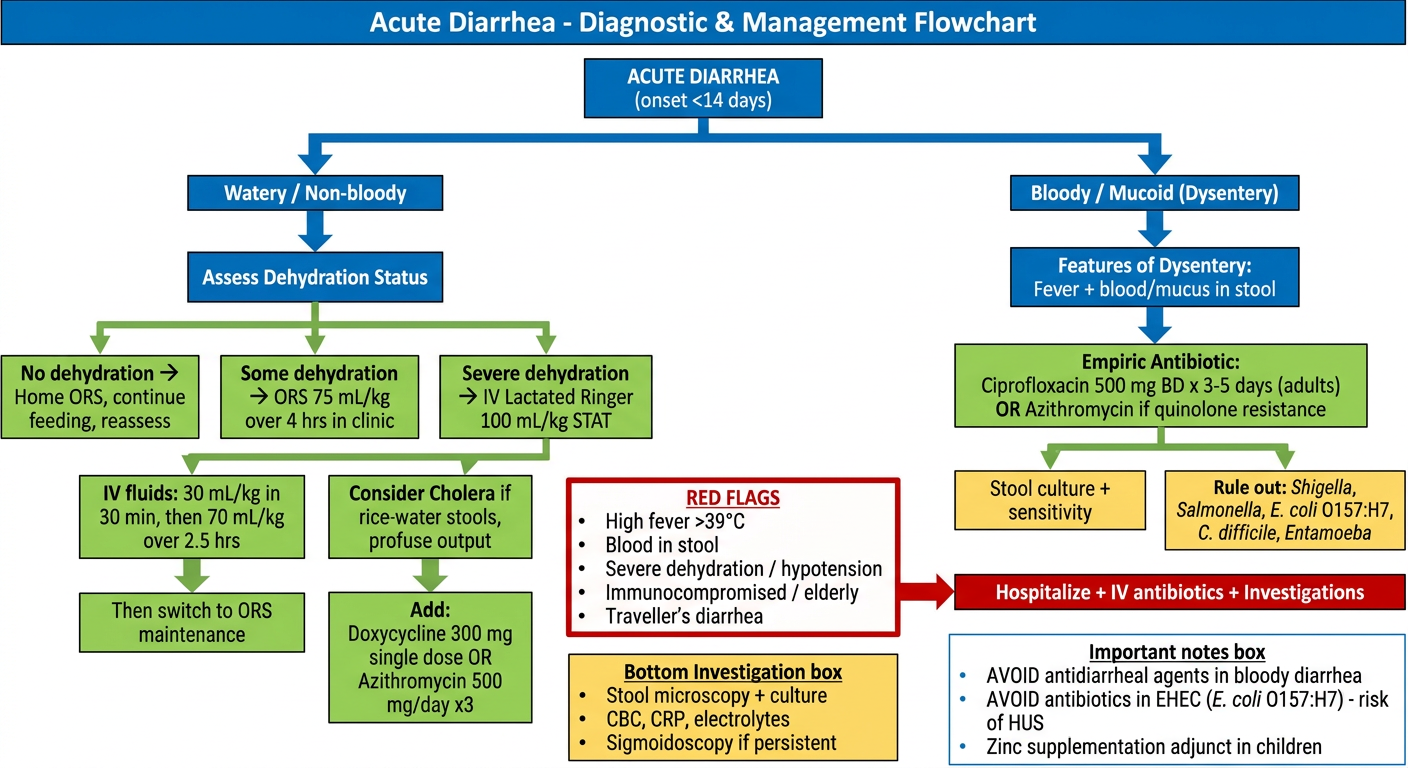
- Total IV volume: 100 mL/kg during rehydration phase
- For adults: infuse 30 mL/kg in the first 30 minutes, then remaining 70 mL/kg over 2.5 hours
- Preferred IV fluid: Lactated Ringer's solution (electrolyte profile closely matches cholera stool losses)
Phase 2 - Maintenance Phase (until diarrhea stops)
Goal: Replace ongoing losses.
- Continue ORS to match ongoing stool output
- Volumes of 800-1000 mL/hour of ORS are commonly needed in active cholera
- Continue until stool volume drops to ≤400 mL/hour and urine output is ≥40 mL/hour
Discharge criteria:
-
Oral tolerance adequate (≥1000 mL/hour without vomiting)
-
Urine output satisfactory (≥40 mL/hour)
-
Stool volume low (≤400 mL/hour)
-
Goldman-Cecil Medicine, Table 278-2
Step 3: Antibiotics (adjunct, NOT primary treatment)
Start antibiotics only after rehydration is established and vomiting has stopped (usually after 3-4 hours of ORT). They reduce the severity, duration, and volume of diarrhea.
| Drug | Regimen |
|---|
| Doxycycline (first-line) | Single oral dose of 300 mg |
| Ciprofloxacin | 500 mg PO twice daily for 3 days |
| Azithromycin | 500 mg PO daily for 3 days (preferred if resistance suspected) |
| Tetracycline | 500 mg PO four times daily |
| TMP-SMX (co-trimoxazole) | Double-strength PO twice daily |
- Single-dose doxycycline 300 mg is the preferred regimen for confirmed cholera - Rosen's Emergency Medicine; Goldman-Cecil Medicine
- If diarrhea persists >48 hours on antibiotics, suspect antibiotic resistance
Drugs to AVOID (no proven benefit, potentially harmful):
- Antidiarrheal agents (e.g., loperamide)
- Antiemetics
- Antispasmodics
- Corticosteroids
Step 4: Monitoring & Supportive Care
- Record fluid intake and stool output on a chart hourly
- Monitor pulse, BP, skin turgor every 1-2 hours during rehydration
- Correct electrolyte abnormalities: cholera stool is rich in K⁺ (20 mEq/L) and HCO₃⁻ (44 mEq/L) - ORS replaces these
- Zinc supplementation (20 mg/day for 10-14 days) as adjunct, especially if not improving - evidence supports reduced stool output and duration
- Once oral tolerance confirmed, resume light diet (rice, bananas, bread) - do not fast
Summary Flowchart
Acute watery diarrhea (6+ episodes, profuse)
       ↓
Assess dehydration severity
       ↓
Some dehydration       →  ORS 2200-4000 mL over 4 hrs (outpatient/ER)
       ↓
Severe dehydration     →  IV Lactated Ringer 100 mL/kg (30 mL/kg in 30 min)
       ↓
Maintenance phase: ORS to match losses (~800-1000 mL/hr)
       ↓
After rehydration + vomiting stopped:
Doxycycline 300 mg single dose (or Ciprofloxacin / Azithromycin)
       ↓
Monitor I/O → discharge when stable
Why water "passes straight through": Cholera toxin irreversibly activates adenylyl cyclase in intestinal epithelial cells, raising cAMP and causing uncontrolled Cl⁻ secretion into the gut lumen. This overwhelms the absorption capacity. ORS works because glucose-coupled sodium transport (SGLT1) is unaffected by cholera toxin and co-transports water - this is the physiological basis of oral rehydration therapy.
With prompt rehydration alone, mortality from cholera can be reduced from >50% (untreated) to below 1%. - Goldman-Cecil Medicine
Sources: Goldman-Cecil Medicine (p. 3110-3111); Park's Textbook of Preventive and Social Medicine (pp. 261-263); Rosen's Emergency Medicine (p. 1311)