
Gout
Reading File
Gout is a form of inflammatory arthritis caused by monosodium urate crystal deposition in joints, triggered by hyperuricemia (serum urate >6.8 mg/dL). It classically presents as sudden, severe monoarthritis - often affecting the first metatarsophalangeal joint (podagra). It is managed acutely with NSAIDs, colchicine, or corticosteroids, and long-term with urate-lowering therapy (allopurinol or febuxostat).
Searching sources...
Finding Sources
Searching PubMed
gout management hyperuricemia
Good results. Now let me read the most comprehensive sources in parallel - Robbins (pathology), Nephrology (management), and Rosen's Emergency Medicine (acute management).
Reading File
Reading File
Reading File
Excellent content. Let me read the rest of Rosen's Emergency Medicine section (which was truncated) and also get the pathology image details from Robbins.
Reading File
Reading File
I now have comprehensive content. Let me fetch the clinical gout image to include in the response.
Loading Image
Loading Image
I now have all the material needed for a comprehensive response. Here is a full, well-structured overview of gout:
Gout
Definition & Epidemiology
Gout is a form of inflammatory arthritis caused by the deposition of monosodium urate (MSU) crystals in joints and periarticular tissues, driven by sustained hyperuricemia (plasma urate >6.8 mg/dL). It affects approximately 4% of U.S. adults - roughly 5% of males and 3% of females - and prevalence increases significantly with age. Risk factors include obesity, hypertension, diabetes, chronic kidney disease, and use of thiazide diuretics or cyclosporine.
- Rosen's Emergency Medicine, 10e
- Robbins & Kumar Basic Pathology
Pathogenesis
Uric Acid Metabolism
Uric acid is the end product of purine catabolism. Purines are produced via two pathways:
- De novo pathway: synthesis from non-purine precursors
- Salvage pathway: recycling of free purine bases from dietary intake or DNA/RNA degradation
Uric acid is filtered by the glomerulus, almost completely reabsorbed by the proximal tubule, with a small fraction secreted by the distal nephron. In primary gout (~90% of cases), reduced renal excretion is the main driver (mechanism usually unknown). In secondary gout, causes include:
- Overproduction: tumor lysis syndrome, HGPRT enzyme defects (partial deficiency = gout; complete absence = Lesch-Nyhan syndrome)
- Reduced excretion: chronic renal disease, diuretics, cyclosporine
Crystal-Induced Inflammation
When urate crystals precipitate in a joint, the sequence is:
- Resident synovial macrophages phagocytose MSU crystals
- Crystals activate the NLRP3 inflammasome
- Caspase-1 is activated, generating active IL-1β
- IL-1β recruits neutrophils, which release cytokines, free radicals, and proteases
- Crystals damage phagolysosomal membranes, causing lysosomal enzyme leakage
- Result: acute synovitis, self-limited but recurrent
Only ~10% of people with hyperuricemia ever develop gout. Contributing factors include age, duration of hyperuricemia, and precipitating events (dietary purine load, alcohol, dehydration, trauma, surgery).
- Robbins & Kumar Basic Pathology
Clinical Stages
| Stage | Features |
|---|---|
| Asymptomatic hyperuricemia | Elevated urate, no symptoms; may persist for 20-30 years |
| Acute gouty arthritis | Sudden, severe monoarthritis; peaks in 1-2 days; resolves in days to weeks |
| Intercritical period | Symptom-free intervals between attacks; attacks become more frequent over time |
| Chronic tophaceous gout | Persistent joint disease; tophi form; bony erosion; joint deformity |
Clinical Features
The classic presentation is podagra - acute, exquisitely painful arthritis of the first metatarsophalangeal (MTP) joint. Other commonly affected joints: knee, ankle, tarsal joints, wrists, and fingers.
Up to 20% of patients present with polyarticular involvement, or associated bursitis and tenosynovitis that can mimic cellulitis.
Tophi are gritty, chalk-like nodules of packed MSU crystals found in subcutaneous tissue, bursae, joint spaces, and soft tissues. They are generally painless but indicate chronic disease.
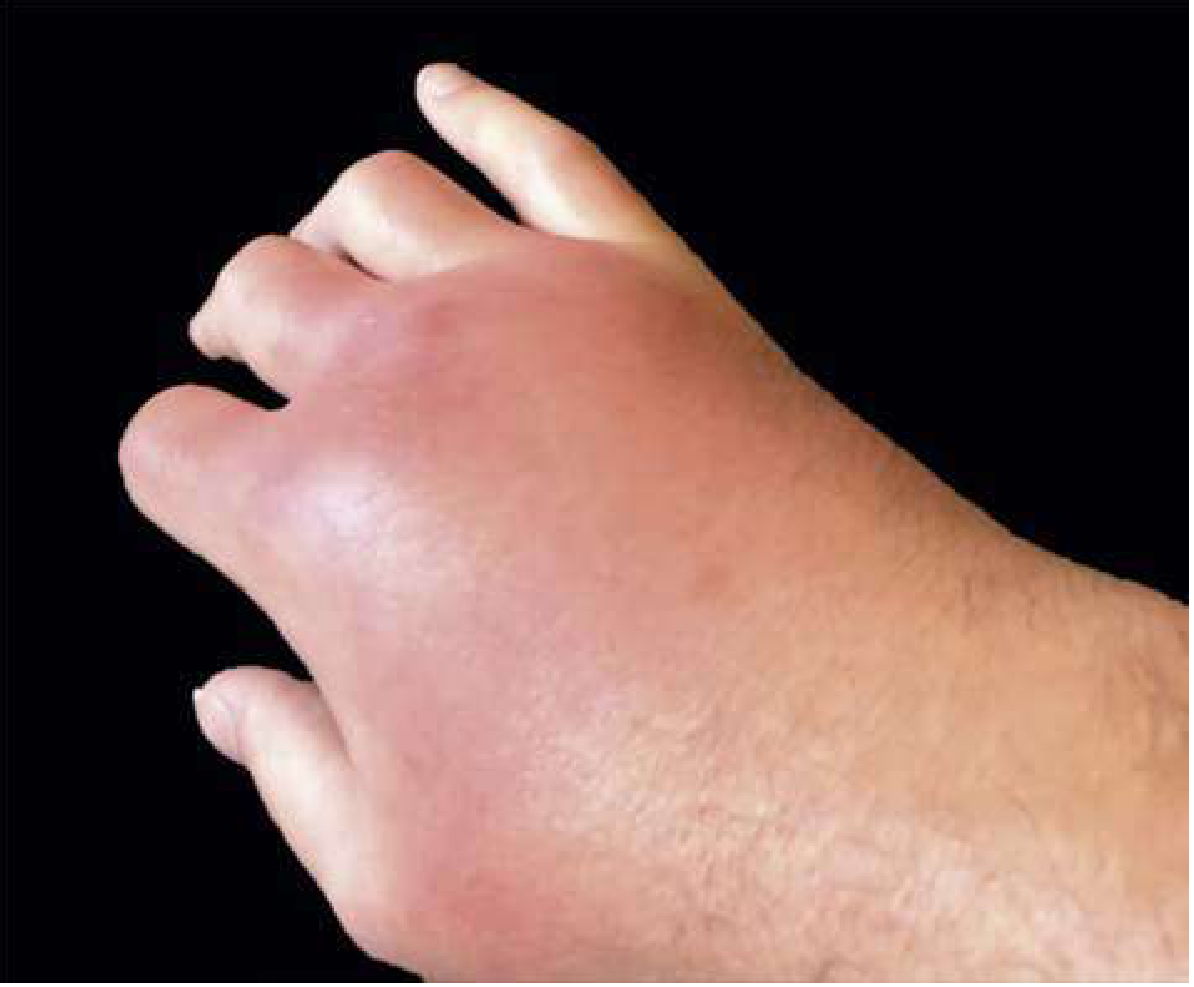
- Rosen's Emergency Medicine, 10e
Diagnosis
Definitive - Synovial Fluid Analysis
Joint aspiration (arthrocentesis) is the gold standard, especially for a first episode or when septic arthritis cannot be excluded. Under polarized light microscopy, MSU crystals appear needle-shaped and negatively birefringent (yellow when parallel to the polarizer axis).
Laboratory
- Serum uric acid: often elevated, but not reliable during an acute attack (may be normal). Does not correlate well with flare frequency.
- WBC: may be elevated (nonspecific)
- Renal function: important because many treatments are nephrotoxic and there is an association between gout and renal insufficiency
Imaging
- Plain X-ray: acute attacks show only soft-tissue swelling; chronic disease shows asymmetric, sclerotic-appearing punched-out bony erosions outside the joint capsule ("overhanging edge" sign)
- Ultrasound: highly useful; shows the double contour sign (urate deposition on articular cartilage surface) and tophi with a characteristic "lump of sugar" appearance
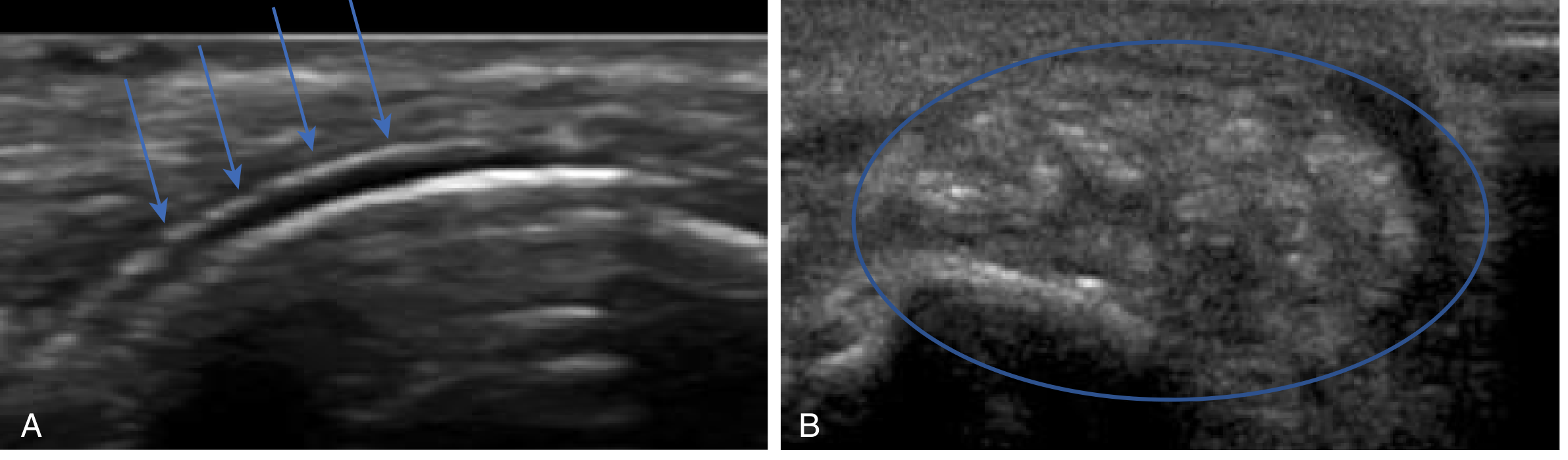
- Rosen's Emergency Medicine, 10e
Management
Acute Attack
The goal is rapid anti-inflammatory treatment. Do not initiate urate-lowering therapy during an acute attack, but do continue it if already prescribed (stopping can prolong the flare).
| Agent | Notes |
|---|---|
| NSAIDs (first-line) | Indomethacin, naproxen, ibuprofen. Start promptly; continue 24h after resolution. Avoid in PUD, GI bleeding, renal insufficiency. |
| Colchicine | Inhibits microtubule formation, blocking crystal-induced inflammation. Effective, but narrow therapeutic window; contraindicated in renal/hepatic insufficiency; GI side effects common. |
| Corticosteroids | Prednisone 40 mg/day x 5-7 days, or intra-articular injection (most effective for monoarticular disease; do not use if septic arthritis possible). Avoid concurrent oral steroids + NSAIDs (GI risk). |
| Combination therapy | Intra-articular steroid + colchicine or NSAID reasonable for severe/polyarticular disease. |
Non-pharmacologic: ice, elevation, oral hydration, avoidance of triggers.
- Rosen's Emergency Medicine, 10e
Long-Term / Urate-Lowering Therapy (ULT)
Target serum urate: <6 mg/dL in symptomatic patients (some guidelines target <5 mg/dL for tophaceous disease).
| Drug | Class | Key Points |
|---|---|---|
| Allopurinol | Xanthine oxidase inhibitor (purine analog) | First-line. Start 100 mg/day; titrate up by 50 mg every 4 weeks. Dose-adjust for renal impairment. Avoid or reduce azathioprine dose if co-prescribed. |
| Febuxostat | Xanthine oxidase inhibitor (non-purine analog) | Use in allopurinol-intolerant patients. 40 or 80 mg/day; no dose adjustment for renal impairment. Caution: a large RCT showed higher all-cause and CV mortality vs. allopurinol in high-CV-risk patients. |
| Probenecid | Uricosuric agent | Increases renal urate excretion. Avoid in uric acid overproducers and nephrolithiasis. |
| Pegloticase | Recombinant pegylated uricase | Converts uric acid to allantoin (more soluble). For refractory/tophaceous gout. FDA-approved 2010. Risk of infusion reactions and loss of efficacy due to anti-drug antibodies. |
ULT should not be started during an acute flare. When initiating, co-prescribe low-dose colchicine or NSAIDs for 3-6 months as prophylaxis against flare precipitation.
- Comprehensive Clinical Nephrology, 7e
Lifestyle Modifications
- Reduce purine-rich foods: red meat, organ meats, shellfish, anchovies, beer
- Avoid fructose-sweetened beverages
- Increase hydration
- Reduce alcohol (especially beer)
- Weight loss in obese patients
- Review and discontinue precipitating medications (thiazides, low-dose aspirin) when feasible
Differential Diagnosis
- Septic arthritis: fever + joint swelling; must be excluded by arthrocentesis (joint fluid Gram stain/culture); never treat empirically as gout without ruling this out
- Pseudogout (CPPD): calcium pyrophosphate crystals; positively birefringent (blue when parallel); chondrocalcinosis on X-ray; associated with hyperparathyroidism, hemochromatosis, hypothyroidism
- Reactive arthritis: follows GI/GU infection; asymmetric oligoarthritis
- Rheumatoid arthritis: symmetric, small-joint, chronic; RF/anti-CCP positive
Special Situations
Transplant patients: Cyclosporine significantly reduces renal urate excretion. NSAIDs should be avoided. Allopurinol and febuxostat interact dangerously with azathioprine (reduce AZA dose by ~25% and monitor CBC closely, or switch to mycophenolate). Pegloticase may be an option for refractory cases. - Comprehensive Clinical Nephrology, 7e
Renal impairment: Allopurinol start at lower doses (100 mg/day); titrate cautiously due to oxypurinol accumulation. Febuxostat does not require dose adjustment.
Lesch-Nyhan syndrome: Complete HGPRT deficiency - causes severe hyperuricemia plus neurologic manifestations (self-mutilation, cognitive impairment, choreoathetosis). Classified as secondary gout. - Robbins & Kumar Basic Pathology
Recent Evidence (2024-2026)
A recent systematic review (PMID 39794008) found that SGLT2 inhibitors reduce hyperuricemic events, providing an additional benefit in diabetic patients with gout or at risk. An additional meta-analysis (PMID 39961457) confirmed a significant association between psoriasis/psoriatic arthritis and hyperuricemia/gout, suggesting shared inflammatory pathways and the need for uric acid monitoring in psoriatic patients.
This is a shared conversation. Sign in to Orris to start your own chat.