
Hi
Sepsis
What would you like to know about sepsis?
- A particular mechanism (coagulation, cytokine storm, etc.)
- Pediatric or neonatal sepsis
- A specific organism or source (e.g. gram-negative, urinary source)
- Biomarkers (lactate, procalcitonin, etc.)
- Something else entirely
Flashcard
Which aspect of sepsis should the flashcard cover? · How many flashcards?
"sepsis" AND "surviving sepsis campaign" AND "bundle"
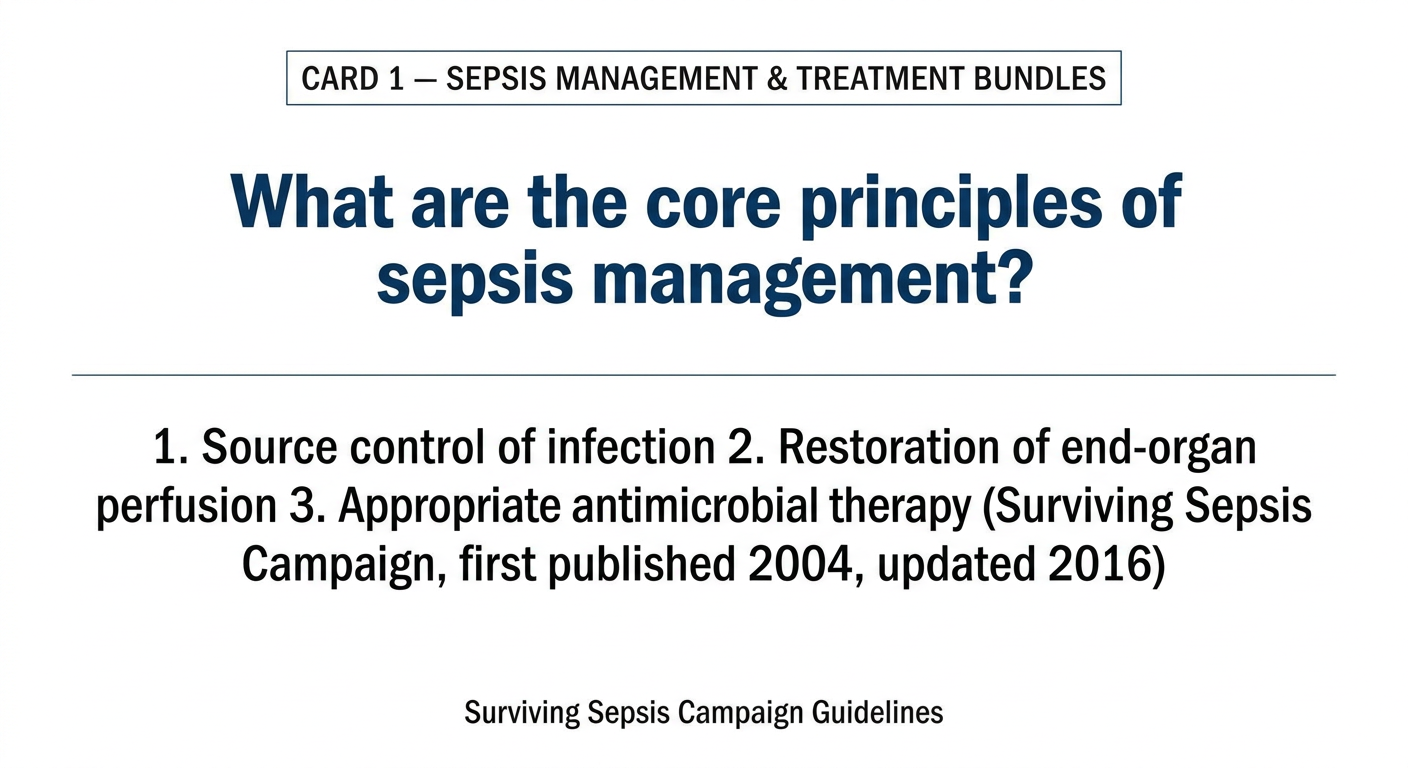
Medical flashcard set, card 1 of 5. Front side label at top: "CARD 1 — SEPSIS MANAGEMENT & TREATMENT BUNDLES". Clean white background, professional medical education style. Title at top center in bold dark blue: "What are the core principles of sepsis management?". Below a dividing line, the answer section: "1. Source control of infection 2. Restoration of end-organ perfusion 3. Appropriate antimicrobial therapy (Surviving Sepsis Campaign, first published 2004, updated 2016)". Small footer text: "Surviving Sepsis Campaign Guidelines"
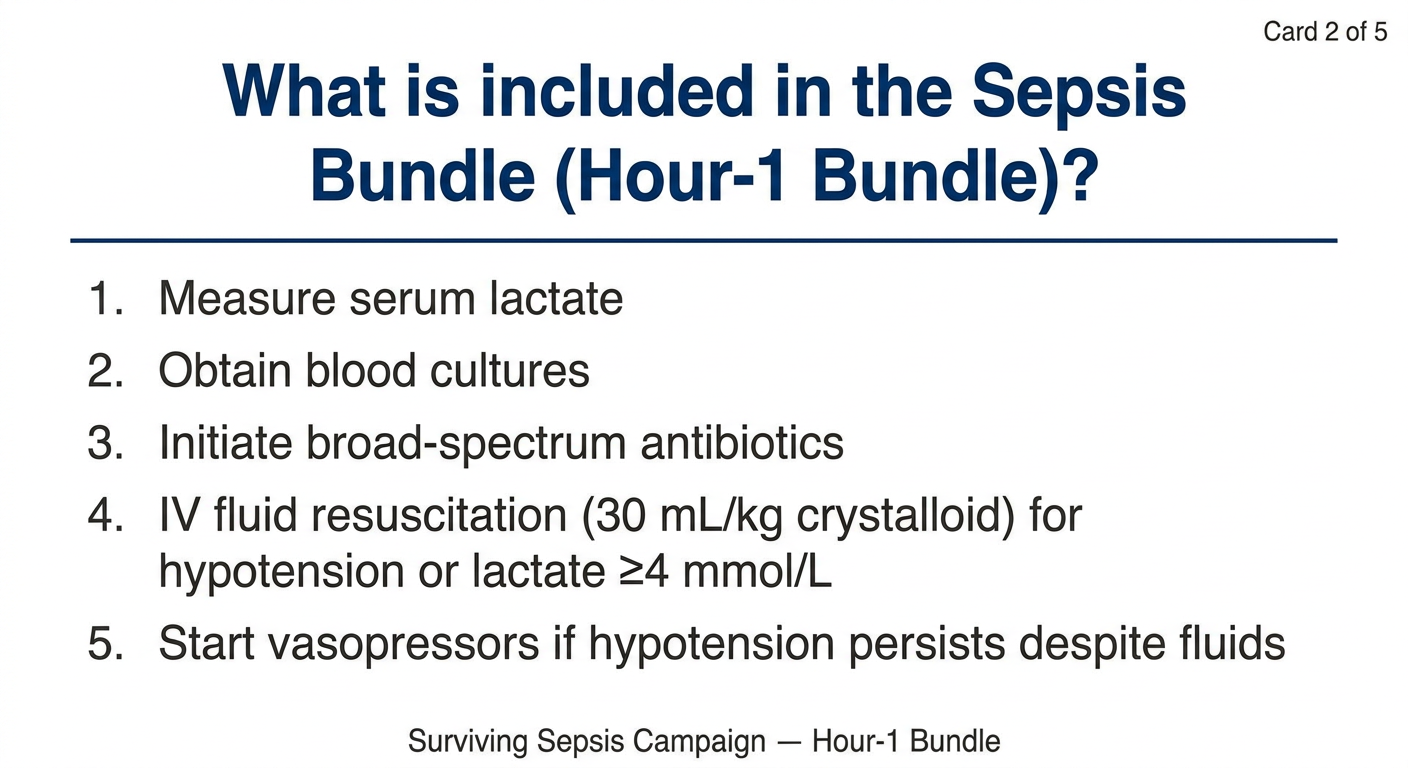
Medical flashcard, card 2 of 5. Clean white background, professional medical education style. Title in bold dark blue at top: "What is included in the Sepsis Bundle (Hour-1 Bundle)?". Numbered list as the answer below a horizontal divider line: "1. Measure serum lactate 2. Obtain blood cultures 3. Initiate broad-spectrum antibiotics 4. IV fluid resuscitation (30 mL/kg crystalloid) for hypotension or lactate ≥4 mmol/L 5. Start vasopressors if hypotension persists despite fluids". Footer: "Surviving Sepsis Campaign — Hour-1 Bundle"
Medical flashcard, card 3 of 5. Clean white background, professional medical education style. Title in bold dark blue at top: "What is the target timeframe for completing the Sepsis Bundle?". Answer section below a divider: "Goal: Complete within 1 HOUR of presentation. Originally: 3 hours. Faster completion = lower in-hospital mortality. Note: Controversy exists — not all screen-positive patients have confirmed sepsis, risking unnecessary antibiotics or excessive fluids." Footer: "Surviving Sepsis Campaign"
Medical flashcard, card 4 of 5. Clean white background, professional medical education style. Title in bold dark blue: "What is the 'Sepsis Six' and when is it used?". Answer below a divider line: "Sepsis Six — complete within 1 hour of diagnosis: 1. Administer high-flow oxygen 2. Take blood cultures 3. Give broad-spectrum antibiotics 4. Give IV fluid challenges 5. Measure serum lactate 6. Measure hourly urine output. Aims to make early management achievable by junior staff with senior oversight." Footer: "Scott-Brown's ENT / SSC Guidelines"
Medical flashcard, card 5 of 5. Clean white background, professional medical education style. Title in bold dark blue: "What vasopressor and fluid strategy is used in septic shock?". Answer below a divider: "Fluids: 30 mL/kg IV crystalloid (initial resuscitation). Vasopressor: Norepinephrine (noradrenaline) is first-line. Target MAP ≥ 65 mmHg. If MAP not achieved with fluids → start vasopressors early. Early goal-directed therapy (EGDT) no longer recommended (does not reduce 90-day mortality). ICU admission for ongoing management." Footer: "Surviving Sepsis Campaign 2016 / ESICM 2025"
Sepsis: Management & Treatment Bundles — 5 Flashcards
Card 3 — Sepsis Bundle Timeframe
- Original goal: 3 hours from presentation
- Current advocacy: 1 hour (faster completion = lower in-hospital mortality)
- Controversy: Not all screen-positive patients have confirmed sepsis - risk of unnecessary antibiotics and overly aggressive fluid resuscitation
Source: Current Surgical Therapy 14e
Card 4 — The Sepsis Six
Complete within 1 hour of diagnosis:
- Administer high-flow oxygen
- Take blood cultures
- Give broad-spectrum antibiotics
- Give IV fluid challenges
- Measure serum lactate
- Measure hourly urine output
Designed to make early management reliably achievable by junior staff, with senior/critical care escalation when needed.Source: Scott-Brown's Otorhinolaryngology & Head and Neck Surgery
Card 5 — Vasopressors & Fluid Strategy in Septic Shock
- Fluids: 30 mL/kg IV crystalloid for initial resuscitation
- Vasopressor: Norepinephrine (noradrenaline) is first-line - target MAP ≥ 65 mmHg
- Start vasopressors if hypotension persists despite adequate fluids
- Early Goal-Directed Therapy (EGDT) is no longer recommended (does not reduce 90-day all-cause mortality)
- ICU bundles improve outcomes when used after initial resuscitation
Source: Creasy & Resnik's Maternal-Fetal Medicine; ESICM Guidelines 2025