
Causes of bradycardia
Reading File
Now let me search the library and PubMed in parallel.
Finding Sources
Finding Sources
Searching PubMed
bradycardia etiology causes
Good results. Now let me read the key sections in parallel — Guyton (physiology), Rosen's (EM/causes table), Washington Manual (etiology table), and Harrison's (SA nodal disease).
Reading File
Reading File
Reading File
Reading File
Let me get the rest of the Washington Manual causes table and Harrison's reversible causes table.
Reading File
Finding Sources
I have comprehensive data. Let me also fetch the sinus bradycardia ECG image from Guyton for visual clarity.
Loading Image
Here is a comprehensive overview of the causes of bradycardia, synthesized from multiple authoritative sources.
Causes of Bradycardia
Definition: Heart rate < 60 beats/min. On ECG, sinus bradycardia shows normal P-wave morphology with a fixed P-P interval equal to the R-R interval and a ventricular rate below 60 bpm.
Figure: Sinus bradycardia (Lead III) — Guyton and Hall Textbook of Medical Physiology
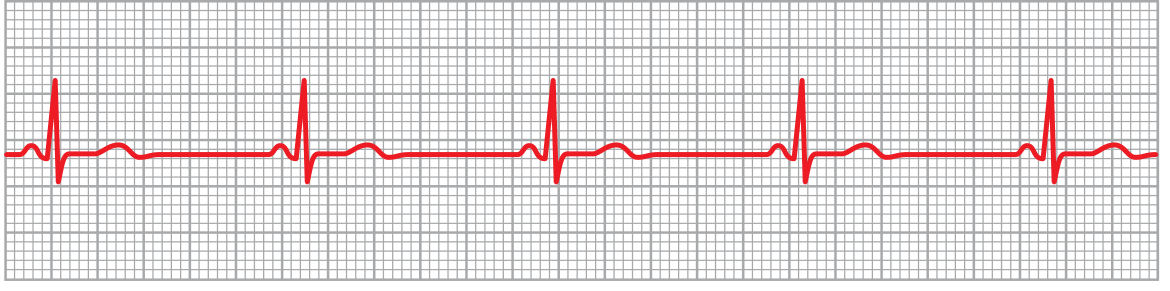
1. Physiological (Normal) Causes
| Cause | Mechanism |
|---|---|
| Athletic training | Increased stroke volume triggers baroreceptor-mediated vagal reflexes; downregulation of If ("funny current") ion channels in the SA node reduces intrinsic pacemaker activity |
| Sleep | Dominant vagal tone at rest; sinus bradycardia and pauses during sleep are typically not an indication for pacing |
| High resting vagal tone in young adults | Normal variant |
— Guyton and Hall Textbook of Medical Physiology; Rosen's Emergency Medicine
2. Intrinsic (Structural/Cardiac) Causes
These reflect direct damage or disease of the SA node or conduction system:
| Cause | Notes |
|---|---|
| Idiopathic degeneration (aging) | Most common cause of sick sinus syndrome |
| Ischemia / Infarction | Particularly right coronary artery territory (supplies SA node); acute inferior MI |
| Cardiomyopathy | Dilated, hypertrophic |
| Infiltrative diseases | Sarcoidosis, amyloidosis, hemochromatosis |
| Collagen vascular diseases | SLE, rheumatoid arthritis, scleroderma |
| Infectious diseases | Endocarditis, Lyme disease, Chagas disease |
| Congenital disorders | May present later in life |
| Surgical trauma | Valve surgery, cardiac transplantation |
| Myocarditis | Inflammatory damage to SA node |
— The Washington Manual of Medical Therapeutics
3. Extrinsic / Autonomically Mediated Causes
Enhanced vagal tone suppresses SA node firing:
| Cause | Mechanism |
|---|---|
| Carotid sinus hypersensitivity | Hypersensitive baroreceptors; external neck pressure can cause profound bradycardia or even cardiac arrest and syncope |
| Neurocardiogenic (vasovagal) syncope | Reflex vagal surge |
| Valsalva maneuver / raised ICP | Cushing reflex (bradycardia + hypertension + irregular respiration) |
| Visceral reflexes | Coughing, vomiting, micturition, defecation, intubation, ocular pressure (oculocardiac reflex) |
| Acute inferior/posterior MI | Bezold-Jarisch reflex |
| Hemoperitoneum | Vagal stimulation |
4. Drug-Induced Causes
Among the most common, and importantly reversible:
| Drug Class | Examples |
|---|---|
| β-adrenergic blockers | Metoprolol, atenolol, propranolol |
| Non-dihydropyridine calcium channel blockers | Verapamil, diltiazem |
| Digoxin | Enhances vagal tone; slows AV conduction |
| Antiarrhythmics | Amiodarone, sotalol, flecainide |
| Dexmedetomidine | α2 agonist; especially problematic in children |
| Succinylcholine | Muscarinic activation; common in pediatric anesthesia |
| Sevoflurane / Halothane | Particularly problematic in trisomy 21 and CHD patients |
| Opioids | Vagotonic effect |
| Cholinesterase inhibitors | Neostigmine, physostigmine |
| SSRIs | Associated with minor sinoatrial node dysfunction |
— Washington Manual; Miller's Anesthesia; Barash Clinical Anesthesia; Kaplan & Sadock's Psychiatry
5. Metabolic / Systemic Causes
| Cause | Mechanism |
|---|---|
| Hypothyroidism | Reduces cardiac automaticity and conduction |
| Hypothermia | Slows all metabolic processes including SA node firing |
| Hyperkalemia | Depolarization block of cardiac membranes |
| Hypermagnesemia | Calcium channel antagonism |
| Hypoxia | Direct SA node depression |
| Hypercarbia | Elevated CO2 with autonomic effects |
| Obstructive sleep apnea (OSA) | High vagal tone during apneic events; a common reversible cause |
| Sepsis | Autonomic dysregulation |
6. Neurological Causes
| Cause | Notes |
|---|---|
| Raised intracranial pressure | Cushing reflex |
| Spinal cord injury (above T1–T6) | Loss of sympathetic outflow → unopposed vagal tone |
| Autonomic neuropathy | Diabetic or other causes |
Quick Reference: Intrinsic vs. Extrinsic
BRADYCARDIA
├── INTRINSIC (structural heart/conduction disease)
│   ├── Idiopathic degeneration
│   ├── Ischemia/infarction
│   ├── Infiltrative (sarcoid, amyloid, hemochromatosis)
│   ├── Collagen vascular disease
│   ├── Infectious (Lyme, Chagas, endocarditis)
│   └── Surgical/congenital
│
└── EXTRINSIC (reversible)
    ├── Drugs (β-blockers, CCBs, digoxin, antiarrhythmics)
    ├── Autonomic (vagal, neurocardiogenic, carotid sinus)
    ├── Metabolic (hypothyroidism, hypothermia, electrolytes)
    ├── Hypoxia / hypercarbia
    └── Sleep apnea / neurological
Clinical Pearl: Always Rule Out Reversible Causes First
Before attributing bradycardia to intrinsic sinus node disease, reversible causes must be excluded — particularly hypothyroidism, rate-slowing medications, electrolyte disturbances, sleep apnea, and acute ischemia. — Harrison's Principles of Internal Medicine, 22nd Ed. (2025)
Recent literature note: A 2025 review in Am J Emerg Med (Tannenbaum & Long, PMID 40683036) confirms the same core etiologic framework, with emphasis on ECG-based diagnosis and systematic approach to reversible causes in the ED setting.
This is a shared conversation. Sign in to Orris to start your own chat.