
Facial angles and downs syndrome
Reading File
Now let me search the medical library and web simultaneously for facial angles and Down syndrome.
Finding Sources
Finding Sources
Searching the Web
facial angles Down syndrome trisomy 21 craniofacial features clinical
The first DB search found "frontomaxillary facial angle" in the maternal-fetal medicine book. Let me pull that content alongside the embryology and Robbins content.
Reading File
Reading File
Finding Sources
I found an image in the embryology book. Let me fetch it and also search for more detailed content about the frontomaxillary facial angle in prenatal screening.
Loading Image
Finding Sources
Finding Sources
Let me search for the actual content section on Down syndrome in the maternal-fetal medicine textbook and search for more on facial angles.
Finding Sources
Finding Sources
Reading File
Reading File
Now let me get the Langman's Embryology image showing Down syndrome facial features, and also search for the frontomaxillary facial angle concept specifically in prenatal ultrasound context.
Finding Sources
Searching PubMed
frontomaxillary facial angle trisomy 21 first trimester screening
I now have all the core information needed to give a thorough answer. Let me compile it.
Facial Angles and Down Syndrome (Trisomy 21)
Down syndrome (trisomy 21) is the most common chromosomal disorder, occurring in approximately 1 in 700 live births. The characteristic facial profile in Down syndrome is the central clinical feature, and specific craniofacial angles are important both clinically (postnatal diagnosis) and prenatally (first-trimester ultrasound screening).
Clinical (Postnatal) Facial Features
The diagnostic facial features are usually apparent at birth and result from midface hypoplasia and generalized craniofacial underdevelopment:
| Feature | Description |
|---|---|
| Flat facial profile | Due to midface/maxillary hypoplasia; the midface is retruded, creating an obtuse facial angle |
| Brachycephaly | Shortened anteroposterior skull diameter; flat occiput, sloping forehead |
| Upslanting (oblique) palpebral fissures | The outer corners of the eyes angle upward; present in >80% of cases |
| Epicanthal folds | Skin folds covering the medial canthi; present in >60% |
| Flat nasal bridge | Small, depressed nasal bridge |
| Brushfield spots | Gray-white spots on the iris periphery |
| Small/dysplastic ears | Low-set, simplified ear architecture |
| Protruding tongue | Macroglossia relative to small oral cavity; mouth often held open |
| Short neck | With redundant nuchal skin |
| Hypertelorism | Increased inter-orbital distance |
"The diagnostic clinical features of this condition - flat facial profile, oblique palpebral fissures, and epicanthal folds - are usually apparent at birth."
- Robbins & Kumar Basic Pathology, p. 3840
"Features of children with Down syndrome include... upward slanting eyes, epicanthal folds, flat facies, and small ears"
- Langman's Medical Embryology, p. 385
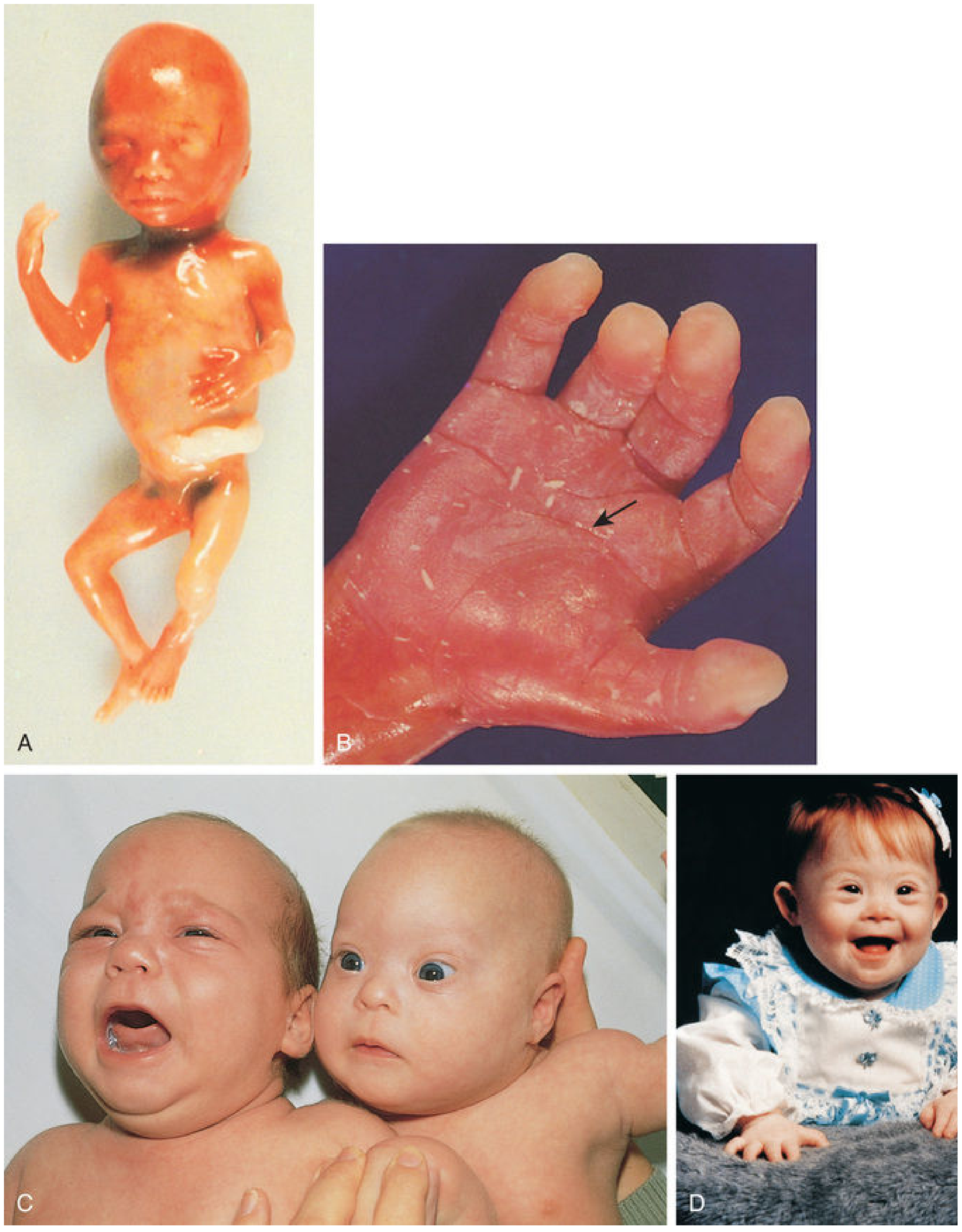
The Frontomaxillary Facial Angle (FMF Angle) - Prenatal Screening
The most clinically measured facial angle specific to Down syndrome is the frontomaxillary facial angle (FMF angle), used in first-trimester ultrasound screening.
What it measures
The FMF angle is measured on a midsagittal (profile) view of the fetal face at 11+0 to 13+6 weeks gestation. It is defined as the angle between:
- A line along the upper surface of the maxilla (from the anterior of the alveolar process to the posterior surface)
- A line from the frontal bone (frontosphenoidal suture)
In trisomy 21, there is maxillary hypoplasia and midface underdevelopment, causing the maxilla to be shorter and more posteriorly positioned. This makes the FMF angle larger (more obtuse) compared to chromosomally normal fetuses.
Clinical significance
- In normal fetuses, the FMF angle is typically ~75-85°
- In trisomy 21 fetuses, the angle is significantly larger (more obtuse), reflecting the flat midface
- Borenstein et al. (2008) found the FMF angle to be an effective marker in screening for trisomy 21 at 11-13+6 weeks (Ultrasound in Obstetrics & Gynecology)
- Sonek et al. (2007) similarly validated this measurement in trisomy 21 fetuses at the same gestational window (Am J Obstet Gynecol)
These references are cited in Creasy & Resnik's Maternal-Fetal Medicine as part of the first-trimester screening battery.
Why the Flat Facial Profile Exists
The underlying mechanism is trisomy of chromosome 21, which disrupts normal craniofacial development:
- The midface (maxilla, nasal bones, zygomatic arches) is hypoplastic
- The mandible is relatively normal in size, but small in absolute terms
- Brachycephaly shortens the skull anteroposteriorly
- This combination creates the characteristic flat, retrognathic facial profile with an obtuse nasal-facial angle
The region D21S55 on chromosome 21 has been specifically identified as associated with the characteristic facial features including oblique eye fissures, epicanthus, and flat nasal bridge (per the AAO's gene map).
Other Associated Craniofacial Angles and Measurements
| Measurement | Finding in Down Syndrome |
|---|---|
| Palpebral fissure angle | Upslanted (positive canthal tilt) due to orbital hypoplasia |
| Nasal bone angle | Absent or hypoplastic nasal bone on profile view (key ultrasound marker) |
| Nuchal translucency | Increased at 11-13 weeks (not a facial angle per se, but adjacent craniocervical marker) |
| Frontonasal facial angle | Also studied (Creasy & Resnik reference 103) |
| Prenasal thickness + nasal bone | Combined second-trimester screening method |
Summary
The "facial angles" in Down syndrome refer to:
- Clinically - the flat (retrognathic) facial profile with upslanting palpebral fissures and epicanthal folds visible at birth
- Prenatally - the frontomaxillary facial angle (FMF angle), which is larger/more obtuse in trisomy 21 fetuses due to maxillary hypoplasia, measured on first-trimester ultrasound as a chromosomal screening marker
Recent evidence: A 2017 Cochrane systematic review (PMID 28295158) confirmed that first-trimester ultrasound markers, including the FMF angle, improve Down syndrome detection rates when combined with nuchal translucency and serum markers.
This is a shared conversation. Sign in to Orris to start your own chat.