
What is olfactorium? Smell disorders and management of complications in detail for long question answer according to standard ent textbook in simplified manner
Reading File
Now let me search the medical library for olfactory anatomy, smell disorders, and management in parallel.
Finding Sources
Finding Sources
Finding Sources
Finding Sources
Finding Sources
Excellent! Found the key ENT textbook sections. Now let me read the comprehensive content from Cummings Otolaryngology and KJ Lee's Essential Otolaryngology in parallel.
Reading File
Reading File
Reading File
Reading File
Reading File
Finding Sources
Reading File
Finding Sources
Now let me get the earlier content with olfactory anatomy and the olfactorium section from the beginning of that chapter:
Reading File
Reading File
Let me now get the olfactory anatomy section from the beginning of the chapter and also search for relevant images:
Reading File
Searching Images
olfactory epithelium anatomy nasal roof diagram
I have gathered comprehensive content. Let me now fetch the olfactory bulb diagram from the textbook and compile the complete answer:
Loading Image
Reading File
I now have comprehensive material from Cummings Otolaryngology and KJ Lee's Essential Otolaryngology. Let me compile the complete, detailed long-answer response.
Olfactorium, Smell Disorders, and Management of Complications
PART 1: THE OLFACTORIUM (Olfactory Area)
Definition and Location
The olfactorium (also called the olfactory area or olfactory cleft region) is the specialized region of the nasal cavity dedicated to the detection of odorants. It is located in the roof of the nasal cavity and includes:
- The upper one-third of the nasal septum
- The superior nasal turbinate (superior concha)
- The roof of the nasal cavity (cribriform plate region)
- The superior meatus
This area is lined by the olfactory epithelium (OE) - a pseudostratified columnar neuroepithelium that is distinctly yellowish-brown in color compared to the pink respiratory mucosa below it.
Olfactory Epithelium - Cellular Composition
The olfactory epithelium contains three main cell types:
| Cell Type | Function |
|---|---|
| Olfactory Receptor Neurons (ORNs) | Primary sensory neurons; bear cilia with odorant receptors |
| Supporting (Sustentacular) Cells | Provide structural support and metabolic support to ORNs |
| Basal Cells | Stem cells; regenerate the ORN population throughout life |
Key unique feature: ORNs are among the very few neurons in the body capable of regeneration throughout adult life (approximately every 30-60 days under normal conditions).
Olfactory Receptor Neurons (ORNs) - Structure
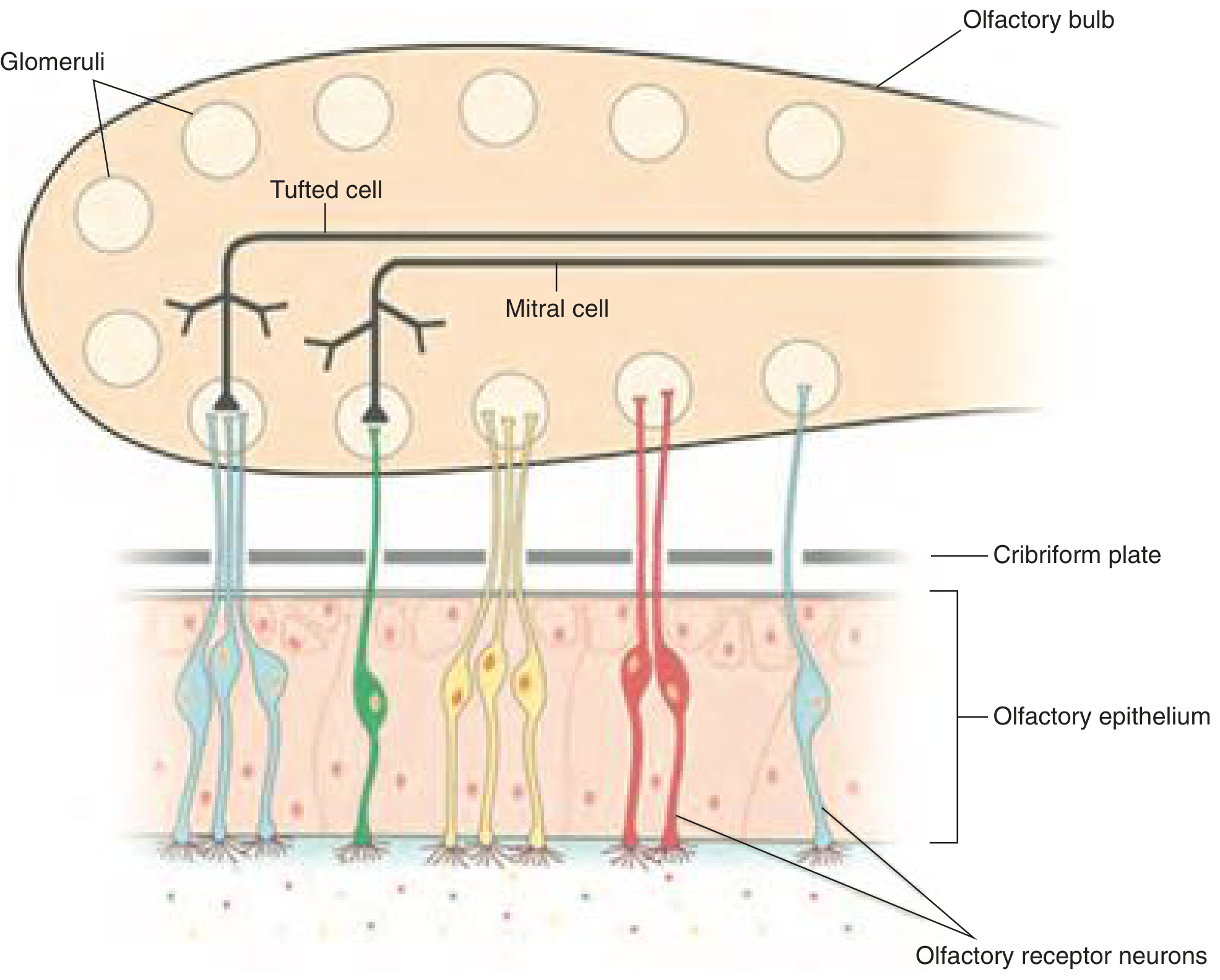
Each ORN is a bipolar neuron with:
- A peripheral dendrite extending to the epithelial surface, ending in an olfactory knob bearing 10-30 cilia
- The cilia are immotile and contain odorant receptor (OR) proteins on their surface
- A central axon passing through the cribriform plate to synapse in the olfactory bulb (OB)
Humans possess approximately 350-400 functional OR genes (the largest gene superfamily known). Each ORN expresses only one type of OR - this is called the "one neuron - one receptor" principle.
Olfactory Signal Transduction Pathway
The process of smell detection proceeds as follows:
- Odorant molecule arrives at the olfactory cleft via orthonasal (sniffing) or retronasal (during chewing/swallowing) routes
- Odorant dissolves in the olfactory mucus layer overlying the cilia
- Odorant binds to a G-protein coupled OR on the cilia
- Activation of adenylyl cyclase (AC) via Golf protein → ↑ cAMP
- cAMP opens cyclic nucleotide-gated (CNG) channels → Ca²⁺ influx
- Ca²⁺ activates Cl⁻ channels → further depolarization
- Action potential generated in the ORN axon
Central Olfactory Pathways
ORN axons (collectively forming the olfactory nerve, CN I) pass through the cribriform plate as olfactory fila (~20 bundles) and synapse in glomeruli of the olfactory bulb.
First-order synapse: ORN → Glomeruli of Olfactory Bulb
Second-order neurons: Mitral cells and Tufted cells of the OB → project via the olfactory tract to:
- Primary olfactory cortex: Piriform cortex, entorhinal cortex, amygdala, anterior olfactory nucleus
- Secondary olfactory cortex: Orbitofrontal cortex (conscious odor identification), thalamus
Unique feature: Olfaction is the only sensory modality that reaches cortex WITHOUT first relaying through the thalamus (in its primary pathway).
PART 2: SMELL DISORDERS - DEFINITIONS
(Based on Cummings Otolaryngology, Table 36.1)
| Term | Definition |
|---|---|
| Normosmia | Normal olfactory function |
| Hyposmia (Microsmia) | Quantitatively reduced olfactory function |
| Functional Anosmia | Reduced to the extent that no useful function exists in daily life |
| Anosmia | Complete absence of all olfactory function |
| Specific Anosmia | Inability to smell one specific odorant; normal physiologic variant |
| Hyperosmia (Superosmia) | Abnormally increased smell sensitivity; rare; seen with migraine |
| Parosmia (Dysosmia/Cacosmia/Troposmia) | Distorted perception of an odor IN THE PRESENCE of an odorant |
| Phantosmia | Olfactory hallucination - smell perceived WITHOUT any odorant present |
| Orthonasal Olfaction | Smell via anterior airflow (sniffing through nostrils) |
| Retronasal Olfaction | Smell perceived during eating/swallowing via the nasopharynx |
PART 3: CLASSIFICATION OF OLFACTORY DYSFUNCTION
A. Anatomic Classification (Traditional - now discouraged)
| Type | Mechanism |
|---|---|
| Conductive | Obstruction preventing odorant access to the OE (polyps, edema, septal deviation) |
| Sensorineural | Damage to the ORN itself or OE |
| Central | Damage to olfactory bulb, tract, or cortex |
Note: This classification is increasingly discouraged because most conditions (e.g., CRS) involve all three mechanisms simultaneously.
B. Etiologic Classification (Current Standard - Box 36.1, Cummings)
- Sinonasal olfactory dysfunction
- Postinfectious olfactory dysfunction (PIOD)
- Posttraumatic olfactory dysfunction (PTOD)
- Neurological/Neurodegenerative dysfunction
- Congenital olfactory dysfunction
- Endocrine-associated dysfunction
- Drug/Toxin-associated dysfunction
- Age-related dysfunction
- Idiopathic dysfunction
- Others (iatrogenic, neoplasia, systemic disease)
PART 4: INDIVIDUAL DISORDERS IN DETAIL
1. Sinonasal Olfactory Dysfunction
Most common cause of olfactory loss seen in ENT practice.
Conditions: Chronic rhinosinusitis (CRS) - with or without nasal polyposis - is the most important. Others include allergic rhinitis, non-allergic rhinitis, atrophic rhinitis.
Hierarchy of severity:
CRS with polyps > CRS without polyps > non-allergic rhinitis > atrophic rhinitis > allergic rhinitis
Pathophysiology (multi-level):
- Mechanical: Mucosal edema/polyps physically obstruct odorant access to the olfactory cleft
- Inflammatory: TNF-α and eosinophilic inflammation interfere with OR-odorant binding at the epithelium
- Histologic: Long-standing disease leads to ORN death, metaplastic replacement of OE with respiratory/squamous epithelium, and subepithelial fibrosis
- Central: Structural MRI studies show reduced olfactory bulb volumes and reduced gray matter in orbitofrontal cortex in CRS patients
Clinical features: Gradual onset, fluctuating course, predominately quantitative (loss rather than distortion), parosmia/phantosmia are rare.
2. Postinfectious Olfactory Dysfunction (PIOD)
Second most common cause of olfactory dysfunction after sinonasal disease.
Cause: Most commonly follows upper respiratory tract infections (URTI) - especially viral (parainfluenza, rhinovirus, COVID-19)
Mechanism:
- Direct viral damage to the olfactory epithelium
- Inflammatory destruction of ORNs
- Some recovery possible through ORN regeneration (basal cell proliferation)
Clinical features:
- Sudden onset coinciding with or immediately after a viral URTI
- Common in middle-aged and elderly women
- Predominantly quantitative but qualitative disturbances (parosmia, phantosmia) are frequently seen
- Recovery rates: approximately 32-66% show improvement; complete recovery is less predictable
3. Posttraumatic Olfactory Dysfunction (PTOD)
Third most common cause overall.
Mechanism (three pathways):
- Mechanical obstruction: Septal fracture, nasal fracture, intranasal blood clots, mucosal edema
- Shearing of olfactory fila: Coup-contrecoup injury causes the brain to move relative to the cribriform plate, tearing the delicate olfactory nerve filaments → immediate, severe smell loss; poor recovery
- Central parenchymal injury: Intraparenchymal hemorrhages, contusions, gliosis affecting primary olfactory cortex; may present with delayed onset of smell loss
Histologic findings in biopsies from PTOD patients:
- Disrupted OE orientation (abnormal nuclear location)
- Axonal proliferation (abnormal growth of axons below basement membrane)
- Absence of ciliogenesis (dendrites without cilia → no functional ORs)
Prognosis: Recovery in approximately 30% of cases; return to normal is rare; long duration of loss = worse prognosis. Qualitative dysfunction (phantosmia) is common.
4. Neurological/Neurodegenerative Dysfunction
Alzheimer Disease (AD):
- Olfactory dysfunction present in 85-90% of AD patients, including early mild cognitive impairment (MCI)
- Reflects early pathologic changes in limbic/paralimbic regions
- Impaired odor identification in MCI predicts progression to AD
- Usually hyposmia rather than complete anosmia
- Worsens as AD advances
Parkinson Disease (PD):
- Second most common neurodegenerative cause
- Related to Lewy body deposition in OB and olfactory tract, plus decreased neuronal populations in the anterior olfactory nucleus
- Olfactory loss may precede motor symptoms by years - important as a biomarker
Other neurological causes: Multiple sclerosis, epilepsy, migraine (may cause hyperosmia), cerebrovascular accident, myasthenia gravis
5. Congenital Olfactory Dysfunction
Kallmann Syndrome:
- Most common and important congenital cause
- X-linked (most common), autosomal dominant or recessive forms exist
- Classic triad: Congenital anosmia + hypogonadotropic hypogonadism + other anomalies (cleft palate, renal agenesis, bimanual synkinesis)
- Pathology: Agenesis or hypoplasia of the olfactory bulbs and tracts
- Mechanism: Failure of GnRH neurons (which normally migrate along olfactory nerve axons from the olfactory placode) to reach the hypothalamus
- Clinically: absence of puberty/delayed puberty + anosmia since birth
6. Drug/Toxin-Associated Dysfunction
Common causative agents:
| Category | Examples |
|---|---|
| Intranasal medications | Cocaine, prolonged nasal decongestants (rhinitis medicamentosa) |
| Systemic drugs | Penicillamine, methotrexate, antithyroids (propylthiouracil), ACE inhibitors, calcium channel blockers, some antibiotics |
| Industrial toxins | Cadmium, lead, mercury, formaldehyde, hydrogen sulfide |
| Tobacco | Direct toxic effects on OE + sinonasal inflammation |
7. Age-Related (Presbyosmia)
- Olfactory function declines progressively with age - the most significant decline begins after age 60
- Nearly 75% of people over 80 have some degree of olfactory dysfunction
- Mechanisms: Reduction in ORN density, thickening of olfactory mucus, reduced central processing
- Anosmia is an independent predictor of mortality in older adults
8. Endocrine-Associated Dysfunction
- Hypothyroidism: Reversible with treatment
- Adrenal cortical insufficiency (Addison's disease): Classically causes hyperosmia
- Diabetes mellitus, renal failure, liver failure: All associated with hyposmia
PART 5: CLINICAL ASSESSMENT
History Key Points
- Onset: Sudden (postinfectious, posttraumatic) vs. gradual (sinonasal, neurodegenerative)
- Duration: Long duration = worse prognosis
- Fluctuation: Present suggests sinonasal disease; absent suggests non-sinonasal cause
- Onset since childhood: Suggests congenital dysfunction
- Associated nasal symptoms: Obstruction, rhinorrhea, facial pain → CRS
- Non-nasal symptoms: Headache/visual changes → intracranial mass; tremor/memory loss → neurodegenerative
- Occupation: Chef, perfumer, sommelier - greater impact
- Safety concern: Does the patient live alone? Can they detect gas/fire/spoiled food?
- Mental health: Depression and anxiety are common sequelae of smell loss
Examination
- Anterior rhinoscopy / nasal endoscopy: Look for polyps, mucosal edema, discharge, septal deviation, olfactory cleft opacification
- Cranial nerve examination: Including CN I, II (for intracranial cause)
- General neurological examination
Psychophysical Testing (Objective Assessment)
The gold standard for measuring olfactory function:
| Test | Measures |
|---|---|
| Sniffin' Sticks (TDI Test) | Threshold, Discrimination, Identification - widely used in Europe |
| UPSIT (University of Pennsylvania Smell Identification Test) | 40-item scratch-and-sniff identification test |
| Connecticut Chemosensory Clinical Research Center Test (CCCRC) | Threshold + identification |
Interpretation (TDI composite score):
- Normal (Normosmia): TDI > 30.5
- Hyposmia: TDI 16.5-30.5
- Functional Anosmia: TDI < 16.5
Imaging
- CT scan (coronal): First choice for sinonasal disease - assess polyps, mucosal thickening, olfactory cleft opacification, bony anatomy
- MRI (coronal, from frontal sinus to posterior corpus callosum): Choice for suspected neurogenic/sensorineural cause; allows visualization of olfactory bulbs, tracts, and cortical parenchyma; assessment of olfactory bulb volume
- Deciding between CT and MRI is controversial when nasal endoscopy is normal
PART 6: MANAGEMENT AND TREATMENT OF COMPLICATIONS
Step 1: Safety Counseling (MANDATORY FOR ALL PATIENTS)
This must be performed before any other treatment, especially for severe dysfunction:
- Install and maintain smoke and gas detectors at home
- Avoid gas appliances (gas stoves/ovens) if possible; use electric alternatives
- Adhere strictly to food expiration dates (cannot detect spoiled food by smell)
- Maintain a well-balanced diet (weight loss/gain possible due to taste changes - flavor perception depends heavily on retronasal olfaction)
- Add capsaicin, color, and texture to food to improve appeal
- Patients who live alone require extra counseling
Step 2: Appropriate Referrals
- Ideally managed in a specialist multidisciplinary chemosensory clinic
- Endocrinologist: For hormonal/endocrine causes
- Neurologist: For neurodegenerative suspected causes
- Geneticist: For congenital causes (Kallmann syndrome)
- Psychiatry/Psychology: For significant depression or anxiety secondary to smell loss
Step 3: Reducing Causative Agent Exposure
- Identify and stop or substitute offending medications
- Reduce occupational/environmental toxin exposure where possible
- Smoking cessation counseling
Step 4: Disease-Specific Treatment
A. Sinonasal Disease (CRS ± Polyps)
Medical Management:
- Topical intranasal corticosteroids (INCS): First-line. Reduce mucosal edema, improve odorant access to OE. Examples: mometasone, fluticasone, budesonide
- Short-course systemic (oral) corticosteroids: For acute exacerbations or severe CRS with polyposis (prednisolone 0.5mg/kg/day for 5-14 days); improves olfaction but effect is temporary without ongoing treatment
- Saline nasal irrigation: Helps clear mucus and reduce inflammatory load
- Antibiotics: For acute exacerbations with bacterial superinfection
- Antihistamines + allergen avoidance: If allergic rhinitis is the driver
Surgical Management:
- Endoscopic Sinus Surgery (ESS): For CRS not responding to maximal medical therapy
- Olfactory outcomes following ESS for CRS are variable and challenging to predict
- Presence of nasal polyposis is predictive of postoperative olfactory improvement - polypectomy often gives the best results
- Earlier treatment is associated with superior olfactory outcomes (early histologic changes are more reversible than late fibrotic/metaplastic changes)
B. Postinfectious Olfactory Dysfunction (PIOD) - Treatment
Several medical therapies under investigation:
-
Topical and systemic corticosteroids:
- Controversial in non-CRS anosmia - limited literature
- Systemic steroids may help recovery in posttraumatic anosmia, but spontaneous recovery could also account for some improvement
- Local effects: membrane stabilization, alteration of mediator release, inhibition of cell migration
- Central effects: increased excitability, lowered thresholds for stimulus qualities
- Topical therapy has additional benefit after oral steroid pretreatment
-
Alpha-lipoic acid:
- Fatty acid derivative; acts as an antioxidant
- May be helpful in olfactory loss after URTI
- Mechanism: scavenges free radicals that damage ORNs
-
Theophylline (topical and oral):
- Phosphodiesterase inhibitor - thought to increase olfactory sensitivity by interaction with cAMP signal transduction in the OE
- Increases intracellular cAMP → enhances olfactory receptor neuron sensitivity
- Caveat: Chronic use requires repeated serum monitoring due to narrow therapeutic range; potential serious toxicities include seizures and myocardial infarction
-
Zinc gluconate (oral):
- May help in regeneration of olfactory receptor cells (supports basal cell function)
- May be helpful in traumatic olfactory loss
- High doses can paradoxically be toxic to olfactory epithelium - should be used with caution
-
Vitamin A:
- Supports differentiation and regeneration of olfactory neuroepithelium
- Used in some protocols for postinfectious anosmia
-
Carbamazepine:
- May help specifically for phantosmia (olfactory hallucinations) - reduces aberrant neuronal firing
C. Olfactory Training (Evidence-Based - Key Treatment)
One of the most important treatments for PIOD, PTOD, and idiopathic anosmia.
Protocol:
- Repeated, deliberate sniffing of a set of odorants (classically 4: rose, eucalyptus, lemon, cloves) twice daily
- Duration: 3 to 9 months (longer is better; some protocols use 12+ months)
- Patient sniffs each odorant for approximately 10 seconds per session, concentrating on the memory of the smell
Mechanism (not fully understood):
- May act at the level of the olfactory epithelium - odorant-induced regeneration and targeting of new ORN axons to the OB
- Or more centrally - altered synaptic connectivity, cortical reorganization (neuroplasticity)
Efficacy evidence:
- Beneficial effects demonstrated in postinfectious, posttraumatic, idiopathic, and Parkinson-related olfactory dysfunction
- Also shown to benefit healthy participants
- Some studies suggest extended training (>16 weeks) and high-intensity training (multiple odors/session) improves outcomes
Used in: PIOD, PTOD, neurodegenerative disorders, idiopathic anosmia
D. Posttraumatic Olfactory Dysfunction
- Systemic steroids: Short course may help if started early (reduces edema, helps with conductive component)
- Observation: Allow time (6-12 months) for spontaneous recovery
- Olfactory training: Start as soon as clinically appropriate
- Zinc and Vitamin A: Adjuncts to promote ORN regeneration
- Surgery: Only if structural nasal obstruction is identified and contributing
E. Congenital/Kallmann Syndrome
- Hormone replacement therapy (HRT): For hypogonadism - testosterone in males, estrogen/progesterone in females to induce puberty and maintain secondary sexual characteristics
- Pulsatile GnRH therapy or gonadotropin therapy (FSH + LH/hCG): For fertility induction
- Olfactory loss itself is typically permanent - no treatment for anosmia in KS
F. Drug-Induced Dysfunction
- Identify and stop/substitute the offending drug - recovery may occur over weeks to months after cessation
- Intranasal cocaine abuse: Stop use; recovery variable; mucosal and septal damage may be permanent
G. Neurodegenerative Disease
- Treat the underlying neurodegenerative disease (levodopa for PD, acetylcholinesterase inhibitors for AD) - limited direct benefit to olfaction
- Olfactory training: Some evidence of benefit even in PD
- Prognostic counseling: Olfactory loss in this context tends to be progressive
Step 5: Managing Complications and Quality of Life
Psychological Complications
- Depression and anxiety are well-acknowledged consequences of smell disorders
- Olfactory function and depression are interdependent - reduced olfactory bulb volume predisposes to depression, which further impairs olfaction (bidirectional relationship)
- Management: Referral to psychology/psychiatry; cognitive behavioral therapy (CBT); antidepressants if indicated
Nutritional Complications
- Loss of retronasal olfaction profoundly affects flavor perception (flavor = taste + smell)
- Patients may experience weight loss (food loses appeal) or weight gain (overconsumption due to compensatory behavior)
- Management: Dietitian referral; food enhancement with capsaicin, texture, color, temperature variation; careful attention to food safety
Safety Complications
- Inability to detect gas leaks, smoke, fire, and spoiled food - significant safety risk
- Patients with severe anosmia should be considered "at-risk" especially if living alone
- Management: Smoke/CO/gas detectors; electric stoves; food date labeling system; support networks; regular check-ins for those living alone
Occupational Complications
- Particularly important for chefs, sommeliers, perfumers, firefighters, food safety inspectors
- Management: Occupational medicine referral; workplace adjustment; medicolegal documentation where needed (psychophysical testing with UPSIT/Sniffin' Sticks provides objective documentation)
PART 7: PROGNOSIS SUMMARY
| Etiology | Prognosis |
|---|---|
| Sinonasal/CRS | Good with medical ± surgical treatment, especially with polyps |
| Postinfectious | Variable; 32-66% improve; complete recovery unpredictable; qualitative disturbances may persist |
| Posttraumatic | Poor; ~30% partial recovery; complete recovery rare; shearing of fila = worst prognosis |
| Neurodegenerative | Progressive worsening; parallels disease course |
| Congenital (Kallmann) | Permanent anosmia; no current treatment |
| Drug-induced | Generally reversible on stopping the agent |
| Age-related | Irreversible progression; supportive management only |
| Idiopathic | Variable; some spontaneous recovery possible |
Quick Reference Summary Box
OLFACTORIUM
├── Location: Roof of nasal cavity, superior turbinate, upper septum
├── Lined by: Olfactory Epithelium (ORN + supporting + basal cells)
├── CN I (fila) → Cribriform plate → Olfactory Bulb
└── Primary olfactory cortex (no thalamic relay)

SMELL DISORDERS (Quantitative)
├── Hyposmia → Functional Anosmia → Anosmia (increasing severity)
└── Hyperosmia (rare - migraine, Addison's)

SMELL DISORDERS (Qualitative)
├── Parosmia - distorted smell WITH an odorant present
└── Phantosmia - smell hallucination WITHOUT an odorant

TOP 3 CAUSES (Cummings)
1. Sinonasal (CRS/polyps)
2. Postinfectious (viral URTI/COVID)
3. Posttraumatic

TREATMENT HIERARCHY
1. Safety counseling (ALL patients)
2. Treat underlying cause
3. Olfactory training (3-9 months, twice daily)
4. Steroids (topical/systemic for sinonasal/postinfectious)
5. Alpha-lipoic acid, zinc, Vitamin A, theophylline (adjuncts)
6. Manage complications: depression, nutrition, occupational
Sources: Cummings Otolaryngology Head and Neck Surgery (Chapter 36: Olfactory Dysfunction); KJ Lee's Essential Otolaryngology (Treatment of Olfactory Dysfunction, p. 536); Adams and Victor's Principles of Neurology (Clinical Manifestations of Olfactory Lesions)
This is a shared conversation. Sign in to Orris to start your own chat.