
In CRS post Ot pt on Sodium thiosulfate on LCL and hypothermia occur pt was hypertensive explain all of this
Reading File
This is a complex clinical scenario involving:
- CRS (Cytokine Release Syndrome) post-OT (likely organ transplant or oncology therapy)
- Sodium thiosulfate use
- LCL (likely Lactic acidosis / low cardiac output / or "low chloride level")
- Hypothermia
- Hypertension
Let me search all relevant topics in parallel.
Searching sources...
Finding Sources
Finding Sources
Finding Sources
Now let me get more detail on CRS, sodium thiosulfate mechanism/side effects, and the hypothermia-hypertension link:
Finding Sources
Finding Sources
Finding Sources
Now let me read the key detailed sections:
Reading File
Reading File
Reading File
Now let me look up sodium nitroprusside (SNP) in post-cardiac surgery context - since SNP causes cyanide toxicity and sodium thiosulfate is the antidote, and also look up "LCL" which in this context likely refers to "low cardiac output" or lactic acidosis:
Finding Sources
Finding Sources
Searching the Web
sodium nitroprusside post cardiac surgery CRS cytokine release syndrome sodium thiosulfate hypothermia hypertension LCL
Now let me read the detailed sections on sodium nitroprusside metabolism and the Morgan & Mikhail section on hypothermia:
Reading File
Reading File
I now have sufficient information to write a comprehensive, well-structured answer. Let me also fetch the SNP metabolism diagram since it's very relevant:
Loading Image
Now I have everything I need. Let me put together the full, well-organized explanation.
CRS Post-OT: Sodium Nitroprusside, Sodium Thiosulfate, LCL (Lactic Acidosis/Low Cardiac Output), Hypothermia, and Hypertension - Full Explanation
This is a post-operative (cardiac surgery) scenario. Here is how every element connects:
1. Cytokine Release Syndrome (CRS) Post-OT
CRS is a systemic hyperinflammatory state caused by supraphysiologic release of proinflammatory cytokines - primarily IL-2, IL-6, IFN-gamma, and TNF-alpha - by activated immune effector cells.
Post-cardiac surgery, CRS can be triggered by:
- Cardiopulmonary bypass (CPB) circuit activating complement and immune cells
- Reperfusion injury
- Blood product transfusions
- CAR-T or monoclonal antibody therapies (in oncology OT settings)
Key features of CRS:
- Fever, chills, tachycardia
- Hypotension (the hallmark vasodilatory shock)
- Hypoxemia, dyspnea
- Organ dysfunction (oliguria, confusion, arrhythmias)
- IL-6 is the central mediator - tocilizumab (anti-IL-6 receptor) is the key treatment
ASTCT CRS Grading (Grade 0-4):
| Grade | Features |
|---|---|
| 0 | No CRS |
| 1 | Fever only |
| 2 | Fever + hypotension responding to fluids, or O2 need |
| 3 | Hypotension requiring vasopressors, or high-flow O2 |
| 4 | Life-threatening: multiple vasopressors + mechanical ventilation |
Management: supportive care, IV fluids, antipyretics, O2, vasopressors, tocilizumab, glucocorticoids (Grade 2-4).
- Washington Manual of Medical Therapeutics, CRS/ICANS section
2. Why Sodium Nitroprusside (SNP) Was Used, and Why Sodium Thiosulfate Was Given
Post-OT Hypertension - Why SNP is Used
After cardiac surgery, hypertension is common and multifactorial. The primary driver is arterial vasoconstriction mediated by:
- Pain
- Hypothermia (see below)
- Rebound from withdrawn antihypertensives
- Hypoxemia/hypercarbia
- Sympathetic activation
SNP is the prototypical post-cardiac surgery antihypertensive because it is a non-selective arterial and venous vasodilator that acts within 1-2 minutes and can be precisely titrated. It is particularly useful when afterload reduction is needed (e.g., post-CABG or valve surgery).
- Miller's Anesthesia, post-cardiac surgery hypertension section
How SNP Works
SNP enters red blood cells and reacts with oxyhemoglobin's Fe²+ to release nitric oxide (NO) + 5 cyanide (CN⁻) ions per molecule. The NO activates guanylate cyclase → increased cGMP → smooth muscle relaxation → vasodilation.
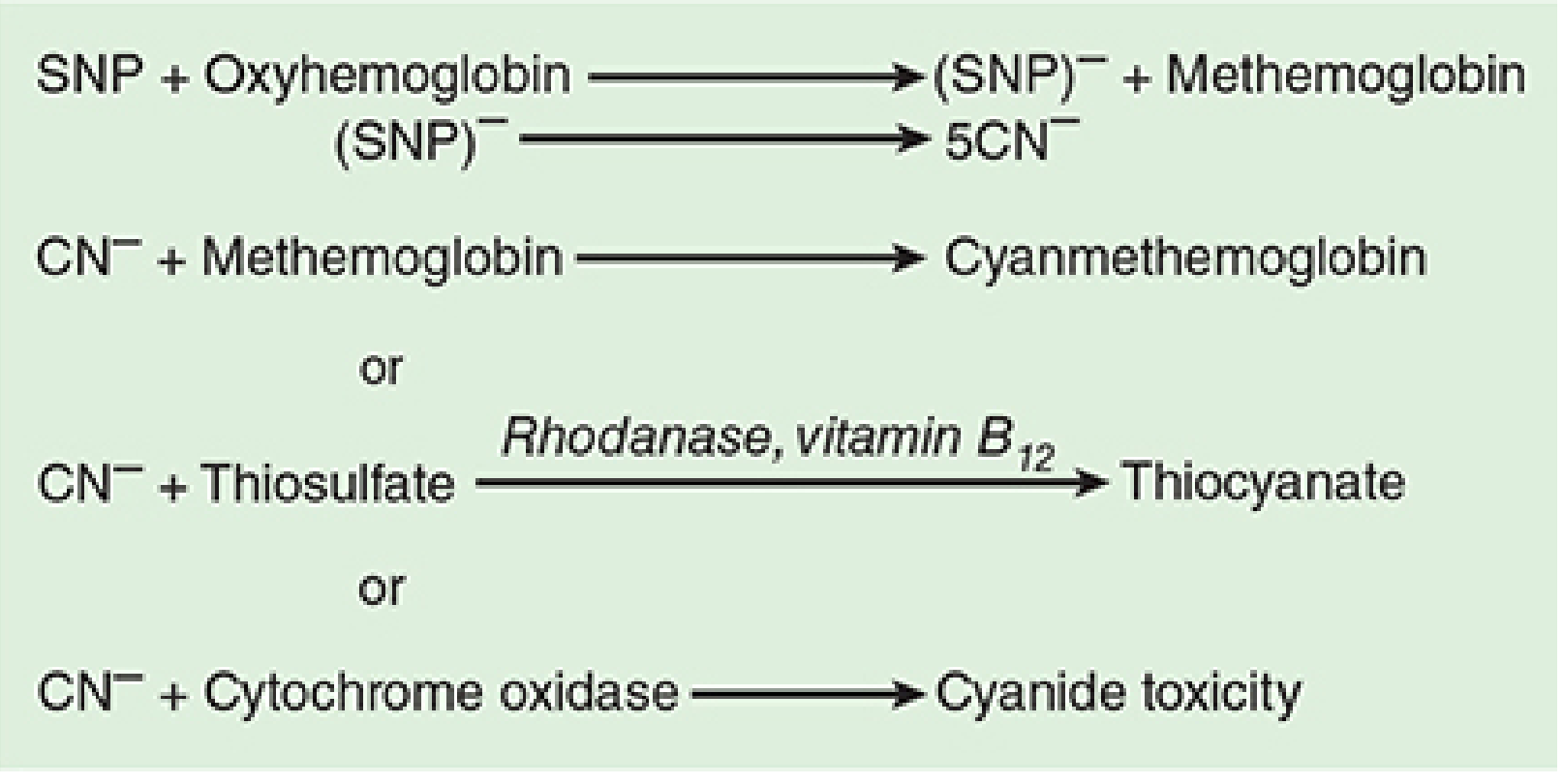
Cyanide Toxicity from SNP
The 5 CN⁻ ions released per SNP molecule can:
- Bind methemoglobin → cyanmethemoglobin (safe)
- Be detoxified by rhodanese in liver/kidney: CN⁻ + thiosulfate → thiocyanate (safe, renally excreted)
- Bind cytochrome oxidase in mitochondria → blocks oxidative phosphorylation → lactic acidosis (toxic)
Cyanide toxicity risk increases when:
- Cumulative dose >500 mcg/kg/day
- Infusion rate >2 mcg/kg/min for several hours
- Renal failure (slows thiocyanate clearance)
Signs of cyanide toxicity:
- Metabolic (lactic) acidosis - this is your "LCL" (lactic acidosis/low cardiac output)
- Cardiac arrhythmias
- Increased mixed venous pO2 (cells can't use O2)
- Tachyphylaxis - the patient becomes suddenly resistant to SNP's hypotensive effect (a classic early warning sign)
Sodium Thiosulfate as the Antidote
Sodium thiosulfate works by donating a sulfur atom to the enzyme rhodanese:
CN⁻ + Sodium thiosulfate → Thiocyanate (SCN⁻) (less toxic, renally cleared)
- Dose: 150 mg/kg IV over 15 minutes
- Can be given prophylactically with high-dose SNP infusions
- Thiocyanate itself can accumulate in renal failure, causing nausea, fatigue, CNS depression, and thyroid dysfunction
- Tintinalli's Emergency Medicine, TREATMENT section; Morgan & Mikhail, p. 468
3. LCL - Lactic Acidosis / Low Cardiac Output
"LCL" in this context most likely refers to lactic acidosis (elevated lactate), which occurs because:
- CRS itself causes hypoperfusion → tissue hypoxia → anaerobic metabolism → lactic acidosis
- Cyanide toxicity (from SNP) blocks cytochrome oxidase → cells cannot utilize O2 → lactic acidosis even with normal O2 delivery
- Hypothermia (see below) impairs cellular metabolism and worsens lactate clearance
This is a "combined lactic acidosis" - both distributive (CRS-driven hypoperfusion) and histotoxic (cyanide-driven mitochondrial block). The key diagnostic clue is the paradox: high mixed venous O2 saturation despite clinical shock (cells not consuming O2).
4. Hypothermia Post-OT
Post-operative hypothermia is extremely common after cardiac surgery. The causes include:
- Cold cardioplegia used during CPB
- Open body cavities with heat loss
- Anesthetic-induced impaired thermoregulation
- Cold IV fluids and blood products
Why Hypothermia Causes Hypertension
This is the key paradox of the case. Hypothermia triggers cutaneous and peripheral vasoconstriction as a physiological heat-conservation reflex (sympathetic-mediated). This vasoconstriction:
- Raises systemic vascular resistance (SVR) - increases afterload
- Directly elevates blood pressure
Additionally, hypothermia causes shivering, which activates the sympathetic system and further elevates heart rate and blood pressure.
"Hypothermia is associated with... vasoconstriction, impaired coagulation, postoperative shivering accompanied by tachycardia and hypertension..."
- Morgan & Mikhail's Clinical Anesthesiology, 7th ed.
"Causes of postoperative hypertension are multifactorial and include... hypothermia. Arterial vasoconstriction usually plays a central role in acute postoperative hypertension."
- Miller's Anesthesia, 10th ed.
Other Effects of Post-OT Hypothermia Relevant Here
| Effect | Consequence |
|---|---|
| Vasoconstriction | Hypertension, increased afterload |
| Delayed drug metabolism | SNP/thiosulfate effects prolonged |
| Impaired coagulation | Bleeding risk |
| Shivering | Tachycardia, hypertension, increased O2 consumption |
| Impaired lactate clearance | Worsens lactic acidosis |
5. How Everything Connects - The Complete Picture
Post-OT Cardiac Surgery
        |
        ├── CRS (cytokine storm, IL-6, TNF-alpha)
        |       → Hypotension, fever, hypoxemia
        |       → Tissue hypoperfusion → Lactic acidosis (LCL)
        |
        ├── Hypothermia (CPB, anesthesia)
        |       → Peripheral vasoconstriction → HYPERTENSION
        |       → Shivering → sympathetic activation → HYPERTENSION
        |       → Delayed drug metabolism
        |
        ├── SNP given for post-OT hypertension
        |       → Releases 5 CN⁻ ions per molecule
        |       → CN⁻ + cytochrome oxidase → histotoxic hypoxia
        |       → Worsens lactic acidosis (LCL)
        |       → Tachyphylaxis = warning sign of cyanide toxicity
        |
        └── SODIUM THIOSULFATE given
                → Rhodanese catalysis: CN⁻ + S₂O₃²⁻ → SCN⁻ (thiocyanate)
                → Detoxifies cyanide
                → SCN⁻ cleared by kidney (monitor in renal failure)
6. Why the Patient Was Hypertensive Despite CRS (Which Typically Causes Hypotension)
This is the key clinical paradox. CRS characteristically causes hypotension (vasodilatory shock from cytokines). Yet this patient was hypertensive. The explanation:
- Hypothermia-driven vasoconstriction overcame the CRS-driven vasodilation
- Rebound from withheld antihypertensives pre-operatively (e.g., beta-blockers, clonidine)
- Pain and agitation in the immediate post-OT period
- SNP tachyphylaxis - when cyanide accumulates, it paradoxically makes the patient resistant to SNP's vasodilatory effect, so BP rises despite ongoing infusion
- Renin release - SNP-induced hypotension triggers renin release; when SNP is stopped, this rebound renin/angiotensin effect raises BP
This is why recognizing tachyphylaxis to SNP (BP rising despite increasing doses) is a critical clinical alarm for cyanide toxicity - and why sodium thiosulfate is given.
Summary Table
| Component | Mechanism | Clinical Significance |
|---|---|---|
| CRS post-OT | Cytokine storm (IL-6, TNF-alpha) activates immune effectors | Fever, hypotension, hypoxemia; treat with tocilizumab |
| SNP used | Post-OT hypertension from hypothermia/vasoconstriction | Controls BP but releases CN⁻ |
| Cyanide toxicity | CN⁻ blocks cytochrome oxidase | Lactic acidosis, arrhythmias, tachyphylaxis |
| Sodium thiosulfate | Sulfur donor for rhodanese; CN⁻ → SCN⁻ | Antidote for cyanide toxicity |
| Thiocyanate (LCL) | SCN⁻ product of detox; accumulates in renal failure | Nausea, CNS depression, thyroid dysfunction |
| Hypothermia | Peripheral vasoconstriction + shivering | Causes hypertension, impairs coagulation and drug metabolism |
| Hypertension | Hypothermia + SNP tachyphylaxis + rebound renin | Treated with SNP; monitor for cyanide toxicity |
Key References:
- Morgan & Mikhail's Clinical Anesthesiology, 7th ed. (SNP metabolism, hypothermia and hypertension)
- Miller's Anesthesia, 10th ed. (post-cardiac surgery hypertension)
- Washington Manual of Medical Therapeutics (CRS grading and management)
- Tintinalli's Emergency Medicine (CRS, sodium thiosulfate mechanism)
- Goodman & Gilman's Pharmacological Basis of Therapeutics (sodium thiosulfate and cyanide antidote)
This is a shared conversation. Sign in to Orris to start your own chat.