
STEPS IN BP TAKING I AM MBBS STUDENT DOING INTERNSHIP
Reading File
Now let me search the medical library for blood pressure measurement technique.
Finding Sources
Finding Sources
Good sources found. Let me read the most relevant sections - Harrison's (the gold standard for MBBS), Roberts & Hedges (clinical procedures), and Gray's Anatomy for Students.
Reading File
Reading File
Reading File
Excellent content gathered. Let me also fetch the clinical image from Harrison's and read the Roberts & Hedges auscultatory steps section.
Loading Image
Reading File
Let me also fetch the Korotkoff sounds diagram and read more of the Roberts & Hedges procedure for completeness.
Loading Image
I now have everything needed to give a thorough, well-illustrated answer. Here is a complete guide to BP measurement for your internship:
Blood Pressure Measurement - Complete Guide for MBBS Interns
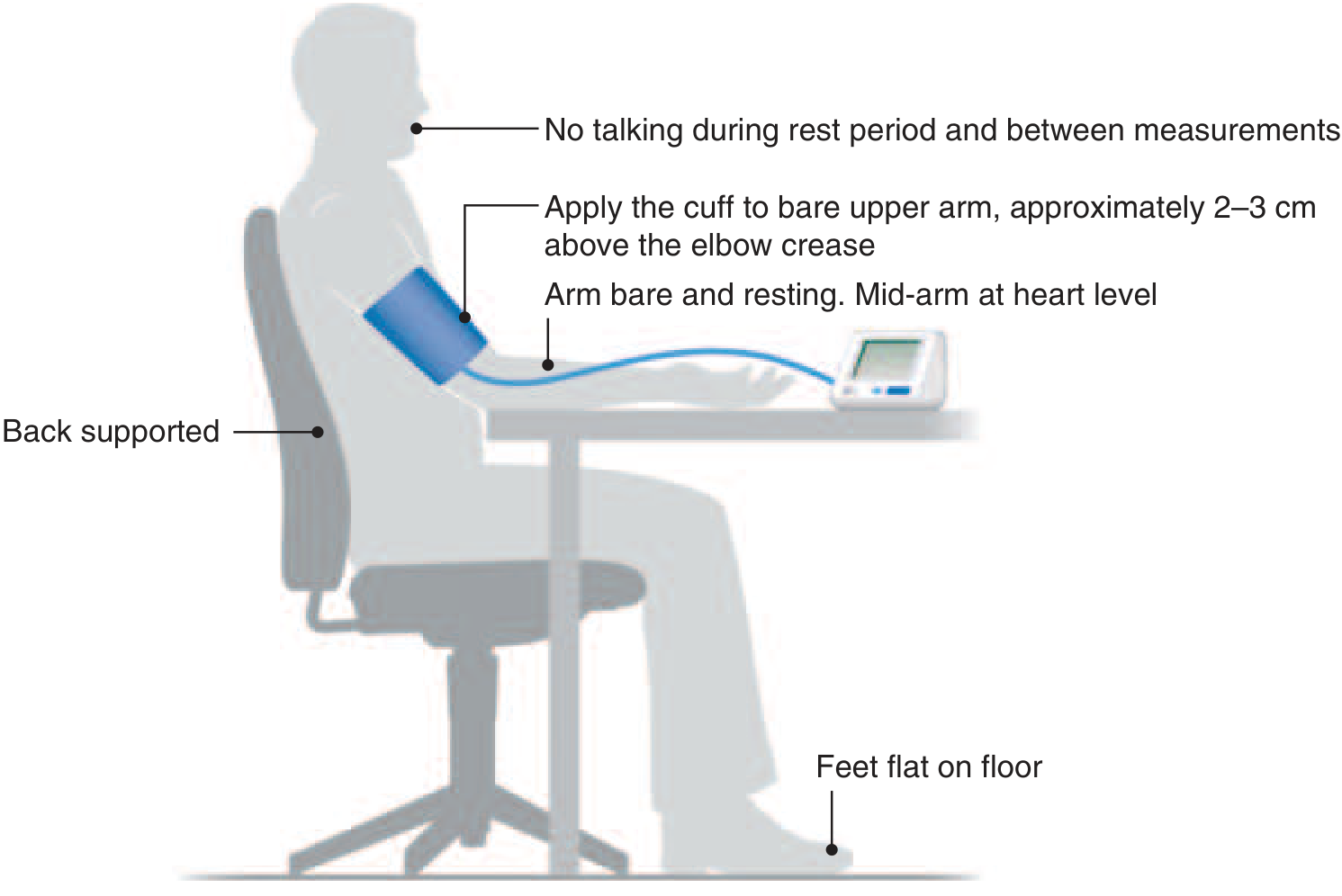
Equipment Required
- Sphygmomanometer - cuff with inflatable bladder, inflating bulb, controlled exhaust valve, and manometer (mercury, aneroid, or digital)
- Stethoscope (bell end preferred)
- Properly sized cuff
Cuff sizing rule (AHA):
- Bladder width = at least 40-50% of arm circumference at midpoint
- Bladder length = 80% of midarm circumference (or twice the width)
- Using too small a cuff gives falsely HIGH readings; too large gives falsely LOW readings
STEP-BY-STEP PROCEDURE
STEP 1 - Patient Preparation (30 minutes before)
- Ask patient to avoid caffeine, smoking, alcohol, and exercise for 30 min
- Ensure the patient has an empty bladder (full bladder raises BP by ~10-15 mmHg)
- Bring the patient into a quiet room with comfortable ambient temperature
- Let the patient rest for 3-5 minutes before the first reading
- No talking or cell phone use during the rest period or measurements
STEP 2 - Positioning the Patient
- Patient seated in a chair with upright back support
- Feet flat on the floor (crossing legs raises BP)
- The measurement arm bare and comfortably supported on a surface
- Mid-arm (cuff) must be at the level of the heart (right atrium)
- If the arm hangs freely parallel to the body, readings will be 9-14 mmHg higher than true value
STEP 3 - Applying the Cuff
- Expose the bare upper arm (no clothing bunched underneath)
- Place the cuff 2-3 cm (approximately 2.5 cm) above the antecubital fossa (elbow crease)
- The center of the inflatable bladder should be placed directly over the brachial artery
- The artery marker on the cuff (if present) should align with the brachial artery
- Wrap the cuff snugly - you should be able to fit 2 fingers underneath, not more
STEP 4 - Estimate Systolic BP by Palpation First (Riva-Rocci technique)
This step helps you avoid missing an auscultatory gap (silent interval between Korotkoff phase I and II, seen in hypertension/arteriosclerosis).
- Palpate the radial pulse with 2 fingers
- Inflate the cuff while palpating the radial artery
- Note the pressure at which the radial pulse disappears - this is the estimated systolic BP
- Inflate 30 mmHg above this level for the auscultatory measurement
- Deflate fully and wait 30-60 seconds before re-inflating for auscultation
STEP 5 - Auscultatory Measurement (Standard Method)
- Place the bell of the stethoscope (or diaphragm) lightly over the brachial artery in the cubital fossa - do NOT tuck it under the cuff
- Reinflate the cuff to 30 mmHg above the estimated systolic (from Step 4)
- Open the deflation valve and deflate slowly at 2-3 mmHg per second (or per beat)
- Listen carefully for Korotkoff sounds
Korotkoff Sounds - What to Listen For
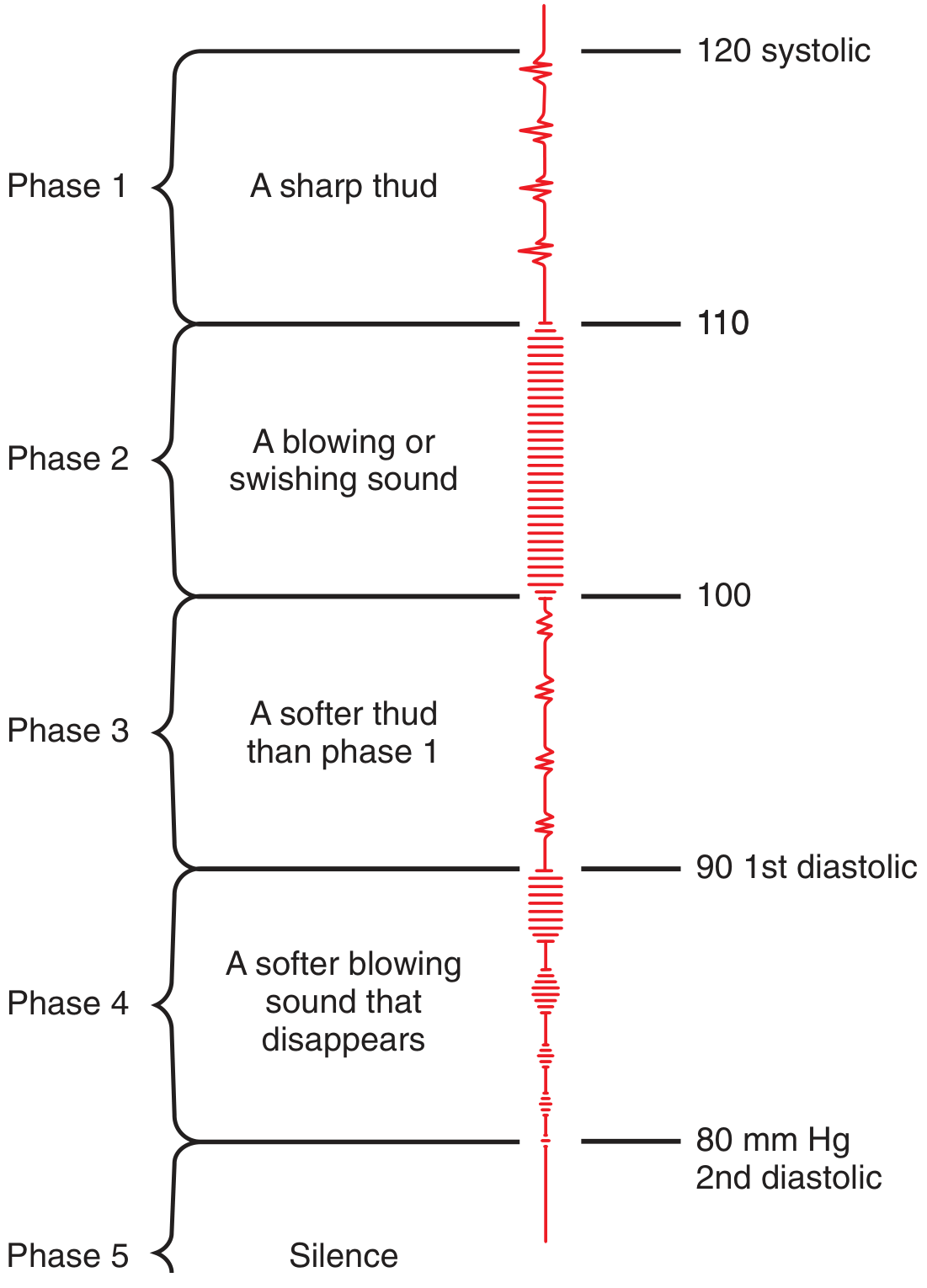
| Phase | Sound | Clinical Significance |
|---|---|---|
| Phase I | First faint, clear, sharp tapping sound | = Systolic BP |
| Phase II | Blowing or swishing sound (softer) | (may disappear = auscultatory gap) |
| Phase III | Softer thud, crisper than Phase II | |
| Phase IV | Distinct muffling - soft, blowing quality | = Diastolic BP in children |
| Phase V | Complete disappearance of sounds | = Diastolic BP in adults |
In adults: Record Korotkoff Phase I as systolic, Phase V as diastolic. In children and pregnant women: Use Phase IV as diastolic.
STEP 6 - Recording and Reporting
- Record the exact mmHg readings - do not round up or down excessively
- Report as systolic/diastolic (e.g., 120/80 mmHg)
- Note which arm was used, patient position (sitting/lying/standing), and time
- Inform the patient of the result
STEP 7 - Repeat Measurements
- Take at least 2 readings separated by at least 1-2 minutes in the same sitting
- Use the average of the two readings
- If readings differ by >5 mmHg, take a third and average all three
- On the first visit, measure BP in both arms - use the arm with the higher reading subsequently
- An inter-arm difference of >15 mmHg systolic is clinically significant (consider subclavian stenosis)
BP Classification (ACC/AHA 2017)
| Category | Systolic (mmHg) | Diastolic (mmHg) | |
|---|---|---|---|
| Normal | <120 | and | <80 |
| Elevated | 120-129 | and | <80 |
| Stage 1 Hypertension | 130-139 | or | 80-89 |
| Stage 2 Hypertension | ≥140 | or | ≥90 |
Source: Harrison's Principles of Internal Medicine 22E (2025)
Common Errors to Avoid
| Error | Effect on Reading |
|---|---|
| Cuff too small | Falsely HIGH |
| Cuff too large | Falsely LOW |
| Arm below heart level | Falsely HIGH |
| Arm above heart level | Falsely LOW |
| Not waiting after exercise/smoking | Falsely HIGH |
| Deflating too fast (>3 mmHg/sec) | Underestimates systolic, overestimates diastolic |
| Stethoscope under the cuff | Falsely LOW |
| Not palpating first | Misses auscultatory gap, underestimates systolic |
| Patient talking during measurement | Raises BP ~10 mmHg |
| Full bladder | Raises BP ~10-15 mmHg |
| Crossed legs | Raises systolic ~2-8 mmHg |
Special Situations You May Encounter in Internship
Auscultatory Gap: A period of silence between Phase I and Phase II, common in hypertension and arteriosclerosis. If you miss Phase I, you record a falsely low systolic BP. Always palpate first to avoid this.
Orthostatic (Postural) BP: Measure lying down, then after 1 minute standing. A drop of ≥20 mmHg systolic or ≥10 mmHg diastolic = orthostatic hypotension. Common in elderly, dehydration, autonomic neuropathy, antihypertensives.
Pulsus Paradoxus: Measure the difference in systolic BP between expiration and inspiration. >10 mmHg difference is abnormal - seen in cardiac tamponade, severe asthma, COPD.
Lower Limb BP: Popliteal artery used with a thigh cuff - normally 20-30 mmHg higher than upper limb. A low thigh BP compared to arm BP suggests coarctation of the aorta.
Sources: Harrison's Principles of Internal Medicine 22E (2025); Roberts and Hedges' Clinical Procedures in Emergency Medicine; Gray's Anatomy for Students
This is a shared conversation. Sign in to Orris to start your own chat.