
In which neuron lesion there is loss of Pain and temperature but touch is not affected
Central lesion affecting the spinothalamic tract - specifically a contralateral spinothalamic tract lesion (e.g., in Brown-Séquard syndrome or syringomyelia).
The key is the anatomical separation of sensory pathways:
- Pain & temperature travel via the spinothalamic tract (crosses at the level of entry, within 1-2 spinal segments)
- Touch (fine/discriminative) travels via the dorsal columns (crosses at the medulla)
Searching sources...
Reading File
Finding Sources
Searching Images
spinothalamic tract dorsal column sensory pathways spinal cord cross section diagram
Reading File
Finding Sources
Loading Image
Finding Sources
Here is a complete, textbook-backed answer:
Loss of Pain & Temperature with Preserved Touch - Spinothalamic Tract (2nd Order Neuron) Lesion
The answer is a lesion of the lateral spinothalamic tract - specifically affecting the second-order neuron of the pain/temperature pathway, while sparing the dorsal column (touch/proprioception) pathway.
Why This Happens: The Two Separate Sensory Pathways
There are two anatomically distinct ascending sensory systems, and this dissociation is possible because they travel in completely separate locations:
| Feature | Pain & Temperature | Touch, Vibration, Proprioception |
|---|---|---|
| Pathway | Lateral spinothalamic tract | Dorsal column - medial lemniscal |
| 1st order neuron | Dorsal root ganglion (DRG) | Dorsal root ganglion (DRG) |
| Fiber type | A-delta (thin myelinated) & C (unmyelinated) | A-alpha/beta (large myelinated) |
| Where it synapses | Dorsal horn (Rexed laminae I, II, V) | Nucleus gracilis / cuneatus (medulla) |
| Where it crosses | At the anterior spinal commissure, within 1-2 segments of entry | In the medulla (much higher up) |
| Tract location | Contralateral anterolateral funiculus | Ipsilateral dorsal columns |
- Localization in Clinical Neurology, 8e, Anatomy of the Sensory System
- Ganong's Review of Medical Physiology, 26th Ed, Somatosensory Pathways
The Key Lesion: Lateral Spinothalamic Tract
A selective lesion of the lateral spinothalamic tract (which carries pain and temperature ONLY after crossing) will produce:
- Loss of pain and temperature - contralateral to the lesion (below the level)
- Preserved touch - because the dorsal columns are intact
This dissociation is called "dissociated sensory loss."
Classic Clinical Scenarios
1. Syringomyelia (Most Classic Example)
- A fluid-filled cavity (syrinx) expands in the central spinal cord
- It destroys the anterior white commissure where pain/temperature fibers cross
- Result: Bilateral cape-like loss of pain & temperature at the level of the lesion, with touch preserved (dorsal columns unaffected)
- Classic: "suspended" sensory level - loss at the level, normal above and below
2. Brown-Séquard Syndrome (Hemisection of Spinal Cord)
- One side of the spinal cord is damaged
- Ipsilateral side: loss of touch, proprioception (dorsal column) + motor loss
- Contralateral side: loss of pain and temperature (spinothalamic) - touch spared
- This is the textbook "crossed" dissociated sensory loss
3. Anterior Spinal Artery Occlusion
- Infarcts the anterior 2/3 of the cord (spinothalamic + corticospinal)
- Spares the posterior columns (dorsal columns survive)
- Result: Loss of pain/temperature + motor paralysis, with preserved touch/vibration/proprioception
From Frameworks for Internal Medicine: "There is preservation of fine touch, vibration, and proprioception (carried by the dorsal columns)" in spinothalamic tract lesions.
Summary: Which Neuron?
| Level of Lesion | Effect |
|---|---|
| 1st order neuron (DRG or peripheral nerve) | All sensory modalities lost together (no dissociation) |
| 2nd order neuron (spinothalamic tract, after crossing) | Pain & temperature lost, touch SPARED - dissociated loss |
| Dorsal column lesion | Touch/vibration/proprioception lost, pain/temperature spared (opposite dissociation) |
So the answer is: A lesion of the lateral spinothalamic tract (2nd order neuron / central pathway for pain and temperature), as seen classically in syringomyelia.
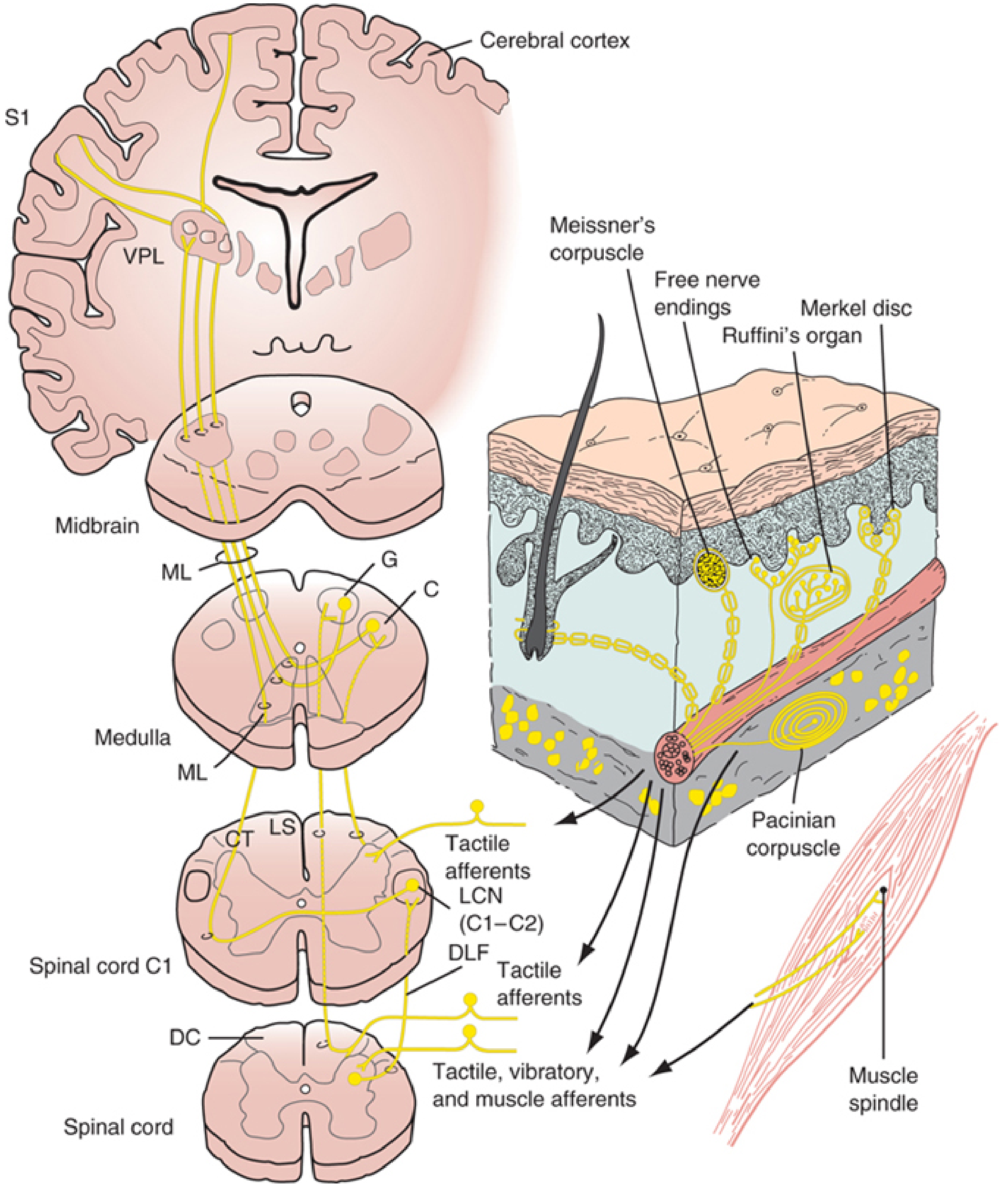
Diagram: Dorsal column (tactile, vibratory, proprioceptive) pathway ascending ipsilaterally to the medulla before crossing. This is why a spinothalamic lesion can selectively knock out pain/temperature while leaving touch intact.
This is a shared conversation. Sign in to Orris to start your own chat.