
Retinoscope vs Ophthalmoscope, fundoscope and ratinoscope Difference And konsa kis disease me use hota hai? With images
Reading File
Now let me search the medical library and web simultaneously for all these instruments.
Finding Sources
Finding Sources
Searching the Web
retinoscope vs ophthalmoscope vs fundoscope difference uses diseases
Finding Sources
Finding Sources
Reading Web Page
https://nationalindco.com/retinoscope-and-ophthalmoscope-how…
Now let me read the relevant textbook sections and fetch images in parallel.
Reading File
Reading File
Loading Image
Loading Image
Now let me fetch the textbook images and a retinoscope image.
Loading Image
Loading Image
Searching the Web
retinoscope instrument image labeled parts
Loading Image
Loading Image
Ab mere paas saari zaruri information hai. Ek comprehensive answer deta hun.
🔭 Retinoscope vs Ophthalmoscope/Fundoscope - Poori Jaankari
Note: "Fundoscope" aur "Ophthalmoscope" ek hi instrument ke alag naam hain. "Retinoscope" ek alag instrument hai alag kaam ke liye.
1. RETINOSCOPE
Yeh kya hai?
Retinoscope ek handheld instrument hai jo aankhon ki refractive error (number) measure karne ke liye use hota hai. Iska doosra naam Skiascope bhi hai. Test ka naam Retinoscopy ya Skiascopy hai.
Parts of Retinoscope:
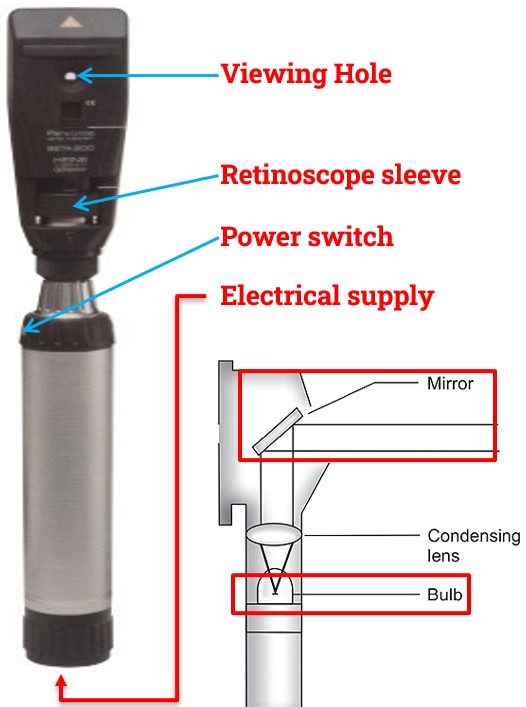
Main parts:
- Head piece - Light bulb, Peep hole (viewing hole), Mirror
- Sleeve - Rotate karne se plane/concave mirror effect milta hai
- Handle - Electrical supply
Kaise kaam karta hai?
- Light beam aankhon mein project karta hai
- Pupil se reflect hone wali light ("red reflex") ki motion observe karta hai
- With motion = Hyperopia (Farsightedness)
- Against motion = Myopia (Nearsightedness)
- Neutralization point pe exact power pata chalta hai
- Patient ki cooperation zaruri NAHI - infants, children, mentally disabled patients mein bhi use hota hai
2. OPHTHALMOSCOPE = FUNDOSCOPE = FUNDUSCOPE
Yeh teeno naam ek hi instrument ke hain!
Yeh kya hai?
Ophthalmoscope (Fundoscope) ek handheld instrument hai jo aankhon ke andar ke structures directly dekhne ke liye use hota hai - retina, optic disc, blood vessels, macula.
Parts of Ophthalmoscope (Fundoscope):
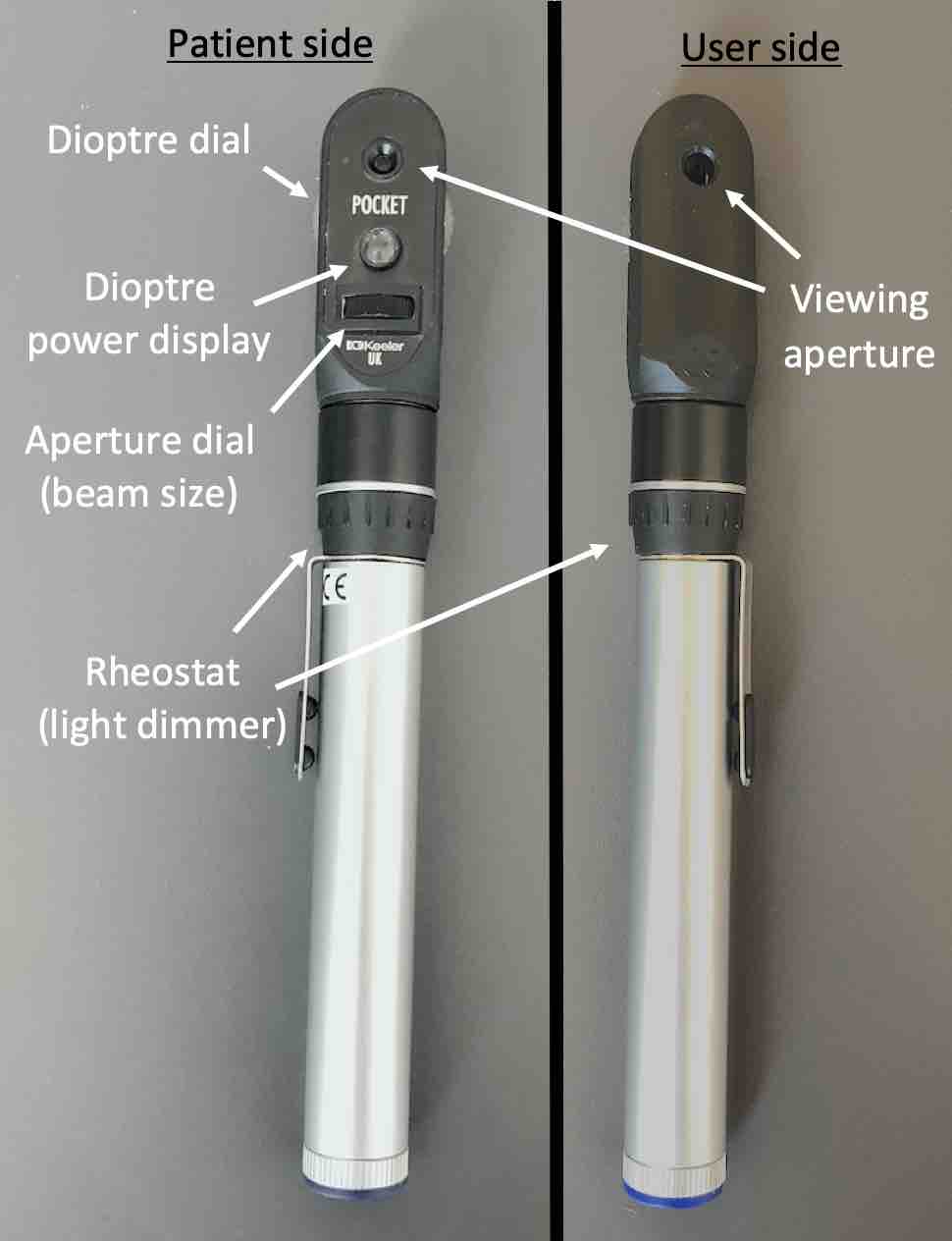
Main parts (as shown above):
- Dioptre dial - Focus adjust karne ke liye
- Dioptre power display - Lens power show karta hai
- Aperture dial - Beam size control
- Rheostat - Light intensity
- Viewing aperture - Doctor is se dekhta hai
Types of Ophthalmoscopes:
- Direct Ophthalmoscope - Common, 15x magnification, small field of view
- Indirect Ophthalmoscope - Binocular, wide field, inverted image (image upar wali iska hai - binocular indirect ophthalmoscope)
- Panoptic Ophthalmoscope - Wider field than direct
3. KEY DIFFERENCES TABLE
| Feature | Retinoscope | Ophthalmoscope/Fundoscope |
|---|---|---|
| Purpose | Refractive error measure karna | Fundus (andar) dekhna |
| What it measures | Light reflex motion | Internal eye structures |
| Red reflex used | Blurred/indistinct red reflex | Clear red reflex |
| Patient cooperation | NOT required | Helpful hoti hai |
| Magnification | Not for visualization | 15x (direct) |
| What you see | Movement of light beam | Retina, optic disc, vessels |
| Also called | Skiascope | Fundoscope, Funduscope |
| Test name | Retinoscopy / Skiascopy | Ophthalmoscopy / Fundoscopy |
| Examiner's retina | Fuses with peephole | Fuses with patient's retina |
Per Kanski's Ophthalmology: "Clear red reflex is more helpful for ophthalmoscopy, while the indistinct red reflex is primarily used for retinoscopy." - Kanski's Clinical Ophthalmology, 10th Ed.
4. KIS DISEASE MEIN KAUNSA USE HOTA HAI?
RETINOSCOPE - Use in:
| Disease / Condition | Kyon use karte hain? |
|---|---|
| Myopia (Nearsightedness / Nikatnazri) | Against motion - exact power pata karna |
| Hyperopia (Farsightedness / Doornazri) | With motion - power measure karna |
| Astigmatism | Two axes mein different power measure karna |
| Amblyopia (Lazy eye) | Children mein number check - cooperation nahi chahiye |
| Strabismus (Squint) | Hyperopia (strabismus ka common cause) detect karna |
| Cataract | Red reflex abnormal hota hai - media opacity pata chalta hai |
| Aphakia | Post-surgery power check |
| Pediatric patients / Infants | Without cooperation refractive error pata karna |
OPHTHALMOSCOPE / FUNDOSCOPE - Use in:
| Disease / Condition | Kya dekhte hain? |
|---|---|
| Diabetic Retinopathy | Microaneurysms, hemorrhages, exudates, new vessels |
| Hypertensive Retinopathy | AV nipping, silver/copper wiring, papilledema |
| Glaucoma | Optic disc cupping (C:D ratio >0.5) |
| Papilledema | Raised intracranial pressure - blurred disc margins |
| Retinal Detachment | Retina ka torn ya detached area |
| Central Retinal Artery Occlusion | "Cherry red spot" macula pe |
| Central Retinal Vein Occlusion | "Flame-shaped hemorrhages" - "blood and thunder" fundus |
| Optic Atrophy | Pale optic disc |
| Age-Related Macular Degeneration (AMD) | Drusen, macular changes |
| Vitreous Hemorrhage | Red reflex absent/diminished |
| Cataract | Red reflex absent/dark spots |
| Endocarditis | Roth spots (boat-shaped hemorrhages) |
| Multiple Sclerosis | Optic disc pallor |
| Sickle Cell Disease | "Sea-fan" neovascularization |
5. QUICK MEMORY AID (Yaad karne ka Tarika)
Retinoscope = Refraction (R = R) Ophthalmoscope = Observation of fundus (andar dekhna)
Retinoscope → "NUMBER PATA KARO" → Glasses/contact lens ka number
Ophthalmoscope → "ANDAR DEKHO" → Disease diagnose karo
6. IMPORTANT CLINICAL POINT
Per Bradley & Daroff's Neurology: Fundus examination mandatory hai un patients mein jo visual loss present karen. Steps:
- Room lights dim karo
- Patient ko dur dekhne kaho (accommodation minimize karo)
- Red reflex check karo (absent = cataract/vitreous hemorrhage)
- Optic disc evaluate karo - edema? Pallor? Cupping?
- Retinal vessels dekho
- Macula evaluate karo
Summary in one line:
- Retinoscope = Chashme ka NUMBER check karta hai (refractive error)
- Ophthalmoscope/Fundoscope = Aankhon ki BIMARI diagnose karta hai (fundus examination) - yeh dono ek hi instrument hain!
This is a shared conversation. Sign in to Orris to start your own chat.