
Explain normal heart sounds in point wise format with a picture
Reading File
Finding Sources
Searching Images
normal heart sounds S1 S2 diagram phonocardiogram
Reading File
Loading Image
Reading File
Loading Image
Here is a comprehensive pointwise explanation of normal heart sounds, sourced from Guyton and Hall Textbook of Medical Physiology:
Normal Heart Sounds
Overview
- Normal heart sounds are described as "lub, dub" heard on auscultation with a stethoscope.
- They arise from vibrations of valves, blood, and cardiac walls transmitted to the chest wall.
- The two primary normal sounds are S1 ("lub") and S2 ("dub").
S1 — First Heart Sound ("lub")
- Cause: Closure of the atrioventricular (AV) valves — mitral (bicuspid) and tricuspid valves — at the onset of ventricular systole.
- Mechanism: Ventricular contraction causes backflow of blood against the AV valves → valves close and bulge toward the atria → chordae tendineae abruptly halt the bulging → elastic recoil causes blood and ventricular walls to vibrate → sound is transmitted to the chest.
- Quality: Described as "lub" — relatively low-pitched and longer in duration (~0.14 seconds).
- Pitch: Lower frequency than S2 because the AV valves are less taut and the ventricles are less elastic.
- Best heard: At the mitral area (cardiac apex / 5th intercostal space, midclavicular line) and tricuspid area (lower left sternal border).
S2 — Second Heart Sound ("dub")
- Cause: Closure of the semilunar valves — aortic and pulmonary valves — at the end of ventricular systole.
- Mechanism: After ejection, semilunar valves close and bulge back toward the ventricles → elastic recoil sends blood back into the arteries → blood reverberates between arterial walls and valves → vibrations travel along the arterial walls to the chest wall.
- Quality: Described as "dub" — relatively higher-pitched and shorter in duration (~0.11 seconds).
- Pitch: Higher than S1 because semilunar valves are tauter and arterial walls are more elastic than ventricular walls.
- Best heard: At the aortic area (2nd right intercostal space) and pulmonic area (2nd left intercostal space).
S3 — Third Heart Sound (Physiological)
- Timing: Occurs at the beginning of the middle third of diastole (early-to-mid diastole).
- Cause: Rapid ventricular filling from the atria — blood rushes in and reverberates against ventricular walls, causing low-frequency vibration.
- Quality: Weak, low-frequency rumbling — usually below the audible threshold for the ear but detectable on phonocardiography.
- Normal in: Children, adolescents, and young adults.
- Abnormal if present in older adults — suggests systolic heart failure (S3 gallop).
S4 — Fourth Heart Sound (Atrial Sound)
- Timing: Occurs at atrial contraction (late diastole / presystole).
- Cause: Atrial contraction forces blood into the ventricles → inrush initiates low-frequency ventricular vibration.
- Quality: Very low frequency (~20 Hz or less) — rarely audible with a stethoscope; recorded only on phonocardiography in normal individuals.
- Abnormal if audible (S4 gallop): Common in left ventricular hypertrophy or decreased ventricular compliance, where atrial kick is important for filling.
Duration and Pitch Summary
| Sound | Valve(s) | Phase | Duration | Pitch | Quality |
|---|---|---|---|---|---|
| S1 | Mitral + Tricuspid | Start of systole | ~0.14 sec | Low | "Lub" |
| S2 | Aortic + Pulmonary | End of systole | ~0.11 sec | Higher | "Dub" |
| S3 | — | Mid-diastole | Very brief | Very low | Soft rumble |
| S4 | — | Late diastole (pre-S1) | Very brief | Very low | Soft thud |
Phonocardiogram — S1 and S2
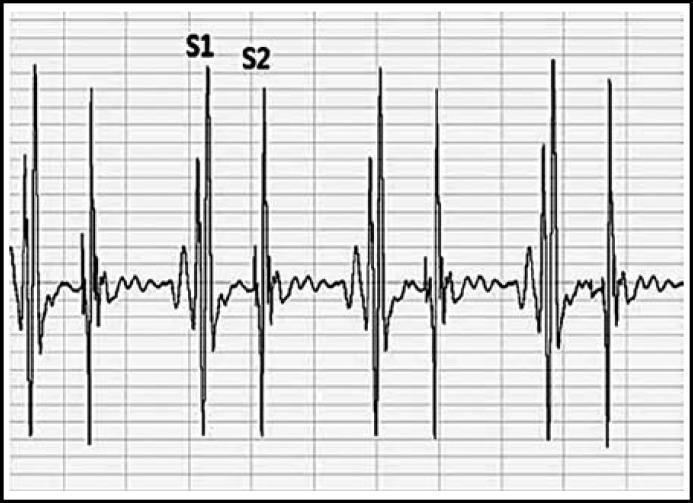
S1 (higher amplitude spike) and S2 follow each other in each cardiac cycle. The shorter interval between S1 and S2 = systole; the longer interval after S2 = diastole.
Auscultation Areas on the Chest
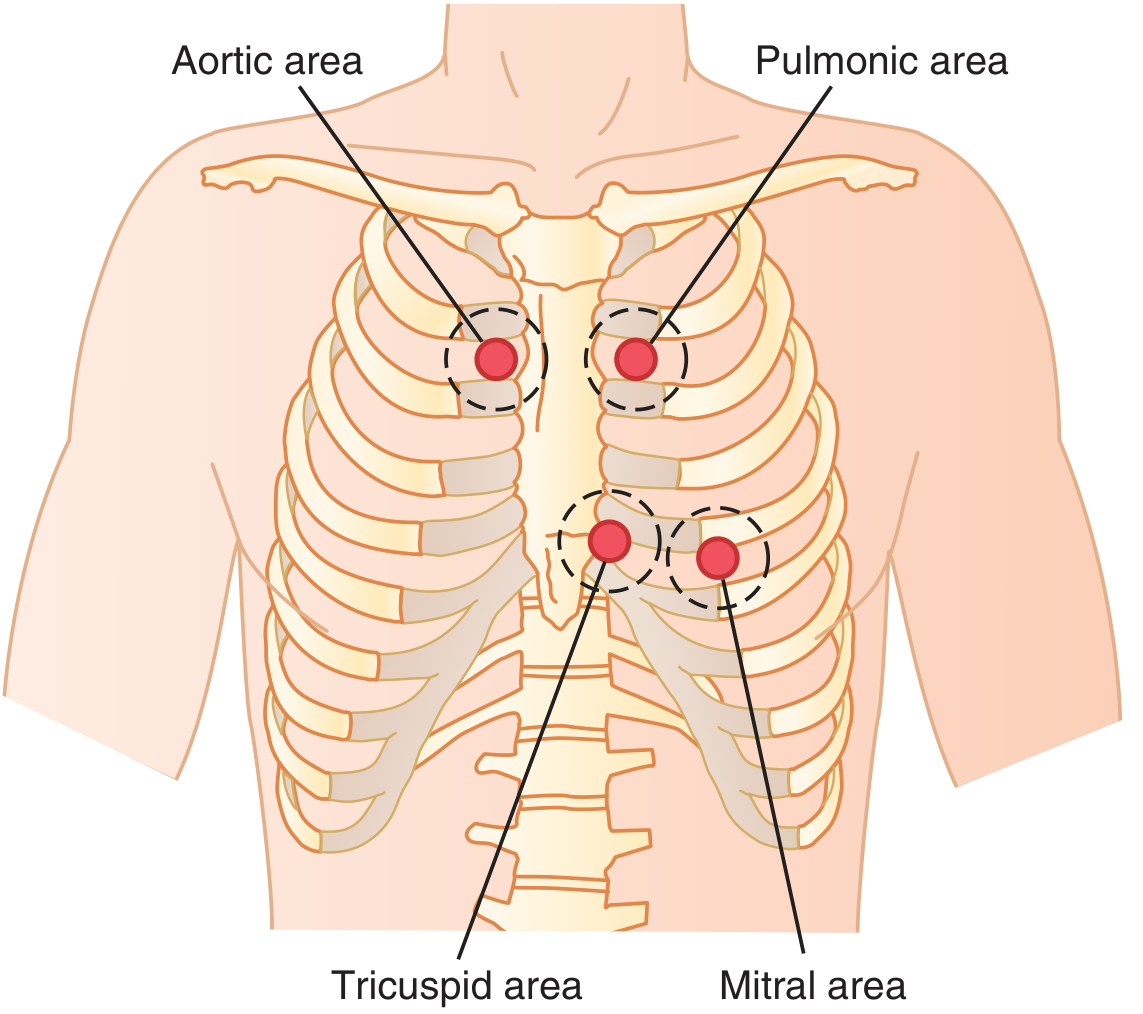
Figure: Chest areas from which sounds from each valve are best heard. Note — auscultation areas are NOT directly over the valves; sounds are transmitted along blood vessel direction. — Guyton and Hall Textbook of Medical Physiology
- Aortic area: 2nd right intercostal space (sound transmitted up the aorta)
- Pulmonic area: 2nd left intercostal space (along the pulmonary artery)
- Tricuspid area: Lower left sternal border (over the right ventricle)
- Mitral area: Cardiac apex / 5th ICS midclavicular line (over the left ventricle)
Key Clinical Points
- The interval between S1 and S2 (systole) is shorter than the interval between S2 and next S1 (diastole) at normal heart rates.
- S1 marks the beginning of ventricular systole; S2 marks the end of ventricular systole.
- The audible frequency range for heart sounds is ~40–520 cycles/sec; large portions of the vibration energy are below audible range and only detectable by electronic phonocardiography.
- Splitting of S2 (A2 before P2) is physiologically normal during inspiration due to delayed closure of the pulmonary valve.
This is a shared conversation. Sign in to Orris to start your own chat.