
Folate trap short note
The folate trap (also called the methyl trap hypothesis) describes how vitamin B12 deficiency leads to functional folate deficiency, even when total folate levels are normal.
Searching sources...
Reading File
Finding Sources
Searching Images
folate trap methyl trap B12 deficiency mechanism diagram
Reading File
Reading File
Reading File
Loading Image
Here is a concise but complete short note on the Folate Trap:
The Folate Trap (Methyl-Trap Hypothesis)
Definition
The folate trap (or methyl-trap hypothesis) describes a state of functional folate deficiency caused by vitamin B12 deficiency, even when total body folate stores are adequate. It explains why B12 deficiency produces a megaloblastic anemia that is biochemically identical to folate deficiency.
Background: Normal Folate Metabolism
Dietary folates are converted to tetrahydrofolate (THF), the active coenzyme form, which carries one-carbon units used in:
- Purine synthesis
- dTMP (thymidine monophosphate) synthesis - via the dUMP → dTMP reaction (requires 5,10-methylene-THF)
The folate cycle includes multiple interconvertible one-carbon forms (N5-methyl-THF, N5,N10-methylene-THF, N10-formyl-THF, etc.). The thermodynamic equilibrium of the folate cycle strongly favors accumulation in the N5-methyl-THF (5-methyltetrahydrofolate, 5-MTHF) form.
The Key Reaction: Methionine Synthase
The only reaction that can remove the methyl group from N5-methyl-THF is catalyzed by methionine synthase (homocysteine methyltransferase):
N5-methyl-THF + Homocysteine → THF + Methionine
This reaction requires vitamin B12 (methylcobalamin) as an obligate cofactor.
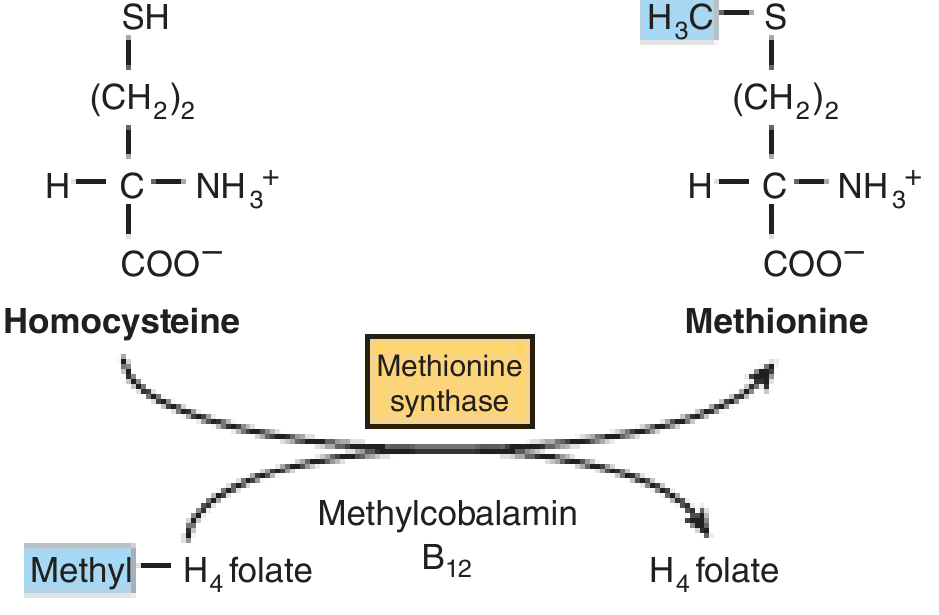
Mechanism of the Trap
When B12 is deficient, methionine synthase cannot function:
- N5-methyl-THF accumulates - it cannot donate its methyl group
- The folate pool becomes progressively "trapped" in the N5-methyl-THF form
- Free THF cannot be regenerated
- Consequently, 5,10-methylene-THF (needed for dTMP synthesis) and N10-formyl-THF (needed for purine synthesis) are unavailable
- This leads to functional folate deficiency despite normal or even elevated serum folate levels
This is the essence of the folate trap - folate is physically present but metabolically useless because it is "locked" in the methylated form.
"If vitamin B12 is deficient, or if the methionine synthase enzyme is defective, N5-methyl-FH4 accumulates. Eventually, most folate forms in the body become 'trapped' in the N5-methyl form. A functional folate deficiency results because the carbons cannot be removed from the folate." - Basic Medical Biochemistry, 6th Ed
Consequences
| Consequence | Mechanism |
|---|---|
| Megaloblastic anemia | Impaired dTMP and purine synthesis → defective DNA replication → abnormally large, nuclear-immature RBC precursors |
| Pancytopenia | Impaired division of all rapidly dividing hematopoietic cells |
| Elevated serum folate | Folate trapped as 5-MTHF cannot enter cells effectively; RBC folate is low |
| Elevated homocysteine | Methionine synthase blocked; homocysteine accumulates |
| Subacute combined degeneration | Separate from the folate trap - due to failed methylation of myelin basic protein and methylmalonate accumulation (B12's other role) |
Why Folate Supplementation Alone is Dangerous in B12 Deficiency
Giving folic acid (not B12) to a B12-deficient patient:
- Partially corrects megaloblastic anemia by "bypassing" the trap - supplemental folic acid can be converted to 5,10-methylene-THF via an alternative route, restoring dTMP synthesis
- Does NOT correct neurological damage (subacute combined degeneration of the spinal cord)
- Masks the true diagnosis of B12 deficiency while the neurological disease progresses silently
This is why it is critical to distinguish folate deficiency from B12 deficiency before treatment.
Key Distinguishing Features
| Feature | B12 Deficiency | Folate Deficiency |
|---|---|---|
| Megaloblastic anemia | Yes (via folate trap) | Yes (direct) |
| Serum B12 | Low | Normal |
| Serum folate | Normal or high | Low |
| RBC folate | Low | Low |
| Methylmalonic acid (urine/serum) | Elevated | Normal |
| Homocysteine | Elevated | Elevated |
| Neurological signs | Yes (subacute combined degeneration) | No |
Elevated urinary methylmalonic acid is the key discriminator for B12 deficiency, since it reflects the other B12-dependent enzyme (methylmalonyl CoA mutase) and is unaffected by the folate trap.
Summary
The folate trap is a downstream consequence of B12 deficiency. Because the only exit point for N5-methyl-THF requires B12 as a cofactor, B12 deficiency diverts the entire folate pool into a "metabolic dead end." The result is a paradox: normal or high serum folate, but severe functional folate deficiency at the cellular level, causing megaloblastic anemia indistinguishable from primary folate deficiency - except for elevated methylmalonic acid and the presence of neurological disease.
Sources: Harper's Illustrated Biochemistry 32nd Ed, Basic Medical Biochemistry 6th Ed, Tietz Textbook of Laboratory Medicine 7th Ed, Katzung's Basic & Clinical Pharmacology 16th Ed
Folate trap short note from dm vasudevan in easy words
Let me search DM Vasudevan's textbook specifically for the folate trap content.
Searching sources...
Finding Sources
Finding Sources
Finding Sources
DM Vasudevan's "Textbook of Biochemistry for Medical Students" is not in the library. The library has Harper's, Lippincott, and Basic Medical Biochemistry (Lieberman). I'll pull the best content from these and present it in the simple, student-friendly style that Vasudevan is known for.
Finding Sources
Reading File
Reading File
I now have all the content needed. DM Vasudevan's book is not in the library, but I have excellent source material. I'll write this in Vasudevan's characteristic simple, stepwise, student-friendly style with easy language, as he presents it.
Folate Trap - Short Note
(In the style of DM Vasudevan - simple, stepwise, student-friendly)
Note: DM Vasudevan's textbook is not available in the library. This note is written in his characteristically simple, point-by-point style, drawing on the same biochemistry covered in his textbook, sourced from Harper's and Basic Medical Biochemistry.
What is the Folate Trap?
Think of it this way: folate is present in the body, but it cannot be used. This happens because of Vitamin B12 deficiency. The result is a "functional folate deficiency" - folate is trapped and made useless.
Step-by-Step Explanation (Easy Version)
Step 1 - Understand active folate
The active, working form of folate in the body is Tetrahydrofolate (THF). THF carries one-carbon units and is needed for:
- Making purines (for DNA)
- Making thymidine (dTMP) - also for DNA
- Without THF → no DNA synthesis → no cell division
Step 2 - What happens to folate in the body?
Most folate in tissues exists as N5-methyl-THF (methyl folate). This is the most stable form. Think of it like folate "resting" in a parking lot.
Step 3 - The only exit from the parking lot needs B12
For folate to come out of the N5-methyl-THF form and become active THF again, it must donate its methyl group to homocysteine. This reaction is:
N5-methyl-THF + Homocysteine  →  THF + Methionine
         (enzyme: Methionine synthase)
         (cofactor needed: Vitamin B12)
This is the ONLY reaction through which the methyl group can be removed from N5-methyl-THF.
Step 4 - What happens when B12 is deficient?
- Methionine synthase cannot work (no B12 cofactor)
- N5-methyl-THF keeps accumulating - it has nowhere to go
- Folate gets "trapped" in the methyl form
- Free THF cannot be regenerated
- The body runs out of active THF
"The carbons cannot be released from the folate because the one reaction in which they participate cannot occur because of the B12 deficiency." - Basic Medical Biochemistry, 6th Ed
Step 5 - Result
Even though total folate in the blood is normal or even high, the cells have no functional (active) folate to work with. This is called Functional Folate Deficiency.
What Goes Wrong Clinically?
| Problem | Reason |
|---|---|
| No active THF | Can't make dTMP or purines |
| No dTMP/purines | Can't synthesize DNA |
| No DNA synthesis | Cells can't divide properly |
| Bone marrow affected most | It divides rapidly and needs DNA constantly |
| Result: Megaloblastic Anemia | Big, immature RBCs released into blood |
Simple Analogy (Vasudevan-style)
Imagine folate is a rechargeable battery. The charger (methionine synthase) needs B12 to work. Without B12, the charger doesn't work. All batteries remain discharged (N5-methyl-THF). Even though you have many batteries, none of them work. That is the folate trap.
Why is This Important Clinically?
1. B12 deficiency mimics folate deficiency
Both cause identical megaloblastic anemia. You cannot tell them apart by blood picture alone.
2. The danger of giving folic acid alone in B12 deficiency
- Giving folic acid tablets corrects the anemia (bypasses the trap)
- But the neurological damage of B12 deficiency continues silently (subacute combined degeneration of spinal cord)
- The anemia gets better, the patient feels fine - but the nerves keep getting destroyed
- This is the biggest clinical danger of the folate trap
3. How to differentiate B12 deficiency from folate deficiency
| Test | B12 Deficiency | Folate Deficiency |
|---|---|---|
| Serum B12 | Low | Normal |
| Serum folate | Normal or High | Low |
| Urine methylmalonic acid | Elevated (key!) | Normal |
| Homocysteine | Elevated | Elevated |
| Neurological signs | Present | Absent |
Elevated methylmalonic acid is the single best marker to confirm B12 deficiency (not folate deficiency), because it comes from the other B12-dependent reaction (methylmalonyl CoA → succinyl CoA).
One-Line Summary
Folate trap = B12 deficiency blocks methionine synthase → folate gets stuck as N5-methyl-THF → no active THF available → cells cannot make DNA → megaloblastic anemia, despite normal serum folate.
- Harper's Illustrated Biochemistry, 32nd Ed, p. 556-557
- Basic Medical Biochemistry (Lieberman), 6th Ed, p. 1394-1396
This is a shared conversation. Sign in to Orris to start your own chat.