
NLEP from PARK TEXTBOOK OF SPM
Reading File
Now let me search the Park textbook for NLEP (National Leprosy Eradication Programme).
Finding Sources
Finding Sources
Finding Sources
Finding Sources
Found the key sections. Let me read them all in parallel.
Reading File
Reading File
Reading File
I have the main NLEP section. Now let me read more of block 6 which has the detailed NLEP content, including the Sparsh campaign and other sub-topics.
Reading File
Reading File
Reading File
Reading File
Reading File
I now have all the key content. Let me also fetch the NLEP referral system diagram.
Loading Image
I now have all the content needed for a comprehensive answer. Here is the full NLEP coverage from Park's Textbook of Preventive and Social Medicine:
National Leprosy Eradication Programme (NLEP)
Park's Textbook of Preventive and Social Medicine
Historical Background
- 1874: Anti-leprosy work in India began when the Mission to Lepers was founded by Baily at Chamba, Himachal Pradesh.
- 1954-55: The National Leprosy Control Programme (NLCP) was initiated as a centrally aided programme, focusing on early case detection and dapsone (DDS) monotherapy on an ambulatory basis.
- The programme gained momentum during the Fourth Five Year Plan when it became a centrally-sponsored programme.
- 1980: Government of India declared its resolve to "eradicate" leprosy by the year 2000. A Working Group was constituted to advise accordingly.
- 1982: The Working Group submitted its report, recommending a revised strategy based on multi-drug chemotherapy (MDT) to reduce the quantum of infection, sources of infection, and chain of transmission.
- 1983: The NLCP was redesignated as the National Leprosy "Eradication" Programme (NLEP).
- Goal: Reduce case load to 1 or less than 1 per 10,000 population.
World Bank Support and Integration
| Phase | Period |
|---|---|
| 1st World Bank Project | 1993 onwards |
| 2nd World Bank Project | 2001-02 to December 2004 |
| Post World Bank | Government of India funds + WHO + ILEP technical support |
- Programme integrated with the general health care system in 2002-03.
- Leprosy diagnosis and treatment services now available at all PHCs and government hospitals.
Components of the Programme
- Decentralized integrated leprosy services through the general health care system
- Capacity building of all general health service functionaries
- Intensified Information, Education and Communication (IEC)
- Prevention of disability and medical rehabilitation
- Intensified monitoring and supervision
Achievements
- After MDT introduction, recorded case load fell from 57.6 per 10,000 population in 1981 to less than 1 at national level in December 2005.
- 34 states/UTs achieved leprosy elimination status.
- Only Chhattisgarh and Dadra & Nagar Haveli were yet to achieve elimination.
- Bihar, Goa, Chandigarh, and Odisha (who had achieved elimination earlier) showed PR >1 per 1,000 population.
- 209 high endemic districts identified for special action during 2012-13.
Major Initiatives
- New Case Detection Rate (NCDR) is now the main monitoring indicator (replaced prevalence).
- Treatment Completion Rate is tracked annually at state level.
- Disability Prevention and Medical Rehabilitation (DPMR) services expanded:
- Dressing materials, supportive medicines, and ulcer kits provided.
- Micro-cellular rubber (MCR) footwear provided for insensitive feet.
- 41 NGOs and 42 Government Medical Colleges strengthened for reconstructive surgery (RCS) - total 83 centres.
- Rs. 5,000/- incentive to BPL patients undergoing RCS.
- Rs. 5,000/- support to government institutions/PMR centres per surgery.
- ASHAs involved in case detection and treatment follow-up.
ASHA Incentives
| Activity | Incentive |
|---|---|
| Confirmed diagnosis of case brought by ASHA | Rs. 250/- |
| Completion of full PB leprosy treatment | Rs. 400/- |
| Completion of full MB leprosy treatment | Rs. 600/- |
| Early case (before visible deformity) | Rs. 250/- |
| New case with visible deformity (hands/feet/eye) | Rs. 200/- |
ASHA activities:
- (a) Search for suspected cases - ASHA Based Surveillance for Leprosy Suspects (ABSULS) launched 1st July 2019
- (b) Follow-up all cases for treatment completion; detect reaction symptoms
- (c) Advise and motivate self-care for disabled cases
- (d) Spreading awareness
- (e) There are 612 self-settled leprosy colonies in the country
Three-Pronged Strategy (from 2016-17)
- Leprosy Case Detection Campaign (LCDC)
- Focused Leprosy Campaign
- Special Plan for Hard-to-Reach Areas
- LCDC 2016-17: Carried out in 163 districts of 20 states - 34,672 cases detected and put on treatment.
- LCDC 2017-18: Extended to 305 districts in 23 states.
- Focused Leprosy Campaign: House-to-house survey in villages/urban areas covering 300 households around a Grade 2 disability case.
- Special plan targets naxalite-affected areas and geographically difficult locations.
Sparsh Leprosy Awareness Campaign
- Launched in 2017 through Gram Sabhas.
- Carried out with help of Panchayat and Village Health and Sanitation Community.
- Aims: Generate awareness, reduce stigma, improve self-reporting.
- Covered 60% of total villages across India.
Disability Prevention and Medical Rehabilitation (DPMR)
Three-tier system:
| Level | Institutions |
|---|---|
| Primary (1st level) | All PHCs, CHCs, Sub-divisional hospitals, Urban leprosy centres/dispensaries |
| Secondary (2nd level) | District HQ Hospitals and District Nucleus Units |
| Tertiary (3rd level) | CLTRI Chingalpettu, RLTRI at Aska/Gauripur/Raipur, JALMA (ICMR) Agra, ILEP supported leprosy hospitals, PMR Institutes |
Other support units: Orthopaedic/plastic surgery departments, identified NGO institutions, National Institutes under Ministry of Social Justice and Empowerment, contractual RCS surgeons.
Referral System in NLEP (Fig. 1)
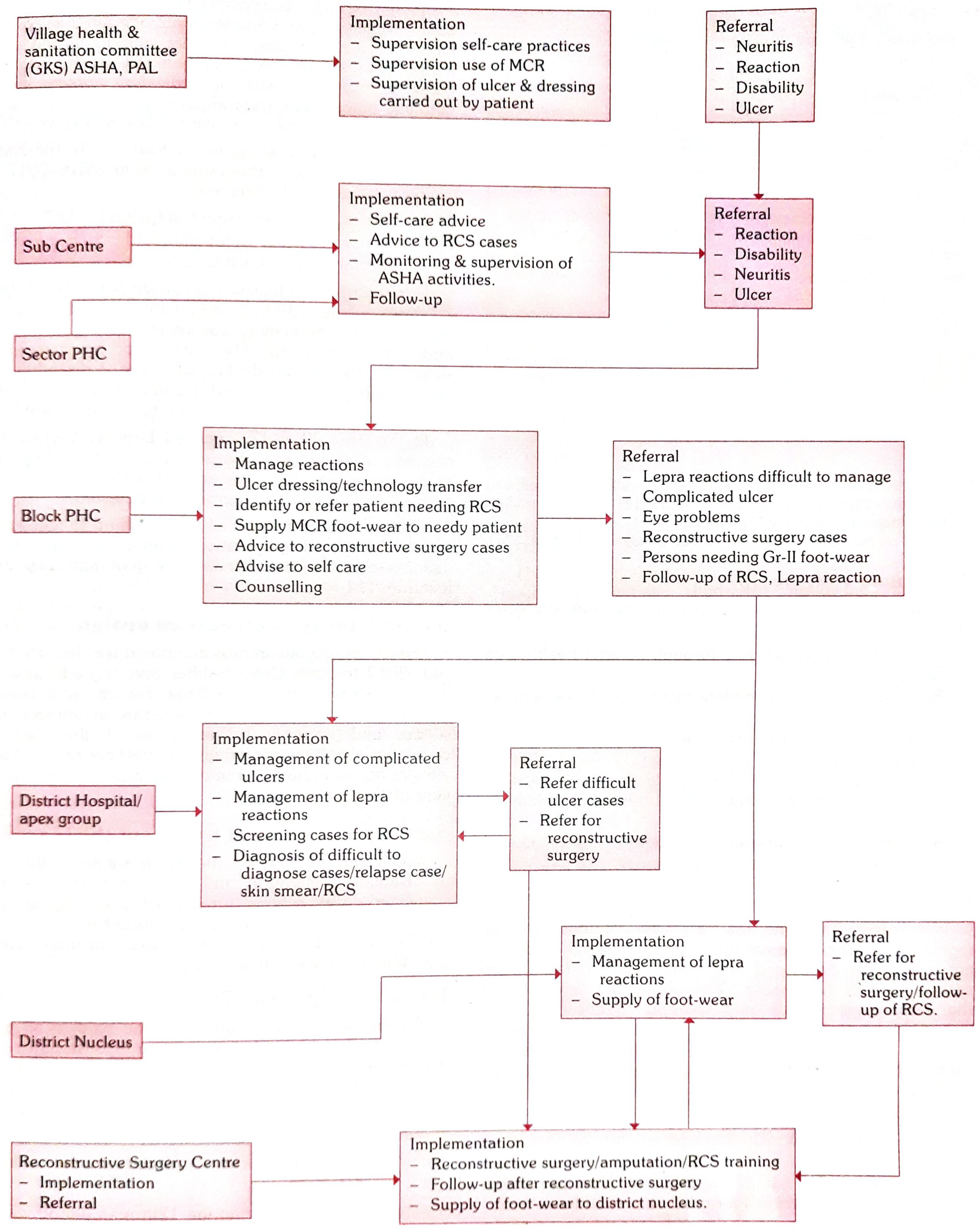
The referral system operates from the village level upward:
- Village Health & Sanitation Committee/ASHA/PAL: Supervise self-care, MCR use, dressing; refer Neuritis, Reaction, Disability, Ulcer
- Sub Centre/Sector PHC: Self-care advice, RCS counselling, ASHA supervision, follow-up; refer Reaction, Disability, Neuritis, Ulcer
- Block PHC: Manage reactions, ulcer dressing, identify RCS candidates, supply MCR footwear; refer complicated leprosy reactions, eye problems, RCS cases, Gr-II footwear needs
- District Hospital/Apex Group: Manage complicated ulcers and lepra reactions, screen for RCS, diagnose difficult/relapse cases
- District Nucleus: Supply footwear, manage lepra reactions; refer for RCS
- Reconstructive Surgery Centre: Perform RCS/amputation, follow-up post-RCS, supply footwear to district nucleus
IEC/BCC Strategy
- Focus on behavioural change against stigma and discrimination.
- Making public aware of MDT availability, deformity correction through surgery, and that leprosy-affected persons can live a normal life with family.
- IEC theme: "Towards Leprosy Free India"
- Activities through mass media and local media.
Survey, Education and Treatment (SET) Scheme
NGOs are involved in:
- Disability prevention and ulcer care
- IEC
- Referral of suspected cases
- Referral for Reconstructive Surgery (RCS)
- Research and rehabilitation
- NGO support is mainly for follow-up in urban locations and difficult-to-reach areas
Incentive to Patient
- Rs. 8,000/- paid to all patients undergoing major reconstructive surgery (irrespective of financial status), as of January 2017.
- As on January 2017: 115 recognized RCS centres (61 Government + 54 NGO).
ILEP Agencies
The International Federation of Anti-Leprosy Associations (ILEP) is an active partner in NLEP. In India, ILEP comprises 10 agencies:
- The Leprosy Mission
- Damien Foundation of India Trust
- Netherland Leprosy Relief
- German Leprosy Relief Association
- Lepra India
- ALES
- AIFO
- Fontilles-India
- AERF-India
- American Leprosy Mission
ILEP support includes: planning, monitoring, supervision, capacity building, IEC, RCS services, and socio-economic rehabilitation. 36 NGOs conducting RCS for disability correction are supported by ILEP.
Research Institutions
- Central JALMA Institute of Leprosy, Agra
- Central Leprosy Teaching and Training Institute (CLTRI), Chingalpettu (Chennai)
- Regional Training and Referral Institutes at:
- Aska (Odisha)
- Raipur (Chhattisgarh)
- Gouripur (West Bengal)
Targets (12th Plan: 2012-13 to 2016-17)
Plan Objectives:
- (a) Elimination of leprosy (PR < 1/10,000) in all districts
- (b) Strengthen DPMR for leprosy-affected persons
- (c) Reduction in stigma associated with leprosy
| Indicator | Baseline (2011-12) | Target (by March 2017) |
|---|---|---|
| PR < 1/10,000 | 543 districts (84.6%) | 642 districts (100%) |
| ANCDR < 10/100,000 | 445 districts (69.3%) | 642 districts (100%) |
| Cure rate - MB leprosy | 90.56% | >95% |
| Cure rate - PB leprosy | 95.28% | >97% |
| Grade II disability rate (% of new cases) | 3.04% | <2% |
District Leprosy Cell
A dedicated team including a Medical Officer and Para-Medical Workers placed at district level to provide technical support to the primary health care system. This structure is known as the "District Leprosy Cell."
Urban Leprosy Services
524 urban localities (population >1 lakh) identified. Divided into 4 categories:
- (a) Town/City (1 lakh - 5 lakh): 432 areas
- (b) Medium city (>5 lakh - 10 lakh): 53 areas
- (c) Mega city (>10 lakh - 45 lakh): 34 areas
- (d) Areas >45 lakh population: 5 areas
Urban challenges: Higher case detection due to migration and institutional availability, but lower treatment completion rates compared to rural areas.
NLEP at Primary Health Care Level (PHC Functions - NHM Essential Services)
Essential functions under NLEP at PHC:
- Health education to community regarding leprosy
- Diagnosis and management of leprosy and its complications including reactions
- Training of leprosy patients having ulcers for self-care
- Counselling for leprosy patients for regularity/completion of treatment and prevention of disability
Source: Park's Textbook of Preventive and Social Medicine, Chapter 7 (Health Programmes in India)
This is a shared conversation. Sign in to Orris to start your own chat.