
Explain me in detail asphyxial deaths chapter from Gautam Biswas
Reading File
Finding Sources
Finding Sources
Reading File
Reading File
Gautam Biswas's Review of Forensic Medicine and Toxicology isn't in my library, so I can't cite its pages or wording. The library does have Reddy's Essentials of Forensic Medicine and Toxicology (36th ed.) and P C Dikshit's Textbook of Forensic Medicine and Toxicology. Both cover the same chapter content, so I'll use them.
What the asphyxial deaths chapter covers
- Definition, physiology and stages of asphyxia, and general post-mortem findings
- Classification (mechanical, pathological, toxic, environmental)
- Hanging: types, ligature mark, mechanism of death, post-mortem findings, suicide versus homicide
- Strangulation: ligature and manual (throttling), and how they differ from hanging
- Smothering, gagging and choking
- Traumatic (crush) asphyxia, positional asphyxia and sexual (autoerotic) asphyxia
- Drowning: types, mechanism, findings, diatoms, medicolegal issues
- Medicolegal comparison tables and viva points
Overview
Asphyxia is a mode of dying, not a cause of death. Interference with respiration, or too little oxygen in the inspired air, deprives the tissues of oxygen and prevents the body from eliminating CO2. Reddy's gives these timings for the brain:
- Cortical nerve cell function stops about 8 to 15 seconds after total ischemia.
- Irreparable cortical damage occurs by about 3 minutes.
- Basal ganglia are damaged by 6 to 7 minutes.
- The vagal centre is damaged by 9 to 10 minutes.
The thumb rule is that breathing stops within 20 seconds of cardiac arrest, and the heart stops within 20 minutes of breathing stopping.
Mechanical asphyxia is the main group. It includes:
- closure of the nose and mouth (smothering)
- pressure on the neck (hanging, strangulation, throttling)
- foreign bodies in the larynx or pharynx (choking)
- fluid filling the airways (drowning)
- compression of the chest and abdomen (traumatic asphyxia)
Dikshit's classifies hanging by mode (judicial, sexual, lynching), by manner (suicidal, homicidal, accidental), by noose position (typical or atypical) and by foot position (complete or partial). Strangulation is divided into ligature and manual.
The general findings in asphyxial deaths are cyanosis, congestion, petechiae (Tardieu spots), fluid dark blood, and congested organs with a heavier lung. These findings are non-specific, and each type of asphyxia has its own signs.
The full chapter is too long for one reply, so I'll cover one topic in detail at a time.
Asking for Preferences
Which topic should I explain in detail first?
Gautam Biswas's Review of Forensic Medicine and Toxicology isn't in my library, so I can't cite its pages or wording. The library does have Reddy's Essentials of Forensic Medicine and Toxicology (36th ed.) and P C Dikshit's Textbook of Forensic Medicine and Toxicology. Both cover the same chapter content, so I'll use them.
What the asphyxial deaths chapter covers
- Definition, physiology and stages of asphyxia, and general post-mortem findings
- Classification (mechanical, pathological, toxic, environmental)
- Hanging: types, ligature mark, mechanism of death, post-mortem findings, suicide versus homicide
- Strangulation: ligature and manual (throttling), and how they differ from hanging
- Smothering, gagging and choking
- Traumatic (crush) asphyxia, positional asphyxia and sexual (autoerotic) asphyxia
- Drowning: types, mechanism, findings, diatoms, medicolegal issues
- Medicolegal comparison tables and viva points
Overview
Asphyxia is a mode of dying, not a cause of death. Interference with respiration, or too little oxygen in the inspired air, deprives the tissues of oxygen and prevents the body from eliminating CO2. Reddy's gives these timings for the brain:
- Cortical nerve cell function stops about 8 to 15 seconds after total ischemia.
- Irreparable cortical damage occurs by about 3 minutes.
- Basal ganglia are damaged by 6 to 7 minutes.
- The vagal centre is damaged by 9 to 10 minutes.
The thumb rule is that breathing stops within 20 seconds of cardiac arrest, and the heart stops within 20 minutes of breathing stopping.
Mechanical asphyxia is the main group. It includes:
- closure of the nose and mouth (smothering)
- pressure on the neck (hanging, strangulation, throttling)
- foreign bodies in the larynx or pharynx (choking)
- fluid filling the airways (drowning)
- compression of the chest and abdomen (traumatic asphyxia)
Dikshit's classifies hanging by mode (judicial, sexual, lynching), by manner (suicidal, homicidal, accidental), by noose position (typical or atypical) and by foot position (complete or partial). Strangulation is divided into ligature and manual.
The general findings in asphyxial deaths are cyanosis, congestion, petechiae (Tardieu spots), fluid dark blood, and congested organs with a heavier lung. These findings are non-specific, and each type of asphyxia has its own signs.
The full chapter is too long for one reply, so I'll cover one topic in detail at a time.
Reading File
Finding Sources
Reading File
Reading File
Finding Sources
Reading File
Reading File
Reading File
Reading File
Reading File
Reading File
Reading File
Gautam Biswas's book isn't in my library, so I can't quote its pages or its wording. This explanation follows Reddy's Essentials of Forensic Medicine and Toxicology (36th ed.) and P C Dikshit's textbook, which cover the same chapter. Where I add standard points that I didn't verify in those texts, I say so. Hanging and strangulation get the most space because they carry the most exam weight. Smothering, choking, drowning and the other asphyxias are shorter.
1. Basics of asphyxia
Definition. Asphyxia is a condition caused by interference with respiration, or by lack of oxygen in the inspired air. The tissues are deprived of oxygen and CO2 is not eliminated, which causes unconsciousness or death. It describes a mode of dying, not a cause of death (Reddy's).
Why the brain matters. The brain is about 1.4% of body weight but uses about 20% of the oxygen. In total cerebral ischemia (Reddy's):
- Cortical nerve cells stop functioning after 8 to 15 seconds.
- Irreparable cortical damage occurs at about 3 minutes.
- Basal ganglia damage occurs at 6 to 7 minutes.
- The vagal centre is damaged at 9 to 10 minutes.
Thumb rule. Breathing stops within 20 seconds of cardiac arrest. The heart stops within 20 minutes of breathing stopping. If the heart keeps beating for some minutes after respiration stops, lung weight can rise to 450 to 500 g.
Arterial oxygen. Young adults have an arterial PO2 of 90 to 100 mm Hg. In people over 60 it is 60 to 85 mm Hg. In severe or fatal asphyxia it falls to 20 to 40 mm Hg.
Classification by cause (Reddy's)
| Type | Mechanism | Examples |
|---|---|---|
| Mechanical | Air passages blocked | Smothering, hanging, strangulation, throttling, choking, drowning, traumatic asphyxia |
| Pathological | Disease stops oxygen reaching the lungs | Laryngeal oedema, laryngeal spasm, tumours, abscess, bronchitis, respiratory muscle paralysis |
| Toxic | Oxygen cannot be carried or used | CO (reduces Hb binding), cyanide (blocks tissue enzymes), opium or barbiturates (paralyse the respiratory centre) |
| Environmental | Low oxygen or irrespirable gas | Trapped in a trunk or refrigerator, sewer gas, high altitude |
| Traumatic | Obstruction in the lungs | Pulmonary thromboembolism, fat embolism, air embolism, bilateral pneumothorax |
| Postural | Unconscious person lying with the upper body lower than the rest | Alcohol or drug stupor |
| Iatrogenic | Related to anaesthesia |
Dikshit's lists the asphyxial deaths themselves as: hanging, strangulation (ligature and manual), smothering, choking, traumatic or crush asphyxia, positional asphyxia, sexual asphyxia and drowning.
Pathophysiology of mechanical asphyxia
This is the "vicious cycle" of asphyxia (Reddy's Fig. 6.1).
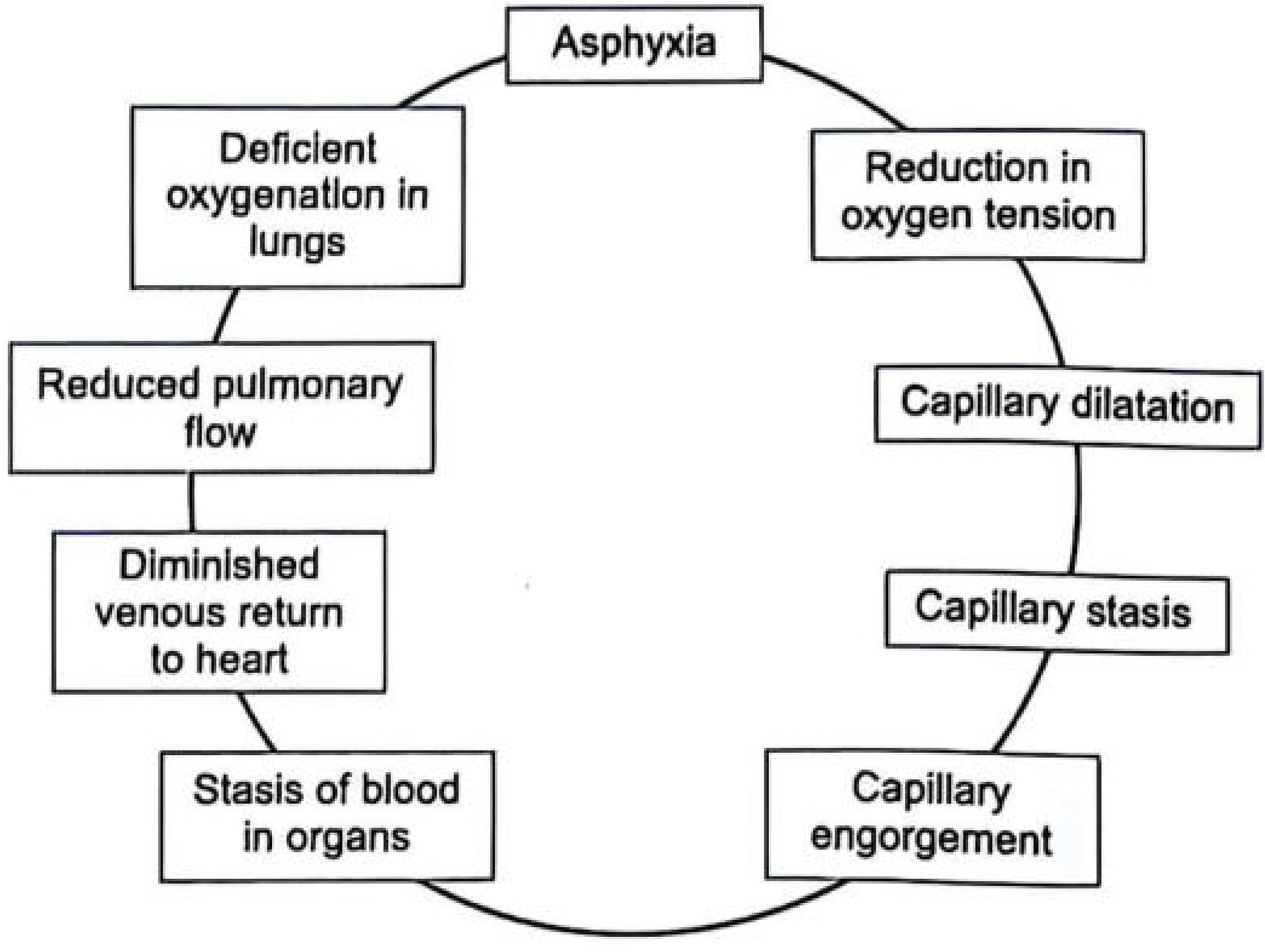
- When the neck is compressed, the jugular veins close first, so venous drainage from the head stops. The carotid and vertebral arteries still supply blood.
- If the airway is also blocked, arterial oxygen falls.
- Low oxygen causes capillary dilatation, then stasis (capillo-venous engorgement).
- Stasis causes organ congestion and reduces venous return to the heart.
- This worsens anoxia, which causes more capillary dilatation, and the cycle continues.
Cardinal signs of asphyxia (non-specific)
Petechial haemorrhages (Tardieu spots)
- They are caused by raised venous pressure from impaired venous return, which overdistends and ruptures venules, especially in lax tissue. Hypoxia of the vessel wall is not the cause.
- At least 15 to 30 seconds of obstruction is needed.
- They measure 0.1 to 2 mm. Larger ones are called ecchymoses.
- Sites: skin, sclerae, conjunctivae, eyelids and mouth mucosa. Internally they are seen in the visceral pleura (interlobar fissures and hilum), pericardium, epicardium, thymus in infants, and brain white matter.
- They are rare in the parietal pleura and peritoneum, except in haemorrhagic diatheses.
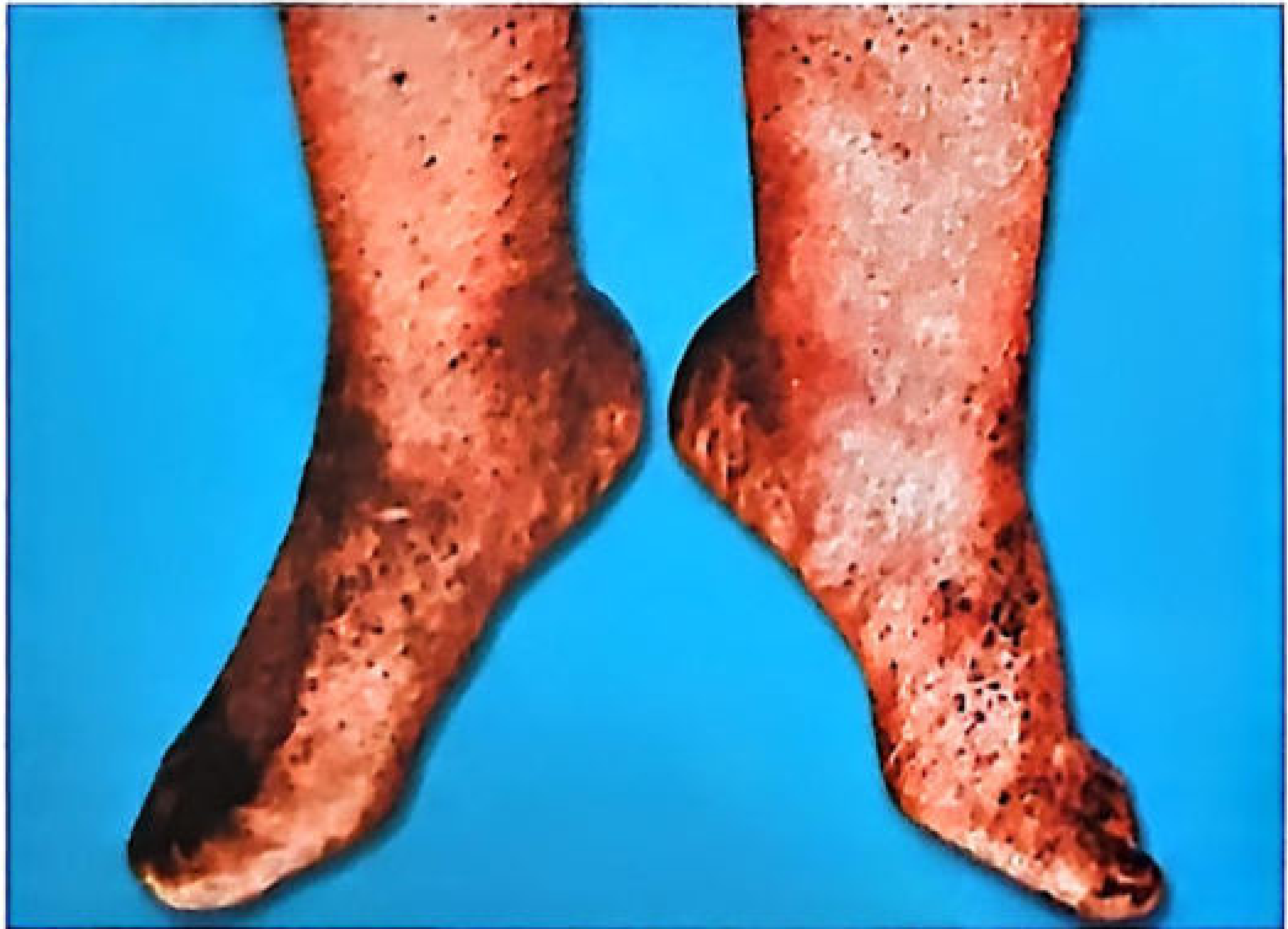
- They can also form after death in dependent areas, such as the legs and feet in a hanged body (Fig. 6.5).
Congestion and oedema
- Raised CO2 dilates capillaries and reduces vascular tone, which causes stasis.
- Capillary permeability rises from stasis and hypoxia.
- Lung oedema is common. Reddy's says it indicates a struggle for survival for some time.
- Brain oedema occurs from back-pressure and hypoxia.
- Congestion and oedema are non-specific. They only reflect obstructed venous return.
Cyanosis
- It follows facial congestion, because blood returning from the head carries more reduced haemoglobin.
- Cyanosis in life can be masked by post-mortem hypostasis, which may be mistaken for it.
Other general findings (standard teaching, not re-read from these texts)
- Dark, fluid blood.
- Right heart engorged.
- Congested, heavy organs.
- Subpleural and subepicardial petechiae.
2. Hanging
Definition. Hanging is asphyxia from constriction of the neck by a ligature, where the force is the weight of the body or part of it.
Classification (Dikshit's):
- By mode: judicial, sexual (autoerotic), lynching (homicidal).
- By manner: suicidal, homicidal, accidental.
- By noose position: typical (knot at the nape, noose over the thyroid-hyoid region) or atypical.
- By foot position: complete (feet off the ground) or partial (standing, sitting, kneeling or reclining).
Mechanisms of death
I did not re-read this part in the text. It is standard teaching.
- Asphyxia: closure of the airway at pharyngeal level. The noose lifts the larynx and tongue and presses them against the posterior pharyngeal wall.
- Venous congestion: compression of the jugular veins.
- Cerebral ischaemia: compression of the carotid and vertebral arteries.
- Vagal inhibition: pressure on the carotid sinus causes reflex cardiac arrest.
- Fracture-dislocation of the cervical spine: seen in judicial hanging with a long drop (the hangman's fracture at C2).
Approximate pressures needed to occlude structures (standard teaching):
| Structure | Pressure |
|---|---|
| Jugular veins | 2 kg |
| Carotid arteries | 5 kg |
| Trachea | 15 kg |
| Vertebral arteries | 30 kg |
Factors that decide the ligature mark (Reddy's)
The mark depends on:
- the nature of the ligature
- the weight of the body and how much of it is suspended
- the tightness of the loop
- the duration of suspension
- the position of the knot
- slipping of the ligature
Further points:
- The impression is deepest opposite the point of suspension.
- A longer suspension gives a deeper groove.
- A soft, broad ligature removed quickly may leave no external mark.
- Slipping can produce a double mark. The lower mark is superficial and linked by fine abrasions.
- A belt can give two parallel marks.
Knots. Reddy's lists:
- Slip knot (running noose).
- Binding knot (fixed noose).
- Reef knot (flat, symmetrical, does not slip).
- Granny knot (asymmetrical, slips or jams).
The knot is usually at the side of the neck, with the ligature rising behind the ear to the suspension point.
External post-mortem findings
Ligature mark
- It is an oblique, non-continuous, inverted "V" or "Λ" shape.
- It is directed upward toward the suspension point.
- The suspension peak is the point where the noose lifts away from the skin. It distinguishes hanging from ligature strangulation (Reddy's).
- The back of the neck has no clear, deep groove because the muscle there is firmer.
- It lies above the thyroid cartilage in about 80% of cases, at the level of the cartilage in about 15%, and below it in about 5% (especially in partial suspension).
- The groove width is about equal to, or slightly less than, the ligature width.
- A horizontal mark occurs with a running noose, a low point of suspension, or partial hanging with the body leaning forward.
- A narrow zone of congestion or haemorrhage along the groove edges is not proof of vitality. It comes from blood displaced sideways from under the pressure zone.
- Abrasions with haemorrhage strongly suggest suspension during life. Ecchymoses alone do not prove it.
- Serum blisters can occur from friction.
Face and head
- The face is usually pale in complete hanging, because the arteries are fully occluded or because of vagal inhibition.
- It is congested and swollen if the veins were constricted before the arteries, as in incomplete suspension or a low point of suspension.
- Petechiae are present in about 25% of cases (conjunctivae and skin). They are more frequent in incomplete suspension, and signs are most marked when the noose is placed high on the throat.
- The head is inclined to the side opposite the knot, and the neck is stretched.
- The eyes are often protruded and firm, with congested conjunctivae.
- The pupils are usually dilated.
- If the knot presses the cervical sympathetic, the same-side eye stays open with a dilated pupil (le facies sympathique). This indicates ante-mortem hanging.
- The tongue is swollen and blue, and often projects between the teeth or lips. The protruding part dries to dark brown or black.
- Saliva dribbles from the angle of the mouth on the side opposite the knot, because of increased salivation before death. This is an ante-mortem sign.
- Minor bleeding or bloody froth at the nose and mouth may occur. It should not be mistaken for foul play.
Rest of the body
- The hands are clenched, especially in violent hanging.
- The penis is semi-erect from hypostasis, and semen may be at the tip.
- Urine and faeces may escape from sphincter relaxation.
- Hypostasis is in the legs, feet, hands and forearms. If the body is cut down and laid flat, new lividity appears on the back and buttocks.
- Petechiae on the legs and feet occur in complete hanging (Fig. 13.12).
Internal post-mortem findings (Reddy's)
Examine the neck last, after removing the brain and the chest and abdominal organs. This gives a bloodless field.
- Tissue under the mark is dry, white and glistening.
- Strap muscle haemorrhage is seen in about 25%.
- Platysma and sternomastoid rupture occurs in 5 to 10%.
- Transverse intimal tears of the carotid (Amussat's sign) occur in 5 to 10%. They are on the side related to the knot, caused by traction. They show the victim was alive at the time of hanging.
- Several horizontal intimal tears along the carotids occur in a long-drop hanging.
- The vertebral arteries may show tears and subintimal haemorrhage.
- Injury to the trachea is unusual. Petechiae may be on the epiglottis, larynx and trachea.
- The base of the tongue may be bruised, and the lymph nodes above and below the mark are congested.
- The lungs are congested and oedematous. Subpleural ecchymoses may be present.
- Simon's haemorrhages are bleeding into the outer layers of the lumbar intervertebral discs. They are seen in bodies suspended for a long time.
Suicide, homicide or accident?
This is a standard medicolegal framework.
- Suicide: the commonest by far. The mark is typical and oblique, the knot is often at the side, and the scene and history fit. Hanging from a low point (partial) is common.
- Homicide: this needs a defenceless victim, such as a child, a drugged person or an old person. Look for:
- evidence of a struggle
- injuries on the body
- a mark that is horizontal or ligature-like
- a victim too heavy to be lifted by one person
- a ligature mark that does not fit the suspension
- Accident: common in children (play, a rope on a swing) and in autoerotic practices, where there is often a protective padding or a release mechanism.
3. Strangulation
Definition. Strangulation is asphyxia from constriction of the neck by a ligature, hands or other means, without suspending the body. Types: ligature strangulation, manual strangulation (throttling), garroting, mugging and bansdola.
Ligature strangulation
Causes of death (Reddy's): asphyxia from closure of the airway at the pharyngeal level, cerebral anoxia or venous congestion, combined asphyxia and congestion, vagal inhibition, and rarely fracture-dislocation of the cervical vertebrae. It is hard to occlude the airway at laryngeal or tracheal level because of the strong cartilages, except under extreme pressure.
Symptoms. Sudden, violent compression unawares causes immediate insensibility and death. Partial closure produces:
- buzzing in the ears
- congestion and cyanosis of the head
- vertigo and tingling
- muscle weakness
- bleeding from mouth, nose and ears
- clenched hands
- convulsions
Findings.
- The ligature mark is well defined and slightly depressed. It is usually horizontal, transverse and encircling, and it lies at or below the thyroid cartilage.
- Other signs are facial congestion and cyanosis, petechiae, protruding tongue and bleeding from the nose.
- Internally there are deeper neck injuries than in hanging. These include bruising of muscles, and fractures of the hyoid or thyroid cartilage in older victims whose cartilages have ossified.
- Strangulation is nearly always homicidal. Accidental strangulation occurs with clothing caught in machinery or a scarf in a wheel. Suicidal strangulation is rare and needs a method that keeps tightening after consciousness is lost.
Manual strangulation (throttling)
This part is not in what I read. Standard teaching:
- It is nearly always homicidal.
- There are fingertip bruises (small, round or oval, 1 to 2 cm) and fingernail abrasions (crescents) on the neck.
- The thumb mark is usually on one side and the fingers on the other.
- There are deep neck injuries: hyoid and thyroid cartilage fractures, bruising of strap muscles and laryngeal mucosa.
- Petechiae are marked.
- Signs of a struggle may be on the body.
- Death is usually from asphyxia and vagal inhibition.
Hanging versus ligature strangulation (high-yield table)
| Feature | Hanging | Ligature strangulation |
|---|---|---|
| Manner | Mostly suicidal | Mostly homicidal |
| Ligature mark | Oblique, incomplete, inverted V, above the thyroid cartilage, with a suspension peak | Horizontal, complete, at or below the thyroid cartilage, no suspension peak |
| Groove | Dry, pale, hard, parchment-like | Soft, with bruising and abrasions around it |
| Neck injuries | Few | Common |
| Face | Usually pale | Congested |
| Saliva dribbling | Present | Absent |
| Petechiae | Less | More |
| Lividity | Legs and feet | Corpse position dependent |
| Scene | Suspension point present | Signs of struggle |
4. Smothering and choking
I did not read these sections, so this is standard teaching.
Smothering
- Smothering is closure of the nose and mouth, which stops air entering. It can also come from filling the airway with mud or a cloth.
- It is mostly homicidal in infants, children, the very old, and the incapacitated.
- It is often accidental in infants (a pillow, soft bedding, overlay).
- Findings may be minimal. Look for abrasions, bruises and lacerations around the mouth and nose, and bruising inside the lips from pressure against the teeth. Petechiae may be absent or few.
- Typical associated forms are gagging (a material forced into the mouth) and burking (smothering plus chest compression).
Choking
- Choking is obstruction of the air passages inside the airway, by food or foreign bodies in the larynx or pharynx.
- It is usually accidental. Café coronary describes sudden death of a person eating, usually with alcohol, from a bolus lodged in the larynx.
- Impaction of a foreign body in the larynx can also cause death by vagal inhibition, even without full obstruction.
5. Other asphyxial deaths
Traumatic (crush) asphyxia
- It is caused by compression of the chest and abdomen that prevents respiratory movement. Examples: a stampede, a collapsing wall, or a vehicle on the chest.
- The classic finding is cervicofacial cyanosis and congestion with petechiae above the level of compression. The skin below that level is relatively pale.
- It is commonly accidental, but it can be homicidal (burking) or suicidal.
Positional (postural) asphyxia
- The body position prevents breathing. Examples: an unconscious person lying with the head lower than the body, restraint asphyxia (a person held prone), or an infant wedged in a cot.
- It is linked to alcohol, drugs, intoxication and disease.
Sexual (autoerotic) asphyxia
- It is accidental hanging during a practice of self-induced hypoxia for sexual arousal.
- It is nearly always male.
- Look for protective padding at the neck, a release mechanism that has failed, and sexual paraphernalia or fetish clothing.
- The manner of death is accidental.
6. Drowning
Definition. Drowning is asphyxia from aspiration of fluid into the air passages during submersion in water or another fluid. Reddy's calls it a non-violent form of mechanical asphyxia. Complete submersion is not needed. Submersion of the nose and mouth alone is enough, and death in shallow water can occur in alcoholic stupor, epileptics or infants. About 150,000 people die of drowning each year worldwide.
Why a drowning person sinks, rises and sinks again (Reddy's):
- The body's specific gravity is about 0.97 against 1 for water, so it rises to the surface because of natural buoyancy.
- Sudden immersion in cold water can trigger a reflex deep inhalation of water.
- A breath-hold lasts until CO2 reaches a level that stimulates the respiratory centre. The forced breathing then draws water into the airways.
- A violent cough drives air out of the lungs and water fills the alveoli. Specific gravity rises above that of water, so the person sinks a second time.
- Fear and partial anoxia make the person vomit and aspirate gastric contents.
- Struggle makes the victim inhale more water, then lose consciousness.
- A convulsing unconscious person may kick the bottom and rise again in shallow water, then sink passively.
- After death, bacterial gas in the intestine makes the body lighter than water, so it rises to the surface. Unless it is snagged, it floats after some days.
Standard points not read in the text, which I can expand if you want:
- Types of drowning:
- Wet (about 90%, with water in the airway).
- Dry (about 10%, from laryngospasm).
- Secondary (death after rescue, from pulmonary complications).
- Immersion syndrome (vagal inhibition in cold water).
- Atypical (for example, after a head injury).
- Fresh and salt water physiology: fresh water is hypotonic and enters the circulation, causing haemodilution and haemolysis. Salt water is hypertonic and draws fluid into the alveoli, causing haemoconcentration.
- Key PM signs:
- Fine, white, copious froth at the mouth and nose.
- Cutis anserina (goose skin).
- Washerwoman's hands.
- Cadaveric spasm with weeds or debris in the hand.
- Emphysema aquosum.
- Paltauf's haemorrhages.
- Water in the stomach and the sphenoid sinus.
- Diatoms in the bone marrow, which show the victim was alive on entry.
What to read next
Say which you want and I'll expand it with the textbook content:
- Hanging, including the judicial hanging details, the full ligature mark descriptions, and a medicolegal differential.
- Strangulation, including manual strangulation and the neck dissection findings.
- Drowning, including all the PM signs and the tests for ante-mortem submersion.
- Smothering, choking, traumatic and positional asphyxia.
This is a shared conversation. Sign in to Orris to start your own chat.