I have all the material I need - comprehensive textbook content and 4 key diagrams. Now I'll compile the full detailed answer.---
PHARMACOLOGY OF INSULIN AND ORAL HYPOGLYCAEMIC AGENTS
2nd Year MBBS | Ref: KD Tripathi's Essentials of Medical Pharmacology + Lippincott Illustrated Reviews: Pharmacology + Katzung's Basic & Clinical Pharmacology
PART 1: INSULIN
1.1 SOURCES OF INSULIN
Insulin is derived from three sources:
| Source | Species | Differences from Human Insulin | Antigenicity |
|---|
| Bovine (Beef) | Cattle | 3 amino acid positions differ (A8, A10, B30) | Highest - most antigenic |
| Porcine (Pork) | Pig | 1 amino acid difference (B30: Ala instead of Thr) | Intermediate |
| Human | Recombinant DNA (E. coli or Saccharomyces cerevisiae); or enzymatic conversion of pork insulin | Identical to endogenous insulin | Least - near zero antigenicity |
Note (KD Tripathi): Animal insulins (bovine and porcine) have been largely replaced by human insulin and insulin analogues in clinical practice due to superior immunological profile of human insulin.
1.2 ADVANTAGES OF HUMAN INSULIN OVER CONVENTIONAL (ANIMAL) INSULIN
| Feature | Human Insulin | Animal (Bovine/Porcine) Insulin |
|---|
| Antigenicity | Very low - structurally identical to endogenous insulin | Higher - structural differences trigger immune response |
| Insulin resistance | Rare (almost none) | More common - anti-insulin IgG antibodies form, binding and inactivating insulin |
| Immunological reactions | Minimal - local or systemic allergic reactions extremely rare | More common - urticaria, angioedema, anaphylaxis reported |
| Lipodystrophy at injection site | Less frequent | More frequent (lipoatrophy or lipohypertrophy) |
| Onset of action | Slightly faster SC absorption | Slightly slower due to less predictable absorption |
| Purity | Monocomponent - free of proinsulin, C-peptide contaminants | May contain proinsulin and other pancreatic peptides |
| Availability/Supply | Unlimited - produced by recombinant DNA technology | Limited by animal source availability |
| Species-transmitted disease risk | None | Theoretical risk (prion diseases, viral contaminants) |
| Patient acceptability | Better - no ethical concerns | Some religious/ethical objections to pork or beef insulin |
| Dose requirement | Lower (more predictable) | May need higher doses due to antibody binding |
Clinical bottom line (KD Tripathi): Human insulin is preferred because it reduces the risk of immunological insulin resistance, eliminates allergic reactions, and is available in unlimited quantities. In countries where it is affordable, it has completely replaced animal-source insulins.
1.3 INSULIN PREPARATIONS - ENUMERATION
Insulin preparations are classified by their duration of action into four groups:
╔══════════════════════════════════════════════════════════════╗
║              CLASSIFICATION OF INSULIN PREPARATIONS          ║
╠═══════════════════╦══════════════════════════════════════════╣
║ RAPID-ACTING      ║ Insulin Lispro (Humalog)                 ║
║ (Bolus/Prandial)  ║ Insulin Aspart (NovoRapid/NovoLog)       ║
║                   ║ Insulin Glulisine (Apidra)               ║
║                   ║ Inhaled Insulin (Afrezza/Technosphere)   ║
╠═══════════════════╬══════════════════════════════════════════╣
║ SHORT-ACTING      ║ Regular (Soluble) Insulin                ║
║                   ║ (Humulin R / Actrapid)                   ║
║                   ║ U-500 Regular Insulin (concentrated)     ║
╠═══════════════════╬══════════════════════════════════════════╣
║ INTERMEDIATE-     ║ NPH Insulin / Isophane Insulin           ║
║ ACTING (Basal)    ║ (Humulin N / Insulatard)                 ║
╠═══════════════════╬══════════════════════════════════════════╣
║ LONG-ACTING       ║ Insulin Glargine (Lantus) - ~24 h        ║
║ (Basal)           ║ Insulin Detemir (Levemir) - ~17-24 h     ║
║                   ║ Insulin Degludec (Tresiba) - >42 h       ║
╠═══════════════════╬══════════════════════════════════════════╣
║ PREMIXED          ║ NPH/Regular 70/30                        ║
║ COMBINATIONS      ║ Lispro protamine/Lispro 75/25            ║
║                   ║ Aspart protamine/Aspart 70/30            ║
╚═══════════════════╩══════════════════════════════════════════╝
Pharmacokinetic Comparison Table (from Katzung)
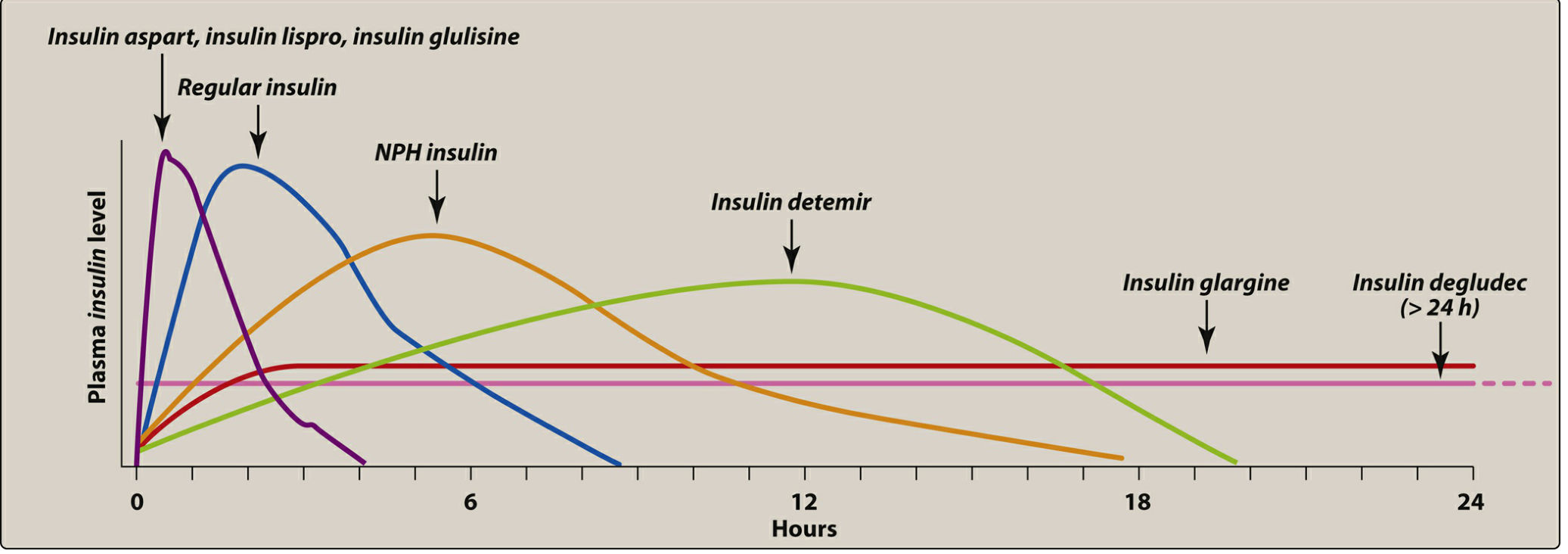
| Insulin | Onset | Peak | Effective Duration | Route |
|---|
| Lispro / Aspart / Glulisine | 5-15 min | 1-1.5 h | 3-4 h | SC |
| Regular (Soluble) | 30-60 min | 2 h | 6-8 h | SC / IV / IM |
| Inhaled (Afrezza) | 5-15 min | 1 h | 3 h | Inhaled |
| NPH (Isophane) | 2-4 h | 6-7 h | 10-20 h | SC only |
| Glargine | 0.5-1 h | Flat (peakless) | ~24 h | SC only |
| Detemir | 0.5-1 h | Flat | ~17 h | SC only |
| Degludec | 0.5-1.5 h | Flat (peakless) | >42 h | SC only |
Onset and Duration Graph (Lippincott Illustrated Reviews: Pharmacology)
1.4 INSULIN ANALOGUES - DETAILS
What is an analogue?
An insulin analogue is a modified form of human insulin in which one or more amino acids have been altered to produce a different pharmacokinetic profile while retaining biological activity.
Rapid-Acting Analogues
| Analogue | Structural Change | Effect | Onset |
|---|
| Insulin Lispro | B28 (Pro) and B29 (Lys) positions swapped (reversed) | Monomers don't self-associate into hexamers → faster absorption | 15-30 min |
| Insulin Aspart | B28 Pro replaced by Asp (aspartic acid) | Reduces self-association → rapid absorption | 15-30 min |
| Insulin Glulisine | B3 Asn→Lys; B29 Lys→Glu | Faster absorption from SC tissue | 15-30 min |
Clinical use: These mimic the physiological prandial (mealtime) insulin spike. Given 15-20 minutes before (or immediately after starting) a meal. Used in insulin pumps (CSII).
Long-Acting Analogues
| Analogue | Structural Change | Mechanism of prolonged action |
|---|
| Insulin Glargine | A21 Asn→Gly + 2 Arg added to B-chain C-terminus | Low pH formulation (pH 4) → precipitates at physiological pH 7.4 at SC injection site → slow, steady release → truly peakless |
| Insulin Detemir | B30 Thr deleted + myristic acid (C14 fatty acid) attached to B29 Lys | Fatty acid chain binds reversibly to albumin → prolonged absorption + circulatory buffering |
| Insulin Degludec | B30 Thr deleted + C18 fatty acid attached via linker to B29 Lys | Forms multi-hexamer depot chains at SC site → extremely slow release → >42 h duration |
Key exam fact: Glargine is peakless (flat profile). It must NOT be mixed with other insulins in the same syringe (its low pH will alter other insulins). Never give IV.
1.5 INDICATIONS FOR INSULIN
┌─────────────────────────────────────────────────────────────┐
│           INDICATIONS FOR INSULIN THERAPY                   │
├─────────────────────────────────────────────────────────────┤
│ ABSOLUTE INDICATIONS                                        │
│ • Type 1 Diabetes Mellitus (mandatory - no beta cells)      │
│ • Diabetic Ketoacidosis (DKA)                               │
│ • Hyperosmolar Hyperglycaemic State (HHS)                   │
│ • Gestational Diabetes Mellitus (when diet fails)           │
│ • Diabetes with acute complications (infection, surgery,    │
│   trauma, MI) - oral drugs insufficient                     │
│ • Severe hepatic or renal disease (OHAs contraindicated)    │
├─────────────────────────────────────────────────────────────┤
│ RELATIVE INDICATIONS                                        │
│ • Type 2 DM: failure of oral agents                        │
│ • Type 2 DM: HbA1c ≥ 9% with symptoms at diagnosis         │
│ • Secondary diabetes (pancreatectomy, Cushing's, etc.)      │
│ • Severely malnourished diabetics                           │
│ • Allergy / intolerance to all oral agents                  │
└─────────────────────────────────────────────────────────────┘
PART 2: DIABETIC KETOACIDOSIS (DKA)
2.1 DEFINITION AND DIAGNOSTIC TRIAD
DKA is defined by the triad (Goldman-Cecil Medicine):
- D - Diabetes / Hyperglycaemia (glucose usually >250 mg/dL; may be normal in euglycaemic DKA)
- K - Ketonaemia/Ketonuria (serum ketones ≥3.0 mmol/L or urine ketones 2+ or more)
- A - Acidosis (arterial/venous pH <7.3, serum HCO₃ <18 mEq/L)
2.2 SEVERITY CLASSIFICATION
| Parameter | Mild | Moderate | Severe |
|---|
| Blood glucose | >250 mg/dL | >250 mg/dL | >250 mg/dL |
| Arterial pH | 7.25-7.30 | 7.00-7.24 | <7.00 |
| Serum HCO₃ | 15-18 mEq/L | 10-14 mEq/L | <10 mEq/L |
| Urine/Serum ketones | Positive | Positive | Positive |
| Anion gap | >10 | >12 | >12 |
| Mental status | Alert | Drowsy/Alert | Stupor/Coma |
2.3 PATHOPHYSIOLOGY OUTLINE
ABSOLUTE/RELATIVE INSULIN DEFICIENCY
+ COUNTER-REGULATORY HORMONE EXCESS
(Glucagon ↑, Cortisol ↑, Catecholamines ↑, GH ↑)
                    │
        ┌───────────┼───────────┐
        ▼           ▼           ▼
   LIVER          FAT         MUSCLE
     │              │            │
↑ Gluconeogenesis  ↑ Lipolysis   ↑ Proteolysis
↑ Glycogenolysis   → FFA →      → Amino acids
     │           Beta-oxidation      │
     │           → Acetyl CoA ────────┘
     │           (excess) →
     │           KETONE BODIES
     │           (β-hydroxybutyrate,
     │           Acetoacetate, Acetone)
     ▼                │
HYPERGLYCAEMIA    KETONAEMIA
     │                │
Osmotic diuresis    H⁺ accumulation
  │                     │
Na⁺, K⁺, H₂O,     METABOLIC ACIDOSIS
PO₄ loss            (↓ pH, ↓ HCO₃)
  │                     │
DEHYDRATION       Kussmaul breathing
HYPOVOLAEMIA      (respiratory compensation)
Precipitating Factors (Goldman-Cecil):
- Most common: Infection (~40%), Insulin omission/non-compliance, New-onset T1DM
- Others: Acute coronary syndrome, CVA, acute pancreatitis, alcohol intoxication
- Drugs: Corticosteroids, thiazide diuretics, SGLT-2 inhibitors (euglycaemic DKA), clozapine, cocaine
2.4 CLINICAL FEATURES
- Prodrome (hours to days): Polyuria, polydipsia, polyphagia, weakness, nausea, vomiting
- Examination: Dry skin and mucous membranes, tachycardia, hypotension, reduced JVP (dehydration)
- Kussmaul breathing - deep, rapid respirations (respiratory compensation for metabolic acidosis)
- Fruity (acetone) breath
- Abdominal pain (can mimic acute abdomen - due to gastric stasis/ileus)
- Altered sensorium - confusion to frank coma in severe DKA
2.5 INVESTIGATIONS
- Serum glucose, electrolytes (Na, K, Cl, HCO₃), urea, creatinine
- ABG (pH, pCO₂, HCO₃)
- Serum/urine ketones (beta-hydroxybutyrate is gold standard)
- CBC with differential (leukocytosis - may be from acidosis itself, not necessarily infection)
- ECG (hyperkalaemia changes), CXR
- Blood and urine cultures if infection suspected
- Serum lipase (if pancreatitis suspected)
- Note: Serum Na⁺ is artifactually low (osmotic shift); serum K⁺ may be falsely normal/high initially despite total body depletion
2.6 TREATMENT OF DKA - DETAILED
DKA Management Flowchart
SUSPECTED DKA
      │
      ▼
IMMEDIATE: IV access + blood tests + ABG + urinalysis
      │
      ▼
CONFIRM DIAGNOSIS (hyperglycaemia + ketonaemia + acidosis)
      │
      ▼
ASSESS SEVERITY + IDENTIFY PRECIPITANT
      │
      ▼
┌─────────────────────────────────────────────────────┐
│           FOUR THERAPEUTIC PILLARS                  │
│                                                     │
│  1. FLUID REPLACEMENT                               │
│  2. POTASSIUM MONITORING AND REPLACEMENT            │
│  3. INSULIN THERAPY                                 │
│  4. TREAT PRECIPITATING CAUSE                       │
└─────────────────────────────────────────────────────┘
      │
      ▼
MONITOR: hourly glucose; 2-4 hourly electrolytes + ABG
      │
      ▼
RESOLUTION: glucose <200 + pH >7.3 + HCO₃ >15 + AG closed
      │
      ▼
TRANSITION TO SUBCUTANEOUS INSULIN
(give SC basal insulin 2 h BEFORE stopping IV infusion)
PILLAR 1: FLUID REPLACEMENT
Goal: Correct dehydration (typical deficit 4-6 L, approximately 7-9% body weight), restore circulating volume, dilute glucose and ketones.
| Step | Fluid | Volume/Rate |
|---|
| Phase 1 (first 1-2 h) | 0.9% Normal Saline (isotonic) | 1-2 L bolus; then 500-1000 mL/h |
| Phase 2 (after volume restored) | 0.45% NS (hypotonic) [or 0.9% NS if hyponatraemic] | 150-500 mL/h (guided by BP, urine output) |
| When BG ≤ 250 mg/dL | Switch to 5% Dextrose in 0.45% NS | To prevent hypoglycaemia while insulin continues |
Caution: Correct no faster than 3 mOsm/kg/h to prevent cerebral oedema (especially important in children).
PILLAR 2: POTASSIUM MANAGEMENT
Why critical: Total body K⁺ is always depleted (from osmotic diuresis) even when serum K⁺ appears normal or high (acidosis shifts K⁺ extracellularly). Insulin therapy drives K⁺ INTO cells → rapid drop in serum K⁺ → life-threatening hypokalaemia.
CHECK SERUM K⁺ BEFORE STARTING INSULIN
              │
    ┌─────────┼──────────┐
    ▼         ▼          ▼
K⁺ < 3.3   K⁺ 3.3-5.5  K⁺ > 5.5
    │         │          │
HOLD        Give K⁺    Do NOT give K⁺
INSULIN     20-40 mEq  Monitor 2-hourly
Replace K⁺  per litre
40 mEq/h    IV fluid
until ≥ 3.3
PILLAR 3: INSULIN THERAPY
Agent: Regular (soluble) insulin IV - ONLY insulin used in DKA. Never NPH or analogues for acute DKA.
INSULIN PROTOCOL IN DKA
      │
Ensure K⁺ ≥ 3.3 mEq/L first
      │
      ▼
IV BOLUS: 0.1 units/kg regular insulin
      │
      ▼
IV INFUSION: 0.1 units/kg/h
(Standard: 100 units in 100 mL 0.9% saline = 1 unit/mL
 Run at 10 mL/h = 10 units/h)
      │
      ▼
TARGET: Glucose falls 50-75 mg/dL/h
(Do NOT correct faster than 100 mg/dL/h → cerebral oedema risk)
      │
      ▼
When BG reaches 250 mg/dL:
• ADD dextrose to IV fluid
• REDUCE insulin to 0.05 units/kg/h
• CONTINUE insulin until DKA resolution
  (NOT just when glucose normalises)
      │
      ▼
DKA Resolution criteria (ALL must be met):
• BG < 200 mg/dL
• pH > 7.3
• HCO₃ ≥ 15 mEq/L
• Anion gap ≤ 12
      │
      ▼
TRANSITION: Give SC basal insulin 2 h before
stopping IV insulin infusion
PILLAR 4: BICARBONATE (Controversial)
- NOT routinely recommended (Rosen's / Goldman-Cecil)
- May be considered only if:
- pH < 7.0, OR
- Life-threatening hyperkalaemia with ECG changes
- Risks of bicarbonate: Paradoxical CNS acidosis; hypokalaemia; cerebral oedema; shifts oxygen-dissociation curve
Phosphate and Magnesium
- Phosphate: Not routinely replaced; only if severe hypophosphataemia (<1 mg/dL) with cardiac/respiratory dysfunction
- Magnesium: Correct only if levels are low (1-2 g MgSO₄ IV)
PART 3: ORAL HYPOGLYCAEMIC AGENTS (OHAs)
3.1 CLASSIFICATION
ORAL HYPOGLYCAEMIC AGENTS
│
├── A. INSULIN SECRETAGOGUES (↑ insulin release from β-cells)
│   ├── 1. SULFONYLUREAS
│   │      1st Gen: Tolbutamide, Chlorpropamide, Tolazamide
│   │      2nd Gen: Glibenclamide (Glyburide), Glipizide, Gliclazide
│   │      3rd Gen: Glimepiride
│   └── 2. MEGLITINIDES (Glinides)
│          Repaglinide, Nateglinide
│
├── B. INSULIN SENSITIZERS (↑ tissue response to insulin)
│   ├── 3. BIGUANIDES
│   │      Metformin (only available member)
│   └── 4. THIAZOLIDINEDIONES (TZDs / Glitazones)
│          Pioglitazone, Rosiglitazone
│
├── C. ALPHA-GLUCOSIDASE INHIBITORS (↓ carbohydrate absorption)
│      Acarbose, Miglitol, Voglibose
│
├── D. INCRETIN-BASED THERAPIES
│   ├── 5. DPP-4 INHIBITORS (Gliptins)
│   │      Sitagliptin, Vildagliptin, Saxagliptin, Linagliptin
│   └── 6. GLP-1 RECEPTOR AGONISTS (injectable - not strictly oral)
│          Exenatide, Liraglutide, Dulaglutide
│
└── E. SGLT-2 INHIBITORS (Gliflozins)
       Canagliflozin, Dapagliflozin, Empagliflozin
3.2 BIGUANIDES
Only clinically used member: METFORMIN
(Phenformin and Buformin were withdrawn due to high incidence of fatal lactic acidosis)
Mechanism of Action
METFORMIN MOA
      │
Enters hepatocytes via OCT1 transporter
      │
      ▼
Inhibits Complex I of mitochondrial respiratory chain
      │
↓ ATP/↑ AMP ratio
      │
      ▼
Activates AMPK (AMP-Activated Protein Kinase)
      │
┌─────────────────────────────────────────────────┐
│ PRIMARY - LIVER                                 │
│ ↓ Hepatic gluconeogenesis (main mechanism)      │
│ ↓ Glycogenolysis                                │
│ → ↓ Fasting blood glucose (accounts for 30%↓)  │
│                                                 │
│ PERIPHERAL TISSUES (Muscle & Adipose)           │
│ ↑ Peripheral glucose uptake                     │
│ ↑ Insulin-stimulated GLUT-4 translocation       │
│ → ↑ Insulin sensitivity                         │
│                                                 │
│ GI TRACT                                        │
│ ↓ Intestinal glucose absorption                 │
│ ↑ GLP-1 secretion (incretin effect)             │
└─────────────────────────────────────────────────┘
      │
      ▼
DOES NOT stimulate insulin secretion
→ NO hypoglycaemia as monotherapy
→ NO weight gain (often mild weight loss)
Adverse Effects of Metformin
| System | Adverse Effect | Notes |
|---|
| GI (most common ~30%) | Nausea, vomiting, diarrhoea, metallic taste, anorexia, abdominal cramps | Dose-related; take with food; usually transient; titrate dose slowly |
| Serious/Rare | Lactic acidosis | Potentially fatal; due to metformin accumulation; risk in renal failure, liver failure, cardiac failure, sepsis, dehydration, alcoholism |
| Metabolic | Vitamin B₁₂ deficiency | Long-term use; reduces ileal absorption; monitor B₁₂ levels especially with anaemia/neuropathy |
| Weight | Neutral or mild loss | Advantage over sulfonylureas/TZDs |
Contraindications:
- eGFR <30 mL/min/1.73 m² (or serum Cr >1.5 mg/dL men; >1.4 mg/dL women)
- Severe hepatic disease
- Acute MI, decompensated cardiac failure, sepsis (risk of acute renal failure)
- Contrast media procedures (hold 48 h before and after)
- Alcoholism
- General anaesthesia / major surgery
Uses of Metformin
- First-line drug for Type 2 DM (ADA, WHO, IDF guidelines) - should be started at diagnosis
- Obese T2DM patients (no weight gain, possible weight loss)
- Prevention of T2DM in prediabetes / high-risk individuals
- Polycystic Ovarian Syndrome (PCOS) - reduces insulin resistance, restores menstrual cycles
- Combination therapy with other OHAs (sulfonylureas, TZDs, DPP-4 inhibitors, insulin)
- Gestational diabetes (limited use - some guidelines support it)
3.3 SULFONYLUREAS
Mechanism of Action
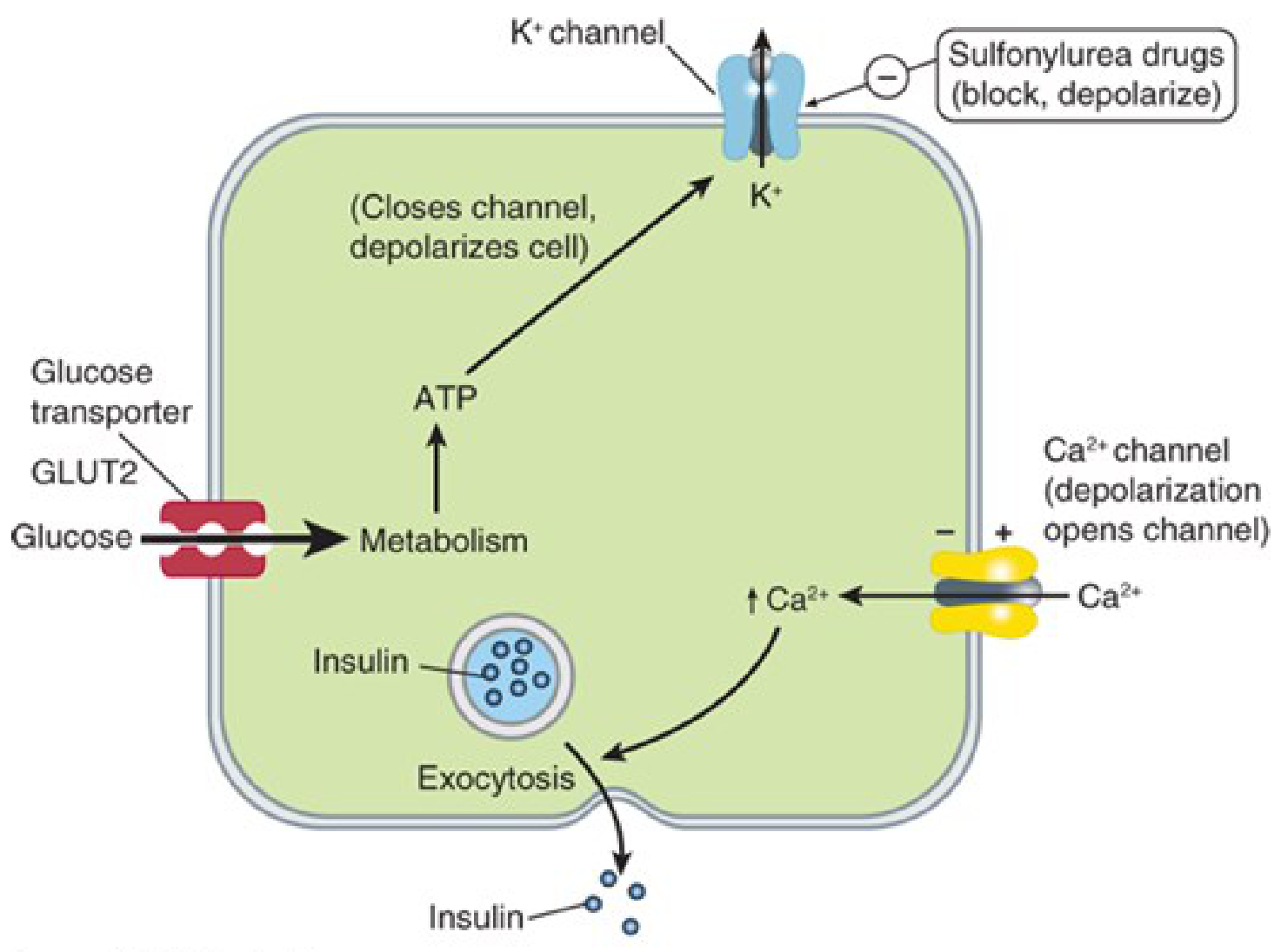
SULFONYLUREA MOA (Katzung's Basic & Clinical Pharmacology)

Sulfonylurea binds to SUR-1 subunit of
ATP-sensitive K⁺ channel (K_ATP) on β-cell membrane
              │
              ▼
BLOCKS K_ATP channel
(same effect as ↑ ATP from glucose metabolism)
              │
              ▼
K⁺ CANNOT leave cell
→ Cell membrane DEPOLARIZES
              │
              ▼
Voltage-gated Ca²⁺ channels OPEN
              │
              ▼
↑ Intracellular Ca²⁺
              │
              ▼
Triggers EXOCYTOSIS of insulin granules
              │
              ▼
↑ INSULIN SECRETION
(glucose-independent - occurs even at LOW glucose)
Key point: Sulfonylureas stimulate insulin release independently of blood glucose → risk of hypoglycaemia even in fasting state.
Extra-pancreatic effects (minor): ↑ Peripheral insulin sensitivity; ↓ hepatic glucose output; ↑ insulin receptor number.
Adverse Effects of Sulfonylureas
| Adverse Effect | Details |
|---|
| Hypoglycaemia | Most important and most common serious ADR; risk ↑ with long-acting agents (glibenclamide, chlorpropamide); elderly, renal impairment, missed meals, alcohol |
| Weight gain | Due to increased insulin secretion and anabolic effects; problematic in obese T2DM |
| Hyponatraemia (SIADH) | Chlorpropamide specifically - augments ADH action on renal collecting duct |
| Disulfiram-like reaction | Chlorpropamide + alcohol → facial flushing, tachycardia (due to acetaldehyde accumulation) |
| Haematological | Leucopenia, thrombocytopenia, agranulocytosis, haemolytic anaemia (rare) |
| Hepatotoxicity | Cholestatic jaundice (rare) |
| GI | Nausea, vomiting, cholestasis |
| Teratogenicity | Contraindicated in pregnancy (cross placenta → fetal hypoglycaemia) |
| Cross-reactions | Sulfa drug allergy may react (sulfonamide structure) |
Uses of Sulfonylureas
- Type 2 DM as second-line (when metformin alone is insufficient) or when metformin is contraindicated
- MODY type 2 (Maturity Onset Diabetes of Young) - highly responsive to sulfonylureas
- Combination with metformin, TZDs, DPP-4 inhibitors
- Not used in: Type 1 DM (no functional beta cells), pregnancy, severe hepatic/renal failure, DKA
3.4 THIAZOLIDINEDIONES (TZDs / Glitazones)
Members: Pioglitazone (Actos), Rosiglitazone (Avandia - restricted)
(Troglitazone was withdrawn due to fatal hepatotoxicity)
Mechanism of Action
THIAZOLIDINEDIONE MOA

TZD enters cell
      │
      ▼
Binds and activates PPAR-γ
(Peroxisome Proliferator-Activated Receptor gamma)
- Nuclear receptor (transcription factor)
- Mainly expressed in ADIPOSE TISSUE
  (also liver, skeletal muscle, endothelium)
      │
      ▼
PPAR-γ + Retinoid X Receptor (RXR)
→ Heterodimer complex
→ Binds to PPRE (PPAR Response Element) in DNA
      │
      ▼
↑ Transcription of insulin-responsive genes:
• ↑ GLUT-1 and GLUT-4 expression
• ↑ Adiponectin secretion
• ↓ TNF-α, ↓ FFA, ↓ Resistin
• ↑ Adipogenesis (small fat cells = more insulin-sensitive)
• Redistribution of fat: visceral → subcutaneous
      │
      ▼
↑ INSULIN SENSITIVITY in:
• Adipose tissue (primary)
• Skeletal muscle
• Liver
      │
      ▼
↓ Blood glucose (fasting + postprandial)
Pharmacological Actions of TZDs
| Action | Details |
|---|
| Glycaemic control | ↓ Fasting and postprandial glucose; ↓ HbA1c by 0.5-1.5% |
| Lipid effects | Pioglitazone: ↑ HDL-C, ↓ TG (favourable); Rosiglitazone: ↑ LDL-C (unfavourable) |
| BP | Mild reduction in blood pressure |
| Anti-inflammatory | ↓ CRP, ↓ IL-6, ↓ PAI-1; ↑ adiponectin |
| NAFLD/NASH | Pioglitazone improves non-alcoholic steatohepatitis |
| Insulin secretion | NOT increased → No hypoglycaemia as monotherapy |
| Weight | Causes weight GAIN (fluid retention + fat redistribution) |
| Ovulation | Improve ovarian function in PCOS |
Adverse Effects of TZDs
| Adverse Effect | Details |
|---|
| Fluid retention / Oedema | Due to ↑ renal sodium and water reabsorption; peripheral oedema |
| Heart failure | Contraindicated in NYHA Class III-IV cardiac failure; may precipitate/worsen CHF |
| Weight gain | Due to fluid retention and fat redistribution |
| Bone fractures | ↑ Risk particularly in women (distal radius, humerus, ankle); ↓ osteoblast differentiation via PPAR-γ |
| Bladder cancer | Pioglitazone with prolonged use (>2 years) - small but significant increased risk; contraindicated in bladder cancer history |
| Hepatotoxicity | Rare (troglitazone was withdrawn for this); monitor LFTs with pioglitazone |
| Anaemia | Dilutional - due to plasma volume expansion |
| Macular oedema | Reported with both agents |
| Rosiglitazone | ↑ Cardiovascular risk (MI) - restricted/withdrawn in many countries |
Uses of TZDs
- Type 2 DM as monotherapy or in combination (with metformin, sulfonylureas, insulin)
- Obese insulin-resistant T2DM patients
- PCOS (improve insulin sensitivity, restore ovulation)
- NASH/NAFLD (pioglitazone - improving liver histology)
- NOT used in: Type 1 DM; heart failure NYHA III-IV; bladder cancer; hepatic disease; pregnancy
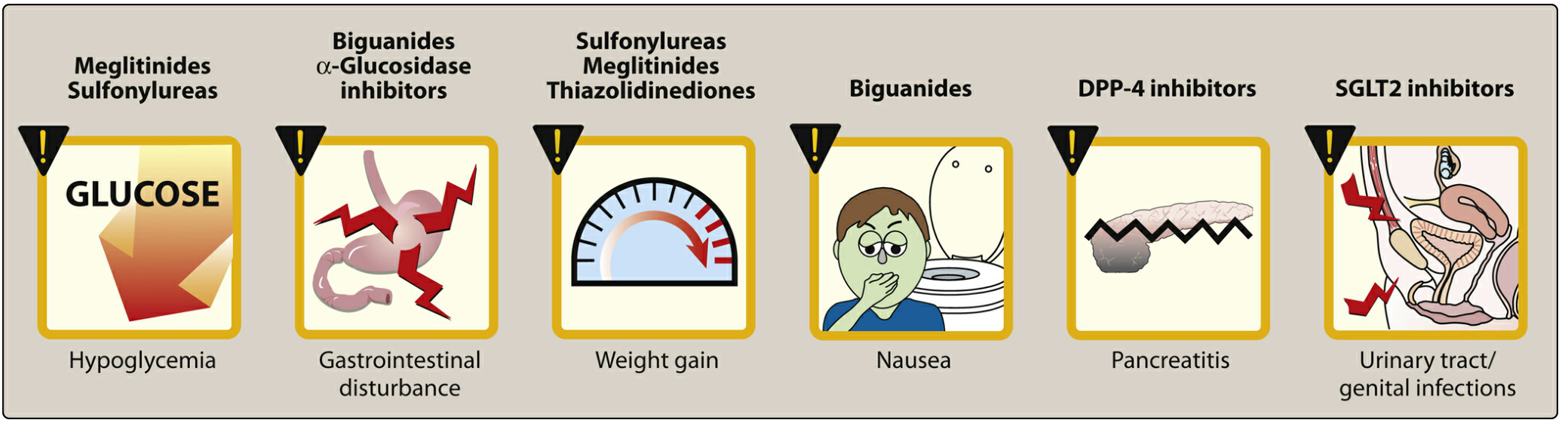
3.5 OHA ADVERSE EFFECTS - VISUAL SUMMARY (Lippincott)
3.6 OHA SITES OF ACTION - DIAGRAM
WHERE EACH OHA ACTS:

PANCREAS (β-cells)        LIVER              PERIPHERAL TISSUES       GUT
[Sulfonylureas]       [Metformin]          [TZDs + Metformin]    [Acarbose]
[Glinides]          ↓ Gluconeogenesis      ↑ Glucose uptake      ↓ Glucose
↑ Insulin           ↓ Glycogenolysis       ↑ GLUT-4               absorption
 secretion          ↓ Hepatic glucose      ↑ Insulin sensitivity
                       output
[DPP-4 inhibitors / GLP-1 agonists] → ↑ Glucose-dependent insulin secretion
[SGLT-2 inhibitors] → ↑ Urinary glucose excretion (glycosuria)
MASTER COMPARISON TABLE: ORAL HYPOGLYCAEMIC AGENTS
| Feature | Metformin | Sulfonylureas | TZDs |
|---|
| Class | Biguanide | Insulin secretagogue | Insulin sensitizer |
| Primary site | Liver | Pancreas (β-cells) | Adipose/Peripheral |
| MOA | ↓ Hepatic gluconeogenesis (AMPK activation) | Block K_ATP → ↑ Ca²⁺ → ↑ insulin exocytosis | PPAR-γ activation → ↑ insulin sensitivity |
| Insulin secretion | Not stimulated | Stimulated (glucose-independent) | Not stimulated |
| Hypoglycaemia | No (monotherapy) | Yes (significant) | No (monotherapy) |
| Weight | Neutral/loss | Gain | Gain |
| HbA1c reduction | 1.5-2% | 1.5-2% | 0.5-1.5% |
| CV effects | Cardioprotective (UKPDS) | Variable | Rosiglitazone - ↑MI risk; Pioglitazone - neutral/beneficial |
| Serious ADR | Lactic acidosis | Hypoglycaemia | Heart failure, fractures, bladder Ca |
| Renal impairment | Contraindicated (eGFR<30) | Avoid (accumulation) | Use with caution |
| Pregnancy | Avoid (limited data) | Contraindicated | Contraindicated |
| 1st line T2DM | YES | 2nd line | 2nd line adjunct |
HIGH-YIELD EXAM POINTS (KD Tripathi / 2nd MBBS)
- Only insulin given IV = Regular (soluble) insulin - used in DKA, surgery, ICU
- Peakless insulins = Glargine and Degludec - never mix in same syringe
- NPH insulin = zinc + protamine + regular insulin; SC only; never IV
- DKA rule = Never give insulin if K⁺ < 3.3 mEq/L → replace K⁺ first
- Metformin = 1st line T2DM; reduces hepatic gluconeogenesis; lactic acidosis = serious but rare ADR
- Sulfonylureas = bind SUR-1/K_ATP; cause hypoglycaemia + weight gain; chlorpropamide → SIADH + disulfiram reaction
- TZDs = PPAR-γ agonists; cause oedema/heart failure/fractures; pioglitazone → bladder cancer
- Human > animal insulin: Less antigenic, no immune resistance, purer, unlimited supply
- Insulin lispro/aspart/glulisine = given 15 min before meals; safe in CSII pumps
- Glargine = pH 4 formulation; precipitates at body pH → peakless 24 h coverage
*Sources: KD Tripathi's Essentials of Medical Pharmacology (10th ed.); Lippincott Illustrated Reviews: Pharmacology (8th ed.); Katzung's Basic and Clinical Pharmacology (16th ed.); Goldman-Cecil Medicine (26th ed.); Rosen's Emergency Medicine (9th ed.)*Here is your complete, exam-ready 2nd Year MBBS Pharmacology notes. Everything is covered with full detail:
What's in these notes:
PART 1: INSULIN
Sources (3 types):
- Bovine (3 AA differences - most antigenic), Porcine (1 AA difference), Human (recombinant DNA - least antigenic)
Human vs Conventional Insulin - 8 detailed advantages:
Less antigenicity, no immune resistance, fewer allergic reactions, no lipodystrophy, faster absorption, monocomponent purity, unlimited supply, no animal pathogen risk
Insulin Preparations - Full Enumeration with table:
- Rapid-acting: Lispro, Aspart, Glulisine, Inhaled (onset 5-15 min)
- Short-acting: Regular insulin (onset 30-60 min) - the ONLY insulin for IV use
- Intermediate: NPH/Isophane (SC only, never IV)
- Long-acting: Glargine (peakless, 24 h), Detemir (~17 h), Degludec (>42 h, ultra-long)
- Premixed combinations
Insulin Analogues - structural changes explained for each (lispro B28/B29 swap; glargine pH 4 precipitation; detemir fatty acid-albumin binding; degludec multi-hexamer depot)
Indications - absolute and relative
Two key diagrams included: Onset/duration curves from Lippincott + Katzung sulfonylurea K_ATP mechanism diagram
PART 2: DKA
Full outline: Definition, diagnostic triad (D-K-A), severity classification table, pathophysiology flowchart, precipitating factors, clinical features (Kussmaul breathing, fruity breath, pseudoacute abdomen)
Management - 4 pillars in detail:
- Fluids: Phase 1 (0.9% NS bolus) → Phase 2 (0.45% NS) → D5W when BG ≤250
- Potassium: Critical decision tree - hold insulin if K⁺ <3.3, replace 20-40 mEq/L if 3.3-5.5
- Insulin: Regular IV only, 0.1 units/kg bolus then 0.1 units/kg/h, target ↓50-75 mg/dL/h
- Bicarbonate: NOT routine; only if pH <7.0
- Resolution criteria, monitoring schedule, transition to SC insulin
PART 3: ORAL HYPOGLYCAEMIC AGENTS
Full Classification (6 classes in a clean tree diagram)
Metformin (Biguanide): AMPK → ↓ hepatic gluconeogenesis (primary), full MOA flowchart, adverse effects (GI, lactic acidosis, B₁₂ deficiency), contraindications, uses
Sulfonylureas: SUR-1/K_ATP mechanism with diagram, generation-wise drugs, ADRs (hypoglycaemia #1, weight gain, chlorpropamide-specific SIADH + disulfiram), uses
Thiazolidinediones: PPAR-γ nuclear receptor mechanism, pharmacological actions (glycaemic, lipid, anti-inflammatory, NAFLD), ADRs (oedema, heart failure, fractures, bladder cancer), uses
Master comparison table for all 3 + visual adverse effects diagram from Lippincott