
Rmp
Asking for Preferences
What would you like to know about RMP?
Reading File
Finding Sources
Searching the Web
resting membrane potential physiology mechanism
Reading File
Reading File
Searching Images
resting membrane potential ion distribution diagram
Loading Image
Reading File
Loading Image
Here is a comprehensive overview of the Resting Membrane Potential (RMP).
Resting Membrane Potential (RMP)
Definition
The RMP is the electrical potential difference across the cell membrane of an excitable cell (nerve, muscle) between action potentials, when the cell is at rest. By convention, the intracellular potential is referenced to the extracellular potential. In most excitable cells the RMP is −70 to −90 mV (inside negative).
Ion Concentrations Across the Membrane
| Ion | Extracellular | Intracellular |
|---|---|---|
| Na⁺ | 142 mEq/L | 14 mEq/L |
| K⁺ | 4 mEq/L | 140 mEq/L |
| Ca²⁺ | High | Very low |
| Cl⁻ | High | Low |
These gradients are maintained by the Na⁺-K⁺ ATPase pump.
Three Determinants of RMP
1. Potassium Diffusion Potential (dominant factor)
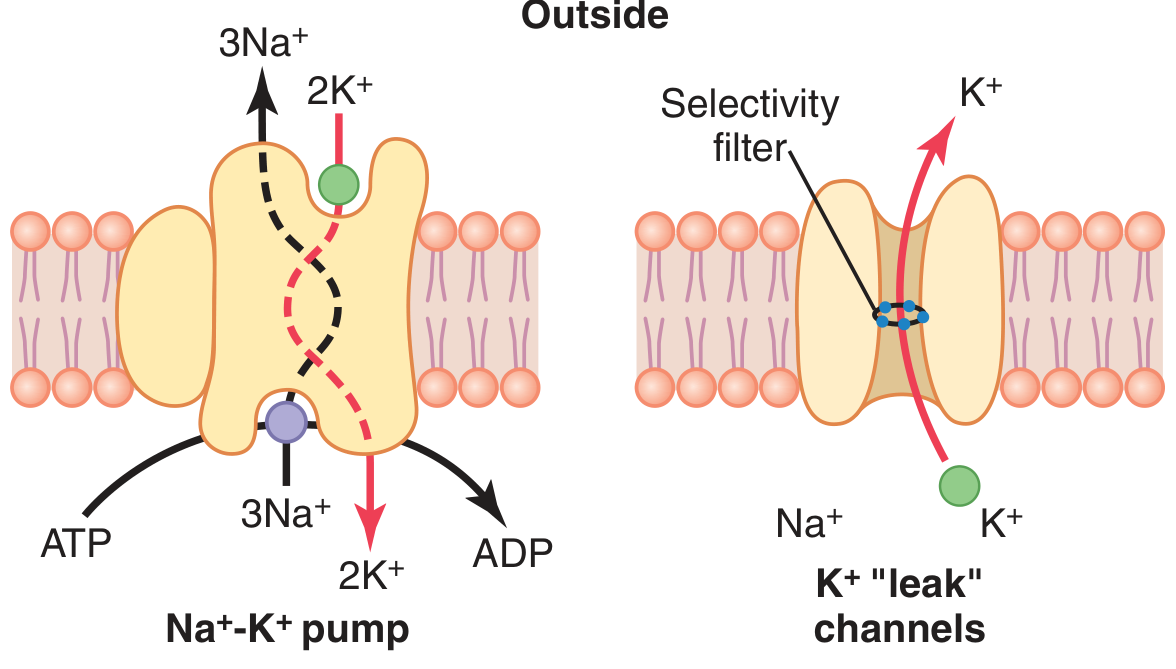
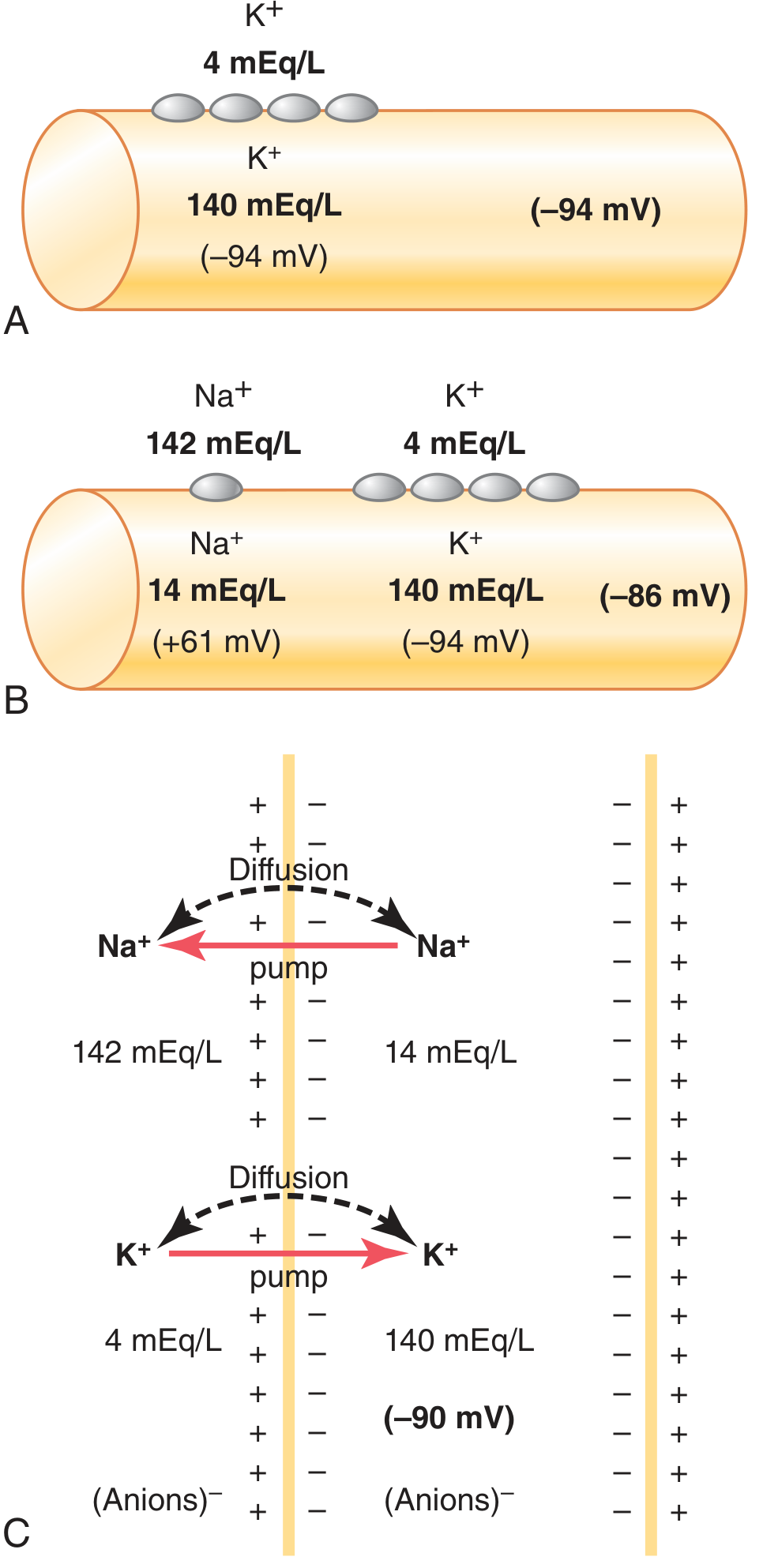
K⁺ is concentrated ~35× higher inside the cell. K⁺ "leak" channels (tandem pore / two-pore domain channels) allow K⁺ to diffuse outward down its concentration gradient, carrying positive charge out and leaving the inside negative. The Nernst potential for K⁺ alone predicts −94 mV.
2. Sodium Diffusion Potential (opposing, minor factor)
The membrane has slight permeability to Na⁺ through the same leak channels (K⁺ permeability ≈ 100× > Na⁺ permeability). Na⁺ diffuses inward, partly offsetting the K⁺ effect. The Goldman (Goldman-Hodgkin-Katz) equation accounts for both ions, giving a calculated RMP of approximately −86 mV.
3. Na⁺-K⁺ ATPase Pump (electrogenic contribution)
The pump transports 3 Na⁺ out for every 2 K⁺ in, producing a net outward current that adds ~−4 mV of additional negativity. This brings the actual RMP to approximately −90 mV. Beyond the direct electrogenic effect, the pump's more important role is maintaining the ion concentration gradients that drive diffusion potentials in the first place.
Diagrams
Na⁺-K⁺ pump and K⁺ leak channels:
Stepwise establishment of the RMP (A → K⁺ only → −94 mV; B → K⁺ + Na⁺ → −86 mV; C → with pump → −90 mV):
Equations
Nernst equation (equilibrium potential for a single ion):
$$E_{ion} = \frac{-61}{z} \log \frac{[ion]{inside}}{[ion]{outside}}$$
- For K⁺: log(140/4) = log 35 = 1.54 → E_K = −94 mV
- For Na⁺: log(14/142) = log 0.1 → E_Na = +61 mV
Chord conductance equation (weights each ion's equilibrium potential by its relative conductance):
$$E_m = \frac{g_{K^+}}{g_T}E_{K^+} + \frac{g_{Na^+}}{g_T}E_{Na^+} + \frac{g_{Cl^-}}{g_T}E_{Cl^-} + \frac{g_{Ca^{2+}}}{g_T}E_{Ca^{2+}}$$
Ions with the highest conductance at rest (K⁺, Cl⁻) drive the membrane potential toward their equilibrium potentials; ions with low conductance (Na⁺, Ca²⁺) contribute little.
Key Principles Summary
| Concept | Detail |
|---|---|
| Typical RMP | −70 to −90 mV |
| Dominant ion | K⁺ (high permeability at rest) |
| Pump stoichiometry | 3 Na⁺ out : 2 K⁺ in (electrogenic) |
| Pump direct contribution | ~−4 mV |
| Pump indirect contribution | Maintains K⁺/Na⁺ gradients (critical) |
| Goldman equation | Accounts for permeability of all ions |
| Nernst equation | Equilibrium potential of a single ion |
Sources: Guyton & Hall Textbook of Medical Physiology, Ch. 5; Costanzo Physiology 7th Ed., Ch. 1
This is a shared conversation. Sign in to Orris to start your own chat.