
Make me understand superheated air, expanded and repelled air and sledge hammer effect in lighting
Searching the Web
superheated air expanded repelled air sledgehammer effect lightning thunder physics
Searching the Web
lightning channel temperature air expansion shockwave thunder formation mechanism
Excellent sources gathered. Let me now give you a thorough, well-structured explanation of all three effects.
Lightning: Superheated Air, Expanded/Repelled Air, and the Sledgehammer Effect
These three concepts are really three stages of the same chain reaction - each one triggers the next.
1. Superheated Air
When a lightning return stroke fires, it drives an enormous electric current - typically 30,000 to 40,000 amperes - through a channel only a few centimetres in diameter. That enormous current density dumps energy into an extremely small volume of air almost instantaneously.
The result:
- The air inside the lightning channel is heated to ~30,000°C (54,000°F), which is approximately five times hotter than the surface of the Sun (~5,500°C).
- Some measurements put peak channel temperatures as high as ~33,000 K during the brief return stroke.
- This does not happen gradually - it happens in a fraction of a millisecond, far too fast for the air to "absorb" the energy quietly.
- The air molecules are stripped of electrons and become a plasma - a glowing, ionized gas channel. This is what produces the visible flash of light.
Key point: It is not just heat - it is heat delivered so fast that the air has no chance to adjust gradually. This is what makes the next stage violent.
2. Expanded and Repelled Air
This stage follows directly from the superheating:
- All gases expand when heated (Gay-Lussac's Law / Charles's Law). The faster you heat them, the faster they try to expand.
- When air is heated to 30,000°C in a fraction of a second, a phenomenon called "explosive expansion" occurs.
- The air in the lightning channel tries to occupy a vastly larger volume almost instantly. It cannot spread gently - it is forced outward hard and fast in all directions perpendicular to the lightning channel.
- This is literally a repulsion: the heated air molecules move so fast and collide so violently with surrounding cooler air molecules that they push, or repel, the surrounding air outward at supersonic speeds.
According to LibreTexts Practical Meteorology, the pressure inside the lightning channel instantly jumps to somewhere between 1,000 and 10,000 kPa - that is 10 to 100 times normal atmospheric pressure (which is ~100 kPa). This extreme overpressure is what drives the outward repulsion of surrounding air.
Timeline of the expanding air front:
| Time after strike | Shock front radius | Speed |
|---|---|---|
| 7 microseconds | ~1.5 cm | ~Mach 10 (10x speed of sound) |
| 0.01 seconds | ~4 m | ~Mach 1 (barely supersonic) |
| 0.1 seconds | ~35 m | Sound wave (subsonic) |
The expanding air begins supersonic, rapidly slows as it spreads outward, and eventually transitions into an ordinary sound wave - which you hear as thunder.
3. The Sledgehammer Effect
This is the immediate, close-range impact of the expanding air - the most dramatic and physically dangerous part for anyone or anything near the strike point.
Here is how it works:
- As the superheated air expands radially outward at supersonic speeds, it compresses the air in front of it into a shock wave - exactly like the sonic boom from a supersonic jet, but cylindrical and originating along the entire length of the lightning channel simultaneously.
- Close to the strike, this shock wave arrives as an almost instantaneous wall of compressed air hitting anything in its path. The force of this compressed air front is described as the "sledgehammer effect" because it delivers a sudden, powerful, blunt-force blow - like being hit with a sledgehammer.
- This is why people standing near (but not directly struck by) lightning can be knocked off their feet, windows can be blown out, trees can be shattered from the inside, and structures can suffer blast damage even when not directly struck.
- The effect is strongest within a few metres of the channel and drops off rapidly with distance as the shock front loses energy and spreads over an ever-larger area.
- Beyond about 35 metres, the sledgehammer/shock effect has largely transitioned into the booming rumble of thunder, which is the same wave - just diluted.
The progression from sledgehammer to thunder:
- Right at the channel - plasma, fire, and direct current damage
- Within ~1-2 metres - maximum sledgehammer shock wave; can rupture eardrums, collapse lungs, throw people
- Within ~35 metres - still a strong shock wave / pressure wave
- Beyond ~35 metres - transitions to thunder (a sound wave)
- Up to ~16 km (10 miles) - you can still hear the thunder
Putting It All Together
Lightning current fires
        ↓
Air heated to ~30,000°C in microseconds
(Superheated air - Stage 1)
        ↓
Extreme overpressure (up to 100x atmospheric) forces air outward at Mach 10
(Expanded and repelled air - Stage 2)
        ↓
Supersonic shock front compresses surrounding air into a wall of force
(Sledgehammer effect close-range - Stage 3)
        ↓
Shock front slows, spreads, transitions to sound wave
(Thunder - the audible remnant of the sledgehammer)
The analogy that captures it well: imagine someone pumping up a balloon inside a sealed cardboard box to insane pressure in milliseconds - the box doesn't expand slowly, it explodes outward. The lightning channel is that box, and the air around you is what gets hit by the explosion.
Sources:
Give me a visual flowchart of it
Generating Image
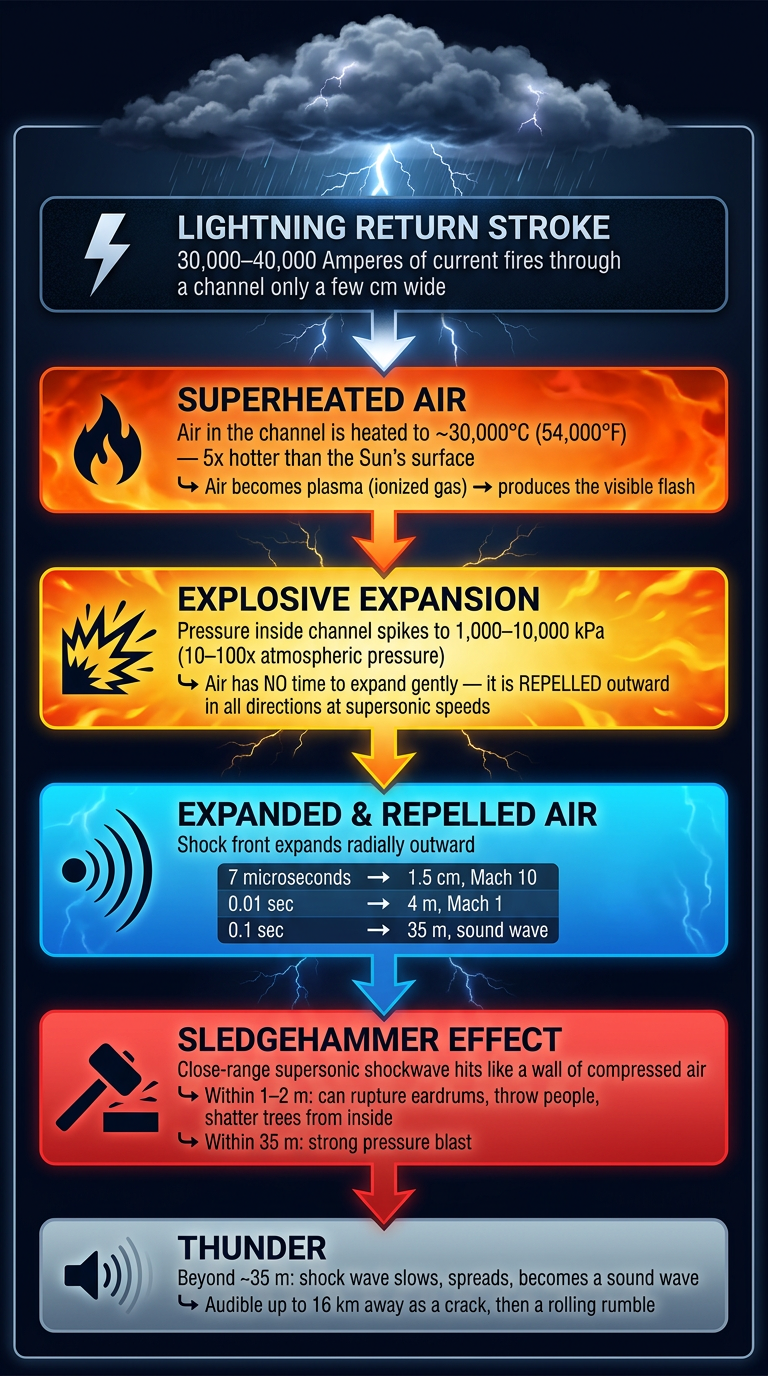
Here is the visual flowchart tracing the full chain - from the lightning return stroke firing, through the superheated air and explosive expansion, to the repelled air shock front, the close-range sledgehammer blast, and finally the rolling rumble of thunder you hear from a distance. Each stage feeds directly into the next.
Explain the mechanism behind formation of filigree burns
Reading File
Searching the Web
filigree burns Lichtenberg figures lightning mechanism formation pathophysiology
Searching PubMed
lightning filigree burns Lichtenberg figures pathophysiology
Finding Sources
Searching PubMed
lightning Lichtenberg figures skin pathophysiology
Reading Web Page
filigree burns Lichtenberg figures mechanism pathophysiology formation capillary rupture
Reading File
Reading File
Reading Article
Reading Article
Loading Image
The textbook image is low quality. I have comprehensive data from all sources. Here is the full, detailed answer:
Filigree Burns (Lichtenberg Figures / Keraunographic Markings)
What They Are
Filigree burns - also called Lichtenberg figures, ferning patterns, feathering burns, or "flowers of Lichtenberg" - are the branching, fern-like, erythematous skin markings that appear on lightning strike victims. They are pathognomonic for lightning injury, meaning their presence on a body is diagnostic of a lightning strike and nothing else.
Important terminology note: They are commonly called "burns" but are technically not true burns - they produce no thermal tissue destruction. This distinction is central to understanding their mechanism.
Clinical Features
| Feature | Detail |
|---|---|
| Appearance | Branching, fern-like, reddish-purple erythematous patterns |
| Onset | Appear within 20 minutes to 1 hour after the strike |
| Duration | Transient - resolve within hours to 48 hours, rarely up to a week |
| Location | Can appear anywhere on the body surface |
| Histopathology | Usually no pathological changes on biopsy, or at most variable degrees of superficial hemorrhage |
| Specificity | Only seen in lightning strikes - NOT seen in industrial AC electrical injury |
Goldman-Cecil Medicine notes them as "an evanescent cutaneous phenomenon" - meaning they fade rapidly and are not permanent scars. - Goldman-Cecil Medicine, Lightning Injury section
The Mechanism - Step by Step
The exact pathophysiology has long been debated and remains not fully resolved, but the current best understanding draws from physics, histopathology, and molecular studies:
Step 1: Lightning current tracks the skin surface ("flashover")
When lightning strikes a person, the enormous energy (estimated ~30 million volts / 50,000 amperes) does NOT predominantly pass straight through the body's deep tissues. Instead, because of the extremely brief duration of the discharge (milliseconds), much of the current travels along the surface of the skin in a phenomenon called flashover - the current finds the path of least resistance, which is the thin film of sweat and moisture on the skin surface, not through the higher-resistance deeper tissues.
This is why internal organ damage in lightning strikes is far less severe than in industrial electrical injuries of equivalent voltage - the body essentially "short-circuits" the current around itself.
Step 2: Electrons are driven into the epidermis and create a "space charge"
The prevailing physics-based hypothesis (Cherington et al., Cutis 2007) proposes:
- As current sweeps across the skin surface, electrons are forcibly driven into the epidermis - the outermost insulating layer.
- Skin is a relatively good electrical insulator (unlike the ionic fluids inside the body), so these electrons cannot flow freely through it.
- They accumulate in place, creating a space charge - a zone of trapped electron density within the epidermal layer.
- This mirrors what happens in laboratory Lichtenberg figure experiments, where a charge is embedded into a solid insulating block (e.g., acrylic).
Step 3: Dielectric breakdown along fractal discharge paths
Once the trapped electron density in the epidermis exceeds the dielectric breakdown threshold of the skin cells, the charge suddenly releases. This release does not travel in a straight line - it follows paths of least resistance through the skin's microstructure, branching repeatedly at each junction in the same way that:
- A lightning bolt branches as it travels through air
- An electrical tree branches through an insulating material
- A river delta branches as it spreads across flat ground
The result is a fractal branching pattern - each branch splits into smaller branches, which split again, producing the characteristic fern-like appearance. The pattern does not correspond to known vascular anatomy or nerve distributions - it is a purely electrical phenomenon mapping the discharge path through the skin's dielectric structure.
Step 4: Red blood cell extravasation from dermal capillaries
The intense electron flow along these branching paths causes dielectric degradation of the local skin cells and rupture of superficial dermal capillaries. Red blood cells leak out into the superficial skin layers along the exact path of the discharge.
This capillary rupture and RBC extravasation is what produces the visible red-purple color of the pattern - it is essentially a very fine, branching bruise mapping the electrical discharge path.
A 2021 molecular study (Lindford et al., Front Med [PMID: 34179045]) confirmed this through proteomics and immunohistochemistry on skin biopsies:
- Extravasation of red blood cells from dermal vessels was confirmed along the LF pattern
- There was increased dermal T-cell infiltration
- Lactoferrin (an iron-binding glycoprotein) was greatly upregulated in keratinocytes and lymphocytes - a marker of cellular stress response to the iron released from lysed RBCs
Step 5: Spontaneous resolution
Because the markings are caused by physiologic changes (RBC extravasation and dielectric stress) rather than structural thermal destruction of tissue, they resolve as the extravasated blood is reabsorbed and the tissue recovers. The skin architecture underneath is largely intact. This explains why:
- Biopsies show no necrosis, no coagulation, no char - the hallmarks of a true burn
- They disappear completely within 24-48 hours in most cases
- They leave no permanent scar in uncomplicated cases
A 2025 forensic autopsy study (Pulagura et al., J Forensic Sci [PMID: 40169362]) confirmed: negative histopathology in Lichtenberg figures supports physiologic phenomena - not thermal injury - as the cause.
Why It Only Happens with Lightning (Not AC Electrical Injury)
Industrial AC electrical injury involves prolonged, sustained current flowing deeply through the body - causing deep tissue coagulation, muscle necrosis, and true burns. The current has time to heat and destroy tissue.
Lightning's discharge is microseconds to milliseconds long - so brief that:
- It cannot heat deep tissue sufficiently to cause deep burns
- It does cause the flashover/surface phenomenon described above
- The space charge accumulation and fractal skin discharge mechanism can occur
This is why Lichtenberg figures are specific to lightning and not seen in household or industrial electrical burns.
Summary Diagram
Lightning strikes → current takes flashover path along wet skin surface
        ↓
Electrons driven into epidermis (poor conductor)
        ↓
Electrons accumulate as "space charge" in epidermal insulator
        ↓
Charge exceeds dielectric breakdown threshold of skin
        ↓
Sudden fractal discharge through microstructure of skin
(branching repeatedly at zones of least resistance)
        ↓
Intense electron flow ruptures superficial dermal capillaries
        ↓
RBC extravasation along exact fractal discharge path
        ↓
Visible red-purple branching (fern-like) pattern on skin
        ↓
Reabsorption of extravasated blood → marks fade in 24-48 hours
Sources:
- Dermatology 2-Volume Set 5e - Electrical and Lightning Burns, Pathology section
- Goldman-Cecil Medicine - Lightning Injury section, Fig. 97-9
- Cherington M et al. "Lichtenberg Figures and Lightning" Cutis 2007 (space charge hypothesis)
- Lindford A et al. [PMID: 34179045] - molecular/proteomics study of LF skin biopsies (2021)
- Pulagura SSK et al. [PMID: 40169362] - negative histopathology confirms physiologic cause (2025)
- PMC case report on Lichtenberg figure and lightning (PMC4763624)
This is a shared conversation. Sign in to Orris to start your own chat.