
Electron transport chain Biochemistry
Reading File
Now let me search the medical library for the electron transport chain content.
Finding Sources
Finding Sources
Excellent - the primary source is Lippincott's Biochemistry. Let me read the main ETC section from that book, plus the Basic Medical Biochemistry section.
Reading File
Reading File
Now let me read more of the Lippincott ETC section covering the complexes:
Reading File
Reading File
Let me continue reading the Lippincott text for the remaining complexes, inhibitors, ATP yield, and also fetch the key diagram:
Reading File
Loading Image
Excellent! Now let me read the inhibitors and ATP yield sections from Lippincott:
Reading File
Loading Image
Now let me read the inhibitors section and ATP yield from Lippincott:
Reading File
Now let me read the section on inhibitors and uncouplers:
Reading File
Now I also need the inhibitors section. Let me look for that specifically:
Finding Sources
Reading File
I now have comprehensive information. Let me also get the specific inhibitors mentioned:
Reading File
I now have all the information needed to write a comprehensive answer. Let me compose the full response.
Electron Transport Chain (ETC)
Biochemistry, 8th ed Lippincott Illustrated Reviews | Basic Medical Biochemistry - A Clinical Approach, 6e
Overview
Energy-rich molecules (glucose, fatty acids, amino acids) are oxidized through a series of reactions that ultimately produce CO2 and H2O. During these processes, metabolic intermediates donate electrons to two coenzymes - NAD+ and FAD - forming the energy-rich reduced forms NADH and FADH2. These then donate electron pairs to the ETC.
The ETC is located in the inner mitochondrial membrane (IMM), with the exception of cytochrome c (which is mobile in the intermembrane space). It is the final common pathway by which electrons derived from all fuels flow to oxygen, reducing it to H2O. The coupling of electron transport with ATP synthesis is called oxidative phosphorylation (OXPHOS).
Mitochondrial Structure
| Compartment | Features |
|---|---|
| Outer membrane | Contains porin channels - freely permeable to small ions and molecules |
| Inner membrane | Impermeable to H+, ATP, ADP, pyruvate - requires specific transporters; rich in cristae (increases surface area); over half of its proteins are involved in OXPHOS |
| Intermembrane space | Where H+ accumulates during electron transport |
| Matrix | Contains TCA cycle enzymes, β-oxidation enzymes, NAD+, FAD, ADP, Pi |
The Four Complexes
Here is the overall ETC diagram from Basic Medical Biochemistry, 6e:
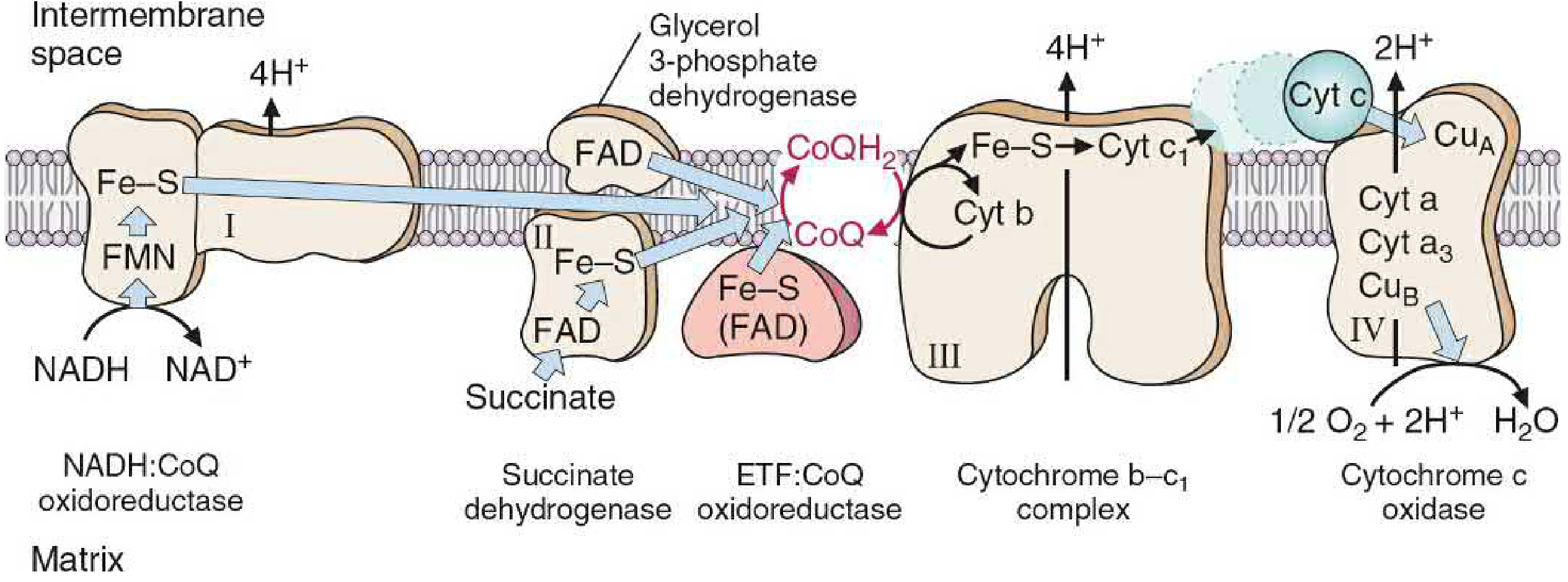
Complex I - NADH Dehydrogenase (NADH:CoQ Oxidoreductase)
- Accepts electrons from: NADH
- Electron path: NADH → FMN (flavin mononucleotide) → Fe-S centers → CoQ
- Protons pumped: 4 H+ from matrix to intermembrane space
- FMN is a coenzyme derived from riboflavin (vitamin B2)
- Contains multiple Fe-S center subunits
Complex II - Succinate Dehydrogenase
- Accepts electrons from: FADH2 (produced by oxidation of succinate to fumarate in the TCA cycle)
- Electron path: FADH2 → Fe-S protein → CoQ
- Protons pumped: 0 - no proton pumping occurs at this complex because no energy is lost in this step
- Also accepts electrons from glycerol 3-phosphate dehydrogenase, acyl CoA dehydrogenase (fatty acid oxidation), and ETF:CoQ oxidoreductase - all feed into CoQ without proton pumping
Coenzyme Q (CoQ / Ubiquinone)
- A lipid-soluble quinone with a long hydrophobic isoprenoid tail (made from a cholesterol synthesis intermediate)
- Acts as a mobile electron carrier, collecting electrons from Complexes I and II and passing them to Complex III
- Serves as a junction point linking flavoprotein dehydrogenases to cytochromes
- When it accepts electrons (becomes reduced to CoQH2), it picks up protons from the matrix side
Complex III - Cytochrome bc1 Complex (Cytochrome b-c1)
- Accepts electrons from: CoQH2
- Electron path: CoQ → Cyt b → Fe-S → Cyt c1 → Cytochrome c
- Protons pumped: 4 H+ to intermembrane space
- Transfers electrons one at a time to the mobile carrier cytochrome c
Cytochrome c
- A small cytochrome protein in the intermembrane space
- Mobile carrier that shuttles single electrons between Complex III and Complex IV
- Clinically important: its release from mitochondria into the cytosol triggers apoptosis (stimulates apoptosome formation and caspase activation)
Complex IV - Cytochrome c Oxidase (Cytochrome a + a3)
- Accepts electrons from: Cytochrome c
- Electron path: CuA → Cyt a → Cyt a3 (with CuB) → O2
- Terminal reaction: 4e- + 4H+ + O2 → 2 H2O
- Protons pumped: 2 H+ to intermembrane space
- This is the only electron carrier where the heme iron can directly react with O2
- Contains copper (Cu) atoms essential for this reaction
- Also called "cytochrome c oxidase" - the only complex where O2 binds
Proton Pumping Summary
| Complex | Enzyme | H+ pumped (per NADH) | Electrons from |
|---|---|---|---|
| I | NADH dehydrogenase | 4 H+ | NADH |
| II | Succinate dehydrogenase | 0 | FADH2 |
| III | Cytochrome bc1 | 4 H+ | CoQ |
| IV | Cytochrome c oxidase | 2 H+ | Cyt c |
| Total | 10 H+ per NADH |
(For FADH2, Complex I is bypassed, so only 6 H+ are pumped - via Complexes III and IV)
ATP Synthesis - Chemiosmotic Hypothesis (Mitchell Hypothesis)
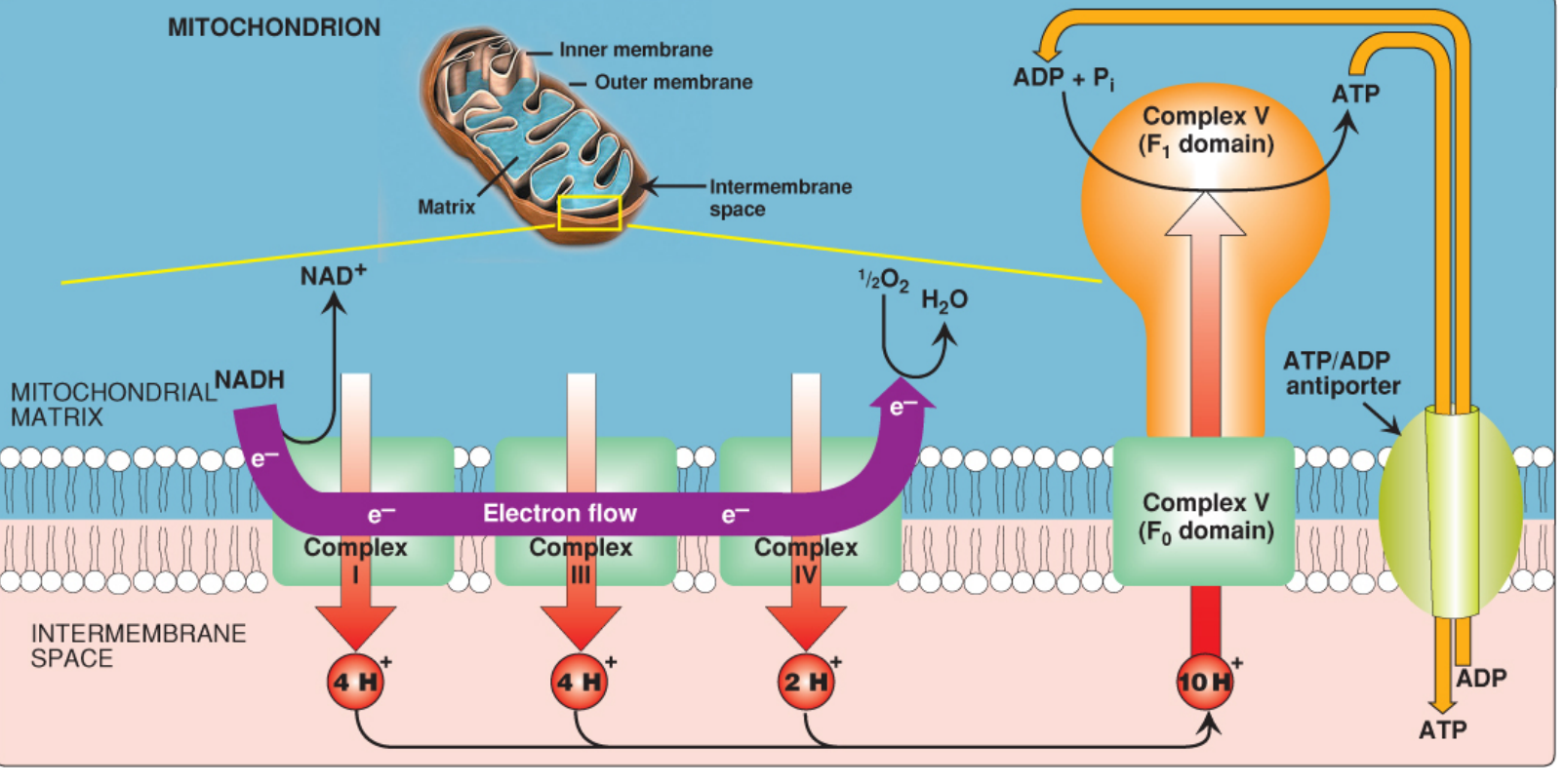
The pumping of H+ creates two gradients across the IMM:
- Chemical gradient (pH gradient) - cytosolic side is more acidic
- Electrical gradient - cytosolic side is more positively charged
Together these form the proton-motive force (Δp), which drives ATP synthesis.
Complex V - ATP Synthase (F1F0-ATPase)
- F0 domain - spans the IMM; contains a c-ring H+ channel (8 c subunits in vertebrates); binding target of oligomycin
- F1 domain - protrudes into the matrix; contains 3 β subunits that synthesize ATP; can also hydrolyze ATP (hence "ATPase")
- H+ re-entering the matrix through F0 drive rotation of the c ring
- This rotation causes conformational changes in F1 β subunits: bind ADP+Pi → phosphorylate ADP → release ATP
- One full rotation = 3 ATP produced
- 8 H+ required to drive one full rotation (so ~2.7 H+ per ATP; P:O ≈ 2.5 for NADH, 1.5 for FADH2)
ATP Yield
| Substrate | ATP produced (current estimates) |
|---|---|
| 1 NADH | ~2.5 ATP |
| 1 FADH2 | ~1.5 ATP |
| 1 glucose (complete oxidation) | ~30-32 ATP |
| 1 pyruvate (complete oxidation) | ~12.5 ATP |
The 30-32 ATP per glucose depends on which cytosolic NADH shuttle is used:
- Malate-aspartate shuttle - produces NADH in matrix → ~2.5 ATP per cytosolic NADH (more efficient, in liver, heart)
- Glycerol 3-phosphate shuttle - produces FADH2 in matrix → ~1.5 ATP per cytosolic NADH (in muscle, brain)
Inhibitors of the ETC
| Site | Inhibitor | Mechanism |
|---|---|---|
| Complex I | Rotenone, amytal (amobarbital), metformin | Block NADH → CoQ electron transfer |
| Complex II | Malonate | Competitive inhibitor of succinate dehydrogenase |
| Complex III | Antimycin A | Blocks CoQ → Cyt c electron transfer |
| Complex IV | Cyanide (CN-), CO, azide, H2S | Bind Fe in Cyt a3; block O2 reduction |
| Complex V (ATP synthase) | Oligomycin | Blocks H+ channel in F0; stops ATP synthesis |
Key point: Inhibition at any point in the chain causes all carriers upstream (before the block) to become fully reduced, while those downstream become fully oxidized. Because electron transport and phosphorylation are tightly coupled, blocking the chain also stops ATP synthesis - and vice versa (oligomycin blocks ATP synthesis which backs up H+ gradient, which halts electron transport).
Uncouplers
Uncouplers dissipate the H+ gradient without generating ATP, so the energy is released as heat instead. The ETC actually speeds up (to try to restore the gradient), but no ATP is made.
| Uncoupler | Notes |
|---|---|
| 2,4-Dinitrophenol (DNP) | Synthetic; lipid-soluble proton carrier; was used (dangerously) as a weight-loss drug in the 1930s |
| Aspirin (high doses) | Can uncouple mitochondria |
| UCP1 (thermogenin) | Physiological uncoupler in brown adipose tissue; responsible for non-shivering thermogenesis in neonates and cold-acclimatized individuals |
Reactive Oxygen Species (ROS)
Electron leakage from the ETC (particularly at Complexes I and III) generates ROS:
- Superoxide (O2-) → Hydrogen peroxide (H2O2) → Hydroxyl radical (·OH)
Cellular defenses:
- Superoxide dismutase (SOD) converts O2- to H2O2
- Catalase converts H2O2 to H2O + O2
- Glutathione peroxidase reduces H2O2 using glutathione
Mitochondrial Disease (OXPHOS Disorders)
- 13 of ~90 ETC polypeptides are encoded by mitochondrial DNA (mtDNA); the rest are nuclear-encoded
- mtDNA mutation rate is ~10× that of nuclear DNA
- mtDNA is maternally inherited (sperm mitochondria are eliminated at fertilization)
- High-energy tissues are most vulnerable: brain, nerves, retina, skeletal muscle, heart, liver
| Disease | Key Features |
|---|---|
| Kearns-Sayre syndrome | Ptosis, ophthalmoplegia, cardiac conduction defects, ataxia, myopathy; onset before age 20; mtDNA deletion |
| Leber hereditary optic neuropathy (LHON) | Bilateral central vision loss; onset 20s-30s |
| MELAS | Mitochondrial encephalomyopathy, lactic acidosis, stroke-like episodes |
| MERRF | Myoclonic epilepsy, ragged-red fibers on muscle biopsy |
| General features | Lactic acidosis, seizures, ophthalmoplegia, myopathy, cardiomyopathy |
Quick Memory Aid - ETC Flow
NADH → Complex I → CoQ → Complex III → Cyt c → Complex IV → O2 → H2O
                  ↑
FADH2 → Complex II ┘
         (no H+ pump)
                              ↓ H+ gradient drives ↓
                         Complex V (ATP synthase)
                              ADP + Pi → ATP
Complexes that pump H+: I (4), III (4), IV (2) - "1, 3, 4 pump; 2 does not"
Sources: Biochemistry, 8th ed Lippincott Illustrated Reviews, pp. 224-252 | Basic Medical Biochemistry - A Clinical Approach, 6e, Chapter 24
This is a shared conversation. Sign in to Orris to start your own chat.