
Miliaria
Reading File
Searching sources...
Finding Sources
Searching PubMed
miliaria heat rash pathophysiology treatment
Reading File
Reading File
Reading File
Reading File
Reading File
Loading Image
Here is a comprehensive overview of miliaria drawn from authoritative dermatology textbooks.
Miliaria (Heat Rash)
Definition & Pathophysiology
Miliaria is a common disorder of the eccrine sweat glands caused by obstruction of eccrine sweat ducts, leading to retention of sweat within the skin. It occurs in conditions of increased heat and humidity - hot/humid climates, tropical regions, and in neonates who are over-swaddled or febrile.
Key mechanism: Staphylococcus epidermidis produces an extracellular polysaccharide substance that obstructs the eccrine duct orifice. The blocked sweat then ruptures into adjacent tissue at varying depths, producing different clinical variants. This does not, however, explain all cases (particularly congenital forms).
Affects up to 15% of newborns and is common across all ages in warm climates.
Classification by Level of Ductal Obstruction
The level at which sweat escapes into the skin determines the clinical type:
| Type | Level of Obstruction | Morphology | Symptoms |
|---|---|---|---|
| Miliaria Crystallina | Stratum corneum (intracorneal/subcorneal) | Small (1 mm), clear, fragile, superficial vesicles ("dew drops"); no inflammation | Asymptomatic; ruptures at slightest trauma |
| Miliaria Rubra (Prickly Heat) | Prickle cell layer (epidermis) | 1-3 mm discrete, erythematous papulovesicles on a bed of erythema | Intensely pruritic; prickling, burning, tingling sensation |
| Miliaria Pustulosa | Epidermis (preceded by duct injury) | Distinct, superficial, non-follicular sterile pustules | Pruritic; occurs in intertriginous and flexural areas |
| Miliaria Profunda | Dermal-epidermal junction (upper dermis) | 1-3 mm asymptomatic, flesh-colored/whitish papules | Non-pruritic; lasts only ~1 hour after overheating ends |
Clinical Features by Type
Miliaria Crystallina
- Seen in bedridden patients with fever, over-bundled infants, or patients with hypernatremia
- Drugs that can induce it: isotretinoin, adrenergic/cholinergic drugs, doxorubicin
- Self-limited; no treatment required
Miliaria Rubra (Prickly Heat) - Most Common
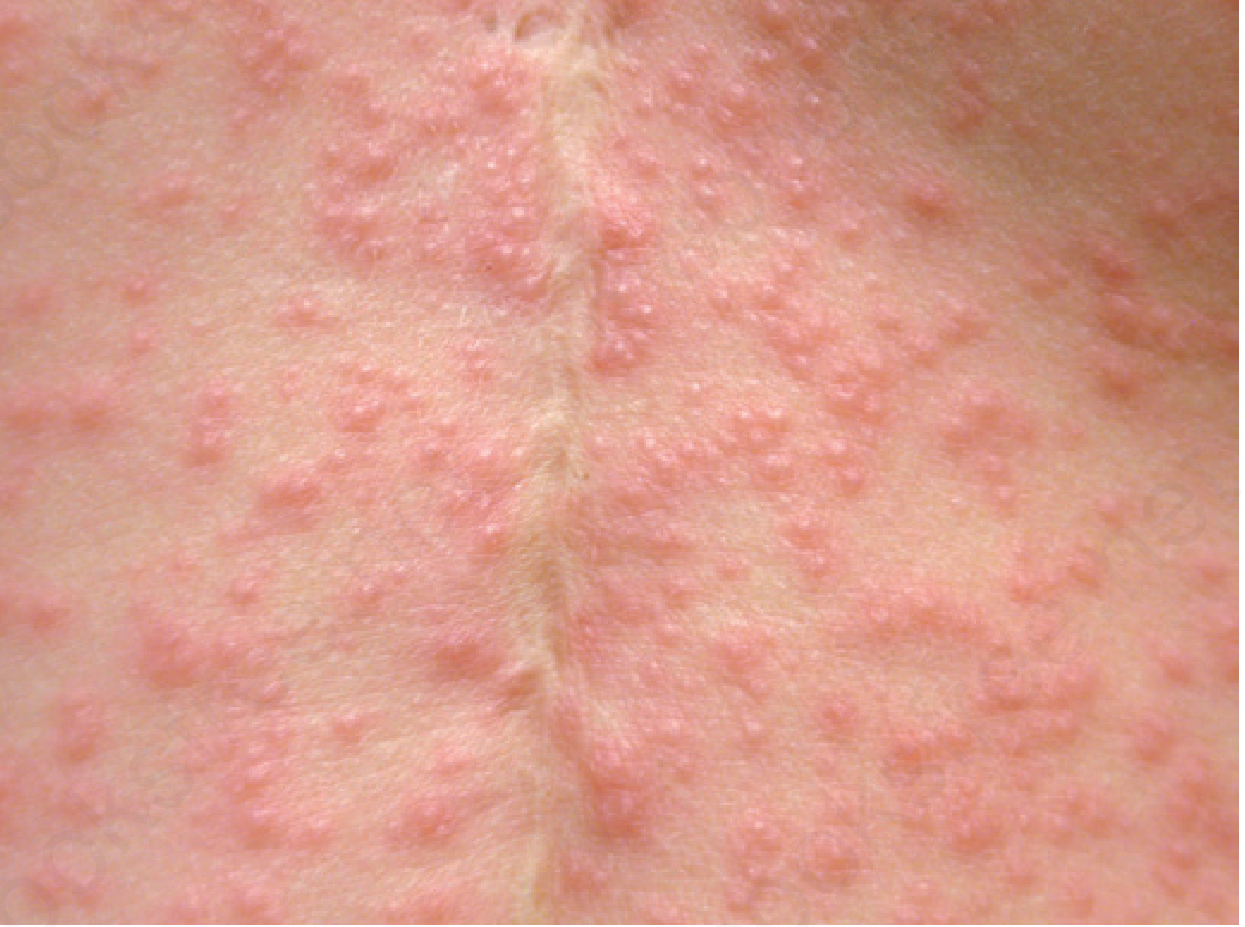
Miliaria rubra - discrete erythematous papulovesicles (Andrews' Diseases of the Skin)
- Predilection sites: antecubital and popliteal fossae, trunk, inframammary areas, abdomen (waistline), inguinal regions
- Sites become macerated because evaporation of moisture is impeded
- Can cause exercise-induced itching and may mimic or complicate atopic dermatitis
- Histology: intraepidermal spongiosis + vesicles with chronic dermal inflammatory infiltrate
Miliaria Pustulosa
- Preceded by another dermatitis that injures or blocks the sweat duct
- Pustules are independent of hair follicles
- Sites: intertriginous areas, flexural surfaces, scrotum, back (bedridden patients)
- Associated with: contact dermatitis, lichen simplex chronicus, intertrigo
- Recurrent episodes can be a sign of type I pseudohyperaldosteronism (salt-losing crises may precipitate it)
Miliaria Profunda
- Rare; seen almost exclusively in the tropics
- Usually follows a severe bout of miliaria rubra
- Except for face, axillae, hands, and feet (which show compensatory hyperhidrosis), all sweat glands are nonfunctional
- Concentrated on the trunk and extremities
Complications
Postmiliarial Hypohidrosis
- Follows miliaria invariably; duration/severity proportional to the severity of miliaria
- Sweating may be depressed to half the normal amount for up to 3 weeks
- Symptoms: decreasing efficiency, irritability, anorexia, drowsiness, vertigo, headache
Tropical Anhidrotic Asthenia
- Rare form with long-lasting poral occlusion producing anhidrosis and heat retention
Histology Summary
- Miliaria crystallina: Intracorneal or subcorneal vesicle centered on the acrosyringium; little inflammation
- Miliaria rubra: Intraepidermal spongiosis + vesicles; chronic inflammatory infiltrate in the dermis
- Miliaria profunda: Perieccrine lymphocytic infiltration of sweat gland secretory coils (anhidrotic skin)
Treatment
The most effective treatment is removing the patient from the heat:
- Cooling the environment - even a single night in air-conditioning significantly relieves symptoms
- Circulating air fans to cool the skin
- Anhydrous lanolin - resolves poral occlusion; helps restore normal sweat secretion; particularly effective in miliaria profunda
- Hydrophilic ointment - dissolves keratinous plugs
- Soothing/cooling baths with colloidal oatmeal or cornstarch (in moderation)
- Dusting powders (cornstarch, baby talcum powder) for mild cases
- Miliaria crystallina requires no treatment (self-limited)
- Treat any underlying febrile illness; remove occlusive clothing
Special Populations
Neonates:
- Miliaria crystallina may be present at birth (congenital)
- Miliaria rubra usually appears after the first week of life
- Precipitants: excessive warming in incubators, over-swaddling, fever, occlusive dressings
- Resolves spontaneously once inciting factors are addressed
Sources:
- Andrews' Diseases of the Skin, Ch. 3
- Dermatology 2-Volume Set (5e), Ch. 34
- Fitzpatrick's Dermatology, Vol. 1-2, Ch. 81 & 103
scaling accompanied by intense itching, burning, or pain
Reading File
Scaling with intense itching, burning, or pain points to a broad differential - conditions like psoriasis, eczema, tinea, lichen planus, contact dermatitis, and ichthyosis all produce scaling, with the symptom character helping narrow the diagnosis. Let me search the textbooks systematically.
Searching sources...
Finding Sources
Finding Sources
Finding Sources
Finding Sources
Finding Sources
Reading File
Finding Sources
Finding Sources
Reading File
Reading File
Reading File
Finding Sources
Finding Sources
Reading File
Reading File
Now I have enough material for a comprehensive, clinically organized response. Let me also pull the xerosis/dry skin data and the tinea/contact dermatitis excerpts that came up.
Finding Sources
Here is a clinically organized breakdown of conditions that produce scaling accompanied by intense itching, burning, or pain, organized by the dominant symptom and setting.
Scaling with Itching, Burning, or Pain - Differential Diagnosis
The combination of scaling + one or more of these symptoms is a core dermatological presentation. The dominant symptom (itch vs. burn/pain vs. both), distribution, and morphology of the scale are the key discriminators.
1. Seborrheic Dermatitis
Dominant symptoms: itching + burning
- Erythematous, greasy scaling patches and plaques on sebaceous gland-rich sites: scalp, nasolabial folds, eyebrows, postauricular areas, external auditory canals, sternal chest, upper back, intertriginous areas
- Severity ranges from mild erythema and pruritus to severe oily/thick scale with burning or tingling sensation
- Chronic, relapsing course; worsens in cold/dry weather
- Strongly associated with HIV (prevalence up to 83%) and Parkinson disease
- Pathogen link: Malassezia spp. (also called Pityrosporum)
- May co-occur with Pityrosporum folliculitis and seborrheic blepharitis (eyelid scaling + irritation)
Treatment: Topical antifungals (ketoconazole shampoo/cream), topical corticosteroids for flares
2. Psoriasis
Dominant symptoms: pruritus (variable intensity), occasionally burning
- Discrete plaques with adherent silvery-white (micaceous) scale at sites of predilection (elbows, knees, scalp, lumbosacral area)
- The itch in psoriasis is variable - some patients report intense pruritus; others describe burning, especially in inverse/flexural psoriasis
- Driven by Th17/IL-17/IL-23 axis; TNF-α plays a co-amplifying role
- Nail involvement (pitting, onycholysis) and psoriatic arthritis are important co-features
- Koebner phenomenon: lesions appear at sites of skin trauma
Treatment: Topical corticosteroids, vitamin D analogues, methotrexate, biologics (anti-TNF, anti-IL-17, anti-IL-23)
3. Contact Dermatitis - Irritant (ICD) vs. Allergic (ACD)
Dominant symptoms: ICD → burning, pain, stinging; ACD → pruritus
This is a key clinical discriminator from textbook dermatology sources:
"A more frequent complaint of burning, pain, and stinging with ICD, in contrast to pruritus in areas of allergic contact dermatitis" - Dermatology 2-Volume Set (5e)
- Both produce erythema, scaling, and weeping/crusting
- ICD: immediate onset, sharply demarcated, dose-dependent; caused by soaps, detergents, solvents, acids
- ACD: delayed (Type IV hypersensitivity), spreads beyond contact zone, intense pruritus
- Eczematous cheilitis (lip involvement): xerosis, scaling, erythema, fissuring + burning and pruritus
Treatment: Remove offending agent; topical corticosteroids; barrier creams; patch testing for ACD
4. Xerosis (Dry Skin / Asteatotic Eczema)
Dominant symptoms: itching + burning + pin-prick sensations
"The most common symptoms of xerosis are nonspecific pruritus, burning sensations, and a pin prick-like feeling. Physical examination reveals roughness, fine scaling, and loss of elasticity in the skin." - Fitzpatrick's Dermatology
- Especially common in the elderly, hypothyroid patients, and in cold/dry environments
- Fine, powdery scale; "cracked earth" pattern (eczema craquelé) in severe cases
- Aggravated by over-bathing, harsh soaps, low humidity, diuretics
Treatment: Emollients, humectants (urea, lactic acid), lukewarm bathing
5. Tinea Corporis / Dermatophytosis
Dominant symptom: mild-to-moderate pruritus
- Sharply demarcated, annular scaling plaques with active, raised, scaly borders and central clearing
- Mildly erythematous; may be chronic with mild pruritus as the only symptom
- Caused by Trichophyton, Microsporum, or Epidermophyton species
- Tinea pedis (athlete's foot): interdigital maceration, scaling, and burning/stinging are prominent
- Tinea cruris: inguinal scaling + marked pruritus and burning
Treatment: Topical azoles (clotrimazole, miconazole); oral terbinafine or itraconazole for extensive/resistant cases
6. Lichen Planus
Dominant symptoms: intense pruritus; erosive forms → pain and burning
- Classic: violaceous, flat-topped (planar), polygonal papules with fine white lines on the surface (Wickham's striae); fine surface scale
- Scalp LP (lichen planopilaris): early signs include itching, burning, diffuse hair loss, perifollicular erythema, and scaling - progression leads to irreversible cicatricial scarring
- Oral/erosive LP: painful, burning ulcers of the buccal mucosa and tongue
- Nail LP: thinning, longitudinal ridging, pterygium formation
Treatment: Potent topical corticosteroids; intralesional steroids; systemic retinoids or immunosuppressants for widespread disease
7. Pityriasis Rosea
Dominant symptoms: pruritus (variable)
- Begins with a herald patch (single oval, salmon-colored, scaling plaque), followed 1-2 weeks later by a widespread eruption along skin cleavage lines ("Christmas tree" pattern on back)
- Usually asymptomatic, but pruritus may be present
- Differential from tinea: Tinea has central clearing and positive KOH; PR has a collarette of scale pointing inward; PR usually clears spontaneously in 6-8 weeks
8. Erythrasma
Dominant symptoms: itching and burning (especially in the groin)
- Caused by Corynebacterium minutissimum
- Reddish-brown, well-demarcated patches with fine, dry scaling in intertriginous areas (groin, axillae, toe webs)
- "Lesions are asymptomatic except in the groin, where there may be some itching and burning" - Andrews' Diseases of the Skin
- Coral-red fluorescence under Wood's lamp is diagnostic
Treatment: Topical or oral erythromycin; topical azoles
Summary Table
| Condition | Scale Character | Dominant Symptom | Key Distribution |
|---|---|---|---|
| Seborrheic dermatitis | Greasy, yellow | Itch + burning | Scalp, face, folds |
| Psoriasis | Silvery, micaceous | Itch (variable) | Extensor surfaces, scalp |
| Irritant contact dermatitis | Fine, variable | Burning/pain > itch | Exposed/contact site |
| Allergic contact dermatitis | Fine, weeping | Itch > burning | Contact + spread |
| Xerosis | Fine, powdery | Itch + burning/prickling | Generalized, legs |
| Tinea corporis | Peripheral (annular) | Mild itch | Trunk, limbs |
| Tinea pedis/cruris | Interdigital/border | Burning + itch | Feet, groin |
| Lichen planus | Fine surface scale | Intense itch; erosive = pain | Wrists, scalp, mucosa |
| Pityriasis rosea | Collarette (inward) | Variable itch | Trunk (Christmas tree) |
| Erythrasma | Fine, dry | Itch + burning | Intertriginous |
Key clinical pearl: The symptom quality helps narrow the differential - burning/pain points toward irritant or erosive causes (ICD, erosive LP, herpes zoster with post-inflammatory scaling), while dominant pruritus favors allergic, atopic, or fungal etiologies. Distribution and scale morphology (greasy vs. silvery vs. fine) are equally discriminating.
Sources: Fitzpatrick's Dermatology, Vol. 1-2; Andrews' Diseases of the Skin; Dermatology 2-Volume Set (5e)
This is a shared conversation. Sign in to Orris to start your own chat.