
Immunity -types -components of immune system (mps,lymphoid component)
Reading File
Finding Sources
Finding Sources
Finding Sources
Finding Sources
Reading File
Reading File
Finding Sources
Finding Sources
Reading File
Reading File
Reading File
Finding Sources
Finding Sources
Reading File
Reading File
Finding Sources
I now have comprehensive content from the textbooks. Let me fetch the key diagram and compile the full answer.
Loading Image
Here is a comprehensive overview of Immunity — Types and Components of the Immune System, drawn from authoritative immunology and histology textbooks.
IMMUNITY
1. Types of Immunity
Defense against microbes is mediated by two sequential, coordinated arms:
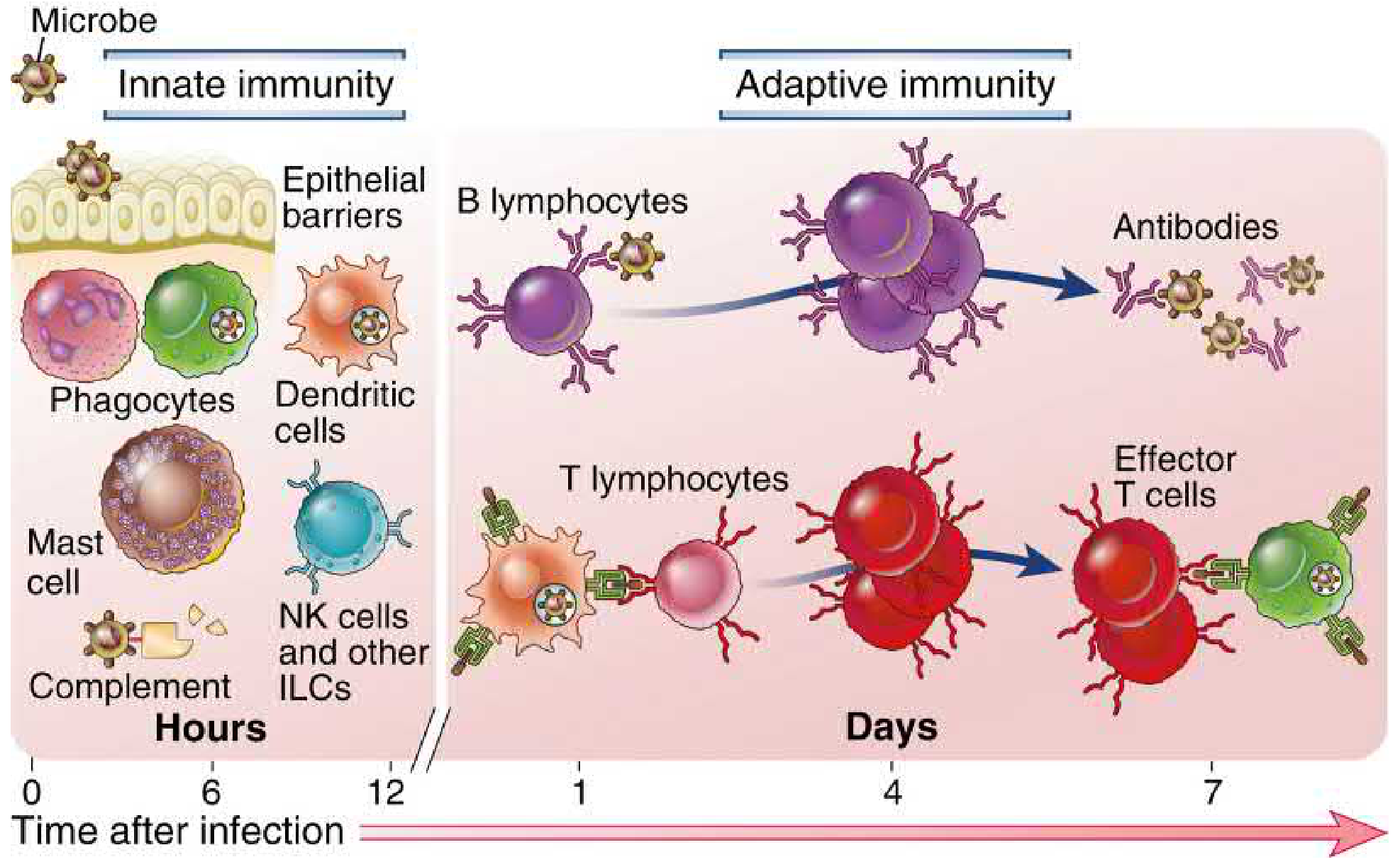
A. Innate Immunity (Natural / Native Immunity)
| Feature | Detail |
|---|---|
| Speed | Responds within hours of infection |
| Specificity | Recognizes molecular patterns shared by groups of related microbes (PAMPs) |
| Diversity | Low — encoded by inherited (germline) genes |
| Memory | Limited or absent |
| Self-discrimination | Yes |
Principal components:
- Physical & chemical barriers — skin, mucosal epithelia, antimicrobial peptides
- Cellular elements — phagocytes (macrophages, neutrophils), dendritic cells (DCs), mast cells, natural killer (NK) cells, and other innate lymphoid cells (ILCs)
- Soluble proteins — complement system, lectins, acute-phase proteins, interferons
B. Adaptive Immunity (Specific / Acquired Immunity)
| Feature | Detail |
|---|---|
| Speed | Days (develops after innate response primes it) |
| Specificity | For individual microbial and non-microbial antigens (epitopes) |
| Diversity | Very high — somatic recombination of gene segments in lymphocytes generates 10⁷–10⁹ distinct specificities |
| Memory | Yes — stronger, faster responses on re-exposure |
| Self-discrimination | Yes |
Two forms of adaptive immunity:
| Humoral Immunity | Cell-Mediated Immunity | |
|---|---|---|
| Mediator cell | B lymphocytes | T lymphocytes |
| Effector molecule | Antibodies (immunoglobulins) | Cytokines, cytotoxic killing |
| Target | Extracellular microbes and toxins | Intracellular pathogens, virus-infected cells |
Active vs. Passive immunity:
- Active — host responds to an antigen (natural infection or vaccination)
- Passive — transfer of preformed antibodies (e.g., maternal IgG, antitoxin injection)
2. Components of the Immune System
All immune cells arise from pluripotent hematopoietic stem cells via two main lineages:
- Myeloid lineage → monocytes, macrophages, neutrophils, dendritic cells, mast cells, basophils, eosinophils
- Lymphoid lineage → T cells, B cells, NK cells
A. Mononuclear Phagocyte System (MPS)
The MPS is a network of phagocytic cells of myeloid origin primarily involved in phagocytosis, antigen processing, and antigen presentation. It comprises monocytes, macrophages, and dendritic cells.
Origins (Two Distinct Waves)
- Early (primitive) wave — Erythro-myeloid progenitors from the yolk sac (~3–4 weeks gestation). These become resident tissue macrophages that are self-renewing and independent of blood monocytes.
- Definitive wave — Bone marrow hematopoietic stem cells → monocytes → monocyte-derived macrophages (appear ~17th week gestation).
Cells of the MPS
| Cell | Location |
|---|---|
| Monocytes (+ precursors: monoblasts, promonocytes) | Blood and bone marrow |
| Connective tissue macrophages (histiocytes) | Loose connective tissue, spleen, lymph nodes, bone marrow, adipose tissue, thymus |
| Dendritic cells | Lymph nodes, spleen |
| Kupffer cells (stellate sinusoidal macrophages) | Liver |
| Alveolar macrophages | Lungs |
| Microglia | Central nervous system |
| Langerhans cells | Epidermis of skin, oral mucosa |
| Mesangial cells | Kidney |
| Placental macrophages (Hofbauer cells) | Placenta |
| Osteoclasts | Bone |
| Intestinal macrophages | GI submucosa and lamina propria |
| Multinucleated giant cells (foreign-body, Langhans) | Pathologic granulomas |
Key Functions of MPS Cells
- Phagocytosis of pathogens and debris
- Antigen processing and presentation via MHC class II (to CD4⁺ T helper cells)
- Cytokine and chemokine secretion to recruit and regulate other immune cells
- Express pattern recognition receptors (PRRs), complement receptors, and Fc receptors
Monocytes (10–18 μm, kidney-bean nucleus) make up 3–8% of peripheral blood leukocytes. They follow neutrophils into inflamed tissue and differentiate into macrophages or DCs.
B. Lymphoid Component
1. T Lymphocytes
- Develop from bone marrow stem cells; mature in the thymus
- Bear the T cell receptor (TCR) associated with the CD3 complex
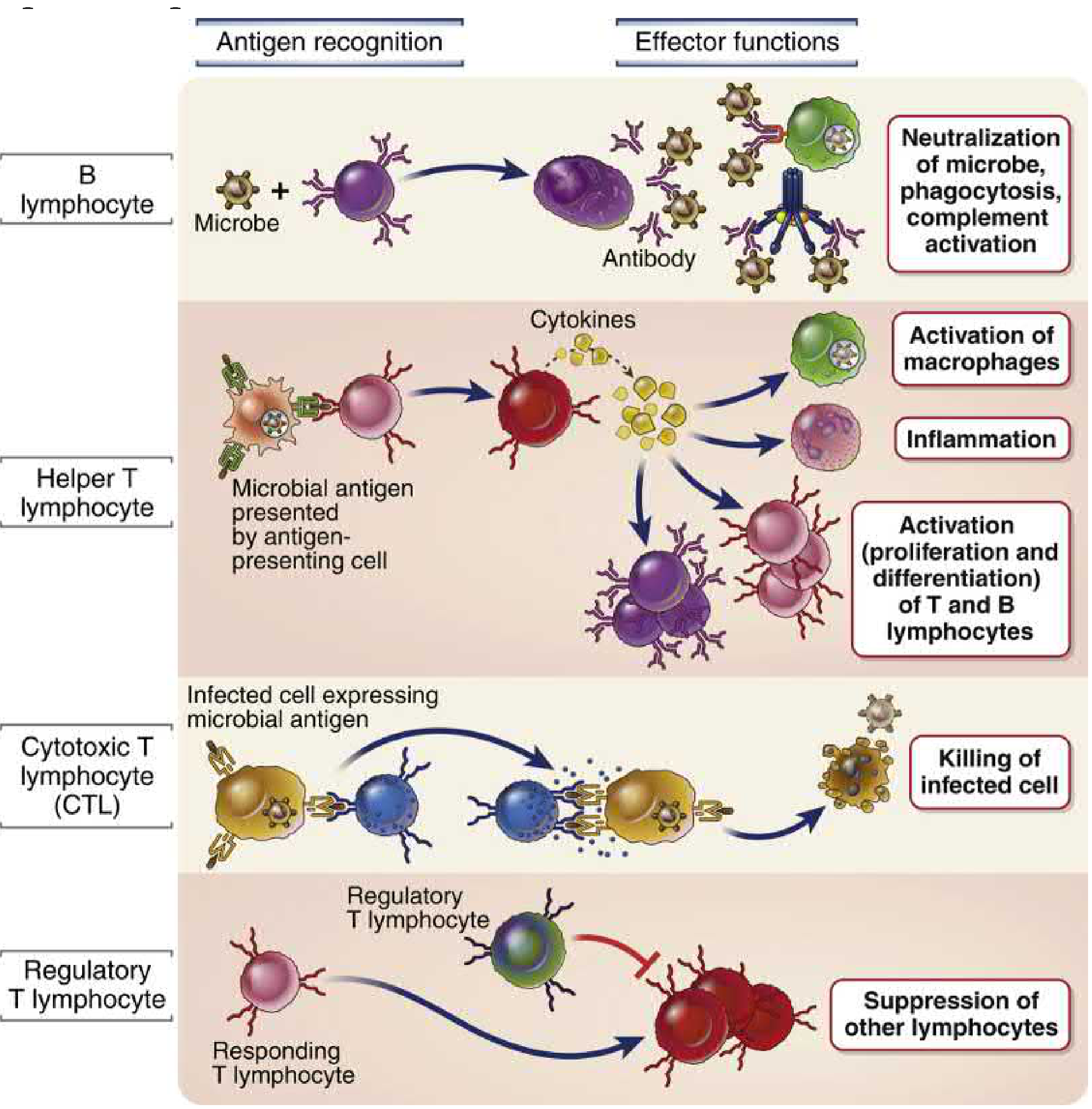
- CD4⁺ T helper cells — recognize antigen on MHC class II; help B cells and activate macrophages
- CD8⁺ Cytotoxic T cells — recognize antigen on MHC class I; kill infected/tumor cells
- Regulatory T cells (Tregs) — suppress immune responses; maintain self-tolerance
2. B Lymphocytes
- Develop and mature in the bone marrow
- Express surface immunoglobulin (B cell receptor, BCR)
- On activation, differentiate into plasma cells (secrete antibodies) and memory B cells
- Responsible for humoral immunity
3. Natural Killer (NK) Cells
- Neither T nor B cells — innate lymphoid cells
- Kill virus-infected cells and tumor cells without prior sensitization
- Activated by absence of self-MHC class I (missing-self recognition)
- Express CD16 (FcγRIII) → mediate antibody-dependent cellular cytotoxicity (ADCC)
4. Key Surface Markers Summary
| Marker | Cell | Function |
|---|---|---|
| CD3 | T cells | TCR signaling complex |
| CD4 | T helper cells, monocytes | MHC class II receptor |
| CD8 | Cytotoxic T cells | MHC class I receptor |
| CD19/CD21 | B cells | B cell receptor complex |
| CD16/CD56 | NK cells | Cytotoxicity, ADCC |
| CD14 | Monocytes/macrophages | LPS receptor |
| CD80/CD86 (B7) | DCs, macrophages, B cells | T cell co-stimulation |
C. Lymphoid Organs
| Type | Organs | Function |
|---|---|---|
| Primary (central) | Thymus, Bone marrow | Site of lymphocyte development and maturation |
| Secondary (peripheral) | Lymph nodes, Spleen, MALT (tonsils, Peyer's patches) | Site of adaptive immune responses; antigen presentation to lymphocytes |
Summary Diagram
Sources:
- Cellular and Molecular Immunology, Abbas & Lichtman (9780323757485)
- Histology: A Text and Atlas with Correlated Cell and Molecular Biology (9781975181512)
- Medical Microbiology, 9e (9780323673228)
- Murray & Nadel's Textbook of Respiratory Medicine (9780323655873)
This is a shared conversation. Sign in to Orris to start your own chat.