
Cori cycle
The Cori cycle (also called the glucose-alanine or lactic acid cycle) is a metabolic pathway where lactate produced by anaerobic glycolysis in muscles is shuttled to the liver, converted back to glucose via gluconeogenesis, and returned to muscles for energy.
Searching sources...
Reading File
Finding Sources
Finding Sources
Reading File
Reading File
Reading File
Loading Image
Reading File
Reading File
Loading Image
Reading File
Here is a thorough breakdown of the Cori cycle from multiple authoritative biochemistry and physiology textbooks.
The Cori Cycle
Definition
The Cori cycle (also called the lactic acid cycle) is an inter-organ metabolic pathway that links anaerobic glycolysis in peripheral tissues to hepatic gluconeogenesis. Glucose produced by the liver is consumed by muscle and red blood cells (RBCs), generating lactate, which travels back to the liver to be reconverted into glucose. - Basic Medical Biochemistry, 6e, p. 805
Core Mechanism (Step by Step)
In peripheral tissues (skeletal muscle, RBCs, skin, brain, renal medulla):
- Glucose enters anaerobic glycolysis.
- Glycolysis produces 2 pyruvate + 2 ATP + 2 NADH.
- Because these cells lack mitochondria (RBCs) or have insufficient oxygen supply (exercising muscle), pyruvate cannot enter the TCA cycle.
- Pyruvate is reduced to lactate by lactate dehydrogenase (LDH), regenerating NAD+ to sustain glycolysis.
- Lactate exits into the bloodstream.
In the liver:
- Lactate is taken up and oxidized back to pyruvate by LDH.
- Pyruvate undergoes gluconeogenesis (consuming 6 ATP equivalents) to form glucose.
- Glucose is released back into the blood for uptake by peripheral tissues.
This completes the cycle.
The Diagram
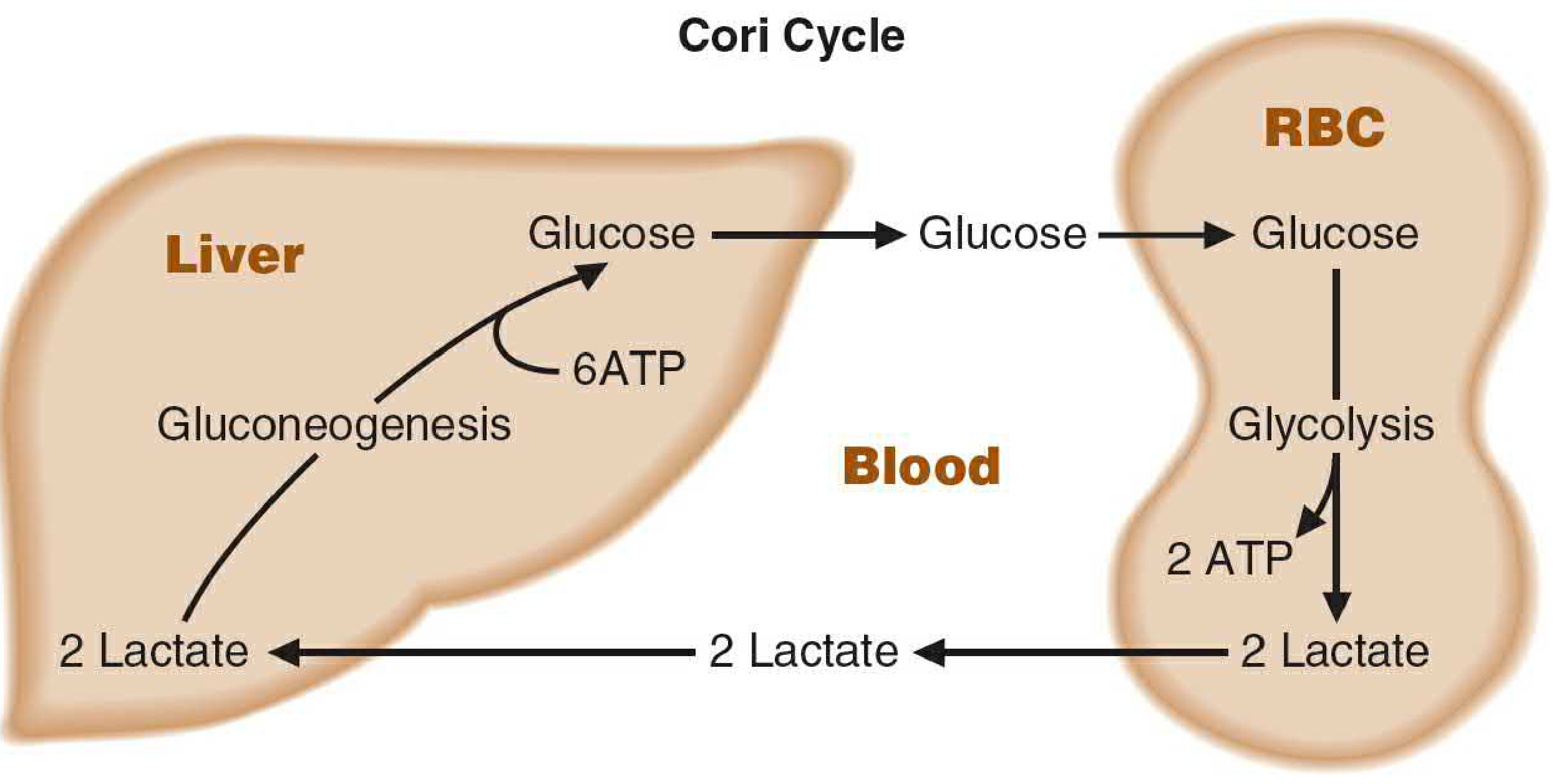
ATP Economics
| Location | Net ATP |
|---|---|
| Muscle/RBC (glycolysis) | +2 ATP per glucose |
| Liver (gluconeogenesis) | -6 ATP per glucose |
| Net | -4 ATP (liver subsidizes peripheral tissues) |
The cycle is energetically costly for the liver but critically important: it allows tissues incapable of oxidative phosphorylation to keep generating ATP while simultaneously preventing dangerous lactate accumulation. - Lippincott Biochemistry, 8e, p. 355-356
Sites of Lactate Production (Resting 70-kg Man)
| Tissue | Daily Lactate (g/day) |
|---|---|
| Total | 115 |
| Red blood cells | 29 |
| Skin | 20 |
| Brain | 17 |
| Skeletal muscle | 16 |
| Renal medulla | 15 |
| Intestinal mucosa | 8 |
| Other | 10 |
- Basic Medical Biochemistry, 6e, p. 804
Physiological Contexts
- Exercise: Exercising muscle mass generates large quantities of lactate when oxygen delivery is outpaced by energy demand. The Cori cycle allows the liver to recycle this lactate into glucose, sustaining prolonged muscular activity.
- Fasting: During the first several hours of a fast, the brain consumes glucose at ~4-5 g/hr. Obligate anaerobic tissues convert glucose to lactate, and the liver completes the Cori cycle to regenerate glucose continuously. - Medical Physiology (Boron & Boulpaep), p. 1392-1394
- Shock/Seizures/Burns: Under these high-stress states, skeletal muscle and wound tissues generate large lactate loads. The liver's efficiency at clearing lactate via the Cori cycle is proportional to liver function. Patients with cirrhosis do not have elevated baseline lactate but show impaired clearance under a lactate load. - Mulholland & Greenfield's Surgery, 7e, p. 77-78
- Renal contribution: The kidneys also metabolize and excrete lactate, accounting for 20-30% of clearance. Significant renal dysfunction impairs lactate clearance.
The Glucose-Alanine Cycle (Related Cycle)
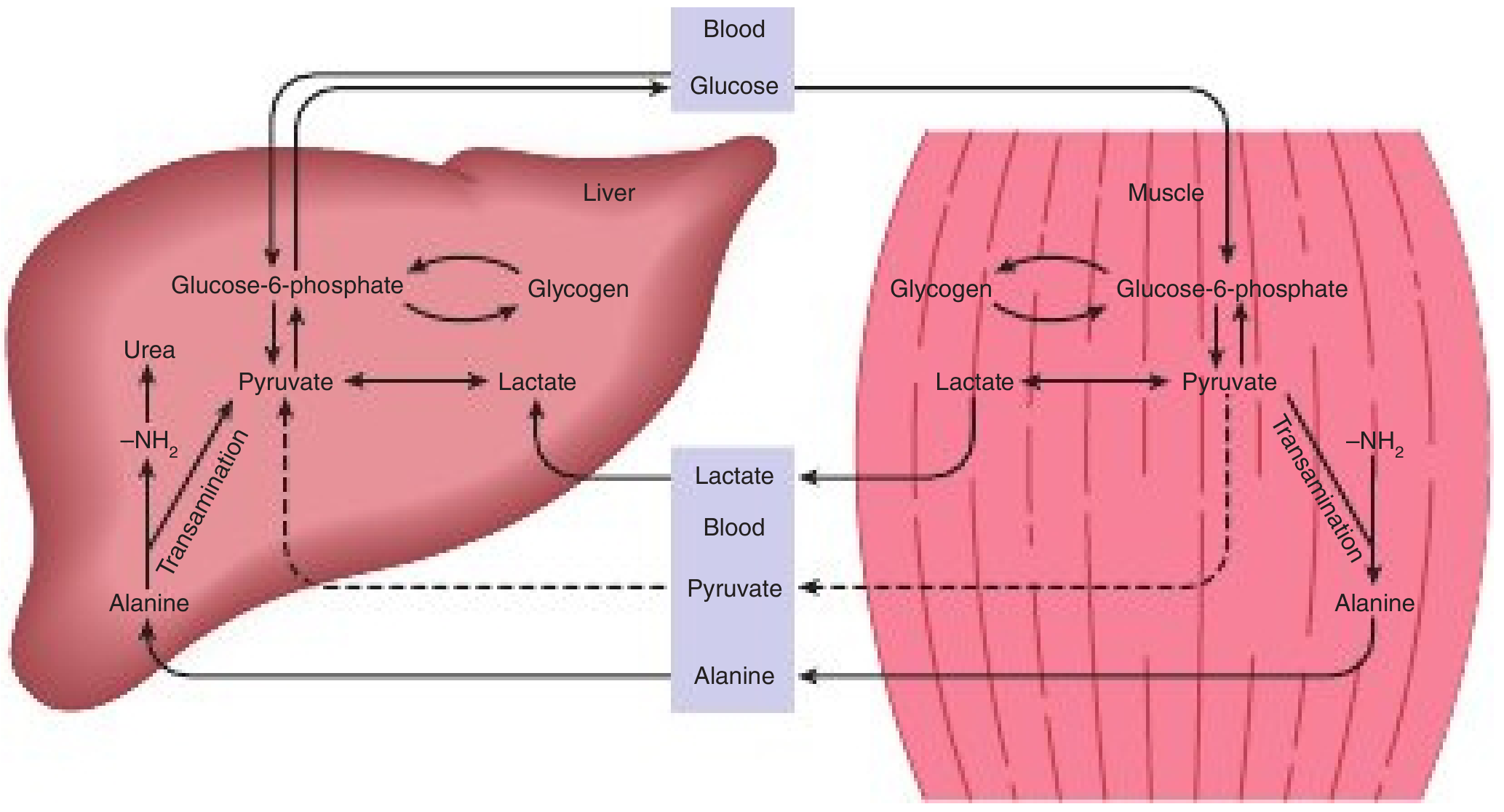
A closely related pathway involves alanine as the nitrogen-carrying shuttle instead of lactate.
In the glucose-alanine cycle:
- Muscle pyruvate accepts an amino group via transamination to form alanine.
- Alanine is transported to the liver, where it is deaminated back to pyruvate.
- The amino group enters the urea cycle; the carbon skeleton of pyruvate goes to gluconeogenesis.
- This serves a dual function: glucose recycling + nitrogen disposal from muscle protein breakdown.
- Alanine is a major carrier of ammonia from skeletal muscle to the liver. - Harper's Illustrated Biochemistry, 32e
Clinical Relevance
| Condition | Relevance |
|---|---|
| Lactic acidosis | Failure of the Cori cycle (e.g., liver failure, severe hypoxia, metformin toxicity) leads to lactate accumulation |
| Cirrhosis | Impaired lactate clearance capacity even though basal lactate may be normal |
| Renal failure | Reduced contribution to lactate clearance |
| Tumors (Warburg effect) | Many tumors preferentially use aerobic glycolysis with lactate production, mimicking the peripheral side of the Cori cycle |
| Fasting/starvation | Cori cycle is a major glucose-sparing mechanism, protecting the brain |
Key Enzymes
| Step | Enzyme |
|---|---|
| Glucose → Pyruvate | Glycolytic enzymes (e.g., hexokinase, PFK-1, pyruvate kinase) |
| Pyruvate → Lactate | Lactate dehydrogenase (LDH) - in muscle/RBC |
| Lactate → Pyruvate | Lactate dehydrogenase (LDH) - in liver |
| Pyruvate → OAA | Pyruvate carboxylase (bypasses irreversible step) |
| OAA → PEP | PEPCK |
| Fructose-1,6-bisphosphate → F6P | FBPase-1 |
| G6P → Glucose | Glucose-6-phosphatase (liver-specific; absent in muscle) |
The absence of glucose-6-phosphatase in muscle is why muscle cannot release free glucose into the blood - only the liver can complete the cycle. - Lippincott Biochemistry, 8e, p. 356
This is a shared conversation. Sign in to Orris to start your own chat.