
properties and overview of immune responses
Reading File
Now let me search the medical library for immune responses content in parallel:
Finding Sources
Finding Sources
Finding Sources
Finding Sources
Excellent results. Let me read the most authoritative sources in parallel - Cellular and Molecular Immunology and Harrison's:
Reading File
Reading File
Reading File
Good start. Now let me get the key properties of immune responses from Cellular and Molecular Immunology (the most dedicated immunology textbook) - reading more content:
Reading File
Finding Sources
Reading File
Finding Sources
Reading File
Reading File
I now have rich content from the textbooks. Let me also fetch the key diagram from Cellular and Molecular Immunology:
Loading Image
Reading File
I now have comprehensive content from authoritative textbooks. Let me compile the full, detailed response:
Properties and Overview of Immune Responses
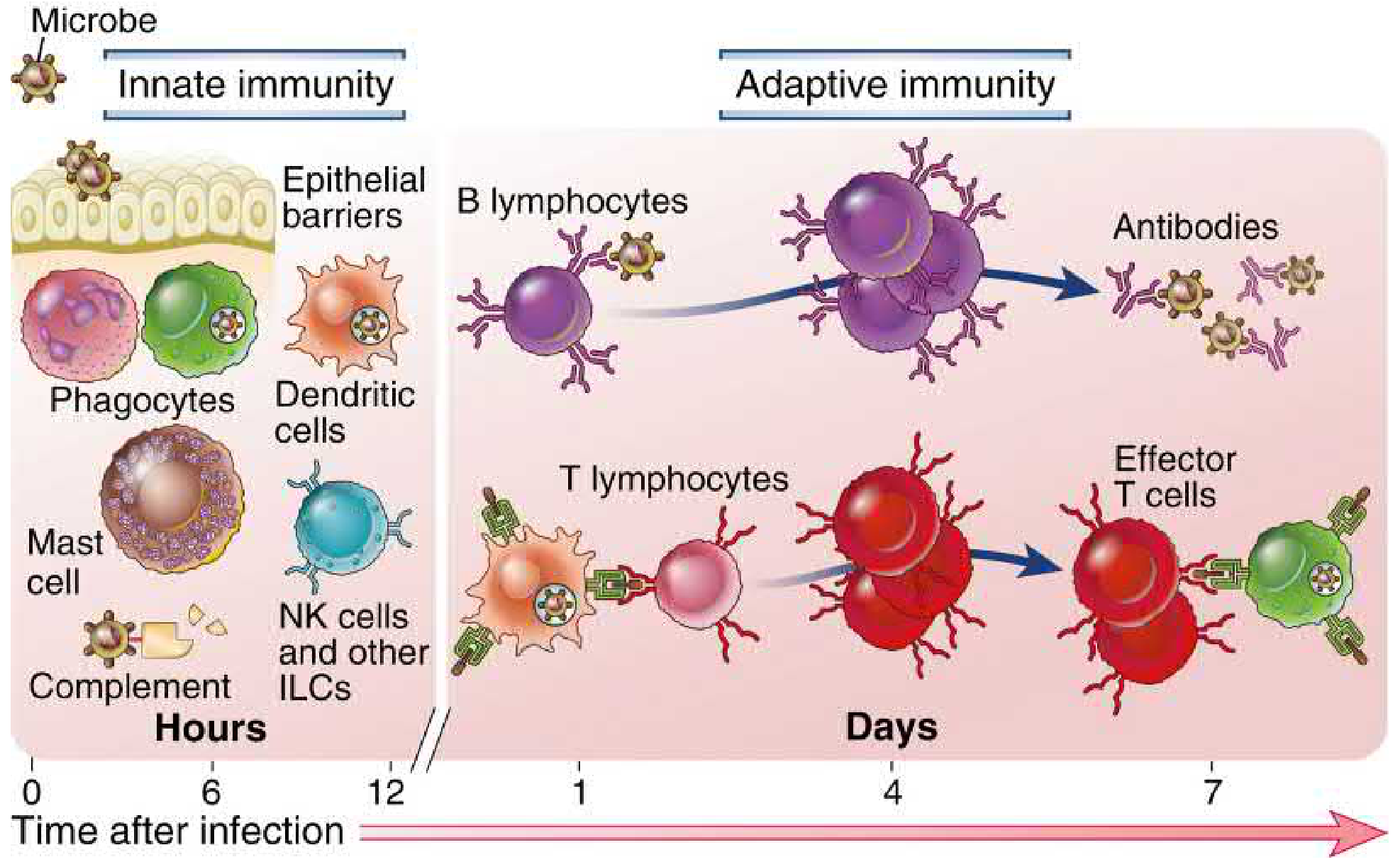
Figure: Innate immunity acts within hours; adaptive immunity develops over days. - Cellular and Molecular Immunology
1. The Two Arms of Immunity
Defense against microbes is mediated by two sequential, coordinated systems: innate immunity and adaptive immunity.
Innate Immunity (Natural / Native Immunity)
Innate immunity is essential in the first hours to days after infection, before adaptive responses have developed. It responds almost immediately and the same way each time - repeated exposures induce virtually identical responses.
Components:
- Physical/chemical barriers: skin, mucosal epithelia, antimicrobial molecules
- Phagocytic cells: neutrophils, macrophages
- Dendritic cells (DCs) - act as tissue sentinels
- Natural killer (NK) cells and other innate lymphoid cells (ILCs)
- Mast cells
- Blood proteins: complement system, lectins
Key strategies:
- Inflammation - recruiting phagocytes to destroy microbes
- Blocking viral replication or killing virus-infected cells (non-inflammatory mechanisms)
Characteristics:
| Feature | Innate |
|---|---|
| Specificity | For shared molecular patterns on groups of related microbes |
| Diversity | Low - recognition molecules are germline-encoded |
| Memory | Limited |
| Non-reactivity to self | Yes |
- Cellular and Molecular Immunology, p. 30-31
Adaptive Immunity (Specific / Acquired Immunity)
Adaptive immunity is stimulated by exposure to infectious agents and increases in magnitude and capability with each successive exposure. It is mediated by lymphocytes (B and T cells) and their products.
Key contrast with innate: Adaptive immunity recognizes and reacts to a vast number of microbial AND nonmicrobial substances called antigens.
Characteristics:
| Feature | Adaptive |
|---|---|
| Specificity | For many different microbial and nonmicrobial antigens |
| Diversity | Very high - receptors generated by somatic recombination of gene segments |
| Memory | Yes (robust immunological memory) |
| Non-reactivity to self | Yes |
- Cellular and Molecular Immunology, p. 31
2. Cardinal Properties of Adaptive Immune Responses
These are the fundamental defining properties, described in Cellular and Molecular Immunology:
A. Specificity and Diversity
- Immune responses are specific for distinct antigens, and even for different portions (epitopes/determinants) of a single complex molecule.
- Individual lymphocytes express membrane receptors that distinguish subtle structural differences between distinct epitopes.
- Clones of lymphocytes with different specificities exist before antigen exposure - this is clonal selection (Macfarlane Burnet, 1957).
- When an antigen enters the body, it binds to and activates preexisting antigen-specific clones.
- The total diversity of an individual's lymphocyte repertoire allows discrimination of 10^7 to 10^9 distinct antigenic determinants.
B. Memory
- Each exposure to antigen generates long-lived memory cells specific for that antigen.
- Secondary immune responses are:
- More rapid
- Greater in magnitude
- Often qualitatively different from the primary response
- Why secondary responses are stronger: memory cells are more numerous than the naive lymphocytes that existed at initial exposure, and they react more rapidly and vigorously.
- Memory allows the immune system to combat microbes encountered repeatedly in the environment.
C. Clonal Expansion
- Antigen recognition activates lymphocytes, causing them to proliferate - increasing the size of the antigen-specific clone.
- Activated lymphocytes then differentiate into:
- Effector cells - perform the immediate defensive functions
- Memory cells - survive long-term and respond vigorously on re-exposure
D. Contraction (Homeostasis)
- After the infection is eradicated, stimuli for lymphocyte activation dissipate.
- Most effector cells die by apoptosis.
- The response contracts, restoring homeostasis.
- Memory cells persist, ready to respond if the infection recurs.
E. Non-reactivity to Self (Self-tolerance)
-
Both innate and adaptive immunity do not react against self tissues under normal conditions.
-
Breakdown of self-tolerance leads to autoimmune disease.
-
Cellular and Molecular Immunology, pp. 33-35
3. Two Types of Adaptive Immunity
Humoral Immunity (B-cell Immunity)
-
Mediated by B lymphocytes and their secreted products, antibodies (immunoglobulins).
-
B cells recognize antigens, proliferate, and differentiate into plasma cells that secrete antibodies.
-
Protein antigens require CD4+ helper T cell activation (T-dependent); many nonprotein antigens (polysaccharides, lipids) can activate B cells without T cell help (T-independent).
-
Different immunoglobulin classes have distinct roles:
- IgM: produced first (within ~6 days of infection); activated by polysaccharides/lipids
- IgG: coats microbes for phagocytosis (opsonization); activates complement; crosses the placenta to protect the newborn; half-life ~3 weeks
- IgA: secreted at mucosal epithelia; neutralizes microbes in respiratory and GI tracts
- IgE: involved in allergy and antiparasitic defense
-
Key protective mechanisms of antibodies:
- Neutralization (blocking microbial entry into cells) - the only adaptive mechanism that stops infection before it is established, which is why vaccines target neutralizing antibodies
- Opsonization - coating microbes for phagocytosis by neutrophils/macrophages
- Complement activation (IgG and IgM)
- Mucosal protection (IgA)
- Maternal passive immunity (IgG across placenta)
-
Some long-lived plasma cells reside in bone marrow or mucosal tissues for years, continuously secreting low levels of antibodies.
-
Affinity maturation: helper T cells stimulate production of antibodies with increasing affinity - this improves the quality of the humoral immune response over time.
-
Cellular and Molecular Immunology, pp. 48-49; Guyton and Hall Textbook of Medical Physiology, p. 461
Cell-Mediated Immunity (T-cell Immunity)
-
Mediated by T lymphocytes - they do not produce antibody.
-
T cells recognize peptide fragments of foreign proteins bound to MHC (major histocompatibility complex) molecules on cell surfaces - so they respond to cell-associated, not soluble, antigens.
-
Major T cell populations:
- CD4+ Helper T cells: secrete cytokines and express membrane molecules that activate other cells (macrophages, B cells) to kill microbes; also drive humoral responses
- CD8+ Cytotoxic T lymphocytes (CTLs): directly kill infected host cells; major drivers of long-term immunity (e.g., after viral infections)
- Regulatory T cells: inhibit immune responses, maintaining tolerance and limiting immunopathology
-
After activation, naive T lymphocytes differentiate into effector cells that migrate to sites of infection.
-
Cellular and Molecular Immunology, pp. 49-50
4. Antigen-Presenting Cells (APCs) and Initiation of Adaptive Responses
- Adaptive responses are initiated when antigens are captured, processed, and displayed to specific lymphocytes.
- The most specialized APCs are dendritic cells (DCs), which:
- Capture microbial antigens entering from the external environment
- Transport them to lymphoid organs
- Present them to naive T lymphocytes to initiate immune responses
- Other APCs operate at different stages of the response.
5. Cytokines - The Communication Network
-
Cells of the immune system interact via secreted proteins called cytokines.
-
Cytokines regulate and coordinate activities of both innate and adaptive immunity.
-
Functions of cytokines include:
- Promoting growth and differentiation of immune cells
- Activating effector functions of lymphocytes and phagocytes
- Stimulating directed migration of immune cells (chemokines - a structurally related subfamily)
-
Cytokines are involved in immunological diseases and are key drug targets (e.g., TNF-α inhibitors in rheumatoid arthritis and inflammatory disease).
-
Cellular and Molecular Immunology, pp. 47-48
6. Connections Between Innate and Adaptive Immunity
-
Innate and adaptive responses are not isolated - they reinforce each other:
- Innate → Adaptive: Innate immune responses provide early "danger signals" that stimulate and shape adaptive responses (e.g., DCs activated by innate receptors present antigen to T cells)
- Adaptive → Innate: Adaptive responses enhance innate protective mechanisms - e.g., antibodies opsonize microbes for phagocytes; T cell-derived cytokines activate macrophages
-
Many pathogens have evolved to resist innate immunity, but the stronger, more specialized adaptive response can eradicate these infections.
-
Cellular and Molecular Immunology, p. 31
Summary Table: Innate vs. Adaptive Immunity
| Feature | Innate | Adaptive |
|---|---|---|
| Timing | Hours (0-12 h) | Days (1-7+ days) |
| Specificity | Broad (shared microbial patterns) | Highly specific (individual epitopes) |
| Receptor diversity | Low (germline-encoded) | Very high (somatic recombination) |
| Memory | Minimal | Yes (primary vs. secondary response) |
| Key cells | Phagocytes, DCs, NK cells, mast cells, ILCs | B lymphocytes, T lymphocytes |
| Soluble mediators | Complement, acute phase proteins, interferons | Antibodies, cytokines |
| Self-tolerance | Yes | Yes |
| Response to repeated exposure | Unchanged | Stronger, faster (immunological memory) |
Sources:
- Cellular and Molecular Immunology (Abbas, Lichtman, Pillai), pp. 30-50 - primary reference for this overview
- Guyton and Hall Textbook of Medical Physiology, p. 461
This is a shared conversation. Sign in to Orris to start your own chat.