
Ecg
Reading File
The query "ECG" is broad - it could mean many things. Let me clarify what you need.
Asking for Preferences
What specifically about ECG are you looking for?
Asking for Preferences
Which condition?
Finding Sources
Finding Sources
Finding Sources
Finding Sources
Reading File
Reading File
Reading File
Finding Sources
Now let me fetch the key ECG images from Harrison's:
Loading Image
Loading Image
Loading Image
Here is a comprehensive guide to ECG changes in Myocardial Infarction (STEMI/NSTEMI), drawn from Harrison's Principles of Internal Medicine (22nd ed.) and Goldman-Cecil Medicine.
ECG Changes in Myocardial Infarction
The Underlying Mechanism
Acute ischemia causes a current of injury - a voltage gradient between normal and ischemic myocardial zones that manifests as ST-segment deviation on the surface ECG.
Diagram - Current of Injury:
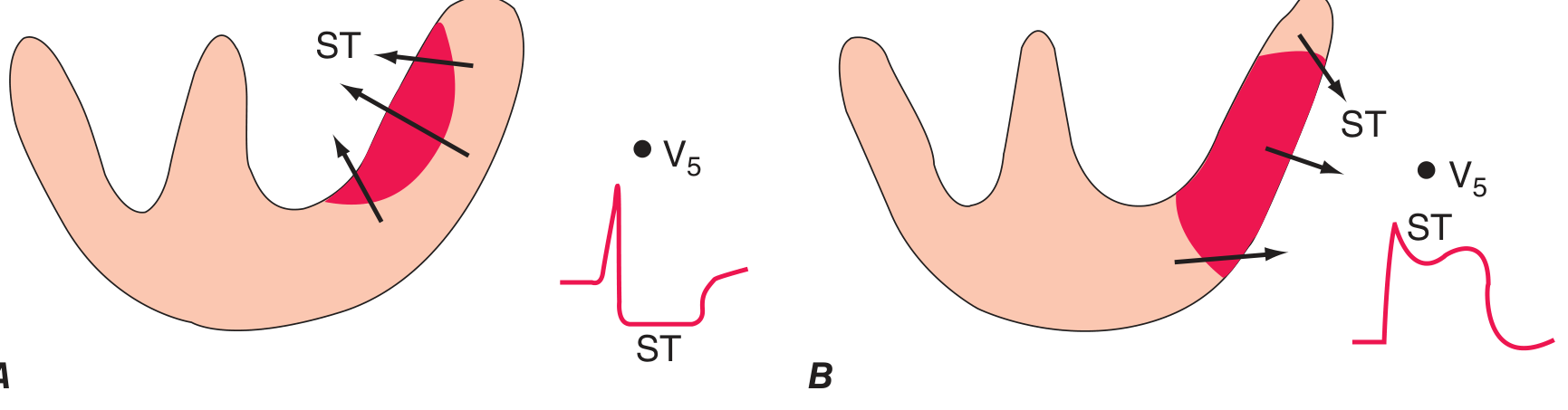
- A (Subendocardial ischemia): ST vector directed inward → overlying leads show ST depression
- B (Transmural/epicardial ischemia): ST vector directed outward → overlying leads show ST elevation
STEMI - ECG Sequence of Changes
The ECG evolves in a predictable sequence:
| Time | ECG Finding |
|---|---|
| Minutes (earliest) | Hyperacute T waves - tall, broad, peaked T waves |
| Hours | ST elevation in leads overlying the infarcted zone |
| Hours - Days | T-wave inversions develop in same leads |
| Hours - Days | Q waves form (indicates transmural necrosis) |
| Weeks - months | ST returns to baseline; Q waves may persist permanently |
Lead Localization of Infarct Territory
| Leads with ST elevation | Territory | Artery |
|---|---|---|
| V1-V4 | Anterior/septal | LAD |
| V4-V6, I, aVL | Lateral | LCx or diagonal |
| II, III, aVF | Inferior | RCA (or LCx) |
| V1-V3 (ST depression = reciprocal) | Posterior | RCA or LCx |
| Right-sided leads (V3R-V4R) | Right ventricle | Proximal RCA |
ECG Sequence - Anterior STEMI (top row = acute, bottom row = evolving):
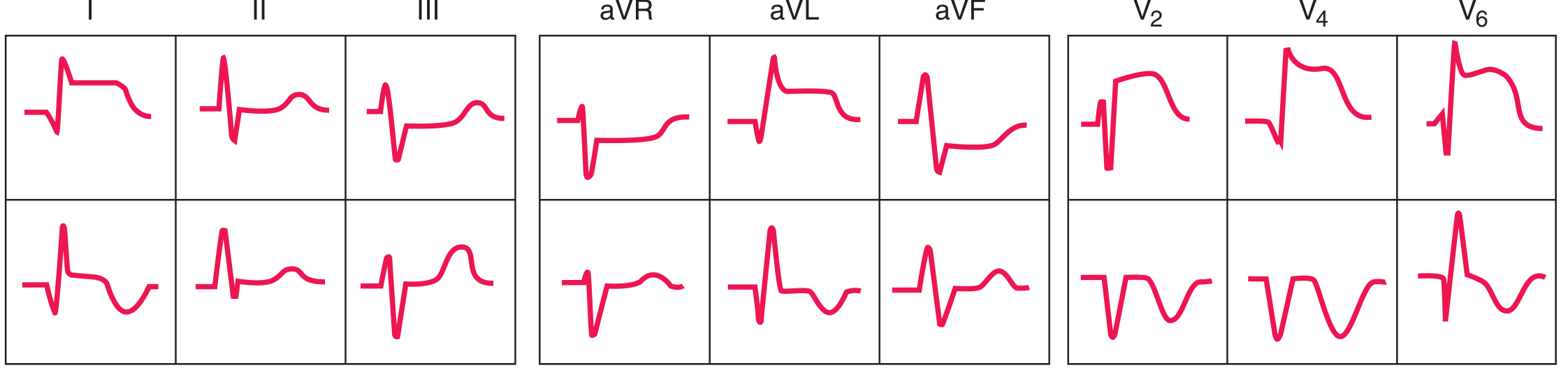
Acute anterior STEMI shows ST elevation in leads I, aVL, V2, V4, V6 with reciprocal ST depression in leads II, III, aVF. In the evolving phase, deep Q waves and T-wave inversions develop in the precordial leads.
ECG Sequence - Inferior STEMI (top row = acute, bottom row = evolving):
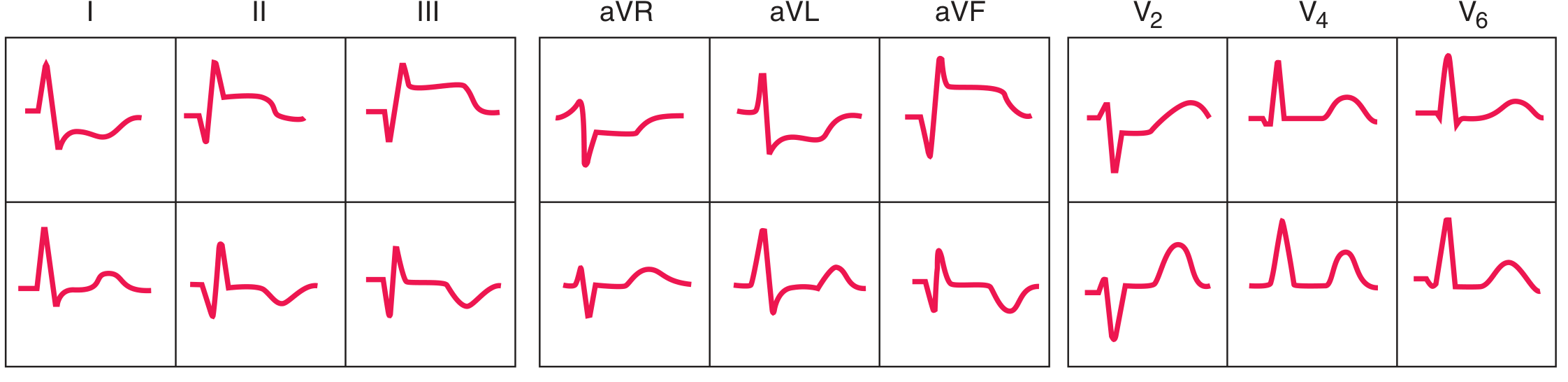
Acute inferior STEMI shows ST elevation in II, III, aVF with reciprocal ST depression in the precordial leads (V1-V6).
Reciprocal Changes
Reciprocal ST depression in leads opposite the infarct zone is an important clue:
- Anterior STEMI → reciprocal ST depression in II, III, aVF
- Inferior STEMI → reciprocal ST depression in V1-V6
- Posterior MI → ST depression in V1-V3 is itself the "equivalent" of ST elevation (no direct overlying leads)
NSTEMI / Non-ST Elevation ACS
- ECG shows ST depression and/or T-wave inversions (no ST elevation)
- Indicates subendocardial ischemia with incomplete coronary occlusion
- A minority of NSTEMI patients eventually develop Q waves ("non-Q-wave MI")
- ST depression in multiple leads with ST elevation only in aVR suggests left main or proximal LAD occlusion
Q Waves
- Pathological Q waves develop when transmural necrosis destroys depolarization forces
- Indicate established (old) MI if seen without acute ST changes
- Loss of posterior/lateral forces may show as reciprocal tall R waves in V1-V2 (posterior MI)
- Important: Q waves can also occur in non-MI conditions - LVH, LBBB, hypertrophic cardiomyopathy, WPW
Key Differential Diagnoses for ST Elevation
Other causes of ST elevation that must be distinguished from STEMI:
- Acute pericarditis (diffuse ST elevation, saddle-shaped, ST elevation in all leads except aVR)
- Left bundle branch block (LBBB)
- Left ventricular hypertrophy
- Brugada pattern (V1-V3)
- Takotsubo syndrome
- Early repolarization (benign variant)
- Acute pulmonary embolism
- Hyperkalemia / hypercalcemia
Key clinical pearl: STEMI is defined by ST elevation in 2 or more contiguous leads (≥2 mm in V1-V3, ≥1 mm elsewhere) and requires emergency reperfusion (primary PCI or thrombolytics) - the ECG is the gating criterion for this decision.
Sources: Harrison's Principles of Internal Medicine, 22nd ed., Ch. 247; Goldman-Cecil Medicine, Ch. 56
Ecg diagram explain with different cases on ECG paper
Finding Sources
Finding Sources
Finding Sources
Finding Sources
Finding Sources
Finding Sources
Reading File
Reading File
Good - I have the ECG waveform diagram URL. Now let me fetch that image and also get images for various ECG cases from the textbooks.
Loading Image
Loading Image
Finding Sources
Reading File
Finding Sources
Loading Image
Reading File
Loading Image
Loading Image
Reading File
Finding Sources
Loading Image
Finding Sources
Now I have all the material needed. Let me compile the full comprehensive guide.Here is a complete, illustrated ECG guide with multiple clinical cases shown on ECG paper diagrams.
ECG: Waveforms & Clinical Cases on ECG Paper
The Cardiac Conduction System (Foundation)
Before reading any ECG, understand what generates each wave:
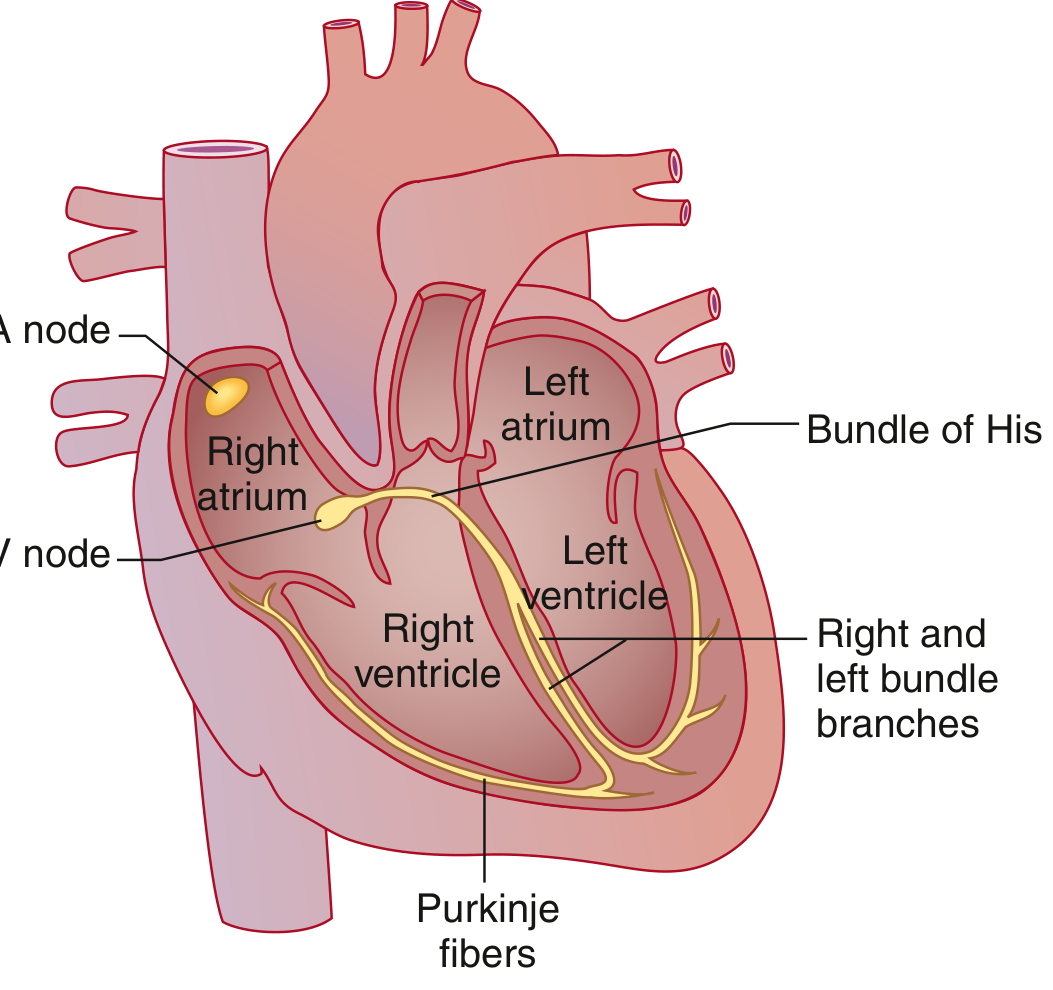
Pathway: SA node → Atria → AV node (delay) → Bundle of His → Left/Right bundle branches → Purkinje fibers → Ventricular muscle
The Normal ECG Waveform - ECG Paper Explained
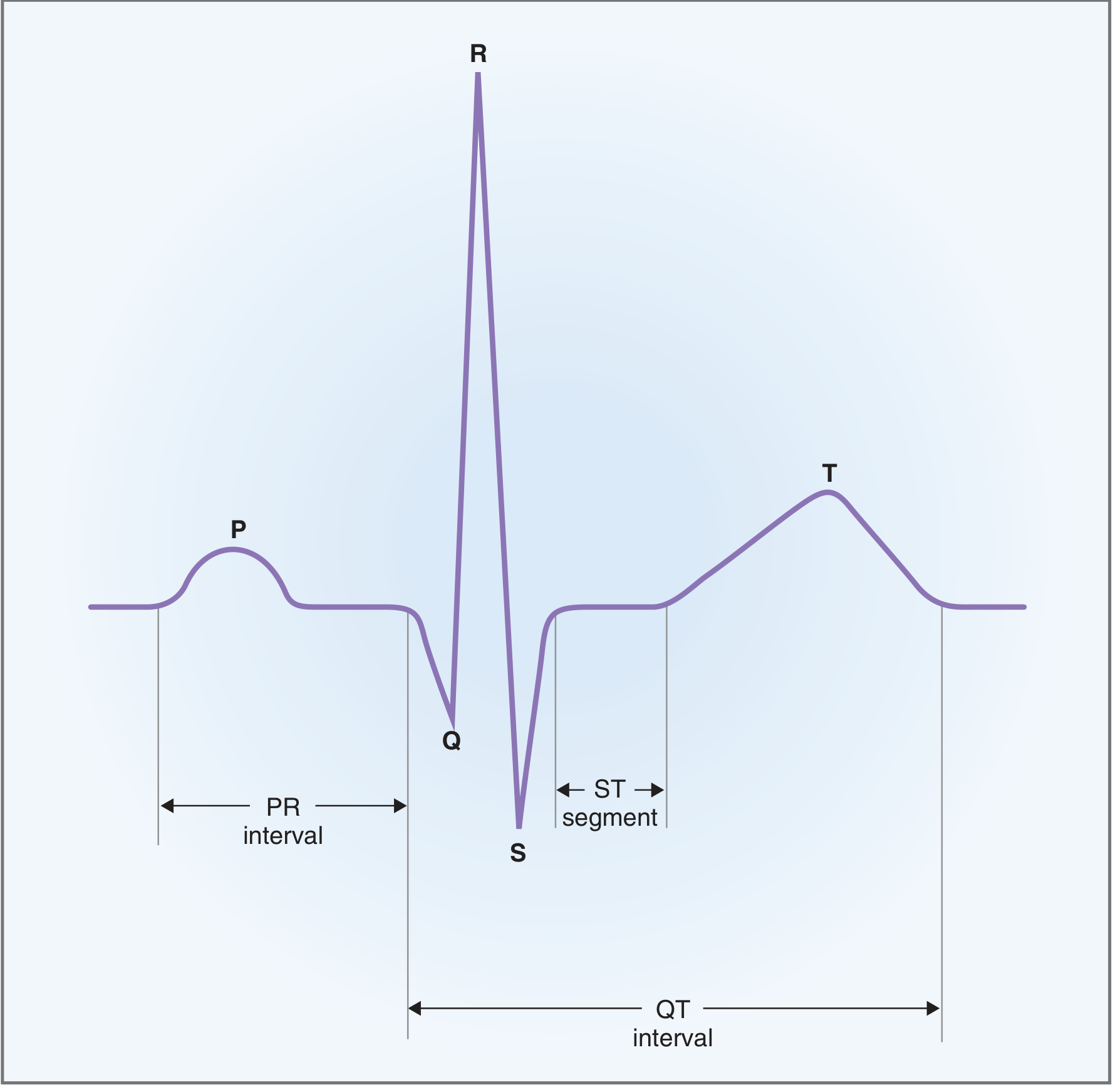
ECG Paper Grid
- Small box = 1 mm = 0.04 sec (horizontal) / 0.1 mV (vertical)
- Large box = 5 mm = 0.20 sec (horizontal) / 0.5 mV (vertical)
- Standard paper speed = 25 mm/sec
Every Waveform Explained
| Component | What it Represents | Normal Value |
|---|---|---|
| P wave | Atrial depolarization (SA node fires → atria contract) | Duration < 0.12 sec, amplitude < 2.5 mm |
| PR interval | Time from atrial to ventricular depolarization (AV node delay) | 0.12 - 0.20 sec (3-5 small boxes) |
| QRS complex | Ventricular depolarization (ventricles contract) | Duration < 0.12 sec (< 3 small boxes) |
| ST segment | Period between ventricular depolarization and repolarization | Isoelectric (flat at baseline) |
| T wave | Ventricular repolarization | Upright in most leads |
| QT interval | Total ventricular electrical activity (depolarization + repolarization) | < 0.44 sec (corrected) |
Memory rule: Every P is followed by a QRS. P = atria. QRS = ventricles. T = recovery.
CASE 1 - Normal Sinus Rhythm
What to look for:
- Regular P waves, all identical in shape
- Every P followed by a QRS
- PR interval constant (0.12-0.20 sec)
- QRS narrow (< 0.12 sec)
- Rate: 60-100 bpm
Rate calculation on ECG paper:
- Count large boxes between two R waves → divide 300 by that number
- (e.g., 4 large boxes between R waves = 300/4 = 75 bpm)
CASE 2 - Acute Anterior Wall Myocardial Infarction (STEMI)
ECG on paper - Leads I, II, III and chest lead V2:
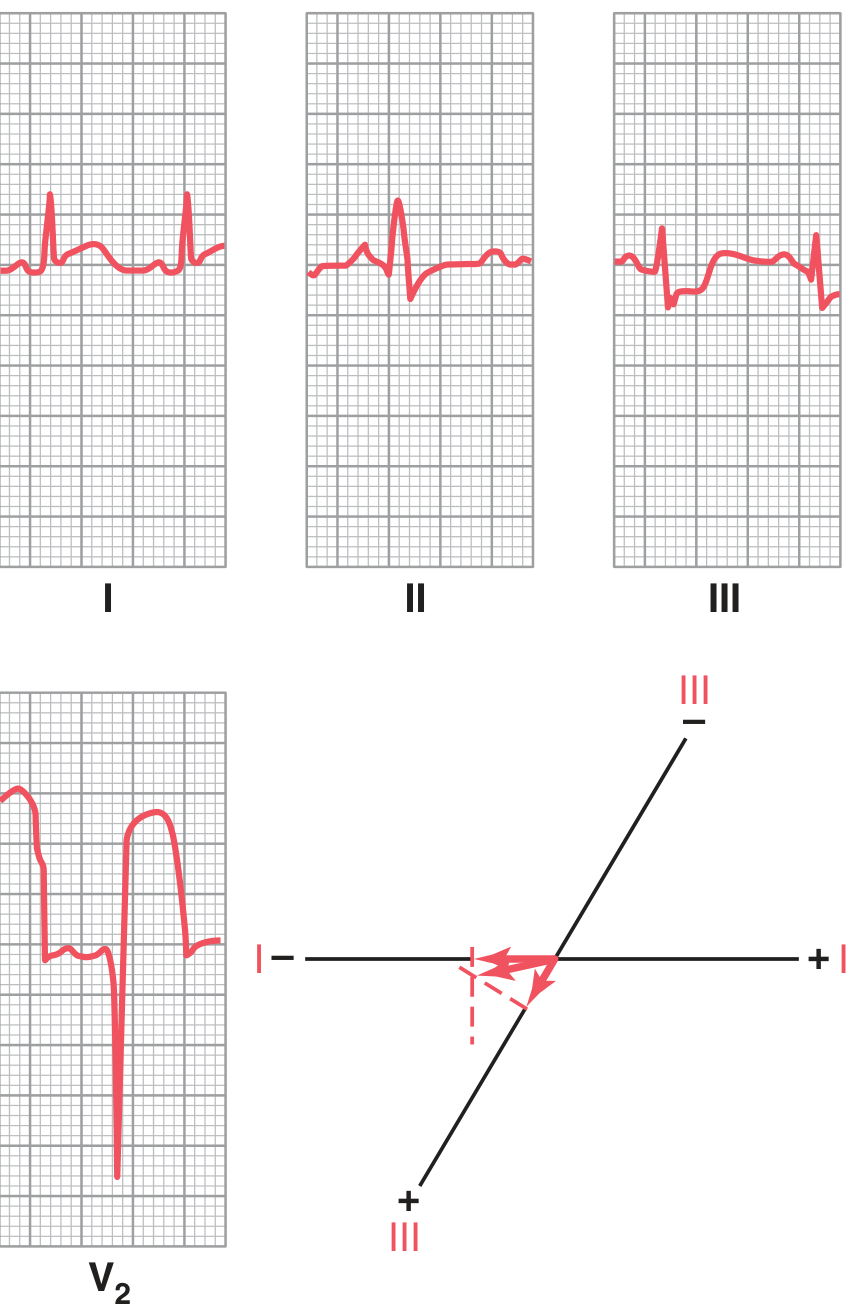
What you see:
- Lead V2 (chest lead): Massive ST elevation - the baseline during the T-P segment is shifted positively upward, representing the current of injury from the anterior wall
- The negative end of the injury vector points toward the anterior chest wall → confirms anterior wall infarction
- Leads I, II, III show varying degrees of ST change depending on lead orientation
Leads affected in Anterior MI:
- ST elevation in V1-V4 (anterior precordial leads)
- Reciprocal ST depression in II, III, aVF
- Caused by: LAD (left anterior descending artery) occlusion
CASE 3 - Acute Posterior/Apical Wall Myocardial Infarction
ECG on paper - Leads I, II, III and V2:
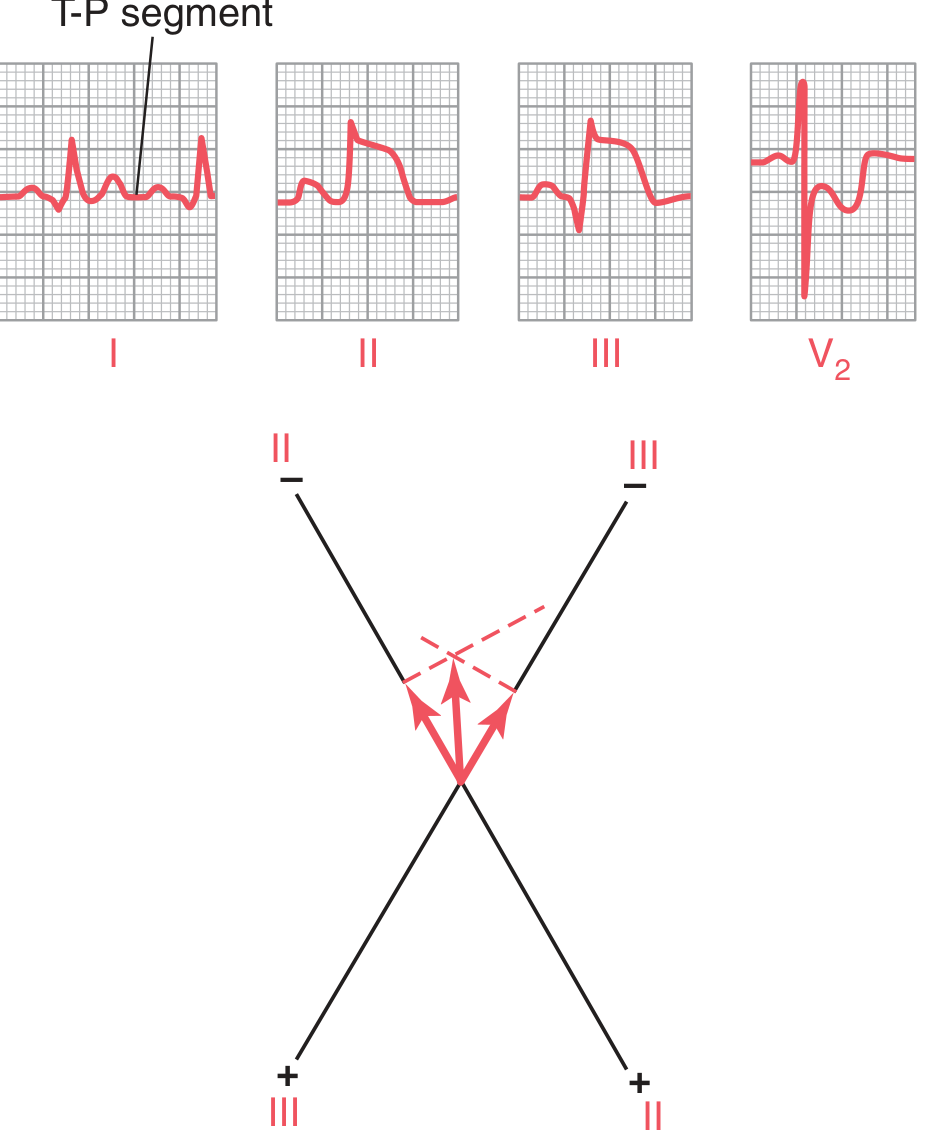
What you see:
- Leads II and III: negative injury potentials in both → vector points at -95° (upward/posterior)
- Lead V2: ST depression (the anterior leads show reciprocal changes because infarct is BEHIND the heart)
- Broad, tall R waves develop in V1-V2 as the posterior depolarization forces are lost
Key rule: Posterior MI has NO direct leads. You diagnose it by seeing:
- ST depression + tall R in V1-V2-V3 = "mirror image" of posterior STEMI
CASE 4 - ECG Evolution After MI (Time Progression)
Single lead (V3) showing how the ECG changes over time:
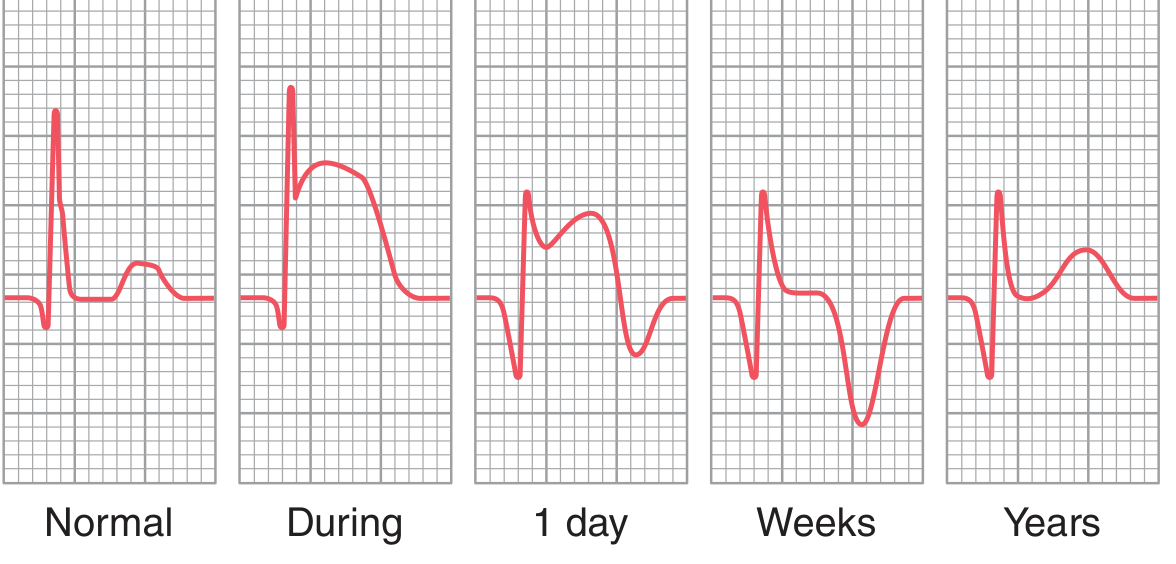
| Stage | ECG Appearance | Timing |
|---|---|---|
| Normal (before) | Normal QRS, flat ST, upright T | Pre-event |
| During (acute) | Huge ST elevation ("tombstone"), hyperacute T | Minutes to hours |
| 1 day | ST still elevated, T wave inversion begins, Q wave forms | 6-24 hours |
| Weeks | ST returns toward baseline, deep T inversions, Q wave present | 1-6 weeks |
| Years | Persistent pathological Q wave only (scar); ST normalized | Permanent |
Clinical pearl: Q waves that persist for >1 month = old/completed MI (scar tissue).
CASE 5 - Atrial Fibrillation (AF)
Lead II ECG strip:
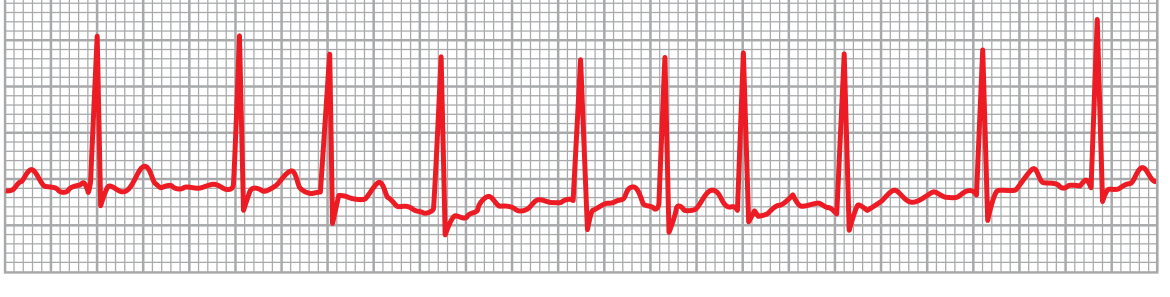
What you see:
- No P waves - replaced by chaotic, high-frequency fibrillatory baseline (f waves)
- Irregularly irregular RR intervals - QRS complexes appear at completely random intervals
- QRS complexes themselves are normal and narrow (ventricles conduct normally via AV node)
- Ventricular rate is usually 100-160 bpm (uncontrolled)
Why irregular? The atria fire chaotically (350-700 impulses/min). The AV node only lets some through randomly, creating the irregular ventricular response.
Risks: Blood stasis in left atrial appendage → clot formation → stroke. Hence anticoagulation is required.
CASE 6 - Heart Blocks (AV Conduction Defects)
1st Degree AV Block
ECG pattern: P → [long gap] → QRS
PR interval > 0.20 sec (> 5 small boxes)
All P waves conduct - none are dropped
Rate: Normal
Cause: Slow AV node conduction (vagal tone, beta-blockers, inferior MI, Lyme disease)
2nd Degree AV Block - Mobitz Type I (Wenckebach)
ECG pattern: Progressive PR lengthening → then dropped QRS → repeats in "cycles"
PR: 0.16 → 0.20 → 0.24 → [no QRS] → 0.16 again
"Grouped beating" pattern
Cause: AV node fatigue - each impulse tires the node slightly more until one fails completely, then resets.
2nd Degree AV Block - Mobitz Type II
ECG pattern: Fixed PR interval, then sudden dropped QRS (no warning)
Some P waves not followed by QRS (2:1, 3:1 ratios)
Danger: Can progress suddenly to complete heart block. Needs pacemaker.
3rd Degree (Complete) Heart Block
ECG pattern: P waves and QRS complexes are COMPLETELY DISSOCIATED
P waves march through at their own rate (e.g., 80/min)
QRS complexes appear at their own slow rate (e.g., 30-40/min - escape rhythm)
P waves have NO relationship to QRS complexes
Look for: More P waves than QRS complexes, no fixed PR interval at all.
Emergency: Patient needs immediate pacemaker.
CASE 7 - Hyperkalemia (Electrolyte Emergency)
Progressive ECG changes as K⁺ rises:
| Serum K⁺ | ECG Change |
|---|---|
| 5.5-6.5 mEq/L | Tall, peaked, narrow T waves ("tented T waves") - earliest sign |
| 6.5-7.5 mEq/L | Flat/absent P waves, prolonged PR interval |
| 7.5-8.0 mEq/L | Wide QRS complex (> 0.12 sec) |
| > 8.0 mEq/L | Sine wave pattern (QRS merges with T wave) → imminent cardiac arrest |
Memory aid: "PEAKED T → No P → Wide QRS → Sine wave → Death" (From Rosen's Emergency Medicine)
CASE 8 - Current of Injury - Mechanism Summary
| Ischemia Type | Mechanism | ECG Appearance |
|---|---|---|
| A - Subendocardial | ST vector → inward (toward cavity) | ST depression in overlying leads |
| B - Transmural (epicardial) | ST vector → outward | ST elevation in overlying leads |
Quick Lead Localization Summary
| Leads | Wall | Artery |
|---|---|---|
| V1-V4 | Anterior | LAD |
| I, aVL, V5-V6 | Lateral | LCx |
| II, III, aVF | Inferior | RCA |
| V1-V3 (ST depression) | Posterior | RCA/LCx |
| V3R-V4R | Right ventricle | Proximal RCA |
Sources: Guyton & Hall Medical Physiology; Costanzo Physiology 7th Ed.; Goldman-Cecil Medicine; Harrison's Principles of Internal Medicine 22nd Ed.; Rosen's Emergency MedicineThat covers 8 clinical cases with ECG paper diagrams and explanations. Here's a quick summary of what was covered:
| Case | Condition | Key ECG Finding |
|---|---|---|
| 1 | Normal Sinus Rhythm | Regular P-QRS-T, rate 60-100, PR 0.12-0.20 sec |
| 2 | Anterior STEMI | ST elevation V1-V4, reciprocal depression in II, III, aVF |
| 3 | Posterior MI | ST depression V1-V3, tall R waves (mirror image) |
| 4 | MI Evolution Over Time | Normal → ST elevation → T inversion → Q wave |
| 5 | Atrial Fibrillation | No P waves, irregularly irregular QRS |
| 6 | Heart Blocks (1st/2nd/3rd) | PR changes → dropped QRS → complete dissociation |
| 7 | Hyperkalemia | Peaked T → no P → wide QRS → sine wave |
| 8 | Current of Injury (mechanism) | Subendocardial = ST depression; Transmural = ST elevation |
Would you like me to go deeper on any specific case - for example, how to calculate the cardiac axis, bundle branch blocks (LBBB/RBBB), or a specific arrhythmia like VT/VF?
This is a shared conversation. Sign in to Orris to start your own chat.